

• Posted on 14 Mar 2023
  • 56-minute read

Navigating gender, race, faith, and belonging.

In Australia, 48.2 per cent of people were born overseas or have parents from overseas – so how can we celebrate these diverse experiences of culture? 

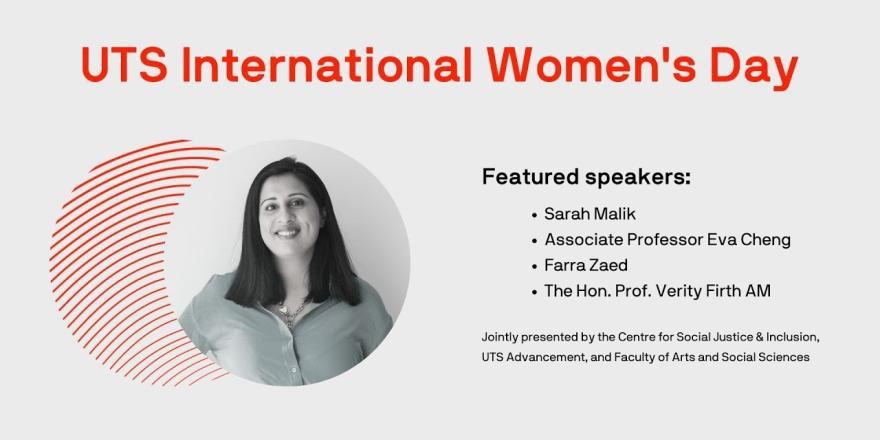
To mark International Women's Day 2023, Walkley-award-winning investigative journalist and author Sarah Malik delivered a compelling keynote on the power of writing from the margins and how to find – and take – your place in the world. 

Associate Professor Eva Cheng and alumna Farra Zaed also joined Sarah to discuss navigating the world through the lens of gender, race, faith, and belonging.
gmS5zJIXXrU

Descriptive transcript

Welcome, everybody. Thank you very much for joining us today for International Women's Day at UTS. We love putting on this day, and this is a day for UTS. This isn't something we advertise externally. It's something where we invite the UTS community to come and share in International Women's Day.

I'm Verity Firth, the Pro Vice-Chancellor of Social Justice and Inclusion here at UTS. It's a real pleasure to welcome you all, both in person and online, to celebrate the successes of women in our community, and also to acknowledge that there are challenges that we still face, and that we all come together in solidarity to face those challenges and to change the way the world works.

I was particularly excited today when I saw the registrations for this event—850 people. So, hello to everyone out there in the online universe as well.

Before we begin, I'd like to welcome Aunty Joan Bell from the Metro Local Aboriginal Land Council, who'll open today's event and conduct a Welcome to Country. Thank you very much.

AUNTY JOAN BELL: Good afternoon, ladies and gentlemen, distinguished guests. Hi there. You're looking at me as if I'm maybe... I am tip-top, darling. Run a mile. And I'm here to do a welcome today for you guys, girls, ladies—we are women.

As an Elder, I support the people in government embracing the Uluru Statement from the Heart—voice, treaty and truth-telling. I also sit on the board of the Metropolitan Local Aboriginal Land Council. Metro LALC is the body for the protection and preservation of all Aboriginal culture and heritage within its boundaries. That includes Sydney CBD and surrounding 24 local government areas, from Canterbury Bankstown to Cessnock. We are proud to acknowledge all respective traditional owners and custodians for this place now called Sydney.

My name is Joan Bell. My family and friends know me simply as Aunty Ding, Ding Bell. I am a proud Wiradjuri/Gadigal woman. I am a mother of 10, a grandmother, a great-grandmother, and a great-great-grandmother of 81 grandchildren.

My Gadigal ancestor was a local custodian who was taken to Parramatta's Native Institute, and in 1845 was taken by Reverend John Cartwright to Pajong, Gundungurra country, near Gunning, New South Wales, to work. I was born at a little central west New South Wales Wiradjuri town called Peak Hill. However, I spent my younger teenage years with my family and friends in Redfern, The Block. I lived on The Block for 15 years and Waterloo, including Louis, Caroline, Eveleigh, Vine and Wellington Streets. That was my stomping ground as a young tidda.

We honour our Gadigal Eora Elders and leaders, including Barangaroo, Pemulwuy and many others who fought the first boat people who landed in Sydney Cove in 1770 and 1778. My respects to Gadigal Elders past and present. We honour our matriarchs and patriarchs. Because of them, we can. My respects to all Elders and peoples from other First Nations here today.

We listen to the old people, ancestors, and they show us the right path. They protect us. They help us. They take care of us. This Welcome to Country is made in the spirit of peace and harmony with all peoples of modern Sydney. Our aim as local custodians is to establish an atmosphere of mutual respect through the acknowledgment of our ancestors and the recognition of our right to declare our special place in the pre and post history of the Sydney region.

Respect is taking responsibility for the past, the present and the future. Evidence of our occupation, ownership and nationhood can be seen everywhere throughout our country. Our signature is in the land, not just in our DNA. Respect is in the fire that warms the camp and the possum skin cloak that shelters all. Respect is in how a woman digs in the earth for yams. Respect is in the rivers, the sea and the breeze quietly moving through country.

The law of this land says that you must respect and honour all the people and all parts of the country. With this welcome, we ask that you all will respect the law of the country. Give honour, be respectful, be polite, be gentle and patient with all. Respect is everything living and growing. Please look after the land, sea and rivers. Then the land, sea and rivers will look after you.

In conclusion, I say to you, respect shapes us and lifts up the people. Welcome to the land of my ancestors. Welcome to my country. Welcome.

[Applause]

VERITY FIRTH: Thank you, Aunty Joan. I really appreciate that Welcome to Country. I'm sure we all do.

I live on Gadigal land. I've lived on Gadigal land for 35 years now. My kids were born on Gadigal land and have grown up and been educated on Gadigal land. It's definitely my home. I feel enormous respect for past, present and future Aboriginal Elders who've looked after this land so well. This, of course, is land that was never ceded.

Today, we have a very special International Women's Day event. We're delighted to be welcoming a keynote speaker, Sarah Malik, who's a journalist, TV presenter and author—I'm doing my marketing bit here, Sarah—and author of the recently released book Desi Girl. She also happens to be a UTS alumna. We're very proud of her. I'll be properly introducing her in a minute.

Following Sarah's keynote address, we're also going to welcome Associate Professor Eva Cheng and Farra Zaed for a chat about their different experiences here and stepping into their power.

I also want to thank, because we were sponsored, this year's event—we were sponsored by UTS Advancement and the Faculty of Arts and Social Sciences. I want to give a warm welcome to our sponsors here today. Before we begin, I'd also like to welcome to the stage our Vice-Chancellor Andrew Parfitt and our Provost, Professor Vicki Chen, who are also going to say a few words. Thank you.

ANDREW PARFITT: Thanks, Verity, and thank you also to Aunty Joan for the Welcome to Country. Let me also acknowledge the Gadigal people of the Eora Nation. They own the land on which the campus stands—they always have, they always will—and pay respects to Elders past and present, and also in this important year where we do have a conversation around the Uluru Statement from the Heart and how we will have truth-telling, how we will arrive at treaty, and how we will create a voice. All of those need to happen. How we can contribute as a community, particularly noting our Indigenous leaders. We have the largest Indigenous professoriate in the country and they do amazing work working with the change that needs to happen, and so we're so proud of supporting them in what they do as a university.

Unlike Aunty Joan, I have one daughter and no grandchildren, so I have a much smaller group, but I learn so much from my daughter every day. She's an HR professional, really just starting out. She told me the other day she's just got her first promotion, which was kind of nice. But she works in a very male-dominated community, and the insights that she has about making change and making an impact as a young woman, as an HR professional, are so important to how one shapes one's thinking about what change really looks like.

So I'm delighted to join you all here today for at least part of this afternoon's International Women's Day at UTS celebration. We do have the opportunity to recognise the amazing achievements of women in the UTS community. There's such a long list, I could be up here all afternoon, but I won't be, I promise, but just some indicators. Our first and our latest ARC Laureate Fellows, Distinguished Professor Jie Lu and Larissa Behrendt, are both women who make incredible contributions to significant areas for the university and for our communities.

If you look at recent award winners in the Order of Australia Awards, we have women leaders across the university working in health, in law, in IT, in social impact—a wide range of areas that have been recognised for what they do in the community. Just our Law Faculty alone has four women Distinguished Professors, so we are very pleased that across UTS we actually develop a leadership that's inclusive, but also committed to excellence and committed to change and committed to the impact of their work.

Half of our student population is female. That might not seem terribly ambitious, but for a University of Technology, where it's dominated by STEMM disciplines, that's quite remarkable as well. Ninety-four percent of those young women are successful, so that's again a commitment that we make to ensuring that professions of the future, in STEMM in particular, but more widely than that, do have a diverse and inclusive membership so that they can go on to change the very professions that they're learning in and they will go on to shape.

But we know there are challenges. We do know that there are challenges getting women into STEMM disciplines and we've done some pretty bold things in that sort of area, but we still need to do more. We know getting women into senior ranks in STEMM disciplines is a challenge and we don't always get it right. We recently had a promotion round where very few women were in the senior promotions cycle. That's not a long-term issue, but we need to make a difference here and be serious about it. We know the gender pay gap still exists and we know that discrimination and harassment and even sexual assault impact people across our community and the work that we do in areas like Respect Now Always in the university we hope will go on to make a difference.

We have a way to go, but the vision is to be a public University of Technology that's recognised for global impact and we can only achieve that vision if we actively challenge the stereotypes we have, we fight bias, we broaden our perceptions and we tackle injustices where we see them. That's why we recognise the importance of placing social change at the heart of what we do. It's the foundation on which we educate the professionals of the future and that we tackle the research challenges that will impact on our society.

To do that, we have to focus, and we do focus, on a culture where the principles of diversity and inclusion are just part of our daily activities. So we're passionate about building a current and future workforce that reflects equity and diversity at all levels, engaging right from primary school through to graduates who are looking at career development and seeking pathways for senior professional positions for women.

Change can't happen without meaningful action and our mission is to create a more just and equal world starting with individual actions and university actions that inspire social change. So today's event is just one part of that conversation. It's great to see so many people here and online to engage in the conversation. We will need to unpack today and today we'll start doing that—intersectionality and the need for society to embrace equity on the journey to reach equality, to cross cultural divides and to address the barriers that will impede us in our challenges.

And on that note, I'm very pleased to introduce to say a few words Professor Vicki Chen, who is our Provost and Senior Vice President. You see, you get two of us for the price of one today. Before joining UTS, Vicki was Executive Dean of the Faculty of Engineering, Architecture and IT at the University of Queensland and before that Head of School of Chemical Engineering at UNSW. She's a very strong advocate for women in STEMM and more broadly across the university and we're very lucky to have her on board as our most senior academic officer. Would you please welcome Vicki Chen.

VICKI CHEN: Thank you, Andrew, and I also acknowledge the Gadigal people of the Eora Nation, upon whose ancestors we are privileged to be standing in here today and pay my respects to past, present and emerging Elders, acknowledging them as the traditional custodians of knowledge of these lands.

What a pleasure it is for me to be here for my first International Women's Day at UTS. I joined UTS as Provost in late November last year, coming, as Andrew said, from the University of Queensland. In my short time at UTS I've been really impressed with the commitment to social justice and gender equity in action with the work of our fabulous Centre for Social Justice and Inclusion and more broadly across the university. As the Vice-Chancellor said, UTS is committed to addressing gender equity and taking on the intersectional approach that considers all diversities, which I am passionate about.

One of our commitments is the Athena Swan Program, a gender equity initiative that aims to remove key barriers and inequities in the STEMM disciplines, and UTS is one of the first pilot institutions to be awarded a bronze accreditation for the initiative in 2018 and we're continuing to work in this area, with a commitment to attracting and promoting women in STEMM.

I want to reflect that I've been privileged by having people around me that supported me in pursuing a career in engineering and as an academic. Initially my parents encouraged me to pursue engineering, to those who kept on asking me, "Have you thought about an academic career?" When that pathway seemed to be really off my radar and in my early professional career I was surrounded, and really unusually for engineering school, by a significant cohort of female academic leaders who were culturally diverse and who showed me that this was the normal, not the exception.

Unfortunately, this is not the experience of many people working today, but working together, we can see maybe we can make that the norm. So at UTS, we aspire to have a more diverse academic community and leadership emerging, particularly in STEMM, and coming back to looking at our students, the orientation and first week of semester were just a few weeks ago and it was fantastic to see the new wave of students arriving on campus, full of excitement—male and female and other—and I could see the long lines at the sausage sizzles right out my office window.

I hope we are paving the way for these students so their opportunities are not restricted based on gender, socioeconomic status, cultural background and other factors that make them who they are, and I'm looking forward to hearing the experience of women at UTS community today. And I will now hand you back to Verity. Thank you, everyone.

VERITY FIRTH: Wonderful, thank you for that. It's now my huge pleasure to introduce our keynote speaker, Sarah Malik. Sarah is a Walkley Award-winning Australian investigative journalist, author and television presenter. Her work focuses on asylum, surveillance, technology and its intersection with gender and race, most notably examining domestic violence, gender inequality and migration.

She has authored two books, Desi Girl: On feminism, race, faith and belonging, and Safar: Muslim women's stories of travel and transformation. She's co-hosted and co-produced award-winning SBS podcasts Let Me Tell You and The New Writers Room. We're also proud to say that she's a UTS alumna, graduating with degrees in law and journalism. So can I please welcome Sarah Malik to the stage.

[Applause]

SARAH MALIK: Thank you so much. I'd like to begin by acknowledging the Gadigal people of the Eora Nation, the traditional custodians of the land on which we are gathered, and pay my respects to all Elders past and present. I extend this respect to all First Nations listeners here today. I recognise that we are on stolen land with no treaty and sovereignty has never been ceded.

It was just over 20 years ago I walked through those front doors—I know, a long time to do an arts and law degree. I was 18 years old and I was a bookish and shy young Muslim woman from a Western Sydney public school. I was so exhilarated and excited by the life I wanted to open up for me at a big city university like UTS, one I had worked so hard to be at. It felt like my love for words was a portal that had transported me with a magic Dorothy-like clicking of the heels into a better space, the promise of an education opening doors that had not been available to anyone in my family.

I dreamed of being a journalist, a writer, of making a mark in the world. Words made sense of the world to me. They helped give shape to a nebulous cloud of half-formed questions and desires. They paved a road to self-determination from the limitations of a working-class adolescence and the wider world that circumscribed it.

Every feeling, from loneliness to anger to curiosity, I could find a salve for in books. I knew what I couldn't find a mirror for would be in the books of the future, written by my generation, existing now in the hyphenated margins of western society.

It's why I felt attracted to a career in journalism and writing. I was fascinated by how contesting, competing truth claims were, the way information was strictly guarded, words carefully crafted to create stories and ideas that impacted the way we think—words full of power, both weapons and shields. They could illuminate or obscure, create sympathy or antipathy. Much of the rhetoric of the media growing up that I heard was directed at people like me—I stress "at" rather than "to". We were the problem, the non-integrating Muslims, migrants, misfits. This racism was sometimes mirrored in what it felt like being a girl for me in a traditional community—being indirectly addressed and talked over, your life analysed and dissected and directed by others, your own feelings and emotions ignored.

This fusion outsider was so many of us children of migrants in the west. I remember reading Dickens and Austen while eating biryani. My morning fasting meal was Vegemite on toast. I watched Beverly Hills 90210 and Bollywood movies. I listened to Qawwali and Bob Dylan. I read Germaine Greer and Kamala Das. How could I reconcile myself without imploding?

I read. I read and I was comforted and discomforted. I was intoxicated by the idea. In my early 20s, I devoured the news, words, the internet, finding solace in other hybrids, blogging to make sense of the world. We were the in-between generation—the Salafis and the Sufis and the seekers who derived inspiration from Ralph Waldo Emerson and Rumi, Amina Wadud and Naomi Wolf, Allama Iqbal and Hafez.

At the time I registered that universities were the place to solve problems, connect with great minds whose own biographies provided the puzzles to the problems they solved in their work, who felt the sting of being lonely, of feeling like an outsider. I read Edward Said and Derrida and Judith Butler and I read these people because I felt like they had the words for the wordless and searching parts of me who could not even dare to ask the questions out loud.

I pored myself into courses that spoke to me. Why am I here? What am I supposed to do? Is there a God? Why do I experience the world the way that I do? What are the social reasons for the struggles that I'm experiencing? Being a woman in the world—constantly policed and surveilled and forced to conform, understandings of religion that circumscribed and stifled me, a wider society where I was treated with suspicion, a post-September 11 world where my identity was constantly foisted upon me as a challenge and a test, where in order to show how Australian, how liberal and how progressive I was, I had to erase myself, my culture and my identity to assimilate into a whiter and supposedly more superior way of being.

I read not as a luxury, but as if my life depended on it—to open up my life from the vice grips of other people's projections of me, of messages that bombarded me from everywhere, that told me who I was and who I should be, from the invasive gazes that felt like they sliced into me, leaving me no room to breathe—the gaze of the imam who told me a woman's place was to be obedient, the gaze of the white feminist who told me my people were backward, the papers that blared "Muslims are dangerous".

Reading was the lifeline that opened up my horizon and literature and higher education was the hand that came out of the page and took mine, the hand that understood, and eventually the hand that empowered me to speak back to those projections, to contest the way those narratives have defined what I learned was historically the other, people like me who did not have the power and the platforms to speak back.

In the library just here I developed a feminist consciousness with works of Simone de Beauvoir, which was later transformed with the works of feminists of colour like bell hooks. Reading shaped a way of looking at the world as filled with nuance and endless possibility, full of histories and meaning that impacted the present day. Instead of being accidents, I learned that our current social realities and relationships had patterns and threads. They were deliberate creations that benefited some at the expense of others.

These knowledges were like x-ray glasses, revealing and opening the world to me as a myriad of ways of living and seeing and being. So much of my memoir Desi Girl: On feminism, race, faith and belonging is about that period of life—the UTS years—when I moved out of home, when I struggled financially, when I became an independent person and, most importantly, it's where I developed a consciousness, an idea of how I wanted to live, what mattered to me, what I wanted to be guided by and a spirituality that spoke to me.

It's where I found housing and scholarships and part-time jobs. It's where I connected with teachers like the late great Islamic studies teacher and feminist academic Jamila Hussain, jurisprudence teacher Penny Crofts, head of journalism feminist Wendy Bacon, immigration law scholar Jennifer Byrne—people who were formulating paradigms to question the frameworks we lived by. That was intoxicating to me.

The university was a precious space, an incubation, a reprieve, a place where instead of a traditional thesis, I created an online website predicting digital journalism would transform society. Increasingly, our universities are under threat, with casualisation of staff and run by corporate metrics. But that time reminds me of what a great trust they have in nurturing the aspirations and social mobility of young people like me from underrepresented backgrounds, to give them the confidence to become leaders of their own lives, as handrails to understand the ropes that bind us and to be free of them, as authoritative voices for social progress.

And this happens by creating the work conditions and psychological safety to thrive through collaborative relationships and fellowship to create breathing room for new ideas and by continuing to engage deeply in the political and social currents we live in but, most importantly, by ensuring our student loan systems are as accessible and affordable as possible.

More importantly than books, university gave me the opportunity to fail, to make mistakes, to get my heart broken, to join political groups and leave them, to do a million ill-advised things that are the privileges of youth. UTS was my safe space, a place where I was like an experimental petri dish, cultivating and becoming something new.

This is the meaning of any true education and what I found in the radical books I read—they gave me the courage and impetus to find my own voice, to build autonomy for myself one small step at a time. They gave me the courage to believe that I too could be the journalist and writer I dreamed of, despite not seeing anyone like me. I connected to an imaginary and I dreamed the possibilities because the books I read, the ones that felt as real as my hand and my heart, were also acts of imagination that became tangible things in the world and maybe I could too.

Years later, now in my 30s, I still don't pretend to have all the answers, but I know that empowerment begins with a question. It begins by becoming comfortable with not having a place, but being in the in-between place where things don't always fit. It is these secret worlds that education and books opened for me that have sustained and shaped me.

I still remember the words of late great writer Audre Lorde: "What are the words that you do not yet have? What are the tyrannies that you swallow day by day and attempt to make your own until you sicken and die of them, still in silence? Of course I am afraid. I am afraid because the transformation of silence into language and action is an act of self-revelation, and that always seems fraught with danger. But tell them about how you're never really a whole person if you remain silent, because there's always that one little piece inside of you that wants to be spoken out and if you keep ignoring it, it gets madder and hotter and hotter and if you don't speak it out one day, it will just up and punch you in the mouth from the inside."

Today I am the writer I dreamed of being and that happened by refusing to be silent. Today I write and my words matter and they are read and considered by others. They are maybe a tiny drop of colour in a river of social narrative that changes the constitution of the whole by just existing.

I wrote my memoir because I am the first in my family to have the privilege of writing a new story for myself, of literacy, of going to university, of choosing a life for myself that I wanted. I think about so many women and girls who are denied that opportunity, people in my own extended family. I think about how history loops and often repeats itself. I think of Palestinian women trying to protect their children, surviving every day under occupation. I think of women in Iran, tear gassed in the street for fighting against police brutality and the right to dress how they please. I think of women in the US stripped of their right to bodily autonomy, where books are now routinely banned. I think of Afghanistan, a new regime that begins now its old assault on women and denies them the power that access to knowledge brings. I think of trans women who face continued discrimination for just existing. I think of First Nations women who daily navigate a society that has systemically taken so much from them.

I think about so many women whose lives are circumscribed by those who want to deny them the autonomy, voice and power that knowledge and education brings. This is why authoritarian regimes ban books. It's why extremists target female education. Art and knowledge creates questions, sows doubt and wonder, and lights a path to an unknown place. A girl who reads is a girl with ideas and a girl with ideas is a powerful girl. In a world where control over women can be either subtly or violently enforced, from conformity to social ideals to rigid laws circumscribing physical control, it is the rebellious mind that has the potential to be the biggest threat.

I think about my mother who grew up a world away from here, who wasn't allowed to go to school, and me who grew up here and how connected we are. It makes me realise how urgent our fight is, and how deeply connected we all are as a global society. The threads that bind us are more intimate than we think. As Audre said, "I am not free while any woman is unfree, even when her shackles are very different from my own."

It also made me realise how, despite it all, women rise. We create art, we create music, we create families, we run businesses, we lead companies, we work at factories, we are professors and students, we volunteer at schools, mosques, churches, synagogues, and we lend our time, our energy, our passion, our care to power our communities, this society and the world we live in, often unpaid, without the recognition and credit we deserve.

For me, rising and finding my voice has always happened through words. Education helped me know another world was possible, and writing helped me feel like I existed. Writing helped me name my experiences, to trace the contours of my emotions and say, "Yes, this hurt," or "Yes, this mattered," or "This is the way I see it. I matter. You matter. We matter."

Outside of the safe haven of university and faced with the real world, writing taught me that we can have difficult conversations with ourselves and others, and this is how we progress—by being truthful, by allowing ourselves to take off the masks we've had to wear to survive and refusing to contort ourselves to be pleasant, to be good, to shapeshift, to fit environments that were never designed for you, but to create new worlds that do.

This is not easy. I think about how, at each step, the temptation and the deep seduction to take the easier route, to conform, to not speak, to play nice, to repress our voices and healthy anger, and how this leads us, or at least me, to the therapist's office, often personalising the collective problems I had internalised—the glass ceilings, the devaluing of my work and labour in environments that sometimes wanted a model minority to showcase, but did not embody the transformative representation and equality that true diversity calls for. For me, it represented itself in burnout, in pain that my body could not ignore, even if my mind did, and I registered that my body, my personal life and my being was intimately linked to society, culture and the wider political structure. So my personal story was political, because it was the instrument on which these structures imprinted itself.

I know the fight is not over, but has new manifestations. I don't experience the challenges my mother did, but different ones, and they still matter: the pay gap; the structural racism in our politics, arts, media and powerful institutions that in 2023 are still largely led by men and people of Anglo-Saxon background; the tokenism, microaggressions, indignities and lack of respect we can experience as we try to make our ascent in a country that often tells us that we don't belong, that we're not good enough; of feeling secondary even in spaces that propose to be for us; the white feminist voices that can sometimes dominate and not make space, whose words can often be unloaded with unconscious white privilege; the progressive who's there to help as long as you remain servile or one down and don't eclipse them.

As Audre Lorde said again, "the visibility which makes us most vulnerable is that which is also the source of our greatest strength, because the machine will try to grind you to dust anyway, whether or not you speak. We can sit in our corners, mute forever, while our sisters and ourselves are wasted, while our earth is poisoned. We can sit in our safe corners, mute as bottles, and we will be no less afraid. The decision is to define ourselves and speak for ourselves, instead of being defined and spoken for by others."

The mazes I sometimes got trapped by, I remembered that great escape route—words, naming the nameless feeling, the shameful thing, the tricky relationship. I think about how words can illuminate and reveal, and they can dazzle and obscure too. They can empower and disempower. I thought about how I wanted to use my words, and how they were an escape tunnel in those early days. By telling my own story in my own words, I reclaimed myself. The right to our own stories, our own ways of seeing the world, is something that no one can ever take away.

I think about every woman here today—you, you who showed up despite a million private griefs, of sorrows privately internalised; who fought for that pay rise; who escaped that psychologically abusive relationship, despite family disapproval and gossip; who decided to study as a mature age student; who recovered from that miscarriage; who maintained a relationship to a spirituality that uplifted you and didn't put you down; who raised that child on her own while juggling two jobs; who chose herself; who said, "Yes, I too do matter, I too deserve happiness, love, prosperity and self-expression, I too deserve to honour myself, to treat myself as something precious, I too am worthy."

Every day that we do this, we rise and we win against the forces that want to chip away at us. It is you that I salute today and I am in awe of. I hope today is a celebration of your strength and your joy and the power of your words, our words, to speak, to keep fighting for the world we want to live in and the capacity always that we have to use our words to write new f

If you are interested in hearing about future events, please contact events.socialjustice@uts.edu.au.

Today is a celebration of your strength and your joy. And the power of our words – to protest, to speak, to keep fighting for the world we want to live in and the capacity always that we have to use our words to write new futures for ourselves. – Sarah Malik

I remember being in high school and just knowing that I wanted to be as invisible as possible. How do I make myself look like the others? So I took up sport. I knew that that playing sport would buy me and give me social currency and protection, and it has until this day, which I think is something we need to work on. – Eva Cheng

It’s helpful to surround yourself with a good support system and to look inwards... so really looking inwards and knowing what your values are and see if you can find people in your life that align with your values. – Farra Zaed

Speakers

Sarah Malik is a Walkley-award winning Australian investigative journalist, author and television presenter. Her work focuses on asylum, surveillance, technology and its intersection with gender and race – most notably examining domestic violence, gender inequality and migration. She is a UTS graduate, with degrees in Law and Journalism.

Associate Professor Eva Cheng is the Acting Head, School of Professional Practice and Leadership at UTS. Previously, she was the Director of Transnational Education and Director of Women in Engineering and IT. With a background in telecommunications engineering, Eva actively collaborates on social justice and community engagement across STEM diversity and humanitarian engineering, including collaborating with the Tech Girls Movement Foundation and Engineers Without Borders Australia. 

Farra Zaed is a Graduate Architect or DJRD Architects, focusing on health infrastructure projects ranging from small to large-scale hospitals and ambulance stations. She recognises that architecture is an important tool that can influence our lives, mood, and the environment we live in. Farra is also a member of the UTS Young Alumni Committee and is passionate about supporting alumni with meaningful connections and networking opportunities.  


Share