- Posted on 20 Jun 2023
- 49-minute read
The global humanitarian crisis has forcibly displaced at least 103 million people due to war, persecution, conflict, violence, or human rights violations.
Universities can be agents for change in the humanitarian crisis – from providing equitable access for students from a refugee background to protecting academic freedoms and at-risk scholars.
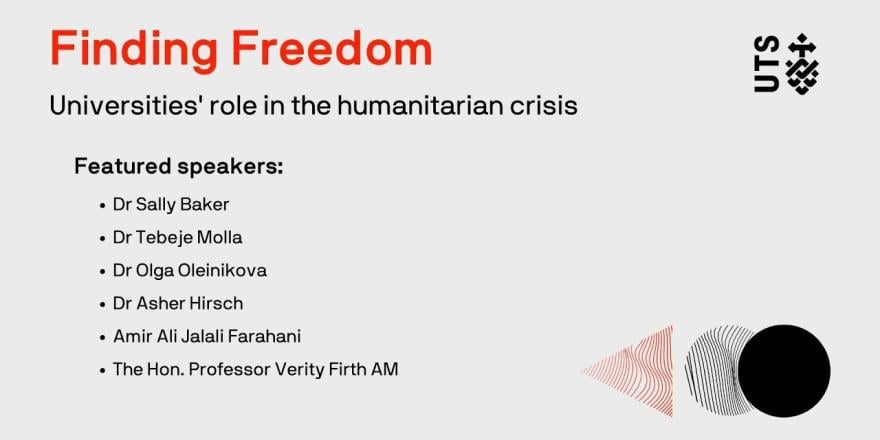
Dr Sally Baker, Dr Tebeje Molla, Dr Olga Oleinikova, Dr Asher Hirsch, and Amir Ali Jalali Farahani joined The Hon. Prof. Verity Firth AM about how universities can better advocate for human rights and freedoms of refugees.
If you are interested in hearing about future events, please contact events.socialjustice@uts.edu.au
The idea of an education migration pathway is a win-win. It gives universities a real bespoke opportunity to create, to co-create with government, co-create with civil society and, importantly, harness all of the goodwill that we know exists on every campus, with students and staff and alumni. Dr Sally Baker
Policy invisibility means no funding. No funding means university cannot provide ongoing targeted support because it's resource intensive. Policy invisibility is a serious issue at the sector level that we need to work on. Dr Tebeje Molla
Being part of the UTS Humanitarian Scholarship Program has been a privilege as its provided me with the guidance to navigate the university education system. By expanding these initiatives across all Australian universities, more students from the same background will have the opportunity to access these valuable resources and overcome barriers. Amir Ali Jalali Farahani
The Refugee Council work alongside academics who are researching and advocating across a whole range of areas: international policy, asylum policy, settlement support. Their work informs advocacy and our job is to connect the research into practical policy outcomes. Dr Asher Hirsch
Ukranian refugees werent eligible for many services as a regular humanitarian migrant. Its been almost a year since Australia closed the humanitarian protection program, and were [Ukraine] still at war Dr Olga Oleinikova
Speakers
Amir Ali Jalali Farahani is a final year Bachelor of Engineering (Honours) and Medical Science student. He comes from a refugee background and is a UTS Humanitarian Scholarship recipient. Amir is driven to make a positive impact in his chosen fields and in his spare time enjoys basketball and photography.
Dr Asher Hirsch is a Senior Policy Officer with the Refugee Council of Australia, the national peak body for refugees and the organisations and individuals who support them. His work involves research, policy development and advocacy on national and international issues impacting refugee communities. Asher is also a Lecturer at Monash University in public law, human rights, and refugee law.
Dr Olga Oleinikova is a Senior Lecturer and Director of the Social Impact Technologies and Democracy Research Hub in the School of Communication, UTS. She is named among Forbes Top 40 Global Ukrainians and Forbes 30 Under 30 in Asia. Her recent projects include a report on the settlement of Ukranian war refugees in Australia and their challenges working with settlement services and barriers to integration.
Dr Sally Baker is a Senior Lecturer in the School of Education, UNSW. Sally’s teaching and research interests centre on language, literacies, transition and equity in higher education, for culturally and linguistically diverse students and refugee students. Sally is the Co-Chair of the national Refugee Education Special Interest Group for students from refugee backgrounds, supported by the Refugee Council of Australia.
Dr Tebeje Molla is a senior lecturer and Australian Research Council Future Fellow in the School of Education at Deakin University. His research focuses on inequality and policy responses in education. His recently completed Discovery Early Career Researcher Award project investigated the educational attainment of African heritage youth from refugee backgrounds.