

• Posted on 5 Apr 2023
  • 6-minute read

If you stroll through UTS’s city campus, something new may catch your eye. Bold red signs announcing #RacismNotWelcome have made their debut on Alumni Green. 

I believe it is important to address racism head-on.  

As the first university campus to display them, I’m proud to see UTS leading the way in promoting inclusivity and standing up against discrimination 

The #RacismNotWelcome campaign is community-led and grassroots. The initiative is intended to acknowledge racism, validate lived experiences of racism, and normalise conversations about racism. 

In the speech at the event held for the signs’ installation, I recounted a story that illustrates how important representation, and acknowledgement, can be: When I saw UTS’s 2017 ‘Racism. It Stops With Me’ video campaign as a high school student, hearing that strong institutional commitment against racial discrimination, paired with actions to equip people with tools to be anti-racist, I knew I wanted to study at UTS. 

Six years later, I was lucky enough to take part in this event to build on UTS’s anti-racism work.  

The signs declare UTS’s intent, marking out a clear space that is safe, welcoming, and inclusive. They orient us towards a brighter future. 
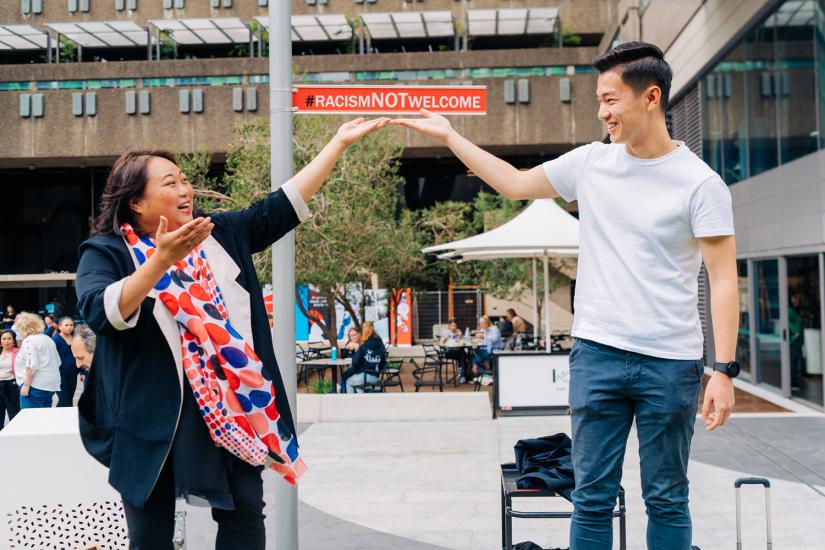
Dr Elaine Laforteza and Kurt Cheng smiling with the #RacismNotWelcome sign at UTS.

Racism Not Welcome was launched as a campaign by the Inner West Multicultural Network in 2020. On their website, they state: 

“An important element is the erection of #RacismNotWelcome street signs in every Local Council across the country as a public demonstration that it is no longer hidden, taboo and left to fester, but is acknowledged, called out, and not welcome.” 

It is my hope that the UTS signs may start conversations, spark thoughts, and eventually help encourage a collective shift. We are not there yet, but I remain optimistic that we are heading in the right direction. 

For as long as we still need them, I am glad to see the signs there.  

The #RacismNotWelcome street signs were installed on the UTS campus on Tuesday 21 March 2023 aka the International Day for the Elimination of Racial Discrimination. 

Led by UTS's Dr Elaine Laforteza and Kurt Cheng, the event saw speeches from Professor Andrew Parfitt, UTS Vice-Chancellor, The Hon Prof. Verity Firth AM, UTS Pro Vice-Chancellor (Social Justice and Inclusion), and Lindon Coombes, Director – Jumbunna Institute. 

It was wonderful to have the team at Addison Road Community Centre, home to the #RacismNotWelcome campaign, join us to mark this important partnership, alongside members of the UTS community include the UTS Centre for Social Justice & Inclusion, the UTS Students Association and ActivateUTS.
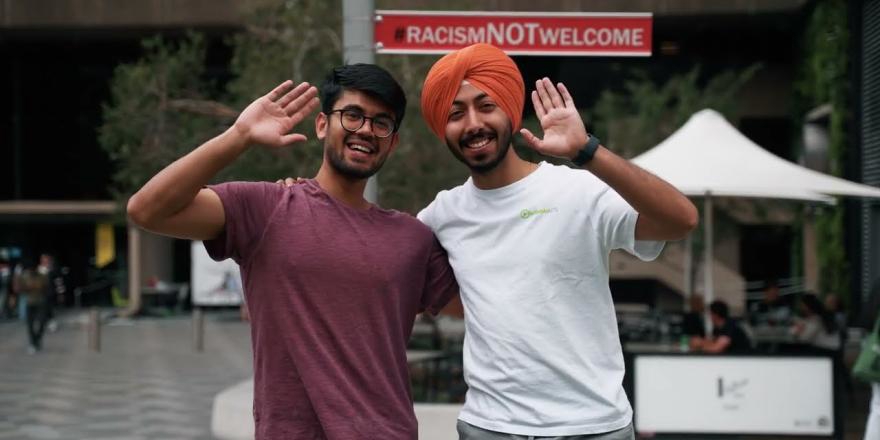
X_oxnmrzwZY

Descriptive transcript

Friends, we're making a strong institutional commitment today.

Today, as a community, we're proud to unveil the Racism NOT Welcome signs.

Two of the iconic red signs in the busiest area on a public campus to validate the experiences of racism, to drive conversations, and to empower our community to be actively anti-racist.

We have a responsibility as a university to advocate for all aspects of social justice, equity and inclusion, and on the day for the elimination of racial discrimination, this focus takes the form of acknowledging and being honest about our part in eliminating and sometimes enabling racism.

I think it's also important to think about the times where we haven't engaged in anti-racism, and to think about, okay, well, what projects have we sidelined because we think that maybe they're too difficult, or we think that they're not relevant?

I know UTS has done a lot of work over the years to commit to diversity, awareness and anti-racism, so I guess I'd really like to see it really embedded into subjects and curricula.

You've got to be really deliberate about learning more about things and taking action on those yourself.

So it's not just about knowing in theory, it's about thinking, what practically can I do?

Now we are here to witness the installation of the signs. We are the first university to do so.

These signs point us in the right direction; they orient us towards being actively anti-racist.

The signs are not just signs that state our intent, they are signs that also reassure people that they're welcome here, that they are welcome here, wherever you come from, whatever your view, whatever your background, whatever you look like, this is a community for you.

I'm a Yuwaalaraay man from northwest New South Wales, and it is my privilege to live and work on Gadigal country.

And so on days like these, with the signs and other things we do, we end up asking ourselves what we can do to actively combat this.

From a structural and institutional point of view, it's really important to think about how the policies we have in place and systems we have in place at the university impact on the likelihood of racism occurring and affecting the university students and staff here at UTS.

I would love to be a part of more anti-racist endeavours like this, so if there are more avenues and spaces where we can sort of impact anti-racist endeavours, I would love to be a part of that.

A place where we have zero tolerance for racism, whether overt or subtle, done knowingly or unknowingly, racism, along with all forms of racial discrimination, is not welcome and not accepted at UTS.

Everyone has their own kind of sphere of influence, and so I think it's about thinking about the work that you do and whether it brings, you know, is it a safe space for people to engage with? Is it a safe place for Black and Indigenous people?

We're a part of a university community here at UTS and we're a part of a campus community, but we also bring communities in from outside the university, looking outwards as well, thinking about how UTS as a university influences and affects change in broader society as well.

It is not a sad day. This is a day where we need to be positive, we need to work together and be together as a community.

This is the day for the elimination of racial discrimination, but let's make this a lifetime.

Byline: Kurt Cheng, UTS student

Share