
• Posted on 3 May 2024
  • 37-minute read

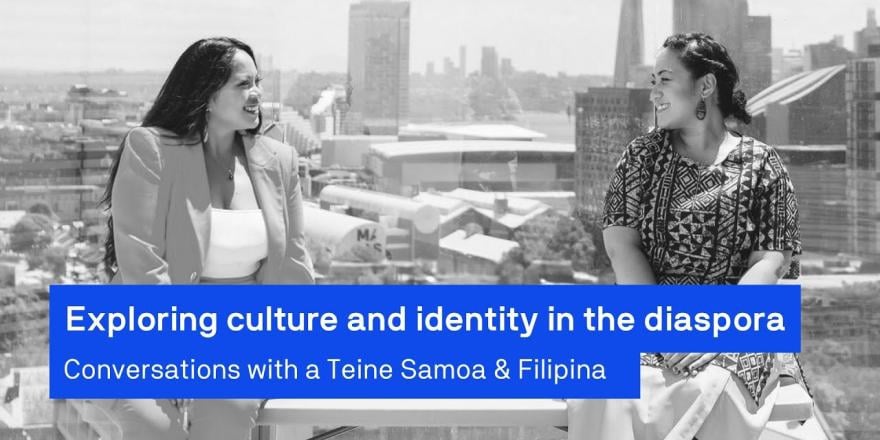
Conversations with a Teine Samoa and Filipina.

Growing up in Australia as part of diasporic migrant communities comes with its joys and complexities. Friends and colleagues Christine Afoa and Leah Subijano sat down to discuss their journeys in exploring culture and identity as first-generation, millennial, brown island women.  

Join this conversation where they unpack what it means to them to be Samoan and Filipino, their personal experiences of stereotypes and labels, and their evolving understanding of culture through a decolonial lens.
VeJpeNCcd-w

Descriptive transcript

Talofa lava, and warm Pacific greetings to you all. UTS Multicultural Women's Network, and Leah and I would like to begin by acknowledging the songlines, lands, skies and waterways we are on today. I'm calling in from Wangal Land, and this platform is where we will recognise and honour the traditional custodians of this country and pay respect to all Elders from the past, present and tomorrow. This land was never ceded. And Leah and I are both women of the Pacific Ocean, and so in this podcast, it is important that we honour our ancestors and the waves that brought them here. We also, at every chance that we get, want to acknowledge those who currently live on lands being stolen from under their feet, and those who are being oppressed today.

Hello, Leah.

Hey Christine, that was beautiful. I love that acknowledgement. I'm going to copy it for another event that we do. I'd also like to pay my respects to Elders past and present. And I'm coming in from Gadigal land, so this is where I'm tuning in for our recording today.

So as Christine mentioned, I'm Leah, and welcome to this conversation about us just having a chat and exploring our Pacific Island and Asian identities. We're both from the diaspora, growing up in Sydney, and there's a whole lot to unpack. But just to be clear, we're not authorities on the topic, which also begs the question: what makes you an authority on culture? But we're just two millennial brown island gals, first gen, woke aunties who were born and raised in Australia, living in the diaspora, and we're both going through this journey of exploring culture. And I'm excited because this conversation is just like an insight into Christine and I staying back late in the office and having a good old chat. And I think it's a gift for people to get some insight into that.

So to start off, I want to introduce Christine. The beautiful Christine Afoa is the eldest of four girls, born in Bankstown, with family from Lalomalava and Lotofaga in Samoa. She's written for Cordite Poetry Review, Red Room Poetry and Sweatshop Women under the mentorship of Australia's first ever Pasifika novelist, Winnie Dunn. Her poetry was featured in 'One Ocean, Many Waves' at Shopfront Arts Lab Gallery. Christine works as a UTS Student Equity Project Officer for the U@Uni Academy and is the Secretary for the Australian Pacifica Educators Network.

Hello, Christine.

Hello. And I'll introduce you, Leah. Leah is the Senior Events and Engagement Officer at the UTS Centre for Social Justice and Inclusion, and Marketing and Communications Lead with the Multicultural Women's Network. She's also a freelance artist, Tahitian and Hula dancer with Nāpua Australia, and performer percussionist with the amazing all-women's Afro-Brazilian inspired rhythm collective Ile Ilu. Her mission is to fuse together her skills and passions and help co-create a better world where historically marginalised communities, especially women of colour, can authentically be themselves, take up space and be free of oppression.

What an intro.

Yeah, I wrote that at like 10pm last night. I was like, is this alright?

I love it. I think it's super important to say that you're also a beautiful Filipino woman.

And I would also like to say a beautiful Samoan woman. And I guess it's not really often you see that in people's bios and introductions. So yeah, but anyway, to kick off this chat, I want to ask by posing to you: what was the inspo behind this beautiful idea of us talking about culture?

Oh gosh, yes. So if you don't already know, America has the whole month of May dedicated to celebrating AAPI, or Asian American Pacific Islander Heritage—it's a mouthful. And we are slowly seeing a shift in the world from AAPI to APID, which is Asian Pacific Islander Desi, or AANHPI, which is Asian American Native Hawaiian Pacific Islander Month. And we don't want to detract from the importance of all these different groups. But we recognise that bunching so many diverse groups together means something's got to give. And often, it's the nuances of those cultures—what makes them so special becomes muted so that it is palatable for everyone else in the world.

And we really, really noticed, especially when we're talking late night in the office, that there's nothing like that in Australia. We're not going to start that with this simple podcast, but we wanted to have that chat about what is it about our identities that is so special and deserves a month of celebration. But even beyond that, we live these lives every single day—a month is just not enough anyway. So let's start this conversation, and we'll see what comes from it.

Yeah, I find it so interesting, because that's a lot of acronyms—AAPI, APID. I do follow a lot of Pacific Island and Filipino content based in the US, so I see a lot of the AAPI stuff and all the Heritage Month stuff come up. And it is very interesting that we don't have that in Australia, considering how closely tied Australia as this, you know, colonial nation state is—so economically, culturally, geographically close to the Asia Pacific region. Yeah, so I do find it interesting, but also not surprising that there's none of that sort of national acknowledgement.

Yeah, I think it's tied to Australia's really complex and difficult relationship, especially historically with our communities—how the White Australia Policy was there and everything that comes with blackbirding, and it's just not... we're not at that place yet.

Absolutely, absolutely. And I think we forget how the White Australia Policy really, really impacted, I guess, the connection of our peoples with this place. And so with the implementation of the White Australia Policy, which was the Immigration Restriction Act of 1901—thank you, year 10 history—but they essentially allowed the Chinese migrants who were here from the Gold Rush era to stay, but then set up this really horrible test to exclude anyone else from entering the country. And so it really was only from like the 70s that Asians—anyway, I'm not sure about their history with the Pacific Islands—but it was in the 70s when they decided, well, not that they decided, economically they needed a workforce to work in these industries like IT and computer software, and then they were like, all right, we'll let the Asians in. And then that's how my parents migrated to this country. And that's how, I guess, the first big wave of migration came. That's also not including the first wave of migration from the Vietnam War, so I'm also acknowledging that. But yeah, I guess that's something to point out.

Yeah, just such huge context here. So to hone in, let's talk about ourselves. And what does it mean to you to be Filipina and more broadly Asian?

OK, very loaded question. And also, like, what is a Filipina? What is an Asian? Like, not to sound—what's the word? I don't know what the word is, but not to make things difficult to answer, but like, how can you even define these terms? So what I think a Filipina is could be completely different or opposing to what another person thinks it means. But it doesn't mean that they're wrong—like, they both could coexist at the same time. But anyway, I will try and answer your question.

So I kind of would want to start sort of like in my experience on how I thought about culture growing up, being like a little brown Filipino girl growing up in Western Sydney. But to me, thinking about Filipino culture, I really thought about—it really ties me to family. Family, big get-togethers, food, big parties. You know, where kids are playing, the aunties are gossiping, the dads are in the backyard. Yeah, it's like really family-oriented activities. And I think as well, a lot of activities relating to the Catholic church or that Catholic religion, which is what my family is.

And I think it also meant having really nice skin colour. They all be jealous. And I'm like, yeah, the ancestors blessed me. This melanin, hashtag. But I guess in the broader context of being Asian, with Filipinos being grouped in the Asian category—which is also, maybe we'll talk about this later, there's some contention overseas, especially in the US, about whether Filipinos are Pacific Islander or Asian. And I'm like, who created these terms anyway?

But I did go to a predominantly white primary school, and then I went to a predominantly Asian high school. So it wasn't just Filipinos—Chinese, Korean, Indian, Sri Lankan—a big diverse group of peers. And I think I remember starting school in year seven and just feeling like this sense of relief and belonging. And then I think I look back and, you know, being one of hardly any brown or Asian kids in primary school, like unconsciously kind of create these things of wanting to be white, wanting to fit in, wishing your last name wasn't so difficult to pronounce.

But I think I'm very grateful that I went to a diverse high school where I just released all of that. Not saying internalised racism just immediately went away, but I did feel, I guess, a sense of just relief and belonging in that context.

But yeah, I want to flip it over to you. So what does it mean to you to be Samoan or Pacific Islander?

I love how you answered that by going back, because it's something that—I mean, we're working in the education space and we see that in the children that we work with as well. That's beautiful.

I'll also start with going back. I was born in Bankstown, so a Western Sydney kid too, but on the other side.

Blacktown, Bankstown, represent!

And I always define it as well through family, just like you. And it's so innate, right? So I'm the eldest of four girls and I've always introduced myself as the eldest whenever I'm with family. And then I realised that I'm doing that now in my professional life as well.

And yeah, it's always the lands that we're connected to. It's the people that we're connected to as well. But to be a Samoan girl, it's like the innate qualities and the values that I've had growing up is just becoming stronger. And the biggest one I can think of is alofa, which is love. And in a Western context, the word alofa or love would be used in just that romantic sense. But love to me, in the perspective of a Samoan woman, is being kind and being open-hearted with everyone that's around you.

And that is also linked to another value that we have, which is fa'aaloalo—respect for everyone, but also the concept of the va, which is the space that is around yourself, but it's also the distance that you keep between you and others. And it's like, I'm relearning as an older Samoan person what that means, but as a kid, you just have these ideas that you're just like, oh, yeah, that's normal.

So yeah, I really like that we talked about being children and being little brown kids.

Well, I found it so interesting just now how you spoke about your family and the connection to land, and in your bio that you sent over, you spoke about being the eldest of four girls and being from Bankstown. And I've managed events for a living and always am collecting bios, but that's not usual for people to open with how many siblings they have and where they are in that sort of positioning or where they're born. And I think that's a really beautiful thing to bring in that we don't really see often in this Western context.

Yeah, because often your professional life is so separate from who you are every single day, and that is so strange to me. But of course, I wasn't always like this—I learned to bring in my culture in my nine-to-five life.

And yeah, I think that's amazing. And I'm aspiring to that or I'm getting there. You know, this is just one example of how we're kind of bringing culture into the workplace and having it be celebrated and valued. I hope you can let us know after you listen if this is celebrated and valued.

Well, like you said in the beginning, we're not authorities, and I feel like we're not authorities on anything because we're still navigating our way, right?

Which is kind of funny because we work in a university, which is quite a hierarchical place where, you know, research and citations and like, it's a very strict hierarchy. And in the academic space—I'm not an academic, by the way, so if you are an academic, feel free to completely school me on what I'm about to say—but there is this real hierarchy on who is an authority. And like, you know, your opinions or research aren't valid unless it goes through this real Western education process—peer-reviewed articles, et cetera, et cetera. And like, this whole university institution is a colonial one, you know. And I know there's a lot of work being done to try and decolonise that, but it's, yeah, it's, you know, I guess we can be some change makers from within, I guess.

Yeah, true. Especially all the brown academics that are coming up. It's like, yeah, we're making our mark in this space that wasn't built for us to make some change. That's the best. And yes, we are.

So to kind of go on to something that's maybe not as cheerful and exciting about, you know, breaking barriers, et cetera, et cetera. But what are some of the personal experiences that you've had—maybe other people judging you or having preconceived ideas of you based on your ethnicity or your race or your looks?

Yeah, this was hard because you don't always want to carry this around with you, hey—all these negative experiences, but they happen. And I think it's important for a conversation like this, especially because we're friends, so when you're sharing this, it's good to be in a safe space.

I remember a time when I was in my first year of university at the University of Sydney and I picked up ancient history as an elective, and we had an exam that was based on Greek mythology. And on the front page of the exam was a picture of Medusa and it was where her head was lopped off, so her snakes are—like, we call it mahana, where it's like all wild everywhere.

And I received the exam back and I got a HD. But on the front page, with Medusa's image, in red pen was a moko drawn—the face tattoo of the Māori people—drawn onto Medusa's image, and the lyrics misspelt of the haka that was popularised by the All Blacks but is really deeply meaningful to the Māori people.

And then in the section where the professor has to leave feedback, she had written, "I saw this picture and I thought of you. Ha ha ha." And I just remember receiving that and I had no feedback on the actual mark or the actual exam other than HD. And when I showed my friends, I was seething, my friends were laughing.

And of course, I didn't have any Pasifika friends in my first year of university, which was really horrible. But I just remember thinking, this is a professor at this really highly esteemed university, and she thought that that was appropriate, but also funny. And it wasn't even my culture—I'm Samoan, that's a Māori culture thing. And it had nothing to do with the exam.

And then I was just, yeah, I was just really surprised, not just by the actual thing that happened, but the reaction of my friends there. And just as a writer—I write through my work but also on the side as well—I would get feedback that reminds me of that, because it would be nothing to do with the actual input of my pieces or the messages I'm trying to convey, but it will always be attacks on me as a Samoan person.

So people will be telling me that I should go back to where I come from, even though I was born in Bankstown, or they would tell me I'm not Aussie enough. Or I even had an example where a man was asking people to find my address so he could educate me on being Australian. And it's things that come up all the time.

But yeah, you can't carry that around as much as you carry around the empowerment from your people. But that's a whole other thing. And that was my experience.

Wow. I think that just shows how far we have to go as a nation, you know, from the micro to the macro—microaggressions, macroaggressions that you experience, the power dynamics, you know, when people who are in positions of power make racist comments and make very inappropriate comments. You've got a long way to go.

Yep. How about you? What have you experienced or what have you gone through?

Well, I totally agree with you in the sense of, like, we can't carry that heaviness around. But I think we also need to bring these experiences up so that we can heal them. Because, like, our bodies and our minds—we carry everything that we've been through in life, and then, you know, ignoring them just doesn't—is not the solution, because they will sit with you and it will manifest in other harmful, dangerous ways or unhealthy ways at least.

So, you know, whilst I know it's really, really important to stand in your power and, like, look at things from a very strength-based approach, I think, you know, on a personal level, there's a huge amount of healing that needs to be done in terms of, like, sort of acknowledging things that have happened or acknowledging how even you have some internalised racism or things like that. And yeah, it's an ongoing process.

But to answer your question, I think, well, I think when people judge me based on being Filipino in a more positive way, they're like, "Oh, so you're Filipino? Are you a sick dancer?" And I'm like, "Yeah, I am." But then they're like, "Oh, so can you sing?" And I'm like, "Nah, fam, that gene skipped me."

And I mean, there's obviously stereotypes of Filipinos being nurses, overseas foreign workers, carers, service workers. But I think when it comes to my personal experience of both racism and sexism, it would have been overseas. And I'm not saying it doesn't happen here, but I think growing up in my own bubble in Western Sydney, generally being surrounded by people of colour, I was a bit shielded from the really harsh, intense racism that I know persists and exists in Australia.

But when I moved overseas as a 21-year-old to Europe—to Spain, which is also the coloniser of my ancestors' land—that's when I just saw how epically racist people are. And so I think there was a lot of catcalling, a lot of racialised catcalls, screaming down the street, like, gross, gross, gross people. A lot of jokes about being a sex worker and, like, you know, I think my favourite—it's not my favourite—but I think one of the first instances or experiences I had when I moved to Spain was going out and then this guy just coming up to me and being like, "cuatro euros." And I was still figuring out Spanish, and then I was like, did he just say five euros? What? You know, horrible person.

And then I guess another sort of experience I had would be when I went to the Philippines as a late teen/early 20s gal and then going to Boracay, which is like the party island of the country. And, like, you witness that real dynamic of old men from many different countries—but to me, what sticks out is the old white men—and then the very young-looking Filipino women and that sort of real, that sex industry, really. And so I think because I look like these women, being who I am and in my skin, like, yeah, just the looks, the way people would approach me, people taking photos of me without consent. Yeah, it was really jarring and eye-opening. And, you know, I think my chip on my shoulder was developed from those experiences.

Oh, sorry, Leah. You know what, like, it's so common. Just ask, you know, I think the fetishisation of Asian women, like, we all experience it. So, like, we all know what it feels like. And unfortunately, it's a common thing across—not just Filipinos—across Asian women from all nationalities.

It's so hard because, like we're saying, you can carry that and it doesn't take away from all the positive experiences that you have with your own community. But yeah. Oh my God, that's so hard. I was like, when I was answering this and just listening to you too, I was thinking about how many times we see people from our own community and then it's so normal to stop and chat with them and to share the good stories because we know that we will stop and listen.

You know, and I was like that because I do this all the time and I'm pretty sure you've seen it. I'll stop and I'll be like, "Hey, my name is Christine Afoa. Where are you from? Are you from the islands as well?" And then it's like, it is so easy for me to carry millions of stories like that—the good ones—and just like, and we need them, and we need to talk about our good stories, and we need to be the ones telling them.

You know, we can't—we need to stay away from, what do they call it, trauma porn or something, you know, like having the POC up on a panel or an event or a movie or a film or whatever, and it being like, "Oh, look at how hard their life is," where it's like, yeah, you know, we can kind of take ownership of our stories and sort of express them the way we want to.

Yes. Yeah, and on that, so how has your understanding of culture evolved? Big question, another big loaded question.

So I think I'll have to do a bit of storytelling here, but I feel like especially within the last five years or so, my understanding of culture has evolved a lot. And I feel like, you know, if we look at a map and the Philippines is here and Australia is here, I've kind of done like a bit of a scenic route through the Pacific Islands only to get back here.

So where that started is that maybe about seven years ago, I started doing Tahitian dance. I've been dancing my whole life, doing a whole bunch of other styles, and then a friend introduced me to Tahitian dance and I was like, this is hectic. And I was drawn by the movement and how strong the dance is and how beautiful it was.

But then I think what kept me was learning about the culture and learning about the language and understanding what we were dancing and singing about. And I also started doing Hawaiian hula dancing, and the learning about the culture, language and the songs—there was so much about connection to land. It was very spiritual, a lot of really beautiful songs and dances about nature, and a lot of tributes to the ancestors.

And I was like, this is so nice, but I can't claim it. This isn't my—this is not my people. And for ages, I just had FOMO and I'm like, oh, this is so cool, like, I wish I had ancestors. And then it kind of hit me and I was like, well, you do. And so, yeah, I was just like, we do.

And I think I sort of started to dig a little deeper and deeper. And I think a lot of my understanding of Filipino culture really comes from the colonial Spanish Catholic sort of framework, I guess, which is like, you know, it is what it is. I'm not shaming anyone for valuing Catholic values or doing all of the Catholic rituals and celebrating all of those special days and things like that.

But I think growing up, I never realised that there was something before all of that was brought to the islands. And then, you know, when in learning Tahitian and Hula dance, I have to learn the culture and learn about concepts and things like that. And then I just started making connections. I was just like, oh, the number five is the same as the number five in Tagalog. I don't know if that's true, but I do remember—lima? It's the same in Samoan. There we go. And I was like, oh, and then mata? Yeah, mata. So like all of these connections started coming together.

And I was like, well, duh, we all kind of come from the same Austronesian sort of lineage. And then I think it just really dawned on me that, like, you know, the Philippines was colonised in the 1500s, and so there was a huge, huge, huge effort to erase that, suppress that. And like, it's starting to come back, I guess, in the mainstream, like, you know, understanding that I'm in the diaspora where we may not necessarily have a lot of contact with—I don't have a lot of contact with—people in the Philippines.

But yeah, I think it's slowly evolving and it's going to be something that I sort of figure out throughout my whole life.

Oh, yeah. And you're being super humble right now because you're an amazing dancer, and even go that step further and be informed about what you're doing and how you're moving is just so beautiful.

I think you have to. You know, we live in a very colonial world where it's like to take and to appropriate and to take credit for is kind of the norm, you know. And like, I feel like I'm very cautious in making sure that I'm being respectful and, you know, I'm honouring the people that taught me—so thank you to everyone who's taught me—and like, not taking advantage of something that's not really mine.

Yeah. But so what about you? How has your understanding of culture evolved?

Yeah, I like how you acknowledge who has taught you, because I think that was really fundamental in me learning about my culture, but also being diasporic is like there's a different element to it and not having that immediate connection to the land, you're kind of feeling like an imposter. At least that was my experience, where you're just like, am I Samoan enough? Do I do enough for my people? Can I be as Samoan as what I feel?

Yeah, and my understanding of my culture was built in the church too, when I was a child. You know, we used to call Monday to Friday school "government school" and Sunday school was the school you focused on all the time. You had to focus on that and I had to be first in those classes. And I loved that I was brought up that way.

How I practice my religion is different these days, but it's still an important building block to who I am. I think the people that I learn off are people that I met at a later stage. So as an adult, it's the authors that I read, it's the artists that I'm surrounded by, and every single one of them has brought a different side of being Samoan to it too. So I love that.

And it was only in university that I read an author called Albert Wendt, and he was so fundamental in shifting my internalised racism, yes, but also my hesitancy to express how Australian Samoan I am. Yeah, so that was pretty big for me.

Yeah, I think it's a struggle for us in the diaspora. Like, honestly, I get it from people who are very, very close to me and I know they don't mean to be harmful, but like this whole idea of like, "You're not Filipino, you're Australian." And I'm like, well, look at my face, you know, and it's not even that. It's like, you know, blood quantum is a colonial construct. It's just like, if you come from a lineage, you are that. Like, it's more than this idea of percentages or where you live or where you were born. I think we need to completely shift how we perceive culture and identity.

Yeah, you know, and I still have some hesitation of, you know, being like a hundred percent confident that I am Filipino because I can't speak the language very well. You know, I like, for example, I mean, I haven't been to the Philippines since I was 21, which was a while ago, a long while ago, and I stuck out like a sore thumb. Like, if anything in that experience, I felt more like distanced or different and not really a part of that place.

But I do feel like if I go back again as a more grown woman, I'll go back with a completely different mindset.

Yeah. I'm going to jump in here and ask you then about the labels that you have to describe yourself and how you think about these labels.

Labels—I think when it comes to labels, we need to ask who created the label and what's it being used for. You know, like, being Filipino, like, if it comes from me and I'm like, yeah, I'm Filipino, that has a very different sort of context behind someone—a coloniser—being like, "those Filipinos," you know what I mean? Yeah. So I don't know how I feel about labels. I'll have to come back to you on that, but I think, yeah, I think it's just important to ask who created them and what's the purpose of the label and who has agency—does this person or community have agency over these labels?

Yeah. And so what's your take on... No, it's the exact same as a Pacific Islander. I mean, the biggest thing that happens when we bring up labels in the Pacific Islander community is the ones that already exist, and they exist because the colonisers brought them over. European settlers would come in and literally divide the Pacific Ocean, and we had the three main labels: Polynesian, Micronesian and Melanesian.

And then going back to childhood, Polynesian was the only label that I really heard, and that was because the school system gave us that. And the biggest example was every single Pacific Islander, whether they were from Melanesia, Micronesia or Polynesia, were lumped together and had to learn Samoan, so we had a Samoan language class. And I remember the school patting themselves on the back because what a great move to have Samoan language classes, but only the Samoan kids would be excelling in those Samoan language classes. And of course, you've got all the other Pacific Island nations—their children would just be failing and it would just be another reason why it's not working.

But to even look deeper into those labels, the literal translations of those labels were really just negative, because you have Polynesia, which means "many islands," you had Melanesia, which meant "black islands," and Micronesia, which meant "tiny islands." And the thing about it today is while I'm shifting away from the Polynesian label, I acknowledge our Micronesian and Melanesian families are reclaiming it. So they find that these nuances, although put on them by outsiders, is something that they need to be amplifying now, and I completely support that. And I love that about the differences in our communities.

But the bigger label of being Pacific Islander, I reckon, especially when someone else is putting it on you, they will just latch on to whatever the most well-known example of that label is. And if you think of Pacific Islanders, straight away you think of really high-profile sports people or people in tough arenas like wrestling or boxing. You've got The Rock, whose matai name is Siuli, but no one really knows that anyway. And it's always our men who are the face of it. And they're brilliant people and they're doing brilliant things in the world of sport, but we're way more nuanced than that. And we've got the women too, who are in these fields that don't have that level, you know, they don't have that weight to their own label.

And I reckon it's changing. I reckon it's shifting. And we're seeing women thriving—Pasifika women thriving in academia, in STEM, in the arts. And it's time now.

Yeah. And it's one of those things where you don't want that label, especially if it's imposed by you from the outside, to just become stereotypes.

Yeah, I feel you on that, girl. I think when you were speaking about sort of like these arbitrary borders and labels that were imposed by settlers, it kind of reminds me of the Philippines. So some fun facts about the Philippines: one, Philippines was named after King Philip II of Spain.

And so, you know, the settlers decided to come in and be like, you know, and they arbitrarily drew the borders as well. Like, before that, we were just hundreds and hundreds of different cultures with different rituals and languages. And, you know, like, what's the difference between the Philippines and Indonesia? Like, we're so close, but these arbitrary borders were created. And then they called it Las Islas Filipinas, which is like the Philippines.

And then the second fun fact: Filipinos originally weren't even the native people. So the Philippines had a real caste system and it basically went from Spanish-born, Spanish blood at the top, Indigenous at the bottom. And so a Filipino in its original context was sort of like a little bit here, and they were full Spanish blood people born in the Philippines.

And then people like me, who come from the Austronesian sort of lineage, we were like towards the bottom. And then this is like, was used as a derogatory term, but they referred to us as the Indios. So using the word Filipino, when you look at its historical context, it wasn't for us, but, you know, it is an active act of reclamation and

Being diasporic there's a different element to it by not having that immediate connection to the land. You're feeling like an imposter. Am I Samoan enough? Do I do enough for my people? Can I be as Samoan as or I feel? Christine Afoa

My understanding of Filipino culture came from a Spanish Catholic framework. Growing up I never realised that there was something, before for all of that was brought to the islands. In learning Tahitian and Hula dance, I learn about the culture and learn about concepts, then I just started making connections - Leah Subijano

Speakers

Christine Afoa is the eldest of four girls, born in Bankstown with family from Lalomalava and Lotofagā in Sāmoa. She has written for Cordite Poetry Review, Redroom Poetry and Sweatshop Women under the mentorship of Australia's first-ever Pasifika novelist, Winnie Dunn. Her poetry was featured in 'One Ocean, Many Waves' at Shopfront ArtsLab Gallery. Christine works as a UTS Student Equity Project Officer for U@Uni Academic and is Secretary for the Australian Pasifika Educators Network. 

Leah Subijano is the Senior Events and Engagement Officer at the UTS Centre for Social Justice and Inclusion and the Marketing and Communications Lead with the Multicultural Women's Network. She is also a freelance artist, Tahitian and Hawaiian Hula dancer with Nāpua Australia and performs as a percussionist with the all-women's Afro-Brazilian-inspired rhythm collective Ile Ilu. Her mission is to fuse together her skills and passions and help her create a better world where historically marginalised communities, especially women of colour, can authentically be themselves take up space and be free of oppression. 

Byline: Christine Afoa and Leah Subijano

Share