


- Posted on 30 Jul 2026
- 3-minute read
Novel cable-stay reinforcement could help offshore wind turbines resist combined seismic, wind and wave loading.
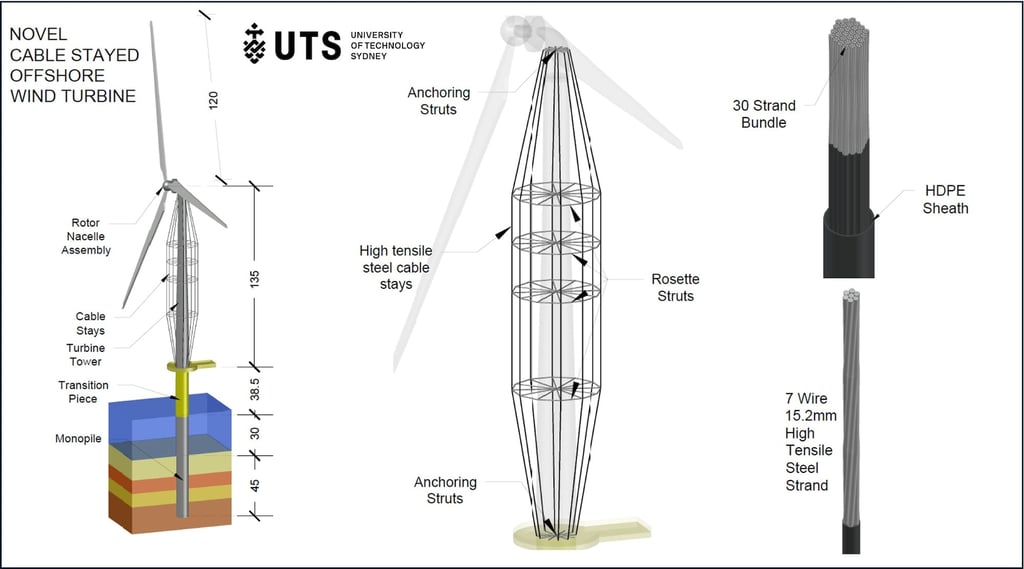
Researchers at UTS have proposed a novel cable-stay reinforcement system that could significantly improve the resilience of large offshore wind turbines exposed to the combined effects of earthquakes, wind and waves.
The study, led by Professor Behzad Fatahi from UTS, investigated a new cable-stayed tower concept for a 15 MW offshore wind turbine supported by a monopile foundation. The research was conducted by UTS PhD candidate Nadeem Fairley, with industry support from Dr Aslan Hokmabadi from Arup.
Offshore wind is expected to play a critical role in the global transition to renewable energy. However, many high-potential offshore wind regions, particularly across the Asia-Pacific, are also located in seismically active zones. This creates a major engineering challenge: ensuring that increasingly large offshore wind turbines can withstand not only wind and wave loading, but also severe earthquake excitation.
The research team used advanced numerical modelling to compare a conventional offshore wind turbine tower with a newly proposed cable-stayed tower design. The cable-stay system uses high-tensile steel cables and supporting struts to increase the tower’s flexural stiffness and reduce damaging dynamic responses during extreme loading events.
The simulations showed that the cable-stayed design substantially reduced tower accelerations, stresses and deformation. In several cases where the conventional turbine model experienced yielding or buckling, the reinforced cable-stayed tower remained structurally intact.
Professor Behzad Fatahi said the findings could open a new pathway for safer and more resilient offshore wind infrastructure.
“Offshore wind turbines are becoming larger and are increasingly being proposed in regions where earthquakes are a real design concern,” Professor Fatahi said.
“Our research shows that a relatively simple structural reinforcement concept, inspired by cable-stayed systems used in bridges and towers, can significantly improve the dynamic performance of offshore wind turbines under combined earthquake, wind and wave loading.”
The study found that the cable-stay system helped reduce internal forces in the upper sections of the tower by increasing structural stiffness and reducing resonance with higher vibration modes. It also helped prevent sectional ovalisation of the tower, a deformation mechanism that can contribute to buckling in thin-walled turbine towers.
Mr Nadeem Fairley said the research highlights the importance of considering realistic multi-hazard loading in offshore wind turbine design.
“Offshore wind turbines do not experience hazards in isolation,” he said. “In the real world, wind, waves and earthquakes may interact, and our modelling shows that this combined loading can have a major impact on structural performance.”
Dr Aslan S. Hokmabadi from Arup said the collaboration demonstrates the value of connecting academic research with industry-focused engineering challenges.
“As offshore wind expands into more challenging environments, there is a growing need for practical and robust design solutions,” Dr Hokmabadi said.
“This research provides an innovative solution improving the resilience of offshore wind infrastructure and supporting the long-term reliability of renewable energy systems.”
The team says the proposed system may also have potential for strengthening existing offshore wind turbines, extending the life of ageing assets or supporting future repowering with larger turbines.
The research has been published in Ocean Engineering under the title Novel cable stay reinforced offshore wind turbine resisting combined seismic, wind and wave loading.
News by topic

News
New report calls for federal reform to address harmful worker surveillance
The Australian Government must urgently address the threat to workers from new forms of AI-powered surveillance, according to a report released today by the...
News
UTS response to NSO report
A statement from The University of Technology Sydney in response to findings of the National Student Ombudsman.

News
Independent review into March protest and event
A message from Vice-Chancellor Professor Andrew Parfitt.

News
UTS coral expert helps reveal global extinction crisis
A landmark international assessment finds nearly half of reef-building coral species are threatened.
News
New report calls for federal reform to address harmful worker surveillance
The Australian Government must urgently address the threat to workers from new forms of AI-powered surveillance, according to a report released today by the...
News
UTS response to NSO report
A statement from The University of Technology Sydney in response to findings of the National Student Ombudsman.
News
Independent review into March protest and event
A message from Vice-Chancellor Professor Andrew Parfitt.
News
UTS coral expert helps reveal global extinction crisis
A landmark international assessment finds nearly half of reef-building coral species are threatened.