


- Posted on 21 May 2026
- 3-minute read
Biotechnology start-up Algenie has won a major national grant to commercialise its biomanufacturing platform.
Algenie has been awarded $1.4 million through the Australian Government’s Industry Growth Program to scale their breakthrough technology that pairs patented photobioreactors with AI-optimisation of strains to grow algae uniquely cheap and at scale.
The grant will fund an industrial-scale proof of concept of Algenie’s bioreactors with the 18-month project runs to September 2027.
The world’s two macro feedstock systems, oil and agriculture, have become more price-volatile and more politically exposed. Feedstock supply chains are now one of the dominant strategic risks for governments and manufacturers.
Biomanufacturing capability has become central to national resilience.
“Algae has always been a great feedstock for food, feed and fuels. It just has never been cheap enough or at scale to be more than a niche product,” said Nick Hazell, Founder and CEO of Algenie.
“Our closed photobioreactors drive up to 30 times higher growth rates than the industry standard. Combined with increasingly cheap renewable energy and AI that makes biology predictable, we can grow algae cheaply and at scale for the first time.”
This grant funds our first industrial-scale proof of concept. That means we are one step closer to unlocking algae as a commodity feedstock.
Algenie’s first market is aquaculture, where the first commercial pilots are planned. From there, the platform expands into high-value ingredients, and at scale into fuels and bioplastics. Thirteen letters of intent already span these verticals.
“What we are really building is a sovereign feedstock platform,” Mr Hazell added.
“Every country has a different feedstock pain point. Algae, grown on renewable energy, optimised by AI, in the right hardware. That is the universal answer. Australia has a real shot at putting its biggest resource to work. Sunshine.”
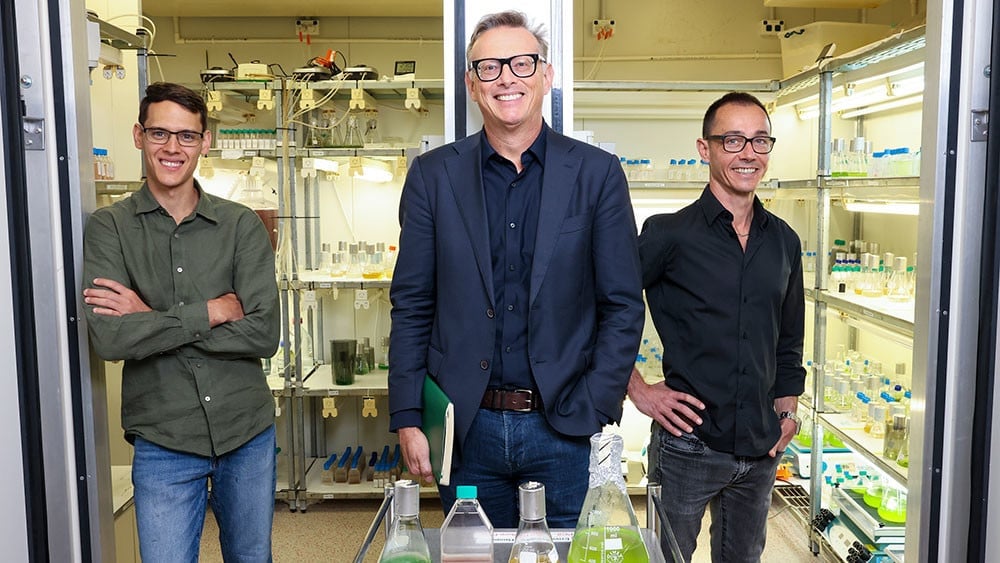
Algenie builds on cutting-edge research from UTS that has built patented algae bioreactors that centre on a novel helix shape that can grow algae to its maximum biological potential.
“Algae can be a very powerful solution to capture a lot of carbon from the atmosphere,” said Assocaite Professor Mathieu Pernice, chief biologist with Algenie and deputy director of the UTS Climate Change Cluster.
“That solid carbon in the form of algae can then be the raw material used to manufacture a whole range of products including fuels, plastics, food, medicines or clothing.”
News by topic

Story
Clean green machine up in lights
UTS-backed start-up Algenie is pioneering a new technology that harnesses the magic of algae to remove carbon from the atmosphere and unlock it for...
News
Algae biotech launches on a mission to tackle climate change
Newly founded biotech company Algenie will commercialise an innovative algae growth platform capable of producing the building blocks for sustainable plastics...

News
UTS scientists at the double for national prizes
A marine biochemist and team of forensic scientists have been named finalists from UTS in the 2026 Australian Museum Eureka Prizes, the nation’s highest...

News
Many biofuels haven’t panned out. Could algae make the clean diesel and aviation fuel Australia needs?
Algal fuels needs much less land than conventional biofuels.
Story
Clean green machine up in lights
UTS-backed start-up Algenie is pioneering a new technology that harnesses the magic of algae to remove carbon from the atmosphere and unlock it for...
News
Algae biotech launches on a mission to tackle climate change
Newly founded biotech company Algenie will commercialise an innovative algae growth platform capable of producing the building blocks for sustainable plastics...
News
UTS scientists at the double for national prizes
A marine biochemist and team of forensic scientists have been named finalists from UTS in the 2026 Australian Museum Eureka Prizes, the nation’s highest...
News
Many biofuels haven’t panned out. Could algae make the clean diesel and aviation fuel Australia needs?
Algal fuels needs much less land than conventional biofuels.