The distinctive smell of smoke in summer is often all you need to know there is a bushfire burning.
Even if the fire is many kilometres away, the drop in air quality can be harmful for your health. Some of us – including older people and those with pre-existing health conditions – are particularly vulnerable.
There is no safe level of exposure. So here’s what to know and how to minimise your risk.
How can smoke affect your health?
Bushfire smoke contains a mix of particles (including fine particulate matter, or PM2.5) and vapours and gases, such as carbon dioxide and nitrogen oxides.
Breathing in this toxic mixture can affect how much oxygen our lungs can absorb and how well the cells in our bodies work.
Being exposed to smoke can affect your health immediately and in the long term. The risks increase with the amount you’re exposed to – usually related to how close the fire is – and for how long.
In the short term, you might have itchy eyes, a runny nose or sore throat, and wheezing or coughing.
In healthy people, these symptoms often clear up away from smoke. But in vulnerable people, breathing in smoke can be serious and even fatal.
At-risk groups include children, the elderly, people who are pregnant, and those with diabetes or pre-existing heart and lung conditions, such as asthma.
If you experience difficulty breathing, or chest pain or tightness, you should call 000.
The long-term risks are also serious
But these often get less attention.
Sustained exposure to bushfire smoke has been linked to lung diseases such as chronic obstructive pulmonary disease. It can also increase your risk of cardiovascular diseases, which affect the heart and blood vessels, and other diseases such as dementia and lung and brain cancers.
Short-term exposure can also exacerbate existing lung and heart conditions and lead to hospitalisations and, in some cases, deaths.
Smoke exposure during pregnancy is also risky, as it can reduce birthweight and increase the risk the child will later develop diseases such as asthma. The increased risk of pregnancy loss is very small, but devastating.
How can I tell if air quality is poor?
Often, we can see or smell smoke in the air. But air that seems clear can still pose health risks.
Luckily in Australia we have several reliable sources for information about air quality. These are managed by state, territory and local governments, for example Air Quality New South Wales.
You can find information about where you live by checking the the federal government’s air quality website.
How can I stay safe indoors?
You should avoid breathing in smoke as much as possible. Of course, this can be tricky – but there are some ways to minimise exposure.
If you can, stay indoors with the doors and windows closed.
Set air conditioners to recirculate mode – this stops any any outdoor air from entering the building.
If you have an indoor air purifier, turn it on. Most air purifiers use a physical filter to remove particles from the air. So the more efficient its filtration is, the better it will protect you.
High efficiency particulate air (HEPA) filters are among the best available. To qualify as a HEPA filter, it must remove at least 99.97% of very small airborne particles.
Make sure to check the manufacturer’s information for efficiency and how it was tested. Look for filters that are certified as “true” HEPA, or H13 or H14 HEPA filters.
And beware of marketing jargon such as “HEPA-style” filter or “99% HEPA” – this designation doesn’t exist and these filters will likely be less effective.
Remember, even HEPA filters are only effective if they are replaced regularly – generally at least every 12 months – and fitted according to the manufacturer’s recommendations.
Most air conditioners will contain a more basic filter, and sometimes these can be upgraded to a HEPA filter. It’s best to talk to your service agent as not all filters are compatible with all air conditioning units.
Indoor plants can also improve air quality. Research has shown they can help remove the toxic gases found in bushfire smoke. But they can’t remove particles from the air, so it’s best to use them along with an air purifier.
If you have to go outside
Wear a mask, especially if you have to be outside for long periods.
Masks that have good filtration (N95, P3 or higher) are the best at preventing you breathing in particles. But these type of masks only work if they form a tight seal on your face.
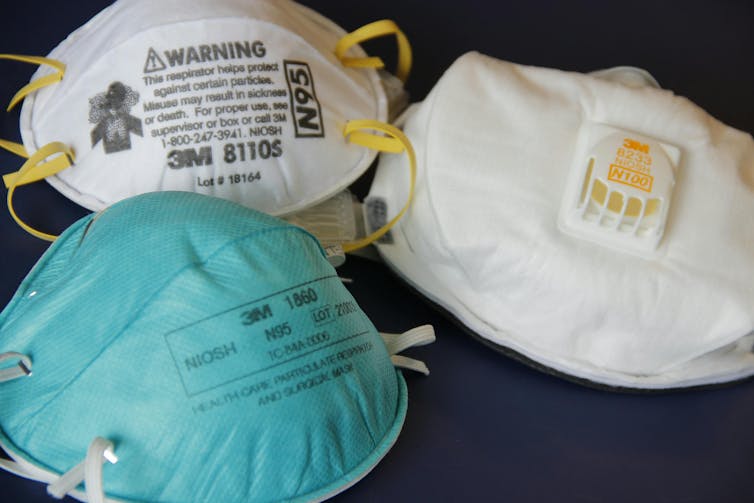
And while N95 or P3 masks reduce risks by removing smoke particles from the air, they do not stop toxic gases from entering your lungs.
People working outdoors close to the bushfire may need a respirator or a gas mask. These filter toxic gases and/or provide clean air.
The best way to know what mask is right for you is to get professionally fitted. Your employer may pay for a “fit test”.
Wearing a surgical mask or pulling a t-shirt or scarf over your face offers very little protection. It’s better than nothing, but should only be done as a last resort.
If you are close to the fire, a mask won’t be enough. You need to take extra precautions such as those outlined by the rural fire service to protect you from smoke as well as heat and embers.
The takeaway
If you’re concerned about smoke, it’s important to talk to your health-care provider – especially if you’re pregnant or have a pre-existing health condition. In an emergency, call triple 000.