

Recording: Accountability, resistance and disruption – The future of disability policy

WHEN

10 December 2025
Wednesday
3.00pm - 5.00pm Australia/Sydney


WHERE

Online

COST

Free admission

CONTACT

If you are interested in hearing about future events, please contact events.socialjustice@uts.edu.au

The inaugural Research Conference of the Disability Law Society Network brought together leading scholars, advocates and community voices to explore accountability, resistance and disruption in disability law.

The panel discussion explored the links between disability, law and society, culture and politics, featuring Rosemary Kayess (Disability Discrimination Commissioner), Professor Scott Avery (Professor of Indigenous Disability, Health and Wellbeing, UTS), Professor Sheila Wildeman (Director, Dalhousie Health Justice Institute, Dalhousie University, Canada), and moderated by Dr Piers Gooding.
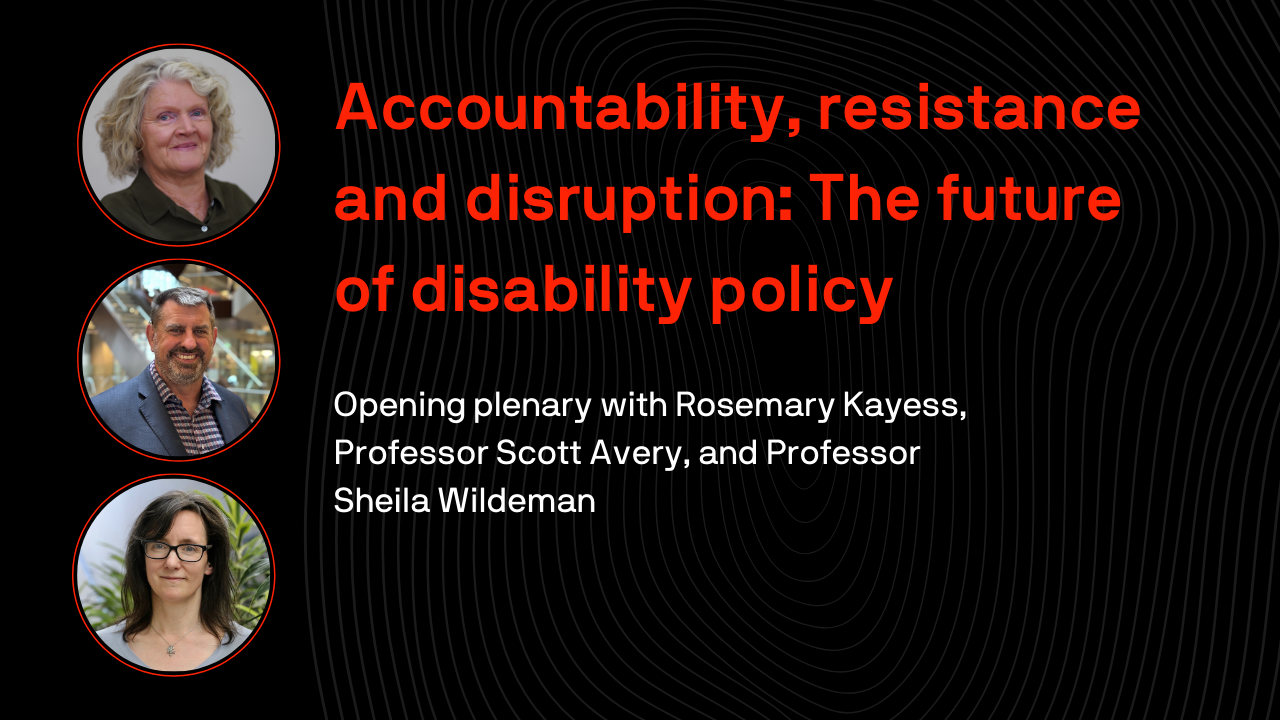
Thumbnail image with the title accountibility resistance and disruption and images of the three panelists

PIERS GOODING: Thank you so much, everybody, for being here.  I was wondering, Scott, if you could turn down the volume on your computer because I'm getting an echo. I am used to the sound of my voice but not with a second delay! Thank you so much for being here.  Good afternoon, everybody, and welcome.  I'm just going to say a couple of words to open things up.  Welcome to this panel discussion to open the inaugural Research Conference of the Disability Law Society Network of Australia and Aotearoa, New Zealand.  My name is Piers Gooding.  I'm an academic at La Trobe Law School and I am one of the co‑organisers, alongside Professor Linda Steele here at UTS, and Tom Baylow, Associate Professor Anna Arstein‑Kerslake and Liddy Schmidt from the Melbourne Law School, and Professor Chris Maylea and Pinez Sansonwell From La Trobe Law School.  It is my great pleasure to be chairing this discussion but before I offer some opening remarks about the conference and introduce our esteemed panellists, I would like to invite to the stage Aunty Glendra Stubbs, who is the Elder‑in‑Residence at UTS, who will offer an Acknowledgment, a Welcome to Country. 


AUNTY GLENDRA STUBBS: Thank you.  I am really happy to be here with Scott.  Thank you, Scott, and thank you for inviting me.  It's always an honour to be asked to do an acknowledgment or a welcome.  It is something that makes me really proud.  I must say, I might be a bit biased, but UTS is the best uni.  So some of you could come.  We would have you, we love you, and you would get Aunty hugs.  Do you get those at your unis? It's a selling point! I'm really honoured to be here and have I said already how much I love Scott? Don't tell your wife.  She knows that we all love you. But I'm going to introduce ‑ we are on the land of the Gadigal people of the Eora Nation and pay thanks to Elders past, present and emerging.  When you work at a University, you see the best of the best.  You see the young ones that are here.  You see them protesting, wanting better things for people.  You see them feeding the homeless.  You see we are in good hands.  We are in really good hands.  You see the best of the best of the young ones at a University, I believe.  Today we are here for the Accountability, Resistance and Disruption Conference focused on disability law and human rights.  As a human right, we are all deserving of equal opportunities and respect.  I had to ask a young one what that meant. 


NEW SPEAKER:  Don't look at me! 


AUNTY GLENDRA STUBBS: Yes, I am.  The young ones at the back of the room.  But isn't that good that I can say I don't really understand what this means? And not feel shame to do that? I think it's really important tonne able to speak up when you don't understand and not feel that you're going to be put down or belittled or feel like you're less than someone else.  The First Nations communities practise accountability, shared responsibility and community responsibility, accountability.  Decisions are not made as individuals but as a collective.  That's why it takes us so long to bloody come to a decision! It's the truth, eh! It's got to go around and then you've got to get the aunties' approval and then there's someone that doesn't want it to happen and then we go back to stage 1, but we get there in the end and then everyone has a voice. Accountability is not just reporting and compliance.  It is listening to lived experiences, knowledge and committing to continuous improvement.  How good would that be, if we all listened and improved everybody's life? I think that's why I believe we're in good hands with our young ones.  I love you, my young ones down the back of the room.  Indigenous cultures demonstrate resilience through survival, our language ‑ we still are recovering and reclaiming our language, which, as some people in the room would know, we weren't allowed to speak our language.  It was illegal to speak our language and you got flogged if you spoke your language, and this isn't years and years and years ago.  This is in my time.  I am old but I'm not that old.  Oh, yeah, I am! But, you know, it's not something from 200 years ago.  It is in my time.  And I'm so proud of your young ones.  My little granddaughter, Ruby, she said the whole acknowledgment to Country in language and she practised that for weeks and weeks and weeks.  I had to say to her, "I don't know, darling.  Don't ask me.  Ask Aunty Carol Cooper, she'll know".  So we also have the ability to ask if we don't know.  And resilience ‑ well, we have survived.  What have we survived? We have survived having our children stolen.  I was just at the Genocide in the Wildflower documentary, and in some states in this country ‑ name and shame ‑ Western Australia and Queensland ‑ things aren't good for our mob.  Things aren't good for our kids.  Things aren't good for ‑ it's not good in New South Wales either, but at least we've got some laws that will protect us.  They're still getting over in Queensland Joh Bjelke‑Petersen.  Don't you reckon? Has anyone else lived through Joh Bjelke‑Petersen? No? Everyone is dead that lived through him.  Yes! We've got a brave woman that is prepared to say that she's a survivor! Woo! Also, First Nations resilience ‑ from the frontier wars to the land rights, we have been disruptive in the pursuit of justice.  We have a whole unit upstairs, the social justice unit, and I tell you, they're still pursuing justice for kids in out of home care, for prisoners, for our most disadvantaged. Real inclusion and accessibility requires disruptive change, not options, adjustments, but structural redesign.  I tell you, when you have a mobility issue, you see that this country isn't mobile, not disabled friendly.  When you go to an office and you have to walk up 36 stairs, with me walker, and there's no lift, or the other option is to walk through the dump.  I chose the stairs because the dump was too smelly.  We say we're a country of disability inclusion but we still have some people and some big businesses that aren't that friendly, and we are going to name and shame them, hey, Scott? No, maybe not Scott; he's too nice! But I'm happy to. 


As Indigenous people, we have always valued and raised those with other abilities, like Pemulwuy, who is also known as "clever man", a person believed to possess supernatural powers or serve as a healer, a wise man.  In the spirit of accountability, resistance and positive disruption, we honour the leadership of Indigenous people past and present who fight for recognition rights, inform every conversation we have today about disability law and human rights, and I want to say that I am so proud to know Scott.  He's a legend.  I think you were one of the first people I ever met at UTS.  I think we snavelled him from another uni? Is that correct? Did we steal you from another uni? He's not saying! But their loss, our gain. So enjoy your time with Scott and the panel.  I don't know anyone else on the panel but if Scott has given them permission, they will be great human beings! I love ya. Thank you, everyone.  (Applause). 


PIERS GOODING: Please join me in thanking Aunty Glendra Stubbs. (Applause). 


AUNTY GLENDRA STUBBS: I have seen you present before.  You are fabulous.  


DR ROSEMARY KAYESS: Obviously not as fabulous as Scott! 


PIERS GOODING: For those who can't hear through the unmicrophoned discussion, there is a lot of love on the panel.  Thank you so much, Aunty Glendra.  It is wonderful to have you here.  May I offer an acknowledgment to the Gadigal people of the Eora Nation and I extend my respect to their leadership, a very important matter for our network and, indeed, for this panel discussion where we will hear about the leadership of Dr Scott, which we will get to shortly.  And an important time in Australia with the Treaty in Victoria that we have just come from, the apology from Parliament in Victoria to Indigenous people, and for which issues of disability are a major part of that story and remain so. I would also like to really welcome and extend respect to our international guests who have travelled to join us here and I want to really welcome our colleagues from Aotearoa, New Zealand.  This network is really proudly trans‑Tasman and it brings together academic students, advocates and practitioners committed to critical engagement with disability law and society.  


Now, this plenary is somewhat Australian centric, notwithstanding our Canadian guest, but we recognise the importance of wider, regional perspectives and look forward to hearing from several of our colleagues from across the ditch during the conference.  We also want to welcome our other international guests, including those joining online; for example, we're going to hear from Dr Dina Afrianty, who will be chairing a session tomorrow exploring disability legal scholarship in the Asia Pacific with colleagues from several law scholars.  We have people joining us from Canada, from Europe and from South Africa today, so welcome and it's going to be wonderful to have this global discussion.  


Just a few words to frame this session.  The Disability Law and Society Network was established in 2020 as a loose network of academics that was first convened by Professor Steele here at UTS and Dr Donna McNamara, showing real intellectual leadership and support for early career researchers, and it has grown into a diverse community examining how legal systems, institutions and political structures shape disabled people's lives and influence the very idea of disability, impairment and normative and non‑normative minds, bodies and ways of being.  Our theme this year is accountability, resistance and disruption, which invites us to consider the law itself as a terrain in which we can offer a source of accountability and resistance but that if we're completely honest is itself a place that can be hostile to disabled people and needs itself to be disrupted.  


So I'll start with some words of the President of the International Disability Alliance, Dr Nawaf Kabbara, who recently expressed pride in the true leadership shown by persons with disabilities across the world and with profound concern for the material realities shaping their lives.  That respect and acknowledgment and profound concern animates our network and we are so grateful to our speakers today to help us explore the way law can offer a source of accountability, resistance and disruption. 


So without further ado, I would like to introduce our speakers.  I will give a very short account of who they are and then I'm going to ask them to introduce themselves more fully and tell us a little bit about their work and their interest in law as a source of accountability, resistance and disruption.  Our first guest is Professor Sheila Wildeman ‑ I am just going in order of seats here ‑ who is a Professor of Law and Director of the Dalhousie Health Justice Institute at the Schulich School of Law.  I'm going to then pass to Professor Scott Avery, who is a Professor of Indigenous Disability here at UTS and who is a Professor of Indigenous Disability Health and Wellbeing in the School of Public Health, and is an Aboriginal man descended from the Worimi people and is a recognised educator, researcher and policy adviser on Indigenous cultural approaches for the inclusion of people with disabilities. 


I'm then going to turn to Dr Rosemary Kayess, Disability Discrimination Commissioner at the Australian Human Rights Commission, who is a leading disability and human rights lawyer who has been absolutely influential in international human rights law for people with disability throughout the world. So could you all join me in just welcoming this incredible group of people.  (Applause). 


So to begin with, could you each briefly introduce yourselves and describe what drives your work at the intersection of disability, law and justice. Do you want to go first, Sheila? 


PROF. SHEILA WILDEMAN: First of all, thank you so much for having me here and including me on this amazing panel, being here with Scott and with Rosemary is just such an honour, and it's a real treat to be among all of you.  I'm looking forward to learning more about what all of you do over the time of this conference and thanks to Piers, to Linda, to others who organised this event.  It's a real honour to be here.  So as Piers mentioned, I'm Director of the Health Justice Institute at Dalhousie University.  That's in Halifax, Nova Scotia, which is the land of Mi’kma’ki, the ancestral and unceded territory of the Mi’kmaq, and I'm so grateful to the Mi’kmaq for all of the learning that has been contributed to my own education and that of my students.  


I'm also involved in community‑based advocacy, and that's part of what I bring in my answer to what drives my work in this field.  So I'm co‑chair of a group called East Coast Prison Justice Society, and that's a group that has a free jail line and is involved in civil society accountability, and that is work that is profoundly pre‑occupied with disability justice.  I've also spent some time since 2019 facilitating an arts‑based action research group called My Home, My Rights, and that centres the human rights insights of six folks with intellectual disabilities and experience of diverse other forms of oppression.  So those two community engagements are so much of what I carry when I think about what drives my work in the disability justice field and as maybe we will explore a little bit more during the panel, I'm really interested in surfacing the contradictions in law and in spaces of carceral applications of law, so both spaces of disability institutionalisation and criminal law incarceration. 


PROF. SCOTT AVERY: Guudji Yiigu, everyone, which is 'hello and welcome' in my native language of Gathang. I just want to start by congratulating the organisers, so Piers, Linda and Anna, and probably many others behind the scenes to make it happen.  I get invited to a number of these but the international presence this has is quite unique, so congratulations.  I have met people like Sheila from Canada.  Today there were people from South Africa.  A very good friend of mine from Belgium, who I'll need to have a conversation with about which city has the best coffee.  But it's just wonderful and I think to bring everyone across the world ‑ when we work in this space, it feels like we're on our own and our issues are parochial but I think the struggle is universal, and I think talking to people across the nations help us clarify in our minds our place and purpose.  


How I landed in this space? A good question.  Often I don't know.  Often we get pulled to things beyond our ‑ you know, our purpose finds us rather than the other way around.  Very much so in my case.  So my landing here started probably a bit over a decade, maybe 15 years ago.  I was working in Aboriginal health and I was working on a version of the Aboriginal health plan in the early 2010, 2011, supporting Aboriginal community groups.  So that's the health plan that speaks of a health system free of racism, which was very much a breakthrough in terms of naming racism, and I think there's a lot to be learned about that around getting a health system free of ableism.  But as we were going through that process, I am a deaf person, I'm in a health group, so Aboriginal medical services, allied health professionals, and they're talking to the doctors, the OTs, the physios, the teachers.  They weren't actually talking to the people with disability and I'm going, "We're in the room".  The first point of landing here is going, "Actually, if we want to speak for ourselves, we do actually have to find a way to speak through ourselves and not through intermediaries".  That was the first idea of when we started, we need our own truth telling in the Indigenous disability space, so drawing upon that philosophy of truth telling.  So that was a first turning point.  


The second thing that came about is we were trying to get support for a program for truth telling.  This predated the Royal Commission and I remember a time when ‑ at this time, I was with an organisation called the First Peoples Disability Network, which is an Indigenous disabled peoples' organisation, and we're pitching to governments "you need to support this" and I was doing it as a systemic advocate.  I remember we were at once the artist formerly known as FaCS, for any local people, we were just hitting up against a wall.  I remember coming out and going, "If we want to change things, we need to start teaching it.  We need to start teaching it to people before they hit the system".  So from that actually, we said we need to actually lead this ourselves.  That is when the research program came.  Just in terms of the time it took, for those Australian people who know Closing the Gap is the Indigenous framework for overcoming health inequalities, so I wrote my first submission to get disability included in that framework in December 2012 and it was accepted in May 2022, so nearly 10 years of turning up, turning up, turning up.  So in our talks about survival, it's not just our subject matter expertise that we know.  We know how to stay in the game and play the long game.  So I'm looking forward to our discussions and thank you. (Applause).  


DR ROSEMARY KAYESS: No, I'm good.  Thank you very much.  In many ways, my journey is a bit, I don't know, reminiscent of Scott's in some respects but very different from Scott's in other respects. I sit here as Disability Discrimination Commissioner and a member of the UN Committee on the Rights of Persons with Disabilities, and they are a culmination of everything that I've basically done.  They bring together the three elements of my life.  I had an accident in my late teens, early 20s, and so it was a jarring personal experience that has led me to be an Associate Professor of law at UNSW, the Chair of the Committee on the Rights of Persons with Disability, Chair of the Chairs, so all the Treaty body Chairs of the United Nations treaty body system and the Australian Disability Discrimination Commissioner.  Actually, when you say it out like that, it's a bloody lot! So I had a traumatic disability spinal cord injury that dramatically changed the role of my life.  Well, not the role of my life; the role that I was given in life, the role that I was accorded, and it was quite a jarring experience.  You see the structural barriers quite clearly when you have never had to experience those structural barriers. I understood gender discrimination but I hadn't understood disability discrimination in any way like the way you experience when you go from one moment having no barriers before you to encountering them across not just the physical environment.  It was personal autonomy, it was sexual rights, it was a complete barrage of recognising the way the world is structured around a completely different concept of who a person is. Not really knowing where I was going to go and what I was going to do with this new role that I had, University became a place that I treasured and the critical thinking and the thought, and I was lucky to be operating at University at a time when disability and critical disability theory was developing significantly, and so I got to engage with those debates around the social model and the medical model and then the development of those theories and those debates.  It was a great time to be engaged in critical thought. 


But I started working with a community legal centre, and discrimination law in my PhD collided, my PhD studies, my doctoral studies, which I didn't complete, even though I have a couple of honorary doctorates attached to my name now, one from Basel and one from UNSW.  It was looking at the limitations of discrimination law.  I had worked with this community legal centre that was a special disability legal advice service and in Australia for some reason we have an anti culture to human rights and I don't know what it is, and discrimination law was the only leverage, legal leverage, that people with disability have in this country to try to seek redress for violations of a small number of rights that are available to them.  The limitations were in the big ticket items.  It's the personal autonomy stuff, the legal violence, that can occur in the lives of people with disability, the mental health laws, the guardianship laws, the real big ticket institutionalisation items.  There's no way the law can facilitate challenging those. And so that's where the timing of the CRPD negotiations was very fortuitous and a great mentor of mine, Phillip French, said, "We have to go".  We all thought we would go and sit in the corner and be amazed by these brilliant minds that would be in the room, and we got there and we thought: "this is a shit show!".  And so we actually were very engaged.  Australia had, with the Canadians, robust discrimination law provisions.  They had robust DPO groupings.  We had really good DPOs like First Nations disability, First Peoples Disability Network, People with Disability Australia, Women with Disability Australia, really strong representative groups in the process.  So being part of the drafting, I ended up being on the Government delegation.  So that role was setting standards for the world and it gave me a belief that it won't happen overnight but if we can work at it, it can happen.  So it was a way to embed it and then when people threw it at me that you should go on the Committee, we would really like to nominate you, I'll be honest, I was dragged kicking and screaming initially, but it's been really interesting.  I will talk more about that later.  


But for me, as the Commissioner now ‑ I'm coming to the end of my second term on the Committee ‑ and so my only day job at the end of 2026 will be as Disability Discrimination Commissioner.  And for me, that task is being driven by the lack of connection between disability and justice in Australia.  So if we look at the policy frameworks around gender and race, they talk about racism.  They talk about sexism.  They talk about equality discrimination.  They talk about social justice.  It is framed in that language and in those principles.  In disability, we get nothing about equality, nothing about human rights, nothing about ableism, and what we get is it being put back on us and that we can reach our full potential.  It is patronising and it is the vision for Australia's Disability Strategy.  That's what drives me.  I want to disrupt that. (Applause). 


PIERS GOODING: I told you I was only giving brief bios of these three amazing individuals. So as Rosemary just alluded to, disruption is a key theme of our conference and I would like to ask each of the panellists to reflect on what you think of when you think of these ideas of accountability, resistance and disruption in the disability context. Sheila, we will go with you first and then we will change.  


PROF. SHEILA WILDEMAN: I really just want to listen! I just want to say something.  I am thinking as Rosemary was reflecting about involvement in the CRPD negotiations and DPOs were involved in the drafting, as I have learned in part from Rosemary's own account, Amita Dhanda's account, but also I wanted to mention because I sit here and I was thinking of my colleague Steven Estey, who was also prominent at the CRPD negotiations and such a wonderful beacon of disability rights advocacy, and Steven passed away just ‑ I guess it's over a year ago and he was so integral to my own education and advocacy work in Nova Scotia and my being open up to the field of international human rights.  I wanted to mention too that Steven's son, Isai Estey, is one of the members of My Home, My Rights.  Isai who uses a wheelchair and communicates through sign ‑ doesn't communicate orally ‑ is just a fabulous, fabulous young man and is in many ways following in his dad's footsteps.  Last year, we co convened a side event at the UN with Arch Disability Law and it was on co‑creating disability rights advocacy and research through inclusive methods.  Our methods are arts‑based, really profoundly arts‑based work, and Isai shone there and the Canadian Government hosted him as a youth delegate to the CoSP last year and so he presented there.  It was just a wonderful coming around of one generation to the next in terms of continuity of disability rights advocacy and also a kind of passing of the torch from Steve, who for those who did not know him, very unique, incredibly funny, incredibly strategic, brilliant advocate, so he had his style and Isai has his style, as a person with intellectual disabilities, who is a very concrete thinker and incredibly direct ‑ he tells you exactly what is on his mind ‑ and so he's got his own advocacy style.  So beautiful to see that continuity. 


So your question was: what the title of the panel brings to mind.  So accountability, resistance and disruption.  Just a word on accountability, because I would like that to be one of the themes.  I don't want to talk too much because these folks over here have way more to share, but there is another piece I want to share about Nova Scotia and I don't want to miss telling you this, since I'm bringing some words from Canada and there's so much to say from Canada.  It's just in the spring that a coalition of Canadian delegates presented to the CRPD Committee and relayed a long list of concerns around gaps in access to let's call them social determinants of health ‑ you know, the disproportionate subjection to deep poverty, homelessness, with particular impacts on Indigenous folks with disabilities.  The Coalition also relayed deep concerns about what we call Track 2 MAID in Canada, which since 2021 it's just a development in our medical assistance and dying legislation whereby folks who are not terminally ill but are disabled have access to MAID where there is no other relief for their grievous and irremediable suffering.  My Home, My Rights was part of the Coalition, kind of a quiet part, on the deinstitutionalisation subcommittee.  Anyhow, the Coalition put to the Committee the terrible relationship between lack of access to those integral social determinants of health and wellbeing, and the availability of medical assistance in dying.  The Committee wonderfully reflected much of what the Coalition had put to them.  So accountability is, in part, about these feedback loops whereby you can feed back to legal accountability mechanisms, I guess, you can feed back what the experience is on the ground, so are these aspirational statements of human rights ‑ are they trickling down, are they filtering down to the experience of the folks they are intended to lift up, or are they not? So the process of states parties accountability is one really important piece that I just want to put in the background to that.  And the last thing ‑ as I should stop talking ‑ is civil society based.  So that was an example of civil society based accountability.  It's shadow reporting as we call it.  So not the state itself feeding back but folks on the ground with connection across Canada, including ‑ it was co‑led by [the] Indigenous Disability Canada Group.  But there's another form of civil society monitoring and maybe I'll come back to this, but two forms, and one relates to prison justice or prison‑based injustice ‑ so I mentioned east coast prison justice ‑ and so that's an example of civil society grassroots organisations stepping up and devising forms of accountability through community‑based relationships where there simply is no state‑based accountability mechanism.  So we don't have an Ombudsman for provincially incarcerated people, for instance.  So we just decided to do it ourselves.  The other piece that ‑ the last piece that I would raise on accountability mechanisms goes back to disability rights specifically, and so I'm very interested in pushing for, pushing with, pushing with community‑based advocates, including My Home, My Rights, pushing for peer co‑led monitoring of human rights, particularly in disability services, and this is really important and timely for us in Nova Scotia where we're undergoing huge deinstitutionalisation, a transformative remedy, which is court‑ordered, intended to happen within five years, including the shutting down of all large disability institutions, which continue to exist in Nova Scotia, and this extends even to all residence‑based disability services with more than four people living in them.  So it's a massive transformation to happen within five years and, at the same time, there is to be a shift to individualised supports, and that's part of why I am so interested in being here in Australia because that remedy in Nova Scotia was in great part modelled on your NDIS, and the question that I'm bringing is: how can we create these feedback loops of accountability such that this incredible transformative remedy ‑ which after hearing Rosemary's story, I am thinking, "Wow, we're kind of in a good place in some ways, in my province, in Nova Scotia, because of what is happening with the force of law, working with the force of community mobilisation around deinstitutionalisation", but how do we make sure that this remedy is responsive to the experience on the ground? Thanks. 


PIERS GOODING: Scott, over to you.  Thank you so much, Sheila. 


PROF. SCOTT AVERY: So I'm going to draw on something that Aunt spoke to in her acknowledgment of Country, and how accountability starts with being personally accountable to our community.  So for those who caught the train or walked today, the acknowledgment of Country ‑ if you walked from the central station to this campus, you actually followed the old hunting tracks of the Aboriginal community.  It goes all the way down to the Gadigal Sea, now named Sydney Harbour.  Overlooking Sydney Harbour, you heard Aunt mention Pemulwuy, a great warrior who led the resistance from the initial invasion at that site. So that's 250 years ago.  


Since that time, there have been generations of resisters that have come forward as colonisation has changed its face and its ways from the militaristic ways, through control, through policy and social engineering, so has the face of resistance changed and adapted to that? So Aboriginal leaders and resisters have a long history.  It goes back many, many millennia.  So we think of accountability in our space.  There have been First Nations disability leaders who actually couldn't get into a place like this.  They couldn't actually get into University.  Universities wouldn't have them.  So that's one generation ago.  But they are taught a law and ethic, keep turning up, stand to your principles.  


So when I think of accountability and I sit on a panel like this, I go, "What would my Elders who have now passed, so they're like my celestial panel now, what would they like me to say"? So we're accountable to our communities and our people. 


Moving on to resistance, what does that mean by resistance? If we see someone getting screwed over by the system, we actually have a cultural obligation to stand up and speak out.  If we are in a position of authority and our standing, as I have now found myself in, it is actually a cultural obligation to speak up and speak out.  We do not have that discretion to go I am just going to look the other way.  If we do that, we are not accountable to our communities.  That is very much our teaching.  So when you heard about surviving, it is surviving in that context and in that way of doing, being, that it's an Indigenous person which is quite empowering because when you do pick fights with people over inaccessible disability standards in places like this, you are kind of going, "I have no choice.  Sorry, mate. I have to do this.  It is my cultural obligation".  It is one thing, though, to bring your warrior spirit and invoke that to the idea of disruption, but I think what disruption does, and particularly in a room like this where we can take a really deep scholarly approach, is understanding how the systems of power work to empower and disempower.  So being in the room helps you understand how the systems will screw people over.  If you can think strategically about how can you target your disruption to get most impact, that is what I think disruption is really about, whether it's disrupting language, disrupting systems, disrupting policy, think about how this will disempower certain groups and preserve the hierarchies and this one ‑ I am looking forward to the next few days where we can get that intellectual deep thinking around how do we actually see power and then redistribute that back to other people.  


PIERS GOODING: Thanks so much, Scott.  Rosemary, over to you.  


DR ROSEMARY KAYESS: For me I come back to the central premise of my doctoral studies, which was Axel Honneth, and Axel's premise is that human rights is about recognition.  I know that for many of us that have spent time as scholars or are still scholars, the art of scholarship, you read really simple things and you think wow, that is kind of profound, but if you put it in the disability context, it is incredibly profound.  Many people with disability are just dismissed as being less than human.  You mentioned Steve Estey, a dear, dear colleague.  You couldn't get a smoother operator, collaborator.  An amazing, lovely man.  I also worked with another colleague, both on the Convention negotiations and who also was a good friend of Steve's, and he was from Aotearoa,  Sir Robert Martin, an advocate with an intellectual disability and an absolute powerhouse of a Committee member, but the experiences in Robert's life and the way he was treated throughout his early life for many, many years was that he was less than human.  He wrote a biography and its title is "Becoming  a person".  It is that fundamental recognition that I think is so incredibly important to keep in mind when we talk about accountability, resistance and disruption.  If human rights are about recognition, for disability it has such an incredible impact on people's lives, and we have in democracies especially, the processes to provide the power for there to be that challenge to those power relationships.  So human rights gives us the tools to be able to recognise the weaknesses within the systems, the failures and the gaps and to try to change systems, but it requires us to organise but it also, like Scott said ‑ we need to be in the room.  So we need to have the critical thought.  We need to have the academics and we need to have academics with disability.  We need to have the lawyers.  We need to have lawyers with disability.  People with disability have to be recognised, not just as human beings but as integral parts of the system.  The reason disability is not part of the policy framework is because people with disability haven't been in key leadership positions.  They haven't been the lawyers, the public administrators, the politicians, the medical fraternity.  So disability was lost.  It was somebody else's concept and somebody else's construct.  We need to be recognised as part of that system before we can be included in that system.  So we live in an ableist society.  That doesn't say much but it does if you resist living in an ableist society.  You can only change what you acknowledge and recognise is the power relationship that disables people. 


PIERS GOODING: Thank you, Rosemary, and thank you, all, for bringing to mind for all of us some of those who came before us, the late Steve Estey, a deeply charismatic individual, aside from anything else in his intellectual and strategic power in the movement, the late Sir Robert Martin, and there are others I could name here actually, and I will: the late Gabor Gombos, the late David Webb, the late Lesley Hall.  All of these individuals profoundly contributed to the disability rights movement here and overseas and the development of the CRPD.  For those HDR candidates here, early career researchers, these are individuals who have influenced our work, whether we know it or not.  So bringing them to mind, as well as, Scott, the ancestors that you recall, I think it is a really powerful contribution to this discussion.  


I have a list of questions that I wanted to ask these wonderful people and I sent them to them in advance and I hope they didn't put a lot of time into preparing for them because we won't be able to get through them, but I do want to ask one or two questions directed at the individual work of those of you on the panel. Scott, if I can start with you: you once said something very profound.  You once described being Indigenous burns your heart and disability freezes you cold.  Could you unpack a little bit what you meant by that and what it means for your work? 


PROF. SCOTT AVERY: Yes, the quote is actually "burns you hot" and speaking about disability, “it freezes you cold”.  I came up with this idea when I was looking at the responses within Australia just after 2023 and I was reflecting on the passions to which people bring to big social policy areas around Indigenous and disability.  So coming off within Australia in late 2023, we had the Voice Referendum, which consumed social discussion for a year, if not more, in a very intense way.  At the same time, we had a four‑year Disability Royal Commission in which people were turning up, speaking of very traumatic stories of violence, abuse and neglect which was flying under the radar. I remember about six months later and the Prime Minister was up at the Garma Festival almost grieving about the outcome of the Voice Referendum, and about a month after that, the Australian Government dropped their response to the Disability Royal Commission during the tea break of the Olympics, and I just went ‑ just the level of passion in one but just dispassion in the other.  So another phrase I came up with: I know if I was to be talking around racism in this place, people bring very strong passions to it, but an awkward discussion around disability.  So I have another phrase for you all.  If you want to start a robust discussion, start a discussion around racism.  If you want to disband it, talk about ableism.  So how do we lift that and change that.  I think it is about very open, frank discussions.  That is what that really came about, is how can we dignity and respect for the issues around people with disability, and it is weird for someone like me being both and you look at all our Indigenous strategies within the University and it's just crickets when it comes to disability, and, strangely, that I'm an Indigenous scholar has given me an platform to talk about disability in a way that others can't.  


PIERS GOODING: I suspect that might come as a surprise to a lot of people in the room and online, and frankly, it came as a surprise to me.  One of the great contributions you have brought to the field, Scott, is your work on culture is inclusion.  I wonder if you could just briefly talk about the inclusion of Indigenous peoples with disabilities in Indigenous cultural life and what does that mean for us in our reflections on the law, in our reflections on our scholarship and advocacy? 


PROF. SCOTT AVERY: So cultural inclusion is spawned from the research project that I talk about.  It was really truth‑telling but we had to call it research so it would be recognised by an institution like this.  It's been mentioned around the social model, and another mentor in the disability world, Tom Shakespeare, who I am quite sure ‑ we used to have discussions around the social model.  He goes, "We know it's kind of whitefella", so I was kind of like cultural inclusion is like if a Blackfella wrote about the social model.  So it was in itself seen as a disruption.  It was funny that as we were doing this work and it wasn't like, "We don't want to have to exist in this social model world in this Western way; we just kind of want to do it ourselves and embrace our culture".  So we went to New Zealand, to the Maori people, who were strong and assertive about culture, and the cultural inclusion ‑ this actually goes back to a lore or a story we have from our ancient ‑ it goes back 20,000 years where in Lake Mungo in western New South Wales, there is this archaeological site of footprints in the clay.  So it's the oldest archaeological site [of an Indigenous community].  And amongst that is a single right line of footprints.  So right footprint, right footprint, right footprint.  It baffled the Western scientists and archaeologists.  They said weather must have washed it away and they said hang on, why is one there and one not?  And they asked the Elders and they said, "That's a one legged man on a hunt".  It has become emblematic of the cultural inclusion we have in our communities in Australia, in our Indigenous communities.  We see it in Maori.  I suspect you would see it in Canadian Aboriginal communities as well, of this cultural inclusion where everyone has a place and purpose.  Everyone has an inherent worth.  And that's a philosophy we start with.  We don't start with a medical model in which we're restoring or accommodating or fixing and curing.  Everyone has a place and purpose.  So in my situation, the Western world might see me as hearing impaired and a deficit, and we need these cochlear implants that I have because that will fix me or cure me.  An elder took me aside and said, "You have a place and purpose.  You are deaf for a reason, so why ditch that?". Medical deficit.  Can I show you a party trick.  I can go to Deaf country. [Takes of his cochlear implants] I am now gifted by silence.  So I just do this and when I do that, I am in the safest, secure place I could possibly be and my act of resistance is to go there.  My superpower is whenever I feel like it, I can come back.  But that is my act of resistance. (Applause). 


PIERS GOODING: Thank you so much.  I don't know where to go from there, Scott? Amazing. Sheila, I would like to turn to you, if it's OK, and then we're going to open up to Q&A.  So get your questions ready.  We'll go to Rosemary as well after that, don't worry, but we are going to go to Q&A.  So get your questions ready in your mind.  But Sheila, you have spoken ‑ Rosemary referenced power and Scott referenced power, individual power, and you look very much at power at the systemic level and particularly in relation to health and justice.  You bring together this focus on disability justice and prison justice movements, and that's a really important intersection for those of us interested in law.  What drew you to focus on deinstitutionalisation and decarceration as sites of legal struggle? 


PROF. SHEILA WILDEMAN: Well, there are so many ways to answer that.  I am so moved by the way that this discussion is coming back to the value of the human and the loving relationships that sustain us in disruptive work and in resistance work, remembering folks who have passed on as well as the folks who are present with us who we owe a duty to.  So in answer to your question around the relationships between deinstitutionalisation and decarceration as to ambitions and then the kind of carceral projects I guess, of institutionalisation and incarceration, I see a deep synergy there.  I am certainly not the only one.  There's a really important literature on the deep relationships between institutionalisation as a form of incarceration and criminal law based incarceration, in that these forms of coercive control are applied disproportionately to folks with disabilities ‑ I mean, obviously, disability institutionalisation is targeting folks with disabilities in the name of care ‑ but placing people in segregated, highly controlling environments that look a lot like gaols.  In Nova Scotia, one of the ‑ I call it a large disability institution; it's called Kings Regional Rehabilitation Centre and I know folks who have lived there for 40 years.  I know one couple who has wanted to marry for a long time.  They live in separate rooms and he gets bullied in his room.  And it's just profound.  It's heartbreaking.  So that is an example where it is very clear to me that disability institutionalisation is analogous to criminal, law‑based incarceration.  That's not a tough one. It is tougher for some people to go to criminal law‑based incarceration and feel the same empathy and affinity, the same injustice, the same deep and egregious injustice that you might feel around disability institutionalisation because I think it's a terrible ideology of just desserts, and that in some way, people are doing their time because it is deserved, because they're dangerous or because they're incapable of being part of society or something.  In Nova Scotia, the civil society monitoring project I mentioned is focused on provincial gaols and 75% of the folks are there pretrial, which is not to say it's just desserts if they have been sentenced but I'm just saying that people cooling their heels in these egregiously debilitating environments are folks who haven't been convicted, and many of them will not be convicted and they won't get any kind of compensation for the time they spent in often solitary confinement or conditions akin to that, and lockdowns.  


I will tell you about one person who I met one time in our provincial gaol.  He was a young man who was both Mi'kmaq as well as African Nova Scotian, and he had no diagnosis but his mum had called us.  She was really concerned about the way he was experiencing incarceration, and at one point as we were sitting there with a few people in a case conference, a bell starting clanging, it was like a phone that wouldn't stop ringing, and it was clear in his response to that noise ‑ and noises are so awful and so common ‑ that he was highly sensorially impacted.  He had sensory sensitivities, and I thought: what hell, what torture, and that's not uncommon in the kinds of calls that we get.  So my sense of why am I drawn to these analogies because I feel such outrage and care really I looked at that young man and I felt that motherly feeling as someone who has two sons and I just thought "there but for the grace go my sons".  So I carry that.  I wanted to add one last thing, which is I started this work looking at the nexus of disability and incarceration.  I was just a kid in law school.  In 1998 I wrote this paper on lack of mental health services, responsive to federally sentenced women in the federal prison in my province.  And I wrote about the way that women who in some sense were labelled as high risk, high needs and in need of mental health supports had been subject to restraints, seclusion; they weren't manageable in this new cottage‑style environment of our federally sentenced women's prisons, and they had been moved to a zone of a men's prison and held in solitary there, and I wrote about one woman's experience in particular that someone had told me about.  She was just anonymous to me.  And then I met her 20 years later in 2018 when Senator Kim Pate, a Senator who is a great advocate for folks who are incarcerated, she brought an amazing woman, Tona Mills, to our law school, and I realised over hearing about her 10 years in solitary confinement and then her further 10 years or more in the forensic psychiatric system, I realised that she was the person I had been writing about way back then in late 90s, and Tona is now one of my dearest friends and Senator Pate has introduced a law to the Senate called Tona's Law, which has various elements to it, and it is an act of disruption but coming from a centre of power, from the Senate, and so it's quite the opposite of what I was talking about with civil society based disruption.  Disruption can come from different places.  What Tona's Law would enact if this were ever to be passed in both our Houses and I'll stop after describing this, but it's a great wish ‑ a wish of disruption ‑ one of my wishes is that Tona's Law would be passed.  So it has four elements.  Two of them relate to independent oversight of solitary confinement, so a person is in for 48 hours, they will get access automatically to judicial review; a second piece goes to creating a new remedy so where there's abusive treatment in prisons, a judge can reduce the sentence.  That's not something that otherwise applies so that would be an interesting way of enforcing accountability but it's the last two pieces that I'm so profoundly moved by and that it's called Tona's Law, so the third piece is that folks with disabling mental health conditions, and that's defined in the law, must automatically be transferred out of prison and to hospitals.  I put a little bit of a pause there because I have some concerns about carceral treatment in hospitals, as you might imagine, but those hospitals are better than what's happening to folks in the prisons.  And the last piece, which is the most profound and it speaks to some of the work that Scott is doing and others, is that this Bill would impose a requirement on the Minister to explore, to identify opportunities to contract with community‑based groups with an emphasis on Indigenous community‑based groups, contract with them to create mechanisms to supervise the sentence as well as parole.  So I'm talking about community‑based alternatives to incarceration.  In Canada, one‑third of our prison population is Indigenous.  Half of federally sentenced women are Indigenous.  Tona is herself a Sixties Scoop survivor, an Indigenous woman .  And she has terminal cancer.  She may make it through Christmas but I feel like wow, I do this work and I don't identify as disabled but I sure identify as a caring, loving ally.  Thank you. (Applause). 


PIERS GOODING: Thanks so much, Sheila.  I can say that part of the reason we were so delighted that you accepted our invitation to come along is that your work very much like Linda's is a source of intellectual leadership in this space and it looks at disrupting the carceral or prison‑like logic that continues to shape disability policy, not just in prisons but, as you have described, in hospitals, but also group homes, sheltered employment and bureaucracy.  So for those who aren't familiar with Sheila's work, I would encourage you to join this session on Friday afternoon and I have many more questions but I'm going to move on so that we can open up to the floor because we are in the midst of a great deal of expertise and knowledge in this room and I am sure online.  Rosemary, I'm going to end with you for my formal part of the questions.  So I had this written but I am going to discard what I had written and change it a little bit. 


DR ROSEMARY KAYESS: Yeah, go nuts! 


PIERS GOODING: We're coming up to 20 years since the CRPD has come into force.  You were there during the negotiations. I was going to ask you about the successes and failures since that time but I would like you to cast your mind back to that period and the aspirations you and those of you who you were collaborating with had for the CRPD and compare it to what exists now.  Where did things happen that you expected and hoped for and where did things happen that were unexpected? The 


DR ROSEMARY KAYESS: OK. The big ticket item for the CRPD was to have the very symbolic recognition of people with disability as rights holders, as subjects of rights.  That very fundamental link between human rights, human dignity, equal value and worth, all those principles that are the anchor norms of the UDHR, the universal declaration of human rights, that was the big ticket item, and doing it in a way that gave normative content to the experience of people with disability in terms of the way their human rights are denied and diminished.  If we went down a traditional non‑discrimination model like ICERD, the International Convention on the Elimination of Racial Discrimination has six operative Articles.  It sets out what racial discrimination is and then applies it to all human rights and fundamental freedoms.  It would not have given any normative content.  It wouldn't have broken down what the issues are.  And that was critical because the whole concept of the care, treatment and protection model that drives disability, that constructs disability, in many, many ways ‑ Tom Shakespeare and I could probably debate that for a while, but Tom can talk under water and I'm not far behind him! ‑ but to break it down because it is so entrenched that it's benign, it is seen as benevolent.  The low expectations of people with disability are really, really difficult to challenge and so that normative content was needed to shed a light ‑ oh, God, yes, to shed a light on the way legal violence is perpetuated against people with disability, to use liberty and security of person and to break it down into a disability context and to expose the myth of it being benign and benevolent, to recognise the violence, abuse, neglect and exploitation of people with disability experience, that there is disability‑based violence that goes on there.  There is predatory behaviour, but then there's violence towards people's bodies through sexual violence in terms of sexual reproductive violence ‑ the sterilisation of women and girls and men and young men with disability.  So it was giving normative content and framework to that.  The denial of civic rights, the denial of people's voting rights, not just through being not included in election roles but merely by making the process so inaccessible for people.  So that was the big ticket item.  That's what we wanted to do.  We wanted to clearly make people with disability and the link between disability and human rights part of the binding human rights framework.  So that was a convention that was part of the treaty body framework, the international law framework. So where is it failing? Well, it challenges.  In many ways, it goes to the heart of many systems.  It challenges for the Anglo‑Celtic framing of liberal law, classic liberal theory.  It challenges the autonomous, racial being.  It challenges the very centre of the understanding of those legal processes and structures.  And so it is very difficult to shift states and it's very difficult to shift the vested interests that have been built around it. It's very hard for people to get past what they see as being benevolent, but we're providing care, we're providing treatment.  The fact that you're denying people with their fundamental human rights seems to be irrelevant because it is seen as such a nice thing to be doing for people. 


PIERS GOODING: Was that kind of ableist belief a bit harder to dislodge than you had expected? 


DR ROSEMARY KAYESS: Yes.  Sheila brought up Track 2 MAID.  I never, ever thought I would ever have to say this to a Canadian Government but I was the rapporteur.  I was the person leading the task force for the Canadian review in March. And I literally had to ask the Head of Delegation to explain why Track 2 MAID was not a form of state sanctioned euthanasia.  Now, for me that's looked to the Supreme Court of Canada and the work that their human rights institutions have done in Canada, the discrimination law case, the firefighters case, it's the stuff of lore for discrimination lawyers, and for me to sit there and ask the head of the Canadian delegation could he explain if Track 2 MAID was not a case of state‑sanctioned euthanasia of people with disability was a little bit disturbing. 


PIERS GOODING: OK.  We have gone over time and that is my mistake.  I thought we had an extra five minutes so that will preclude our ability to have questions from the floor, so that's on me.  My apologies. I'm going to wrap up and I'm going to do so by just listing some of the people who have made this possible before coming back to thank our panellists because we normally thank people at the end of a conference who have made it happen but I just want to do it at the start while you're all here, while some of the people who contributed are in the room, and because these events are collective endeavours that require a lot of labour from people involved.  So can I just quickly ask you to give a quick round of applause to our panellists for an incredible session.  (Applause). 


I am not going to let you off the hook yet, I'll come back with another one soon, but I just want to thank the organisers, particularly Professor Linda Steele, for proposing and working so tirelessly to make this event happen, including a mountain of work here to host at UTS; Associate Professor Anna Arstein‑Kerslake, particularly for the substantial financial contribution of the Melbourne Law School and a lot of work behind the scene; Professor Chris Maylea, particularly for facilitating sponsorship of Sheila's visit through the La Trobe Care Economy Research Institute, and the organisers of our higher degree research and early career research ‑ Liddy and Thomas. Thank you so much.  I want to thank the UTS Centre for Social Justice and Inclusion for hosting this event and Aunty Glendra Stubbs for the Acknowledgment and Welcome to Country.  And the UTS staff behind research events like this one ‑ Bridget Geraghty, thank you so much; Christine, Osmond and the wonderful student volunteers who will be helping us over the next few days from the UTS Faculty of Law, Brendan Program and Rachel Spencer who are helping in coming days.  Melbourne Law School, there are people there, Angela at La Trobe, Care Economy Research, Clare, and to our funders, the Disability Inclusive Law and Policy Hub at Melbourne Law School, the La Trobe Care Economy Research Institute, the La Trobe Law School Law in Context Cluster, the UTS Faculty of Law and the Centre for Social Justice and Inclusion at UTS and the UTS Disability Research Network.  


Finally, I want to thank our plenary speakers for an incredible session. I just want you to join me in thanking them again but I also want to end on the words of the President of the International Disability Alliance, Dr Nawaf Kabbara, who recently said in relation to International People with Disability Day, as we move into 2026, we carry urgency but we also carry hope, not a quiet hope but a determined one, a hope grounded in solidarity, in struggle and in the extraordinary leadership that persons with disability show every day.  The world is no longer in a business as usual moment.  Every global system is being tested, politically, socially and economically, but this moment also offers an opening, a chance to rebuild with justice, accessibility and equality at the centre.  May the next two days of discussion contribute to that aspiration and may we thank life that these three individuals were able to join us and share some of their wisdom and continue doing the work that they do.  So join me in thanking them.  Thank you so much.  (Applause). 


Quotes

Dr Rosemary Kayess

"The reason disability is not part of the policy framework is because people with disability haven't been in key leadership positions.  They haven't been the lawyers, the public administrators, the politicians, the medical fraternity.  So disability was lost.  It was somebody else's concept and somebody else's construct.  We need to be recognised as part of that system before we can be included in that system...  You can only change what you acknowledge and recognise is the power relationship that disables people."


Professor Scott Avery

"If you can think strategically about how can you target your disruption to get most impact - that is what I think disruption is really about - whether it's disrupting language, disrupting systems, disrupting policy, think about how this will disempower certain groups and preserve the hierarchies and I am looking forward to... deep thinking around how do we actually see power and then redistribute that back to other people."


Professor Sheila Wildeman

"Accountability is, in part, about these feedback loops whereby you can feed back to legal accountability mechanisms, I guess, you can feed back what the experience is on the ground, so are these aspirational statements of human rights   are they trickling down, are they filtering down to the experience of the folks they are intended to lift up, or are they not?"

Speakers

Rosemary Kayess is Australia’s Disability Discrimination Commissioner and a member of the UN Committee on the Rights of Persons with Disabilities. A key drafter of the Convention on the Rights of Persons with Disabilities, she previously held senior academic roles at UNSW and University of Galway. She received the 2019 Human Rights Medal and advises multiple disability councils, including the NDIA Independent Advisory Council.

Dr Scott Avery is Professor of Indigenous Disability Health and Wellbeing at UTS and ‘Professor in Residence’ at First Peoples Disability Network. An Aboriginal Worimi man and profoundly deaf, he is a leading researcher and policy adviser on inclusion. His book Culture is Inclusion has helped shaped national policy. He is a 2024 Disability Ambassador and board director at Achieve Australia.
  
Sheila Wildeman is Director of Dalhousie University’s Health Justice Institute, and Professor at Schulich School of Law. She researches disability-based isolation and legal remedies in prison and health contexts. Sheila chairs the East Coast Prison Justice Society, and supports My Home My Rights, an arts-based research collective advancing intersectional justice for people with intellectual disabilities.
 

This event was supported by funding from UTS Law, UTS Disability Research Network, the Centre for Social Justice & Inclusion, La Trobe Law, La Trobe Care Economy Research Institute and Melbourne Law School.

Share