


- Posted on 22 Dec 2025
- 4-minute read
UTS scientist discovering the unexpected connection between lung and gut health has won $1 million in philanthropic funding.
Pharmacologist Dr Chantal Donovan from the UTS Faculty of Science explores the lungs in all their complexity, searching for new ways to beat asthma and other lung diseases.
“Everyone knows someone with asthma. It affects one-in-nine Australians and more than 260 million people worldwide,” she said.
“New therapies in the last 10 years have transformed lives. But it's not enough. We need some out-of-the-box research to move the field forward.”
Dr Donovan has been awarded a prestigious Al and Val Rosenstrauss Fellowship by the Rebecca L. Cooper Medical Research Foundation to push the boundaries of asthma research.
The fellowship provides $1 million over five years to rising stars in Australian medical research who are driving programs to better understand and treat major diseases. It provides for salary and research project funding.
UTS Dean of Science, Professor James Wallman, said the funding is testament to Dr Donovan’s cutting-edge work and the university’s commitment to research that improves people’s lives.
“Research such as this exemplifies how UTS academics are tackling some of the biggest health challenges facing us and working to find solutions that reduce the burden of serious diseases on a global scale,” he said.
Dr Donovan will use the long-term funding to build a team that will discover what drives the lung-gut connection and conduct blue-sky research to find new treatments.
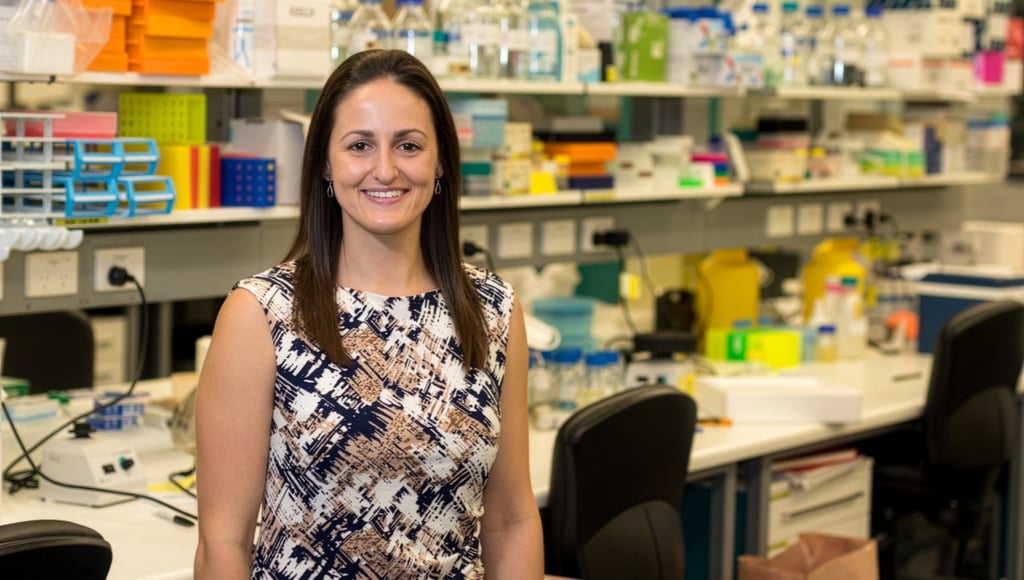
“We know there’s a connection between the lungs and the gut. But we don't know how it works," she explained.
“Do the lungs signal to the gut or the other way around? Once we nail that mechanism down, we can then develop targeted therapies.”
At the heart of this connection, and the main focus of Dr Donovan’s research, are a type of messenger in human cells called fatty acids.
These messengers are signalled through fatty acid receptors in cells that control hormones, metabolism, appetite, immune response and inflammation in the human body.
“Most people think of fatty acids as things you eat in a high-fat diet. But fatty acid receptors aren’t just in the gut, where you'd expect them to be. They're also in the lungs and are involved in different immune cells that circulate through our body,” she said.
“We’re still learning what they’re doing in these places. I want to find out how we can modulate these receptors and work out these pathways. Then we can do something with them."
We need an integrated system to explore the interaction between the lungs and the gut properly.
“Hopefully once we do this, we can either prevent asthma from developing in the first place or reverse it once it has been established.”
While Dr Donovan sees therapeutics that target these pathways may be a decade or more away, she believes the fellowship will help speed the path.
“This fellowship will allow me to do a lot more work with human clinical samples and bring out discovery work with clinical samples to accelerate that pathway. It buys me time and helps to do things faster,” she explains.
Taking scientific discoveries such as this and turning them into life-changing interventions is one of the main aims of the Rebecca L. Cooper Medical Research Foundation.
“This research is very blue sky. If it's proven to be true, it could revolutionise the treatment for asthma. It certainly has the potential to open up a whole new field of discovery treatments and hopefully translation into improved outcomes for people living with asthma,” said Professor Graeme Polglase, one of the directors of the foundation.
Dr Donovan is the third UTS recipient of an Al and Val Rosenstrauss Fellowship, with Dr Jiao Jiao Li and Dr Gang Liu both receiving funding in 2024 to pursue their groundbreaking medical research and are among the more than 20 recipients of the fellowship nationwide.
Translating discovery research into treatments that improve the lives of asthma sufferers is what drives Dr Donovan.
“I have a lot of family and friends living with asthma. It's hard watching them struggle even though we've come a long way with treatments. I remember back in my childhood riding in ambulances with my brother,” she said.
“The ultimate cure for asthma is to prevent it from happening in the first place. We know where many of these interventions need to start, for example, babies who are born with small lungs have a higher risk of wheeze, asthma and lung diseases later in life.”
“I’d love to see a future where early treatments, based on this research, promotes a lifetime of lung health for these high-risk children.”
Researcher
Associate Professor, Faculty of Science
News by topic
News
Million-dollar talents tackle debilitating diseases
Two next-generation UTS biomedical researchers, Dr Jiao Jiao Li and Dr Gang Liu, have each been awarded $1 million in philanthropic funding for cutting-edge...

News
Vitamin C may protect against air pollution
Vitamin C may have the potential to protect people against lung disease caused by traffic-related air pollution, bushfires and dust storms.

News
Asbestos has been found in children’s coloured sand. What’s the risk to kids?
Multiple schools and early learning centres in the Australian Capital Territory have shut on Friday after asbestos was found in coloured sand used for...
News
Australia leads the world in stuttering research, now digital innovation is reshaping stuttering care
The Australian Stuttering Research Centre at UTS marks 30 years of world-leading research.
News
Million-dollar talents tackle debilitating diseases
Two next-generation UTS biomedical researchers, Dr Jiao Jiao Li and Dr Gang Liu, have each been awarded $1 million in philanthropic funding for cutting-edge...
News
Vitamin C may protect against air pollution
Vitamin C may have the potential to protect people against lung disease caused by traffic-related air pollution, bushfires and dust storms.
News
Asbestos has been found in children’s coloured sand. What’s the risk to kids?
Multiple schools and early learning centres in the Australian Capital Territory have shut on Friday after asbestos was found in coloured sand used for...
News
Australia leads the world in stuttering research, now digital innovation is reshaping stuttering care
The Australian Stuttering Research Centre at UTS marks 30 years of world-leading research.