


- Posted on 25 Nov 2025
- 2-minute read
A little black box that turns light into sound is helping school students grasp the concept that light can behave as a particle as well as a wave.
UTS researchers in the ARC Centre of Excellence for Transformative Meta-Optical Systems (TMOS) are typically working to uncover the applications of light at the nanoscale, but it’s been back to basics for a collaboration over the past month with Australia’s national science and technology centre, Questacon.
An unassuming black box called the photon clicker has been put into the hands of more than 4000 year 5-10 students from 51 schools as part of Questacon’s Governor-General’s Design Challenge 2025, a nationwide project supported and introduced by Governor-General Sam Mostyn.
This year’s challenge celebrates the Year of Quantum Science and Technology by turning students into “photon detectives” in the classroom, using a tool that works like a Geiger counter for detecting the tiny particles of light we call photons.

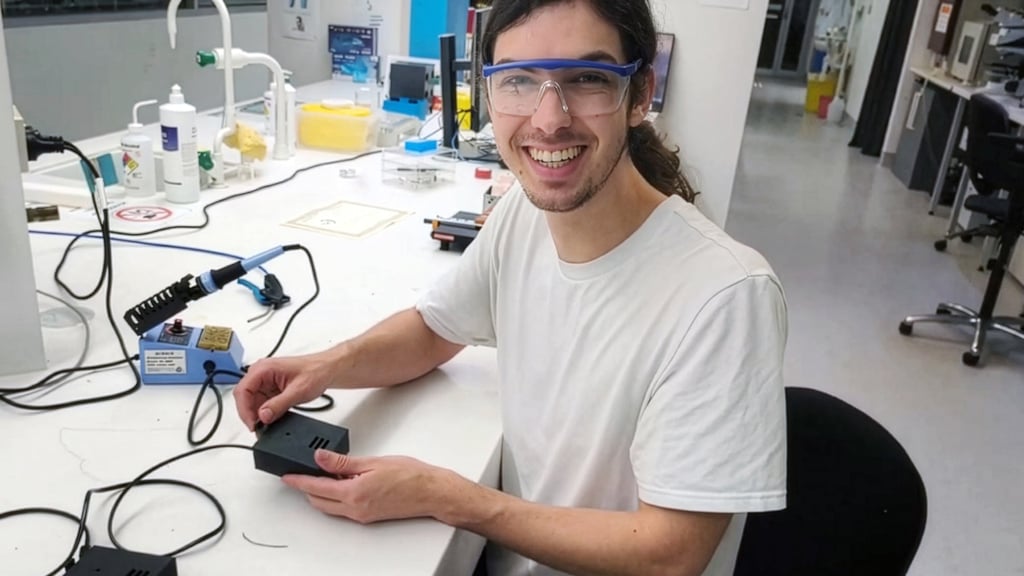
The photon clicker was developed over the past year by a UTS graduate student team, Benjamin Whitefield and Sergei Nedic under the supervision of Professor Igor Aharonovich.
The device converts light into sound – the more light that hits the sensor the faster the stream of audible clicks it emits.
The UTS TMOS team then had to work like a commercial assembly line to produce the number of photon clickers needed for design challenge participants, who are using them to work out the right amount of light needed for various designs, such as indoor plant systems.
“In most school lessons, students first learn about light as a wave, exploring concepts such as colour, refraction and diffraction,” Professor Aharonovich said.
“Quantum mechanics teaches students that reality isn’t always what it seems – a single photon can behave like both a wave and a particle at the same time. But how to demonstrate that?
“The idea that light can also act like a particle usually comes much later, and this sudden shift in understanding can be confusing without a hands-on example.
“Quantum education with light helps spark curiosity early, showing young people that the universe is far stranger, and far more inspiring, than it first appears.
“By exploring how photons bounce, and blink, students can experience quantum ideas not as equations, but as something they can see and play with.
“The photon clicker bridges this gap, giving students an intuitive and interactive way to experience how light can be thought of as both a wave and a particle.
“With the current cutting-edge technologies like quantum computing relying on the particle nature of light it’s important to have a strong foundation in the physics behind light.”
Aside from the Questacon collaboration, TMOS partners, UTS, the University of Melbourne and University of Western Australia, have been running a pilot outreach program this year for rural public schools in South Australia and Western Australia, where students not only get visit from a university team, but also have the chance to apply their new knowledge to a project that deepens their understanding of basic science principles.