


- Posted on 10 Oct 2025
Distinguished Professor Larissa Behrendt AO’s speech at the Mudgin-Gal Yarns launch on 8 October 2025. Published with permission.
I want to begin by acknowledging the Gadigal people of the Eora Nation — the Traditional Owners of the land we meet on. I pay my respects to Elders past and present. This is, and always will be, Aboriginal land.
And that truth matters deeply when we talk about safety, about healing, and about voice — because we can’t talk about domestic and family violence in our communities without acknowledging the violence of colonisation that continues to shape our lives.
Today is about voice. It’s about Aboriginal women telling our own stories — in our own words, in our own way — and being heard.
The Mudgin-Gal Yarns and this podcast series, Aboriginal Women’s Voices – There’s Power in That, came out of that simple but radical idea: that Aboriginal women don’t need to be spoken for — we just need to be listened to.
This project began when Ashlee Donohue and Jane Wangmann met after a webinar. Out of that conversation came a vision: to work together on something that would strengthen Mudgin-Gal’s ability to tell its own story — to build an evidence base rooted in women’s experiences, not in bureaucracy.
It’s important to remember that Mudgin-Gal had been doing this work — life-saving, award-winning work — for decades, without any dedicated funding for domestic and family violence. That’s how it so often is for Aboriginal women’s organisations: doing the hard work, the frontline work, long before the funding ever shows up.
Ashlee and Jane took their time. They worked slowly, carefully, and respectfully — on Country, with the Board, guided by cultural protocols and Indigenous methodologies.
They held four yarning circles here at Mudgin-Gal — creating a safe space for Aboriginal women from their twenties to their sixties to talk about their experiences of the service system, what had helped, what had harmed, and what real change would look like.
The final yarn was a feedback session — a chance for the women to see the themes emerging from their own voices, to guide what would happen next. And it was there that the idea for this podcast was born.
As Donna said in that final yarn, “Our voices need to be amplified.” And Ashlee added, “There’s power in that.”
The women spoke with a depth of honesty and courage that should stop all of us in our tracks.
They talked about the nature of violence — not just physical, but coercive control, financial control, emotional abuse — the quiet, constant ways that violence takes hold.
They spoke of grief that never really ends, and the lifelong work of healing.
They spoke of racism in every part of the system — from police to housing to child protection — and of being judged, ignored, or treated as if they were the problem.
And they spoke of resilience. Of aunties and sisters who step in. Of art as therapy, of laughter, of “accidental counselling” that happens when women paint together and talk.
None of these issues are new — and that, in itself, is the problem. These are things Aboriginal women have been saying for decades.
So the question isn’t what don’t we know — it’s why haven’t we listened?
That’s why Mudgin-Gal is so vital. For more than 30 years, it’s been the heart of this community — a safe place for women and families, run by Aboriginal women, for Aboriginal women.
It’s a space where you can just drop in — no judgment, no criteria, no red tape. A space where you can have a cup of tea, wash your clothes, or just sit quietly and feel safe.
And through that ordinary, everyday care, something extraordinary happens: healing. Connection. Dignity.
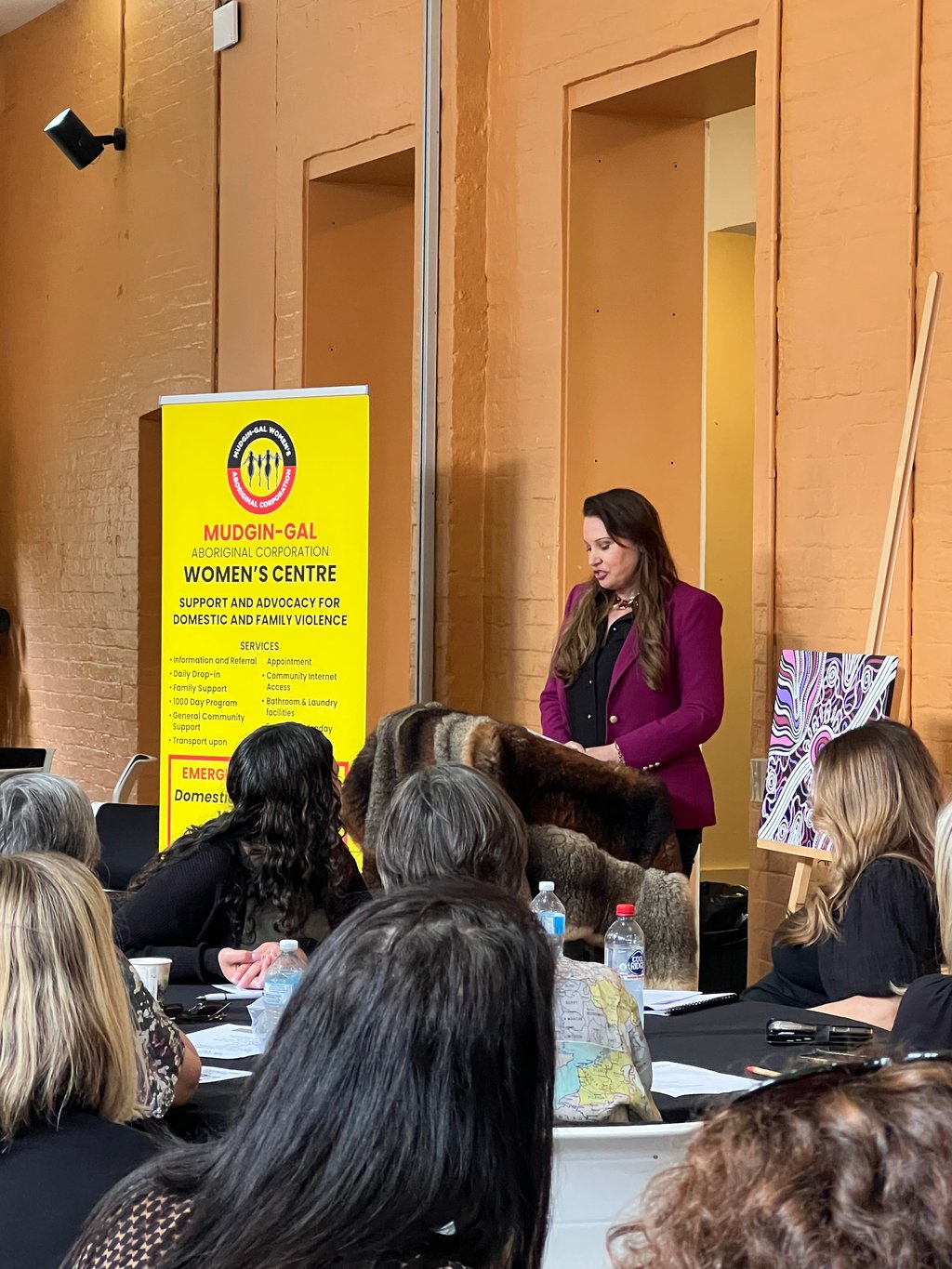
The women in the yarns described Mudgin-Gal as a place where they feel wanted, welcomed, and understood. And that feeling, in a world that so often devalues Black women’s lives, is revolutionary.
And still — despite all of that, Mudgin-Gal has had to fight for every dollar. That is not acceptable. This work is not a luxury. It is essential.
Out of those yarns came this beautiful collaboration with UTS Impact Studios.
Five podcast episodes — three drawn directly from the yarns, one walking listeners through Mudgin-Gal, and one conversation with Ashlee and Jane about the making of the project — hosted by yours truly.
The theme music, Intertwined by Nardi Simpson and The Stiff Gins, and Vicky Golding’s artwork Women’s Journey, give this work its emotional and cultural heartbeat.
This isn’t a slick media exercise — it’s storytelling with purpose.
It’s Aboriginal women leading the national conversation on violence, healing, and reform — and doing it with creativity, power, and truth.
And at the centre of it all is Ashlee — whose own journey embodies courage, wisdom, and the kind of leadership that transforms pain into power.
Ashlee’s vision — to give women space to speak, to listen deeply, and to tell our truths in our own voices — is what made this possible.
She shows what happens when Aboriginal women lead: we create not just data, but change; not just policy evidence, but community empowerment.
For me, as a storyteller, it’s an enormous privilege to help launch this series.
Every day, in my work as a writer and filmmaker, I see how stories can shift the way people see the world — and this project reminds me why that matters.
These are not stories told about Aboriginal women; they are stories by Aboriginal women, told with strength, humour, heartbreak and hope.
It’s been an honour to launch this podcast series as it brings these important voices to a wider audience, making sure those voices are not just heard, but respected.
What these yarns remind us is that voice is power — but only if someone is listening.
These podcasts are not just stories; they’re a call to action.
They ask government, policymakers, and services to do more than nod sympathetically — they ask for commitment, accountability, and change.
They remind us that healing takes time, that justice takes courage, and that listening is not passive — it’s an act of solidarity.
One of the most devastating impacts of domestic and family violence is silence.
Violence isolates. It shames. It convinces women that their voices don’t matter — that speaking out will make things worse, or that no one will listen anyway.
That’s why this podcast series is so powerful. It gives voice back to women who have been silenced — not through pity or framing them as victims, but by letting them speak in their own words, on their own terms.
Listening to these stories isn’t just moving — it’s an act of justice. It restores agency, dignity and the truth that Aboriginal women have always had the wisdom and strength to deWine their own narratives.
So today, as we celebrate this incredible achievement, let’s make a promise: that we won’t just hear these voices — we’ll listen.
And then we’ll act.
Because, as Ashlee said so powerfully —
“There’s power in Aboriginal women’s voices.”
And today, we honour that power.
Laureate Fellow, Provost