


- Posted on 10 Sep 2025
- 5 minutes read
Understanding education as a fundamental human right imposes a moral responsibility on universities to ensure it is accessible to all. We are not just institutions of knowledge transmission; we are public service providers.
This framing demands we design systems that serve students and communities equitably, dismantling both historical and structural barriers.
Right now, there is more focus on equity and access in the Australian higher education sector than ever before. Yet across both access and success, the sector is falling short for many of the students it claims to serve. Since the Bradley Review in 2008 (Bradley et al., 2008) and the introduction of Higher Education Participation and Partnerships Program (HEPPP) funding, universities have made progress in expanding participation from underrepresented groups (Department of Education, n.d.). However, class inequalities, cultural exclusions, and institutional inertia remain deeply embedded in the system.
Universities continue to operate within traditions shaped by patriarchy, class hierarchy, and colonialism.
These legacies are evident not only in policies, but also in the rhythms, routines, and norms of academic life. The subtle and often invisible architecture of exclusion, signalling who belongs and who thrives, can be as powerful as financial or structural barriers. If we are serious about equity, we must be prepared to confront these institutional norms and examine our own practices.
Addressing inequity requires more than targeted programs or outreach. It calls for a critical rethinking of how institutions are structured, funded, and governed. The transformation needed must extend to the very culture and operations that define the student experience. Without this, Australian higher education will fall short of the national equity goals set out in the Universities Accord Final Report (Department of Education, 2024). The Accord rightly sets an ambitious target: achieving population parity for underrepresented groups by 2050. But this goal will not be achieved under current policy and system settings. For example, to achieve parity in low socio-economic status (SES) participation alone, we would need to more than double the number of low SES students entering and completing university. The current model, which leans heavily on narrow admissions pathways and fragmented support systems, is not built to deliver that scale of transformation.
Incremental changes will not suffice. A full system overhaul is required. This includes:
- diversifying entry pathways beyond reliance on ATAR
- embedding equity outcomes into student success frameworks, not just access metrics
- resourcing institution-wide equity infrastructure
- prioritising needs-based and place-based funding approaches.
Equity must become part of the institutional core. It cannot remain an add-on or be treated as the responsibility of isolated units.
The bigger challenge is not just adding more students to classrooms. It is about reimagining the academic and cultural environment they enter. Today’s students face a complexity of challenges rarely acknowledged a decade ago. These include escalating mental health concerns, financial insecurity, rising disclosures of neurodiversity, caregiving responsibilities, and academic environments that still alienate through unspoken cultural codes. These are not marginal issues. They are increasingly the norm.
To meet our equity targets, universities must be truly prepared to support the students they claim to welcome. At the University of Technology Sydney (UTS), we are striving to model a different approach. We have embedded social justice into our institutional strategy and, critically, we have resourced it (UTS Centre for Social Justice and Inclusion, 2024).
The Centre for Social Justice and Inclusion (CSJI) at UTS is one of the few remaining centralised and fully funded equity hubs in Australia. CSJI does far more than run programs. It influences institutional policy, supports staff development, advocates for students, and drives operational and cultural change across the university. It integrates student equity, diversity and inclusion, community engagement, and thought leadership into a cohesive and connected ecosystem.
And it helps UTS deliver results:
- Our low SES student success rate stands at 90%, well above the national average of 82.45%.
- The U@Uni Academy supported over 389 students in 2024, achieving an 82.6% success rate (UTS CSJI, 2024).
- The UTS Pathways Plan, launched in 2025, will offer non-ATAR entry routes to broaden access (UTS, 2025).
- Programs such as the Pasifika Program, Humanitarian Scholarships, and projects for LGBTIQA+ inclusion embed equity across the university experience (UTS CSJI, 2024).
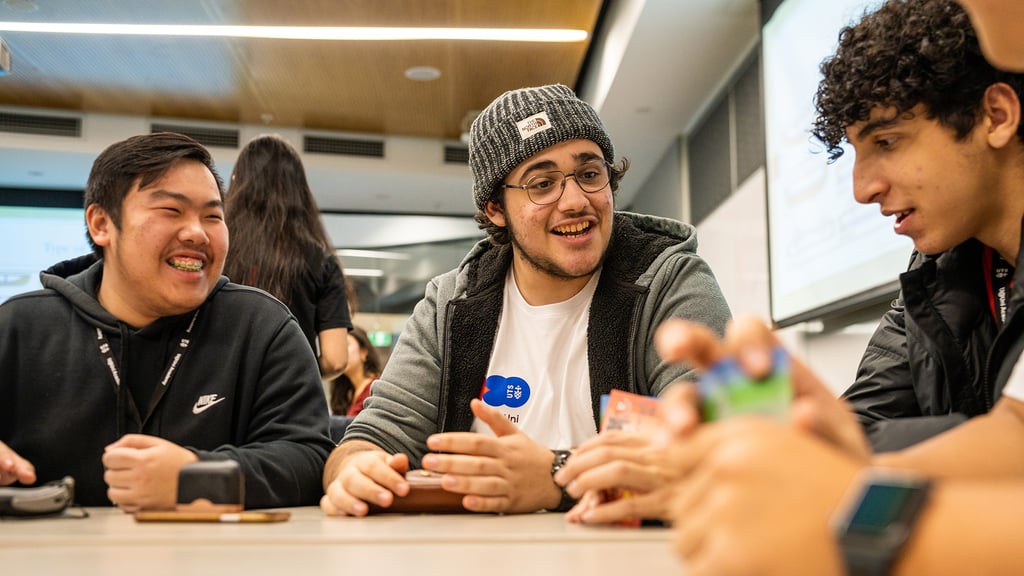
These are not generic or transactional initiatives. They are co-designed, relational, and deeply informed by dialogue, lived experience, and reciprocal learning. They are made possible by a diverse team, and by an institutional commitment to equity as a foundational principle which is supported by the faculties and divisions we work in partnership with.
We are not claiming to have all the answers. UTS continues to listen, learn, and evolve. But we are unwavering in our belief that equity and excellence go hand in hand. We are building systems that elevate the voices and leadership of historically marginalised communities and give them real power to influence change.
Institutional commitment, however, is not enough. Needs-based funding, as recommended by the Accord, is critical to sustaining and scaling effective equity practice (Department of Education, 2024). Without strategic and targeted investment, even the most committed institutions will struggle to achieve lasting change. Inclusion must be viewed as a core measure of institutional performance, not as a compliance task.
Needs-based funding, as recommended by the Accord, is critical to sustaining and scaling effective equity practice (Department of Education, 2024).
We (universities) must also roll up our sleeves and lean into the challenge of a more integrated tertiary system. We must do the hard work to help design a system with the student at the heart, creating and supporting more seamless transitions and options for a more diverse student cohort. This should involve more active support for the incredible work done by our colleagues in TAFE, working collaboratively to boost the perception of vocational education and training as delivering excellence on par with the university system. They are different experiences, but the notion that one is somehow 'better' than the other needs to fade into a past that is no longer relevant.
The Universities Accord provides a rare and urgent opportunity to go beyond incremental reform. It invites us to reimagine higher education.
The future will not belong to those who stay comfortable. It will belong to those bold enough to lead with equity at the centre.
This article was originally published in 'Equity Insights 2025: Policy, power, and practice for a fairer Australian tertiary education system'.
References
- Australian Government, Department of Education. (2024). Australian Universities Accord – Final Report. https://www.education. gov.au/australian-universities-accord/ resources/australian-universities-accordfinal-report.
- Bradley, D., Noonan, P., Nugent, H., & Scales, B. (2008). Review of Australian higher education: Final report. Department of Education, Employment and Workplace Relations.
- Centre for Social Justice and Inclusion. (2024). Equity initiatives and success data. University of Technology Sydney.
- Department of Education. (n.d.). Higher Education Participation and Partnerships Program (HEPPP). https://www.education.gov.au/heppp.
- University of Technology Sydney. (2025). UTS Pathways Plan. UTS Internal Publication.
Discover more
Read 'Equity Insights 2025: Policy, power, and practice for a fairer Australian tertiary education system'.
Author/s

Pro Vice-Chancellor (Social Justice And Inclusion), Provost

Head Of Equity Pathways, Deputy Vice-Chancellor (Education and Students)

News
Beyond the ATAR: Building a unified, strengths-based admissions system for a harmonised tertiary sector
Across Australia, more than 60 per cent of undergraduates enter university through non-ATAR pathways. These routes have become the norm, rather than the...

News
“It gave me hope in life.”
For Mohammad Sakhvidi, a civil engineering UTS graduate, the UTS Humanitarian Scholarship became both a launchpad to success and an opportunity to give back.

News
Recording: Student equity post-election
As the dust settles post-election, and with potential policy shifts on the horizon, how do higher education practitioners ensure that student equity remains...

News
Seen, heard and supported
The distance between Sydney’s western suburbs and metropolitan universities in the heart of the city isn’t just measured in train stops. It’s also felt in...
News
Beyond the ATAR: Building a unified, strengths-based admissions system for a harmonised tertiary sector
Across Australia, more than 60 per cent of undergraduates enter university through non-ATAR pathways. These routes have become the norm, rather than the...
News
“It gave me hope in life.”
For Mohammad Sakhvidi, a civil engineering UTS graduate, the UTS Humanitarian Scholarship became both a launchpad to success and an opportunity to give back.
News
Recording: Student equity post-election
As the dust settles post-election, and with potential policy shifts on the horizon, how do higher education practitioners ensure that student equity remains...
News
Seen, heard and supported
The distance between Sydney’s western suburbs and metropolitan universities in the heart of the city isn’t just measured in train stops. It’s also felt in...