Held on Thursday 14 August at UTS.

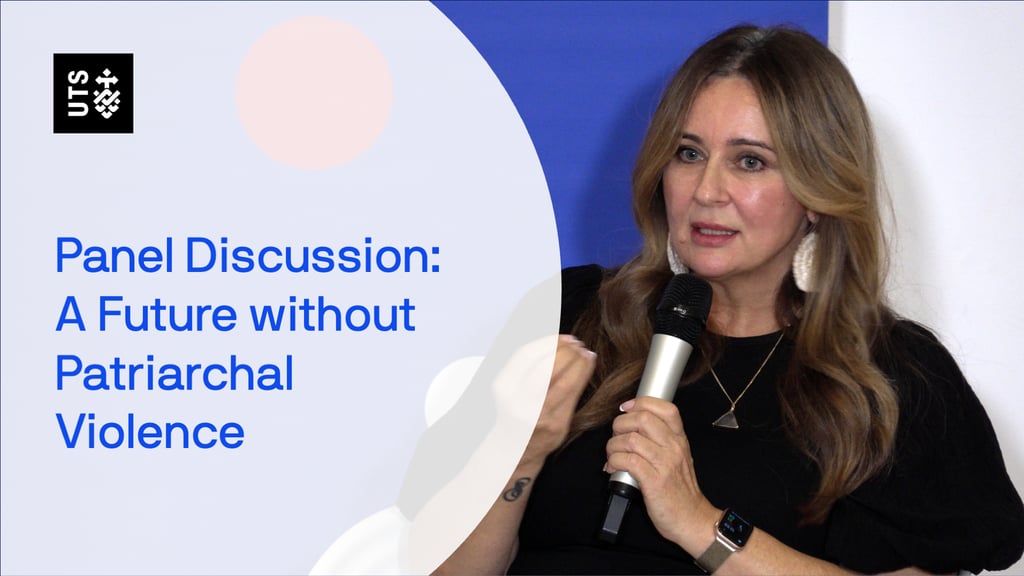
In this session, Dr Anne Summers AO, Jess Hill and Ashlee Donohue joined Annabelle Daniel OAM for a powerful conversation exploring what a future without patriarchal violence could look like, the economic inequalities tied to gendered violence, and the ongoing research and policy efforts aimed at creating meaningful change.

This event was hosted by UTS Gallery and Art Collection in partnership with the UTS Business School, UTS Centre for Social Justice and Inclusion, Jesse Street National Women's Library, UTS Library, UTS Media Lab, and Creative Australia.

This discussion formed part of a suite of public programs to support Zanny Begg’s Elsie (and Minnie) exhibition.
Decorative.
(01:09:38)

If you are interested in hearing about future events, please contact events.socialjustice@uts.edu.au.

Hello, everyone.

I'm Alice Rizende. I'm the assistant curator at UTS Gallery in our collection. Thank

you all for coming.

I would like to acknowledge the Gadigal people of the Eora Nation upon whose

ancestral lands our city campus now stands. I would also like to pay respect to the

elders both past and present, acknowledging them as the traditional custodians of

knowledge for this land. I would further like to acknowledge the traditional

custodians of the various ancestral lands from which our attendees join us today and

to pay respects to those elders past and present. I warmly welcome all First Nations

people who have joined us in person and on Zoom today.

UTS Gallery would like to thank our exhibition partners UTS Business School and UTS

Centre for Social Justice and Inclusion, Jesse Street National Women's Library, UTS

Library, UTS Media Lab and Creative Australia.

Your support for Zanny Begg's exhibition, Elsie (and Minnie) has enabled us to be gathered

here today for this important discussion.

Elsie (and Minnie) is a UTS Gallery Commission exhibition of new screenworks by

the artist Zanny Begg that reflect on the origins of the women's refuge movement in

Australia and the ongoing crisis of gender violence today. The exhibition is on show

at the gallery until September 5 with an archival satellite display also showing at

UTS Library. This talk today forms part of a suite of public programs around the

exhibition.

I'd like to extend a final thank you to Zanny Begg for offering the provocation for

today's program and to our extraordinary panellists for generously giving their time.

Ashlee Donohue, CEO, Mudgin-Gal Aboriginal Corporation, Jess Hill,

Industry Professor, and Dr. Anne Summers, Professor of Domestic and Family Violence,

UTS Business School.

I will now hand over to our moderator Annabelle Daniel, CEO, Women's Community Shelters.


And a huge thank you to Alice and the UTS team for their preparations for today. I

would also like to acknowledge the traditional custodians of the land and pay my

respects to elders past and present. I'd also like to acknowledge the huge and

ongoing work of Aboriginal women in their contribution to violence prevention and also

to note that Aboriginal women are more likely to experience domestic and family

violence and serious impacts, more likely to die in domestic homicides, more likely

to be hospitalised. And we also know that they're more likely to be at risk of

homelessness as a result of the combined impacts of violence and colonisation. So

that's an important framing of the discussion that we're having today. And I would

also like to introduce our panellists a little bit further. So, we have Ashlee Donohue,

a courageous, [APPLAUSE]

We also have just a few more notes on Ashlee because she is extraordinary.

Born and raised in Kempsey, New South Wales, her journey from surviving a 14-year

abusive relationship to becoming a leading voice against domestic and family violence

is nothing short of inspiring. Her memoir, Because I Love Him, Ashley uses her pain

to spark change and foster hope for others. She's also created, co-created HACIS,

We've Got Your Back, the only Aboriginal Women's Sexual Assault Network in Australia

and has developed education programs for the NRL and Country Rugby League Domestic

Violence Programs. She holds a Masters of Education from UTS, earned the UTS Human

Rights Reconciliation Award and was selected as a Roberta Sykes Scholar at the

Harvard Kennedy School. She sits on the City of Sydney's Aboriginal and Torres Strait

Islander advisory panel and DV New South Wales's Aboriginal Advisory Committee.

She's a frequent media commentator, appearing on ABC's The Drum, NITV/SBS, and

speaking at the UN Commission on the Status of Women. Please join with me in

welcoming Ashlee again.

Jess Hill. Jess is a journalist, author and speaker who focuses primarily on social

issues and gendered violence. She started her career as a producer for ABC Radio,

went on to become a Middle East correspondent for the Global Mail, and then an

investigative journalist for background briefing. Her Supporting has won two Walkley

Awards, not one, but two, (laughs), an Amnesty International Award and three Our Watch

Awards. Her first book, See What You Made Me Do, on the phenomenon of domestic

abuse and coercive control was released in 2019 and was awarded the 2020 Stellar

Prize. In 2021, it was adapted into a series on SBS. Her projects include a podcast

series on coercive control, and patriarchy called The Trap. A quarterly essay on how

Me Too has changed Australia, titled The Reckoning, and another quarterly essay in

2025 entitled Losing It, which has sparked debate about the prevention of violence in

Australia. She's spoken at hundreds of public events about coercive control and

regularly conducts training and education for groups as diverse as magistrates, high

school students, workplaces, and local councils. She is also an Industry Professor at

the UTS Business School. Please welcome my colleague, Jess.

And last but by no means least, Dr Anne Summers AO is a journalist, commentator,

and best-selling author of nine books, including the classic Damned Whores and God's

Police, first published in 1975 and still in print.

Her most recent book Unfettered and Alive a Memoir was published in 2018, and was

recently appointed Professor of Domestic and Family Violence in the School of Business

at UTS Sydney. She has been awarded funding by the Paul Ramsey Foundation and UTS

continue her innovative, data-based research into domestic violence in Australia. Her

recent report, The Choice, Violence or Poverty 2022, used previously unpublished ABS

data to reveal the far greater prevalence of domestic violence than was previously

known, and especially the shockingly high incidence among women who have become single

mothers as a result. The report argued that the federal government is responsible for

policy-induced poverty. That is the fate of more than 50 per cent of single mothers

who are forced to rely on government benefits as their sole income. Previously, Anne

has advised Prime Minister Bob Hawke and Paul Keating, run the Office for the Status

of Women, been Canberra Bureau Chief for the Australian Financial Review newspaper,

editor-in-chief of Australia's leading feminist magazine Ms, editor of Good Weekend,

chair of the Board of Greenpeace International and a trustee of the Powerhouse. She

has been an activist in the women's movement since its inception in 1974 and was

involved in establishing Elsie Women's Refuge, the first modern shelter for women and

children escaping domestic violence. She was appointed an officer of the Order of

Australia for her services to journalism and to women in 1989, had her image on a

postage stamp as an Australian legend in 2011 and in 2017 was inducted into the

Australian Media Hall of Fame. Please join with me in welcoming Dr Anne Summers.

And for those who might not know me I'm just a fan girl that gets to moderate.

So, we have set ourselves an ambitious topic to talk about today. So, the title of

this panel is 'A Future Without Patriarchal Violence'. Full stop.

It's not phrased as a question, interestingly. So, I'm going to assume that we must

all have some hope that it is in some way achievable.

The other thing that I will note is that we've named a word that we're not using

all that often in public discourse at the moment, patriarchal. Books like Angela

Saini's The Patriarchs highlight that patriarchy isn't the inevitable social structure

and Australia prior to colonisation was more gender equal. So today we're asking not

only how do we respond to patriarchal violence, but whether we can ask and imagine

a future that rejects patriarchal systems entirely. What would it mean to truly build

safety, sovereignty and self-determination into the core of how we address violence?

And on that note, I'll come to you, Ashley. Could you talk about how Aboriginal

women's power, could you talk about Aboriginal women's power and what we can learn

from history, especially about Aboriginal lead community safety spaces?

Yes, we can Hello, everyone. I am Ashlee Donohue. That was a wonderful introduction

to me and everybody else and I am a proud Dunghutti woman born and raised in

Kempsey and because of that I too will acknowledge the land we meet on today, the

Gadigal people of the Eora Nation, pay my respect to elders past and present, and

also reiterate that sovereignty was never ceded. This was and always will be

Aboriginal land.

When we talk about Aboriginal women and power, I've took notes, you know, because

these questions are questions that just come off the top of my head. And as I'm

doing right now, if I don't stay focused, I will go off on my own little So, I'm

going to read from notes. So as I said, when we talk about Aboriginal women's

power, we're talking about something that existed long before colonisation, a power

grounded in connection to country, community and culture. Before invasion, many of our

nations had governance systems that were not built on patriarchy. Women held decision

-making authority, managed resources, carried or LORE and were protected as a family

and land. Men and women had different but equally valued roles and those roles were

underpinned by respect and reciprocity, I can never say that word right.

Colonisation disrupted that balance and imposed patriarchal systems that have harmed

our communities ever since. But that original balance has not gone. We see it in

the way Aboriginal women continue to lead today, creating safety and healing spaces

where no one else will. Aboriginal -led community safe spaces where the women's centre

is like Majingal, the one where I'm CEO, healing circles or culturally safe crisis

responses are built on the principle that our women know what works for our women.

They center relationships, trust, and cultural authority. You know that the saying

that is thrown around now we are all the experts on our own life. That seems to

only be for all other women except Aboriginal women because in this space all

decisions are made for us. We are left out of tables, we are left out of all the

things or there's only one person speaking. You know, who can name an Aboriginal

person that sits at the top of something in this space. And yet everything around,

see I'm going off tangent,

power and history disempowers our women. And so we have to have these honest

conversations. If we're going to say that we're truth -tellers then we have to tell

the whole truth.

You know the power was taken from Aboriginal people during colonisation and people

say I'll get over it, get over this, but I'll tell you a little story about

myself. My mother was 15 years old and sent to Sydney to clean houses. She got

pregnant with me at 16. She was booked into Crown Street Hospital. She was told to

get back home because they were still taking babies off their children then. When I

was born in Kempsey District Hospital on the 31st of December 1968, after giving

birth to me, my mother was put in what they called the veranda ward, which was

exactly that of verandah with green mesh around it, but I was put in the nursery.

So the disengagement right there, the power from my mother was taken for being a

mother in that very instance. So when we talk about power and disempowering

Aboriginal women, we've got to start there. It's not just in the violent space, it's

in all the spaces. And we have to be clear on that. Thanks Ashley.


And Jess, we know that there are other examples of cultures where gender justice has been a

more prevalent underpinning. Can you talk to us about some of those you've come

across in your research? Yeah, sure. And like Ashley, I just want to acknowledge the

elders here who have for millennia really set that example.

And I think when you look at the way that we respond to domestic family and sexual

violence here in Australia compared to, say, the UK, I think that influence from

Aboriginal women particularly is so strong that we actually, we tend,

even though systems also continue to tend more towards punishment, the whole narrative

around restoration and healing is so much more prevalent here and I think that is

almost entirely due to the influence of Aboriginal women, particularly around men,

which has always been a vexed issue for feminists, and it's always been a bit of a

crowbar of separation between Aboriginal women and non -Aboriginal women in this space.

Before I go to that question, I just wanted to maybe set a bit of a framing

statement, and that is that, you know, patriarchy didn't create violence.

There was sexual violence. There's been sexual violence in societies for many

millennia, including societies that have more egalitarian and care -based cultures.

So I think when we talk about a world without patriarchal violence, we're not saying

a world in which violence does not occur at all. We're talking about a very

particular form of violence coming to an end. And that is a harm that comes from

and reinforces the systems that privilege men, whiteness,

heteronormativity, adults over children. And I think really when you talk to victim

survivors, you're talking to people who've experienced either an incident or an entire

lifetime or a course of conduct that's been harmful.

Often what they will say is the secondary harm that was done to them by their

communities or by their families or by the institutions that betrayed them can be

worse. So that secondary harm, that is something that is absolutely in our power to

end. We can't stop every person from using violence. We can stop them from using

violence within punitive and we can decide who gets believed,

who gets supported. That's what an end -to -page for me. That's how I sort of

conceive of an end -to -patriarchal violence I'm sure other two panellists and

Annabelle will have things to add to that So but Annabelle's question instead of

just reframing it because like a journalist I'm just like yes nice question, but

I'll answer the question. I'd like to answer it for me Even though I actually asked

her to ask me that question Unbelievable see what I have to deal with Yes, luckily

we're good friends. Anyway, but yes, we know such societies have existed.

We know, as Ashley just outlined, that such societies existed here in Australia, and

this is where we actually can draw a lot of inspiration for where we could return

to, or in that Hegelian way, sort of reimagine, bring these two worlds together. But

I think what was really interesting to me early in my research was that early

suffragists in the US, they were able to actually imagine what a world without the

rigidity of patriarchy, what that world could look like, because they looked to the

Haudenosaunee, how do you say it, Haudenosaunee, also known as the Iroquois, the

local Native American population on the east Coast of America. And there was that

egalitarian culture. The clan mothers would appoint and remove chiefs. They held veto

power. They governed by consensus. And the authority of women was embedded in the

law, in land ownership, in community welfare. That was evident before the colonization

of the United States. And you had these early suffragists, Elizabeth Cady Stanton and

Matilda Gage, who looked at that and said, "Well, we don't have the right to vote.

We don't have property rights. We are absolutely under the yoke of male power,

but we look across to the women in this other society who have obviously also been

colonised into the state of patriarchy now, but in these pre-contact documents that

had been made by this society, they could see what had pre -existed. And I think,

just to quote Elizabeth Stanton, she said, "The position of women among the Iroquois

is a proof that the rights of women have been violated not because of her nature,

but because of the circumstances of civilisation. Among the Iroquois, women owned the

lands, chose the chiefs, and had the power to depose them. their position was the

foundation of the government. So those examples, they really grounded those early

feminist critiques. And I think that's why we don't need to be unrealistic about

what we imagine, but we need to be able to see, like you need to be able to see

what you want a dream to be in a way, you know, to be completely pat. And I

think those pre -colonised societies show us that this is possible.

What we don't know is how to undo patriarchy once it's already embedded.

Really powerful reflections there. How could we walk it back if we were to want to?

I'm going to take us a little bit of a fast forward now to a very singular and

important event that is actually the subject of the exhibition of which this panel

as a part and talk about how in 1974 a group of women squatted in a vacant

property in Glebe to create the first women's refuge in Australia, Elsie. This wasn't

just a crisis response. It was a radical act. Women created a space outside of

patriarchal structures based on principles like self -help, collective management, and

political activism. Aboriginal women were also integral to Elsie and were also leading

parallel initiatives in their own communities at the same and similar times. And I'd

like us to talk a little bit about what's happened in the past and what stayed the

same. And so to you, Anne, can you reflect on the origins of this movement and the

feminist principles that it was built on and perhaps then moving on to how still

shows up in in the work today or doesn't in your view?

No, sorry about that.

I'll certainly try to answer that, but just before I do, I'd just like to make a

brief comment on Jeff's comments about patriarchy and in thinking about this I mean these the questions that Annabelle has

prepared are all very challenging I think and have forced I think we've all agreed

that it forced us to when we got them we thought I had to go later and

couldn't just look at them later to actually do some work and think about it which

is - Oops, sorry about that folks. - No, no, this is good. I mean, we need to be

pushing ourselves because we do tend to be saying the same things over and over and

that's not getting us very far. But, you know, in trying to think about what

patriarchy means, you know, there are many ways to define it, many ways to look at

it, but I decided the way that I want to look at it and that kind of reflects

the sort of research that I've been doing over the past few years and that is

economic research is that patriarchy really is all about money and people who have

money and all people who don't have money are victims of patriarchy.

People who have money are, if you like, it's custodian and it's implementers and

when you think back, I was struck or mention of the suffragettes, Jess, because when

you think back to the way in which the vote was given, not so much in Australia,

but in other countries, that the vote first of all went to men of property, and

then working -class men of property, and then women of property. But it took a long

time before the vote went to people who had nothing. And so patriarchy and politics,

or patriarchy or patriarchal former politics was very integrally intertwined with the

notion of power emanating from money. And when we come a bit later on to talk

about some of the research I've been doing lately, it is all about money and the

use of money and the abuse of money and how women who don't have money are the

most vulnerable people in this society. - Thank you. But to get back to Elsie, it's

sort of interesting, I think, about some of the myths that have grown up about Elsie,

and it's kind of now seen as a feminist paradise from day one, and they sort of golden gates of Elsie you walk through and everything was solved.

This wasn't quite true. Having set up a refuge or two I believe you, Anne.

But the whole question about whether or not, you asked whether or not, it was set

up on feminist principles.

Sort of the irony in that is that at the time, this is in 1974,

at the time, those of us who did set up Elsie, we decided that we needed to do

something very practical, i.e., provide shelter and 24-hour shelter and a home and

other forms of assistance for women escaping violence. We wanted to get away from

feminist theory, because feminist theory was what we thought, we know women are

sitting around in circles at women's house in Alberta Street with their mirrors,

looking at their clits and all the rest of it, and that was all very interesting

and exciting and quite a revelation for most of us, but you know,

and we talked about consciousness and we talked about theory and patriarchy, but we

didn't do anything practical except for ourselves, you know, and when we started Elsie,

there was huge criticism by the so -called feminist consciousness theorists that we

shouldn't be doing it. It wasn't the job of feminists, not that we called ourselves

feminists back then, we were still women's liberationists, but it wasn't our job to

be social workers or to provide services for women. And so we sort have fell into

a way of doing things, partly by necessity, because suddenly, you know,

as we've said before in many recent forums about Elsie, suddenly, here's this group

of young women, mostly under 30, most of us students, most of us knowing nothing,

with this huge responsibility, women and kids who were very traumatised, very

distressed, needed help, we had no money, we had no way of helping them. So, we had

to learn very quickly and we very soon learned that the principles on which the

women's movement was being run at the time didn't work. I mean some of you here

will remember very famous documents around that time which came out of America which

was called the tyranny of structuralistness. Because we blithery thought that we

didn't need organisation, Everything was going to be done by collective and collective

decision -making and no one needed to take any responsibility for anything. Well,

that's fine when you're sitting around Alberta Street, but it wasn't fine when you

were at 73 Dewart Street and you've got 30 women and 30 kids, all needing to be

fed, all needing help. And so the feminist principles of running a refuge evolved

out of necessity. And in turn, I wasn't there for the critical parts of it,

but the thing that was really striking about it, and I think the thing that perhaps

Annabelle you're referring to in saying how do we recapture that, some of that

today, was that who were the bosses, who were the clients,

who was who, you know, and it was paying the rent, well actually nobody, until

eventually Labor got in and they let us live there for a while. But what we soon

learned that there was no real power structure that the women who started the refuge

and who were desperately trying to keep it going, and the women who were seeking

refuge there, that we're actually pretty much the same, even if we might be

different in terms of our class, in terms of our needs, in terms of all sorts of

ways. We were there for a common purpose and it wasn't long before the women who

initially were called clients

said they wanted to have a say in the way things were done. They didn't like it.

They didn't like the bloody brown rice and crap like that. And they didn't like the

way decisions were being made about them by these women sitting in the front room

who really had no qualifications at all. And so the feminist theory of how to run

a refuge really developed kind of perforce. And they turned out to be,

I mean they've turned out to be quite traumatic at times and they didn't always

work well and there was a lot of fighting in a lot of tears and a lot of

disagreement. But out of all of that, there did come a model that did work.

And that was, you know, the hierarchy wasn't the way to do it. We had to find

ways of sharing the power and sharing the responsibility. And that's pretty much what

happened. And that is the thing, I think, that a lot of people, when we had the

Olson Conference last year a lot of people mourn the fact that that has been lost

and that we've now become perhaps a little too hierarchical,

maybe where a little too structuralist is terrible because it hides autocracy and

bullying, but we do need to have some structures and we need to be very conscious

about how we set them up and who they work for. - Oh, it's powerful reflections.

And I might then jump around a little bit actually and come to you on that then,

Jess. So you've spoken a little bit about the depoliticization of the domestic

violence movement, where crisis management perhaps, and where government stepping in

has replaced some of that feminist activism. How do you think that shift in approach

or the governmentalisation might have affected outcomes for women and children? Yeah,

well, I think this is how we met, is when I first started covering this issue was

in 2014. And for those of you who have worked in the Refuge Movement for years,

or perhaps even were working back then, 2014 was a real turning point for the

refuge movement in New South Wales. It's like it suddenly went back to the future

where these feminist -run refuges were handed back to the big faith agencies by way

of what I think was quite systematic by the minister at the time, Prugawad, to de

-feminise the movement. There was what I would characterize as quite a dishonest

tender process that went on that was extremely traumatising for the women -run

refuges, such that when I was calling people to speak to them and interview them

for this monthly piece that I wrote, which was the first ever piece I wrote on

this subject, people were talking to me like I was asking them about organised

crime. They were like, "You cannot mention my name to anyone,

but here's what I know." And it's just like, Why is everybody feeling so under

threat? And it soon became evident because not only were they facing losing control

of their refugees, but these people are looking after women and kids who are under

threat of homicide. This is not like, this is not just, well, how am I gonna

continue in this job or how am I going to continue my career? This is how are we

gonna keep these people safe, and is it safe to hand it back to the big faith

agencies? This is how, I mean, when Anne started, Elsie's, when she co -founded it,

the whole point was to stop it being in the hands of the faith agencies, because

so often what they wanted was actually counter to what the women and kids needed,

things like reproductive rights and all those sorts of things, And I think also

around that hierarchy and, you know, centering dignity, rather than just taking pity,

you know, the feminist movement, as it grew, as Anne says, not from pre -existing

feminist principles, but as those principles emerged, that thing of like, we are in

this together, we don't infantilise you, we help support each other, we learn from

each other. So I think that was so in New South Wales I think it's more stark

than perhaps around the country, but everywhere the refuge movement has been

professionalized and Like there's a certain extent to which there's a necessity to

that just because of the scale and so the gains that have come from much more

government intervention in this area which were felt by Elsie, after one of your

workers told the minister or whoever it was that docked on the door to piss off,

um, initially, um, but you know, it was, it brought in sustainability,

right? So, funding, services, but also if you've got government involved,

it's a recognition that this is a public issue that requires a public response, that

it's not just a niche feminist issue or a niche issue for women to run privately.

So it's almost like a necessary trade -off, but because that's happened,

the political edge and the way that these refuges doubled as political operatives,

that has to a large extent been lost, not entirely, Exhibit A,

but largely,

and you know we saw that in some, particularly when the coalition was in government,

where we're actual funding, it was predicated that you do not do advocacy, and

otherwise your funding is under threat. So, but how else do we get the changes that

actually prevents these these refuges from being necessary in the first place. Who

does that? You know, who does that? Historically, it's been frontline workers.

So I think what we're talking about today, dismantling patriarchal power,

addressing economic inequality, there's been a fair neutering of what was probably the

most powerful part of that movement. And so Now I think all that movement is quite

fractured, it's often conducted under the aegis of government.

So even when you talk about, like we talked about primary prevention just briefly

before coming on, and people talk about gender inequality, but when we talk about

patriarchy, they talk about what is socially acceptable to talk about, what's

palatable to government. But the more radical nature of it, the radical imaginings I

think have been lost, maybe not forever, but certainly they are in a cryogenic

chamber, and maybe they can be reanimated. Yeah,

it's a really vexed issue. How do we reagitate and have even just a part of that

radical history reanimated whilst still operating at scale. And I think those are

really interesting points. If we make a bit of a jump, you know, sort of from the

2014 era to now, I would offer a slightly more hopeful counterpoint,

probably in the sense that so many victim survivors, the advocacy of victim

survivors, has been a huge feature of the last, you know, sort of 10 or so years.

We've seen that shift and the awareness of domestic and family violence grows so

significantly to be a public issue. You know, and on that note, we're talking so

much more about coercive control over the last five years, really, in a lot of

ways, kicked off by the murder of Hannah Clark and her children and the conversation

that sort of grew from that. And I do want to get to that and come to both you

and Jess, but I want to come to Ashley first, because we now do have this

understanding that domestic and family violence, we know it's more than physical

violence, but it's really important that we continue to make space and recognise and

not turn away from the very real physical violence that Aboriginal women experience,

And how do we continue to highlight that and not minimise that or make it just

more palatable for an everyday audience? And that's been my issue with the coercive

control. Like I respect the work that's been done, I don't particularly agree with

everything that's been said and done either. The issue for me, and I've written this

down so I don't go off topic, the focus on coercive control has been important.

It's helped name patterns of abuse that were often invisible, and it's opened up new

conversations about how power and control operate. But for Aboriginal women, we can't

allow that focus to erase or minimise the very real, very extreme physical violence

we are experiencing. Our women are among the most victimised in the country. We are

34 times more likely to be hospitalised due to family violence. That's not a theory.

That's a daily reality for Aboriginal women and we make up less than 2 % of the

population.

If we only talk about violence as controlling behaviours without naming the broken

bones, the murders, the children growing up in homes where the violence is visible

and constant, we are not telling the whole truth. We also have to remember the

intersection here. Aboriginal women are dealing with violence and intimate relationships

while also experiencing systemic violence from police, courts and prisons. We can't

separate them. So making space means this. We have to hold both truths at once.

Yes, recognise coercive control, but do not let it become the new polite way of

talking about violence in a way that sanitises what's happening to our women. The

work must still centre physical safety, urgent responses And the cultural community

led solutions that actually keep our women alive. That's my take on the coercive

control space

Can I weigh in just very briefly go for it? I think I agree with Ashley in the

sense that What it's been difficult because coercive control has I think been

probably Misinterpreted to be only the non -physical coercive behaviours and I think

where the national principles on coercive control got it right was to say this is

actually just the umbrella under which even sadistic acts of physical and sexual

violence can occur that the controlling behaviours are what are so often what

underpin those acts of what can be quite extreme physical violence and I was because

I'm re -releasing See What You Made Me Do, the book next year, so I was re -reading

part of that. And a lot of what was really important to include in that was to

say, just like we did with Me Too, where we came to grips with the really

difficult visceral nature of sexual violence and sexual harassment, was to say, look

up close. This is what a rape looks like. This is what a really severe physical

attack looks like. I guess some of the emphasis on those controlling behaviours has

been so strong because for a lot of people in Australia, they had no idea that

isolation and degradation and monitoring and all that was part of domestic violence.

So it's, I think, with any kind of awakening to a new reality, it ends up the

pendulum swings all the way in one way and I think like I agree completely what

Ashley is saying is that the pendulum has to come back to the middle to say that

all of this is happening some women are experiencing much more sadistic levels of

violence than others particularly Aboriginal and Torres Strait Islander women and

subjected to that often by non -Aboriginal men who find it easier to target them

because of all the systemic violence that Aboriginal on Torres Strait Islander women

experience and the disadvantage there. So I just wanted to add that that I don't

think, I think that the reckoning on coercive control should not be that we are now

just focusing on non -physical and, you know, all those sorts of types of illnesses.

Yeah, and I just want to add to that that we can't make the conversation more

comfortable by making the violence sound less dangerous. And to me that's what

coercive control has done for Aboriginal women. And you proved that in the show that

you did look what they made me do. Aboriginal women were standing there covered in

a blood with a sheet wrapped around her, pleading to the police along with her

father, he's going to kill my baby, he's going to kill my baby. What did they do?

They threw her in the back of a bullwagon and what happened? That

all of that. And even though you put that all on national TV jests, that didn't

get that much traction for Aboriginal women. And that's why I respect you, because

you put that front and centre for everyone to see, and still Australia didn't

respond, I don't think, in the way that you anticipated. And that's to really

highlight the eight -ball, for one of a better term at the moment, for Aboriginal

women in domestic, family and sexual violence. Because we, you know, do our lives

really matter? You only have to look at those plans. Like in 2023, is it? Oh, I

might have, you know, we're in '25, '33, whatever, when the national plan, you know,

to eliminate violence against women or women. But the one for Aboriginal women is a

year before, but that's only 50%. Now, I heard at a conference that I was with

that recently that they had to put that number there because they didn't even want

to put a number. So do Aboriginal women's lives really lives really matter. We talk

about the missing and murdered, that it's misidentification. Misidentification is really

saying that it was a mistake. It's not a mistake, it's racism. And until we note

that and hear that and not cover it with all these new fancy terms,

it's confusing for Aboriginal women. You go out Western Arts Aboriginal community and

what's coercive control. They don't know that language. If you say what is the

immense stand -in over you, yeah. So it's the dialogue too. It's the way that we

work thing and that's problematic because everything, I say this every time,

everything is seen through a middle -class white lens and that white lens does not

see Aboriginal women.

And this is

the challenge and the conversations that we keep having to have and the questions

that we keep needing to ask, what frame are we looking through, you know, when

we're looking to solve things? What are the alternatives? What are, you know, what

are the examples right in front of us and our long and rich history that we can

lean into to help solve these kinds of violence? And I wanted to come to you

on an element of what you were talking about earlier, particularly with money,

because money matters, and we're also talking about that so much more in respect of

abuse these days. Your reports, the choice and the cost show us that economic

dependency is both a result of violence and can also be very clearly the reason why

women stay because they can't afford to leave. So how is patriarchal violence also

economic violence?

It's a really important question Annabelle and one that's quite complicated.

The way I've tried to address it in the two reports that you referred to, has been

to use data that hasn't been accessible before,

which has been able to actually prove certain things about women's income or lack

of, women's lack of employment, directly associated with domestic violence,

women's not finishing university degrees directly related to these young girls'

experience of domestic violence, and the lifelong consequences there are stemming from

that. But I think the thing that really, you know, the many shocking statistics that

I came across, there's a couple that are kind of more shocking than anything else,

and perhaps, you know, not as shocking as the kinds of physical violence that

Ashley's talking about, and certainly not as shocking as women being murdered. But

what these figures show is the extent to which men are prepared to go to stop

women being able to have the financial wherewithal to have independence and freedom.

And these figures are from the Personal Safety Survey of 2021 -22,

so it's a couple of years ago.

It shows that 451 ,000 women, 451 ,000 women,

that's nearly half a million women, had previous partners who had controlled or tried

to control them from working or earning money. While a further 538 ,400 women had a

previous partner who controlled or tried to control their income or assets.

Now, in the scale of that is quite extraordinary. We also have figures showing women

who are with current partners. 30 ,700 report their current partner has controlled or

tried to control them from earning money and 33 ,200 women reported that their

current partner was controlling or trying to control their income or assets. One of

the things that we know also from this data work is that 60 % of women who

experience domestic violence are in the workplace. Now you might assume that okay

they're working, they can leave.

But the reason they probably can't leave is probably the kind of job they have.

They don't earn enough to leave. There may be other reasons to do with their

children, to do with their attachments of their partner, they still love him for

whatever reason. There are cultural reasons that prevent a lot of women from leaving

because of the sanctions that are applied to them within their societies. So we

can't be too judgmental about this but all we can do is look at the bare numbers

and say look of all the women in Perse experiencing domestic violence at the moment,

60 % are in the workforce. That means they're sitting next to us every day of the

week where we work, whether we know it or not, whether they disclosed it or not.

And so the whole issue about women earning money or women not earning money or men

trying to force them not to earn money, the other figure that I got in the choice

was of the 200 and, Where was it?

275 ,000 women left their husbands in 2016. 12 ,000 returned because they had no

money. So at the end of the day, it is all about the money. If you don't have

enough money to get away, to be able to build a decent life for yourself and your

children, you are trapped. And to me that is patriarchal violence at its core.

That's what it's all about. And I think the data that's come out from the reports

and the work that you've done has been extraordinary and it's had, I think, a

really landmark impact. I mean, working in women's refuges and shelters, what we see

is that close to 100 % of the women that we support have been financially abused in

some form, and that is no surprise. But it hasn't really been talked about very

much, except recently. - Or measured. - Or measured, exactly right, exactly right. And

so I'm gonna take us towards envisioning a future, envisioning a hopeful a little

bit. And I'm going to come to each of you on this, but I want to start with you,

Jess. What do you think it would take to build services that both prevent and

respond that are not just nonviolent in the way that we construct them,

but also perhaps anti -patriarchal, if we could ask for that as well? I think if

you were thinking of a principle that you would basically draw from in terms of

building those services is that you have dignity -centred practice for the people that

you're serving. And I feel like if everything comes back to that basic value, you

are creating something that is egalitarian and actually serves and protects the people

that you're aiming to do that for. I think sometimes you see across the refugee

movement and heard horror stories from some refugees in the regions, particularly of

service rules that totally infantilise women, that basically require them to pay for

their stay within two weeks of them moving in so that they can prove they can be

financially independent, like women who have fled the threat of homicide with like

three children, like one infant under their arm.

So, and I think recognizing resistance amongst women and kids,

and not punishing those coping strategies or the efforts that victim survivors make

at getting their perpetrators to desist, the fact that they may return because they

still believe he can be changed, not just because they are afraid of being

destitute, but because they are invested in that relationship and they feel like

there is no one else that can absolve them of the pain that they've been subjected

to than the person who subjected them to that pain. I think recognizing and

respecting all of that and holding that dignity at the centre of that practice,

that is, for me, the key, not punishing women for using substances to cope,

not punishing or not coercing women, not reinstating a version of what these women

and kids have just escaped in order to, quote unquote, keep them safe.

Really powerful. I think it's such a nice way to think about it.

And it also, I think, builds into some of the conversations that we've had almost

that emerged out of me too and about believing and taking women seriously.

You know, we have so much of a narrative that runs through public discourse about

minimising what women say when they speak to a truth, "Oh, she's crazy. Just don't

listen to her. She's crazy." You know, don't believe what she it's like she's got

to be lying about it, you know, and I think that the counterpoint to that in the

services that we build is exactly as you said, it's building that dignity, building

that respect, meeting women where they are, and taking them seriously when they tell

us the truth. Totally, and I think it's also asking that question, what made her

sound crazy? You know, it's like the other thing that sometimes I talk about in

education is when you have police or other, you know, service providers even saying,

well, you know, it takes two to tango. It's like, what did you just say? It takes

two to tango. What happens in a tango? One person leads and the other follows. So

maybe you could find out who's leading this dance. You know, like it's like there's

so many clues even in the offhand comments people make that if they were just to

interrogate their own language, they might actually be able to fix things.

- And Ashley, you've spoken a lot about changing the belief system and also the

damaging approach of helicopter money. I loved your characterization of that when we

were meeting to prepare the panels. So what do you think, in your view, that real

financial self -determination And real practical support for Aboriginal women would look

like.

Just a touch on one thing, Father, Gabby. And I meant to say this in the first

instance. And we can't dismantle patriarchy while sidelining the very women who have

been resisting at the longest in this country. And that's Aboriginal women. But

in the notes. Who's ever taken notes?

I can't remember what I said to you in the thing meeting but I must have been

good because it was amazing. What you were talking about was sort of,

hey, we've all been there, girl, helicoptering money in and dropping it down.

Yeah, I've got that here, yes, now I know where I'm at. So when I talk about

changing belief systems, I mean shifting away from the idea that Aboriginal women can

be fixed with short -term top -down programs. That's what I mean. What I call the

helicopter approach. We're going to, what is it? Frame that now? Yep.

So Ashley said that.

So that's when money drops in with strings attached, right? For a year or two and

then disappears. It keeps us dependent on someone else's priorities instead of

building our own. That's what it means. Now, I don't know if everyone is aware of

this, but Mudge and Gold, the organisation that I run, is the only 100 % run by

and for Aboriginal Women's Centre in Metropolitan Sydney. Probably New South Wales, if

I'm absolutely honest. Even our accountant is Aboriginal. That's how far we go.

Last year was the first time we ever received money for domestic, family or sexual

violence in that organisation from the government. Thirty 33 years. So we've been

doing the domestic violence, family violence, sexual violence for all those years on

donations and philanthropic. And one of the reasons why I come up with that term is

that I was speaking to one of, I'm not going to name people or anything, but

speaking to one of the people in a high place and we were talking and I was so

frustrated because all the submissions I was putting in, and I've been at Mudge

imagine going five years in this role, we're just getting rejected, rejected. And I

said, I'm so sick of bleeding our trauma on the pages of these submissions for the

white gays to then reject how traumatic our lives are in this space. And she turned

around and she said to me, she said, well, we have to ask those questions so that

we can make sure that you understand. I said, so you're asking me to make you

understand How bad domestic family and sexual violence is in this country for

Aboriginal women? And she, oh my goodness. Like, realize that the brain thought of

that even having to be a thing. And that's what we're up against. So that's what I

mean. It's all good to get funding for a worker. But if there's no money to help

the clients, what's it called? Brokerage, you know? If we don't have that To help

our clients and there's no point just having a worker, you know if we can't put a

screen door Where I had a lady come in yesterday, and she's she's in she's housed

and everything She doesn't want to go back to the house she's luckily got into a

refuge which is hard to do anyway when you've already got a house and You know the

people that were working with all we can get cameras and she turned on she said

cameras cameras aren't gonna keep me safe So we have to we have to think You know,

we have to centre the women like we all say. Like, what do you want us to do?

What's going to make you safe? And that's what's missing in this space too, is

talking about safety and what that looks like for all... Because all different

nationalities have different ways of feeling safe and being and doing. And again,

it's all in that middle class white lens and so it's all missed. So if we're going

to talk truth, then we've got to make it truthful and honest and safe for or

women.

So that's the helicopter approach. Don't just drop money in because it looks good

for your tick and your boxes because it's not really helping. I mean, you know what

I mean? And I think you're right, that short -term funding approach is also a way

to keep services dependent, to keep them compliant and really to kneecap you for

being able to embed good work and keep it going. I was actually scared that I was

being set up to fail. That's how suspicious I was of receiving funding.

So I was thinking, they're going to chuck this big money at me and then what am I

going to do, like type thing. And so I had to really think and I was reluctant to

sign, but it's not about me, you see. It's about the women that walk through the

door and Mudge and goals sources serves some of the most disadvantaged women in in

Sydney all like all over they come from all over and it's you know it's daily it's

not like just the one -off thing it's a daily occurrence so so it's not like other

services where clients aren't walking in like our Aboriginal women will come to our

service rather than go to the police and so then we have to navigate the level of

safety for them Do we call the police and then get, no, no, don't go down there

because they'll bring the police on you. So we have to, but then if she's there

and you can see that she needs stitches or something,

the balance is scary for us because if something happens to that woman while she's

in our service, then it's our responsibility. So what we do is call the ambulance

and then the ambulance, as those people do all the stuff and then we keep our name

well. Don't quite me on that because we don't want to, but this is what we have

to do. You know, it's not like other services. If I'll tell you another quick

little story, here I go, I told you to keep me on notes. We've rocked up at work,

our workers rocked up at work one morning. There was an Aboriginal woman sitting at

the front door naked flicking a lighter.

Any other organisation, what would they have done? called the police. What did we

do? Talk her inside. And then when the police came and they said,

"Oh God, you've handled that well." Because we knew she was one of our rough

sleepers. We knew she was off her medication. We knew that she wasn't well. She'd

come there, want to shower, give her a feed and we've got like this little chair

that folds out to a bed and she'd sleep up there all day because she wasn't

sleeping at night because it wasn't safe for her and so you know we knew and we

knew what to do but so that's what we're up against

and the rapid review last year to take take us right back up to the super

structural level let's let's get in the elevator and zoom up to the top in your

view what are some of the leverage points that we could take advantage of for real

and rapid change. Do you think we've got some quick wins that we could activate

right now? Well, this is something, Jess, of course, was also on the rapid review,

there were six of us all together, she and I were two of them, and we've recently

been talking to each other about this because we are pretty pissed off to put it

politely, that it's now a year since we submitted that report and at the time we

weren't even sent a copy of it, letter on letter of thank you or anything like

that and we still haven't heard anything at all from the government as to what has

happened with those findings and so we have decided that we are going to write to

the minister who is Katie Gallagher and ask for a briefing on the outcome of the

report and which of the 26 recommendations, I think it was.

21, yeah. Something something like that. A lot. A lot. It wasn't a lot really. 21

areas. It was a manageable area. But there were a number of things that were very

practical. And for fact one that we recommended that they agreed to, which was to

restrict the sale of alcohol.

But whether they said they would, but whether they did, whether it happened, we

don't know. Well, I think so far only South Australia, of all the states and

territories, has done even drafted a bill. Okay, so they didn't do it. The two

things that we, or we concentrated on a lot of things,

and one of the areas that I particularly concentrated on was the personal thing of

minor suicide, women's suicide and how many women commit suicide to escape domestic

violence and then they are not counted amongst the women dead from domestic violence

and they should be, they are in England, they should be. The other issue is the

number of deaths, murders that are made to look like suicide, whole issue there. We

asked for an inquiry into this, that hasn't happened. But of the two fairly

practical things that could be done immediately, which we thought they would agree

to, was one is to have a bigger role for GPs, to start putting a lot more of the

sort of onus on disclosure and also on perhaps sort of minor forms of help that

can be given in a GP's room, we're not talking about need for ambulances and stuff,

and that people trust GPs. People will trust GPs and they will tell them things

that they're not gonna tell the police, or they're not gonna perhaps even tell their

family members, or they can't tell their family members if they come from certain

cultures where it's shameful to talk about that. So we were suggesting a bigger role

for GPs in all of this and bringing GPs into the whole ecosystem of the family

domestic violence world and this is something that could be done very easily and

relatively cheaply and I don't think it has been done. The second thing that we

recommended that again and I think should be done is to pay a lot more attention

to children. One One of the things that happens in domestic violence is that you've

got traditionally the women's refugees have looked after the women and the kids,

but the women are primarily the focus. Child support looks after the children. The

interests do not always coincide, and often children are removed who shouldn't be

removed. I mean, probably no children should be removed, but children should not be

removed because I remember sitting in a meeting once of a whole lot of child

support workers at a training session and they were talking about, they were trying

to get these women to be sympathetic to the mothers. I couldn't believe the

hostility these case workers had towards the mothers. They just, they basically,

they are trained to look after the children and they don't care about the mothers,

they're either actively hostile, they hate them, they think they're bad mothers, it's

their fault of the violence, all of that. So we have got to find ways to break

down that way of thinking. We've got to bring the women and the kids together and

the people who are involved in the system have got to understand that they both

have their issues and they've both got to be dealt with often separately. And the

main point is that if we really want to stop violence, We've got to intervene with

those kids so that they don't repeat those patterns of behavior as they become

adults. We know that. We've always known that, but what are we doing about it?

So we recommended immediate action on this, and again, we don't know the result.

Jess, would you like to call out any more of the low -hanging fruit or the

opportunities that we could grab right now to make a change? Yeah, I mean, I guess

to add to what we were saying about the medical system, we were recommending and we

were told that this is actually possible and that the federal health minister could

authorize this mandatory training for GPs and for psychologists as a requirement for

certification. And I think that these are things that you need to start putting into

practice now as well as continuing professional development being mandatory on family

violence. When you consider the scale of it, four in ten kids are growing up with

domestic and family violence, three in ten are growing up being subjected to

emotional abuse. You know, like this, the scale of it is so gigantic that if you

are working in these areas and you don't understand this, you don't understand the

people who are coming to see you. You are a large, a large percentage of them or

their backgrounds.

So that's, I think that was really clear. One thing that also was a very big

focus, the children were the priority, that was like children and young people make

them the priority because right now, we can't even really properly see children as

people. And that was feminism's sort of great achievement to say that women are

people too. And now we need to go further and say children are people too. But at

the moment, we subject them to systems like child protection, particularly aboriginal

children, like youth justice, again, particularly aboriginal children, many of them

survivors of type of violence or trauma, and we make them more traumatized by

subjecting them to greater levels of abuse, leaving them in systems that leave them

open to exploitation. This is just, I mean, this just seems like Obviously, you need

a complete system reset and reframe on that. The low -hanging fruit is not just the

way that perpetrators can weaponise systems, but the way systems are inherently

weaponised against people, and that this is in the power of federal and state and

territory governments to change. And that's what, I mean, that stopping perpetrators

weaponising systems was, I one of the more radical recommendations in the report,

but it's also one that got the most traction from government because it was

something they could take and say, "Yes, we can do that. We can look at the way

that child support is weaponized. We can look at the way the tax office is

weaponized." They are progressing that. We don't know what else is being progressed,

is the point. They won't tell us about it. They won't tell us. you know, we're

your ambassadors, like we can tell people what you're doing, but you just don't have

the time or the interest in telling us. So anyway. But there's, I think that

there's a, there's a number of things there that, where they picked up. There was,

there was also one other thing I would mention. There were recommendations around

police and backing in the commission of inquiry in Queensland for true accountability,

civilian let accountability for police and until we have civilian let accountability

for police, until we have accountability for courts, we're just going to keep,

we're going to be stuck in this trap that we're stuck in at the moment, which is

victim survivors feeling like they have to take their lives and their children's

lives in their hands if they go and seek that kind of help.

I'm going to bring us into land because we're cutting up to time. I want to come

to you, Ashley, for some final thoughts. In a future free from patriarchal violence,

what does real full safety look like in your view?

For me, I've written this down again so I don't go off on a tangent. Real safety

is when our women are not just surviving violence, but living with dignity, choice

and freedom. It's when our daughters and granddaughters grow up without that constant

low level fear in their bodies. It's safety that is cultural, emotional, physical and

economic all at once. And it's when sovereignty over our lives is respected as the

foundation of our safety. And I say that because I have six grandchildren, one on

the way, so it'll be seven in December, four of them granddaughters. They change

from chocolate chip colour to milky white, right? I don't want a world where my

granddaughters walk into any place, whether it be a shop or job or renting a place

or going to get their hair done, where they are treated differently because of the

colour of their skin. You know, or because of their nationality when they're asked,

because I sit here looking like a white woman. I know that. I didn't realise that

till I That's why I moved to Sydney, because I was born and raised in Kempstown. I

was just a donny girl. Anyway, I digress. But the thing is, is that I just

don't... And that's what happens with Aboriginal kids, you know? I don't want to be

sitting here having this same yarn in 20 years, if I'm still around. But you know

what I mean? What we're doing isn't working. We've been doing it and doing it, and

it's not working. We have to change it up. And in order to change it up for

Aboriginal women, we have to sit at the tables, like at the rapid review, where

there wasn't an Aboriginal woman. And we need women like you and just to advocate

for Aboriginal women to sit in those spaces. Because if we're not sitting in those

spaces and you're just discussing Aboriginal women and children, then you're missing a

whole demographic of information. So that's got to change there. That's where we

start. I would just add that we did. Well, that's good. You need to make that

statement that you did because a lot of people are saying, "Well, why didn't they

say this or didn't say that?" So, you know, and that's, again, that transparency,

the truth -telling. So, well, we did do this, and then people can't say, "Well, why

didn't they?" Well, like, I just did.

Transparency, truth -telling and dignity. What a lovely note to finish on.

Quotes

Ashlee Donohue

"Real safety is when our women are not just surviving violence, but living with dignity, choice and freedom. It's when our daughters and granddaughters grow up without that constant low-level fear in their bodies. It's safety that is cultural, emotional, physical and economic all at once. And it's when sovereignty over our lives is respected as the foundation of our safety.”

Jess Hill

“I think when we talk about a world without patriarchal violence, we're not saying a world in which violence does not occur at all. We're talking about a very particular form of violence coming to an end. And that is a harm that comes from and reinforces the systems that privilege men, whiteness, heteronormativity, adults over children…

“When you talk to victim survivors … often what they will say is the secondary harm that was done to them by their communities or by their families or by the institutions that betrayed them can be worse. So that secondary harm, that is something that is absolutely in our power to end. We can't stop every person from using violence. We can stop them from using violence with impunity and we can decide who gets believed, who gets supported … That's how I sort of conceive of an end to patriarchal violence.”

Anne Summers

[On why patriarchal violence is also economic violence.]

“275,000 women left their husbands in 2016. 12,000 returned because they had no money. So, at the end of the day, it is all about the money. If you don't have enough money to get away, to be able to build a decent life for yourself and your children, you are trapped. And to me that is patriarchal violence at its core.”

Speakers

Dr Anne Summers AO – Professor of Domestic and Family Violence, UTS Business School.

Jess Hill – Award-winning journalist, author of See What You Made Me Do, and Industry Professor, UTS Business School.

Ashlee Donohue – CEO of Mudgin-Gal Aboriginal Corporation, author, educator, and advocate for domestic and family violence awareness.

Annabelle Daniel OAM (moderator) – Chief Executive Officer, Women’s Community Shelters.
Share

More like this

News

This week marks a historic milestone for Australian universities with the passing of the National Higher Education Code to Prevent and Respond to Gender-based Violence.

Webpage

Vitex Pharmaceuticals and UTS are collaborating on a range of workforce sustainability initiatives and research projects. Together we’re innovating production techniques and reducing the skills gap in pharmaceutical manufacturing.

Webpage

UTS has been partnering with Sydney Water to extend the life of its critical infrastructure. Through cutting-edge robotics, analytics and intelligent technologies, our researchers are improving asset performance and the efficiency of the water utility’s operations.

Webpage

How research into simple home upgrades transformed lives, cut energy bills and reshaped government policy.