


- Posted on 30 Jun 2025
- 5-minute read
Associate Professor Roman Marchant is HTI’s Head of Research for the Thrive program and a senior contributor to HTI’s Tools Team.
He develops AI algorithms to identify causes and potential solutions to complex social issues such as completing high school, youth mental health and STEM education.
Roman grew up in Chile, moving from an interest in making soccer-playing robots smarter to compete in the Robotics World Cups, to machine learning and decision making to improve the environment, and inform social policy. Ultimately, he aims at embedding ethical AI into government decision making for maximising societal benefits.
He is a busy father of three, enjoys the outdoors and taking an active role in his children’s education.
Beginnings in Chile
Roman's journey to HTI began in his home country of Chile, where he studied Electrical Engineering majoring in Robotics. During his studies, he competed in the Robotics World Cup for the University of Chile, programming soccer-playing robots to compete against other universities. This is when he realised it wasn’t so much about the mechanics of the robots that made them effective soccer players, but how they made decisions on the field based on the state of the environment.
“Electrical engineering means you build stuff. It's more about doing, than the more abstract machine learning... the hardware is interesting, but it always fascinated me what you can code in the brain of the robot, making them smarter, making them learn.”
Roman made the move to Australia, completing his PhD at the University of Sydney on machine learning and decision making under uncertainty.
“I took those decision-making ideas, so that instead of scoring goals, robots would monitor the environment, to efficiently model pollution…we need smarter robots to help us understand better dynamic environments and to better understand coral reef depletion or bushfires, or whatever other spatial temporal phenomena,” he said.
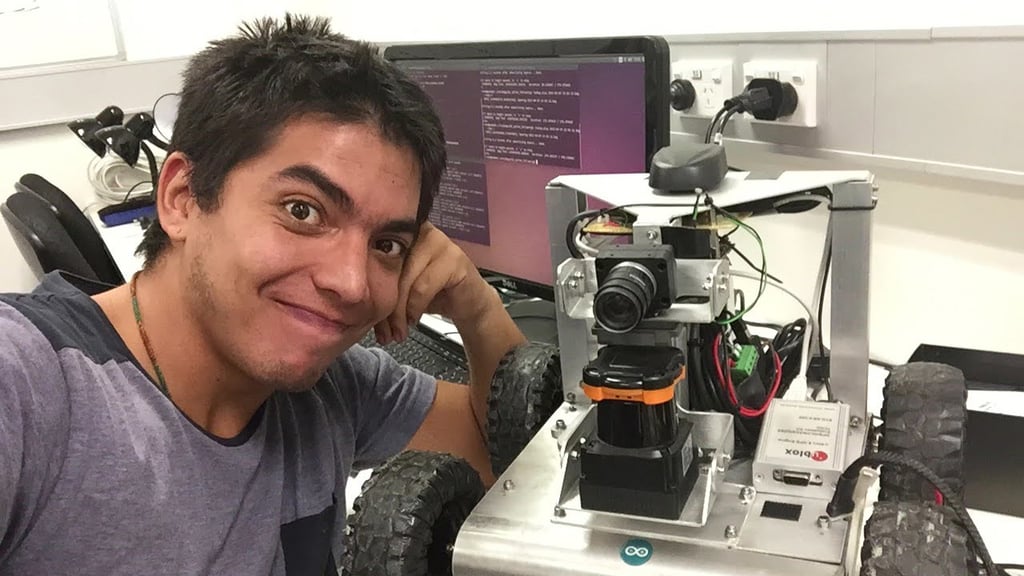
Using Machine Learning to benefit society
This marked a clear motivation for using his skills in machine learning for the benefit of society. “So I guess that ever since then, my view of robotics and the development of technology was always towards the positive impact that it can have on the world and people.”
Roman then joined the Centre for Translational Data Science (CTDS) at the University of Sydney, led by Professor Hugh Durrant-Whyte, a pioneer in probabilistic robotics. During this time, Roman was able to apply probabilistic modelling and sequential decision-making processes to the social sciences for the first time, working on predicting domestic violence and devising ethical predictive policing routes.
Motivated by these projects, Roman convened the first Ethics for Data Science Conference in Australia in 2019.
“We brought together academia, but also industry, to speak about ethics of AI, fairness, interpretability, and transparency and its relationship to data science and AI…That kept paving the way for us getting into this space,” Roman said.
That same year Roman released research attracted national attention, contradicting the NSW Government on the effectiveness of the Sydney lockout laws, finding that they didn’t cause violence to decrease in the CBD.
That research quickly gained public traction. I came out on the cover of the Sydney Morning Herald and spoke to what felt like every radio station around Australia.
“And we actually ended up submitting our work to a Parliamentary committee [which] ultimately recommended that the Bureau of Crime Statistics and Research work with us to better understand the complex crime dynamics.”
It was also during this time at CTDS that Roman realised the limits of using conventional regression models to make inference on complex social phenomena, and turned to Bayesian Networks to unravel more intricate relationships between variables.
“[This is] a crucial aspect of what we're doing today, which results in more representative models for the complexity inherent in social phenomena.
“For modeling the environment, you have physics, and physics tells you a whole lot about how the world works, and therefore you don't need to bake in those many assumptions. But with social science, it's so complex, there's no clear set of equations to describe society. We need to learn those equations, which are the structures of these Bayesian networks.”
In 2021, Roman joined CSIRO to develop the coursework for the Next Generation Graduates PhD and Master’s program, the largest tech-grad cohort scholarship program in Australia, which aims at recruiting 500 students. The coursework covered topics such as deep learning, data-centric engineering, ethical tech design, machine learning and decision-making under uncertainty.
Move to HTI
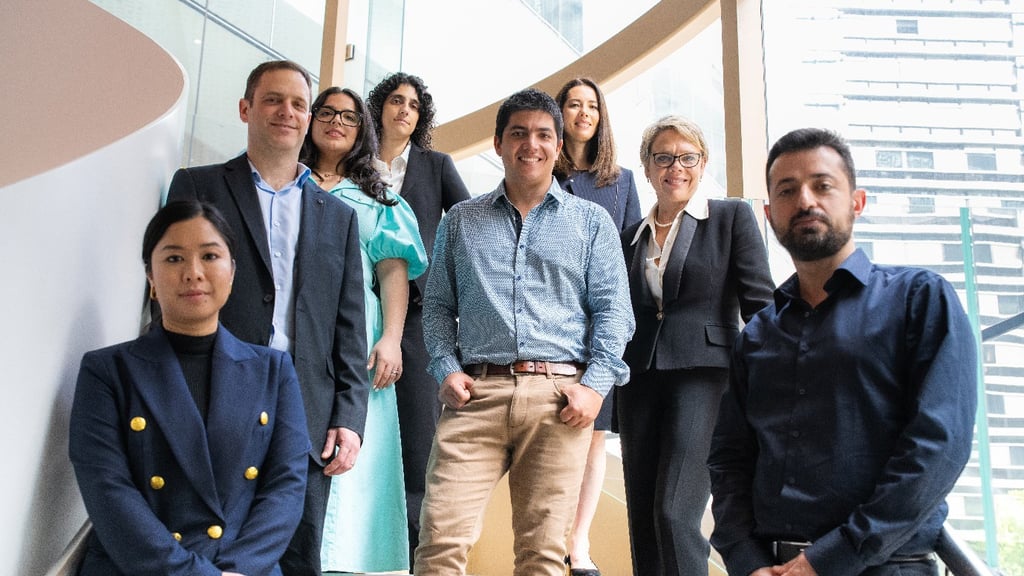
Roman joined HTI in 2023 and is currently the Head of Research for the Thrive program, which combines the power of statistical machine learning, lived experience and community co-design to understand what factors impact NSW school students finishing school well; as well as leading programs on mental health and STEM education. His goal, moving forward, is to generalise from these siloed projects to a more wholistic approach to community wellbeing that coordinates various government departments.
"We've always dreamed about developing the technology for the wellbeing of the community in all domains, [for example], for employment, for housing, for crime, for education.
“What does the department of education need to do? What policies should social services put in place? How can the department of health best and most efficiently treat patients? Is it possible to use the latest machine learning algorithms to coordinate wider policy decisions, leveraging the power of AI, to better understand what works best for the community?”
Although this dream is yet to be realised, Roman is excited with the current stage of the Thrive project, where having identified that students’ sense of belonging is critical to them finishing school well, he is working with schools to co-design what those belonging initiatives look like for them.
“We are now working directly with schools based on the analysis we've done over previously collected data.... getting to the point where we are actually meeting with real people, with real students, and we are getting physically into schools to materialise our research and achieve impact.”
Roman was also recently named as Associate Editor of the Cambridge Data & Policy Journal. “This is huge for my career, since it recognises my contributions to the field and my capacity to identify relevant research at the world stage around these topics.”
Interests outside work

Outside work, Roman is a busy dad of three. He now lives on the Sunshine Coast in Queensland and commutes regularly to HTI in Sydney. That doesn’t leave much time for his interests in rock climbing, highlining and surfing. In the meantime, he enjoys being involved with his kids’ education.
“I guess I've realised from our very own research in Thrive, how important parental engagement is for the future success of my children.”