

- Posted on 6 Jun 2023
- 9-minute read
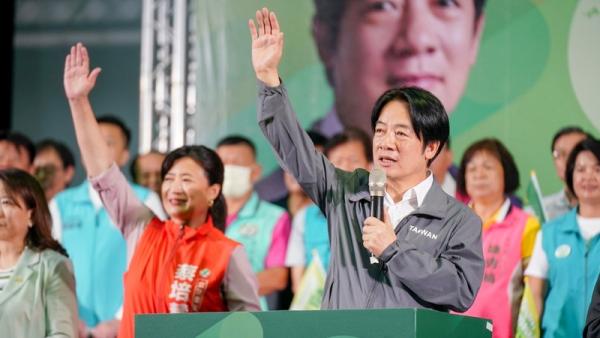
賴清德 / Facebook

Corey Lee Bell, Project and Research Officer, Australia-China Relations Institute, University of Technology Sydney
This article appeared in the University of Nottingham’s Taiwan Studies Programme's Taiwan Insight on June 6 2023.
Taiwan’s main opposition party, the Beijing-friendly Kuomintang (KMT), recently selected its candidate for the 2024 presidential election. With the main competitors for Taiwan’s top job essentially locked in, each has been interrogated on their policies on cross-strait relations in recent weeks. With tensions high across the Taiwan Strait, and between Beijing and Washington, what each candidate stands for could have profound ramifications for, and perhaps even beyond, the Indo-Pacific region.
The KMT preselection resulted in a victory for the incumbent New Taipei City major, Hou Yu-ih. Hou is set to run against the frontrunner and current vice president, Lai Ching-te, who represents the independence-leaning Democratic Progressive Party (DPP). Ranking last among the three in recent polls is the Taiwan People’s Party’s founder and representative, Ko Wen-je.
Assuming the winner is likely to hail from one of the two mainstream parties (i.e., the KMT or DPP), how do the former two candidates’ major policy platforms on cross-strait relations compare with each other? What response are they likely to elicit in Beijing, and what impact might they have on the prospects for peace across the Taiwan Strait?
Hou Yu-ih – A ‘blank page’?
Hou, a moderate former police chief, emerged victorious in a pre-selection runoff against Terry Gou, a conservative populist who has been compared with Donald Trump. Gou ran on his strong economic credentials as the founder and former chair of Foxconn, the world’s largest technology manufacturer and service provider. But Gou’s business interests in China, and Beijing-friendly positions on cross-strait relations raised concerns about his electability, with internal polls showing he would perform worse than Hou in a two-party race against Lai. These concerns were likely accentuated by the KMT’s record drubbing in the 2020 presidential election, after the incumbent president Tsai Ing-wen, capitalising on anxieties surrounding crackdowns on Hong Kong’s Anti-Extradition Protest Movement, pushed a hard line on threats from Beijing to Taiwan’s sovereignty.
In line with this, Hou has explicitly rejected the ‘one country, two systems’ model that ostensibly prevails in Hong Kong and that Beijing insists will be the framework for Taiwan’s ‘unification.’ He also remains a forceful advocate of Taiwan’s ‘democracy and freedoms’ – in contrast to Gou, who in 2014 controversially said, ‘Democracy doesn’t put food on the table.’
Yet Hou has also firmly rejected Taiwanese independence, declaring that such a move would pose a grave threat to peace. He has also refused to disavow the 1992 Consensus, whose fundamental tenet is the principle of ‘one China with respective interpretations.’ Hou has responded to questions about his views on ‘one China’ by merely stating he will ‘abide by the Republic of China’s constitution and the Cross-Strait Act.’ He has at other times stated that the ‘Republic of China’ and the island are like ‘cup and water‘ and that ‘if the nest (i.e., cup/Republic of China) is tipped over, the eggs (i.e., water/Taiwan) won’t stay intact.’ This intimates that retaining constitutional links to ‘China’ protects Taiwan by laying grounds for a less antagonistic relationship with Beijing. As Hou stated more recently, ‘The Republic of China is our country; Taiwan is our home. The most important thing is that we make the Taiwan Strait stable and the region peaceful.’
On this point, Hou has clearly sought to capture the political centre. Hou, for instance, has said that he rejects the DPP’s alleged bifurcation between ‘fighting China to protect Taiwan’ or ‘cosying up to China and selling out Taiwan’ and any notion that Taiwan must simply choose between China or the United States. Yet he has also attempted to foray into the DPP’s base by promoting an identity as a Taiwanese patriot. Hou regularly uses Taiwanese language slogans and has at times mimicked the nationalistic rhetoric of Lai, including on one occasion saying, ‘Protecting the Republic of China, and loving the people of Taiwan, Penghu, Kinmen and Matsu (i.e., the outlaying islands governed by Taipei), is my only creed… Taiwan is our home.’ In addition, he has aggressively responded to claims that his position on Beijing is unpatriotic, claiming ’we [all] love Taiwan… we are Taiwanese.’
Lai Ching-te – a ‘pragmatic’ independence proponent?
Threats emanating from China have long put the Beijing-friendly KMT on the defensive in relation to its stance on ‘one China.’ Yet Hou’s shift to the political middle ground has placed pressure back on Lai, whose self-description as a ‘proponent of Taiwanese independence’—along with his position that ‘Taiwan is a sovereign independent nation’— have recently come under scrutiny as unconstructive provocations. Lai and his allies have since emphasised that his approach to Taiwan’s independence is ‘pragmatic,’ that he wants peaceful coexistence with Beijing, and that he ‘stands against the [Chinese] Communist Party, not China.’ However, Lai has also said he is open to discussions with Beijing and has even voiced support for veteran independence activist Koo Kwang-ming’s view that mainland Chinese and Taiwanese are ‘brothers.’
Yet Lai’s views on cross-strait relations otherwise remain largely aligned with the firm stance on the sovereignty of the incumbent president. He supported inscribing Tsai’s ‘four commitments’ – which relate to democracy, autonomy, sovereignty, and self-determination – into the DPP’s constitution. He has also continued to emphasise deterrence by strengthening Taiwan’s defence capabilities and key security partnerships. He has reached out to Tokyo, repeating Japan’s former Prime Minister Shinzo Abe’s claims that Japan and Taiwan’s security are intertwined, recommending establishing a defence dialogue mechanism between the two nations and promoting closer security collaboration ‘to preserve peace in the Indo-Pacific region.’ He also restated Taiwan’s desire to strengthen security and economic cooperation with the US in a mid-April meeting with Lauran Rosenberger, Chairperson of the American Institute in Taiwan (the United States’ pseudo-embassy), and in a subsequent meeting with the US’ former National Security Advisor John Bolton.
Different candidates, different dangers?
Both candidates’ attempt to reclaim the middle ground has seen a nascent shift toward bipartisan consensus on cross-strait relations, according to the Taiwan Normal University political scientist and popular political commentator Fan Shih-ping. Yet Lai and Hou’s positions remain divergent and present different dangers to stability across the Taiwan Strait.
Lai’s past hostilities towards Beijing arguably dampen hopes for the immediate resumption of high-level cross-strait engagement should the DPP prevail. Moreover, Lai’s calls for the continuation of high-level interactions with US officials or political figures risk a repeat of the tensions across the Taiwan Strait that followed former House Speaker Nancy Pelosi’s visit to Taiwan last August, and Tsai’s meeting with current Speaker Kevin McCarthy in April.
Weighing against this is Lai’s assertion that Taiwan cannot afford to ‘rely on the goodwill of mainland [China]’ or the stronger view that Beijing may be settled on absorbing Taiwan. This factor drives his agenda of closer engagement with Washington as part of a broader effort to rally the world’s support for the island, which Tsai has promoted as a democracy at the frontline of the struggle against authoritarianism and a vital semiconductor hub. This gambit balances short-term risks for stability across the Taiwan Strait against the promise of enlisting allies whose combined strength, including in the realms of economic, structural and systemic power, might be sufficient to deter Beijing from trying to take the island by force.
In contrast, Hou and the KMT reject what they see as the thesis that Beijing is on an inexorable trajectory towards war. On the contrary, they have promised to restore stability by pursuing regular engagement with Beijing and toning down ‘provocations’ that might draw Beijing’s ire. Yet the KMT, and the central leadership in China, are very different from those that prevailed during a period of relative stability that ended when the last KMT President, Ma Ying-jeou, completed his term in 2016. As a result, the KMT also faces the danger that Beijing will set a higher bar of expectations for the KMT vis-à-vis the DPP – one that fails to appreciate the shift in the KMT’s political circumstances.
The KMT today is undergoing a change of guard. It is no longer dominated by the civilisational rejuvenation agenda of its early Chinese founder Sun Yat-sen, nor the militaristic ethos of its former leader, the ‘generalissimo’ Chiang Kai-shek. Instead, it is moving closer to a conventional social and economic conservative party. While it retains strong identarian affiliations with Chinese civilisation – not unlike social conservatives’ views on Britain’s heritage in its former colonies – its aspirations for closer ties with China are increasingly driven by economic as opposed to political incentives. Beijing’s discontinuation of former suggestions that Taiwanese representatives could claim senior posts in a post-‘unified’ China’s Politburo, the diplomatic downgrade afforded Taiwan’s former president Ma Ying-jeou in his recent trip to the mainland, and the ongoing erosion of Hong Kong’s autonomy, means KMT elites, in any event, may not be enticed by Beijing’s diminishing political ‘carrots.’
Hou, moreover, may find that his modest goals of improving ties will do little to placate Beijing’s growing impatience on the Taiwan issue. In particular, any expectations Beijing may have that the KMT will hastily move forward on negotiating a concrete path towards unification are likely to be met by frustration, assuming Hou’s public stance that the Taiwanese people should decide their own future is in any way indicative of his private musings. Beijing has arguably long endured the independence-leaning DPP due to expectations that the election cycle would eventually deliver a more pliant KMT administration. The end of that hope could well mark the beginning of its focus on a non-political solution for the ‘Taiwan problem.’
On these grounds, it would be prudent for the democratic world not to raise high hopes that the 2024 election will dramatically reduce cross-strait tensions. Yet whichever candidate prevails, their capacity to freely prosecute their democratic mandate will likely require a continued investment from free nations in making the cost of a unilateral resolution to the ‘Taiwan problem’ sufficiently prohibitive.
Authors
Dr Corey Lee Bell is a Project and Research Officer at the Australia-China Relations Institute, University of Technology Sydney.