

  • University of Technology Sydney home
  • Home

    Home
  • For students

  • For industry

  • Research

Explore

  • Courses
  • Events
  • News
  • Stories
  • People

For you

  • Libraryarrow_right_alt
  • Staffarrow_right_alt
  • Alumniarrow_right_alt
  • Current studentsarrow_right_alt
  • Study at UTS

    • arrow_right_alt Find a course
    • arrow_right_alt Course areas
    • arrow_right_alt Undergraduate students
    • arrow_right_alt Postgraduate students
    • arrow_right_alt Research Masters and PhD
    • arrow_right_alt Online study and short courses
  • Student information

    • arrow_right_alt Current students
    • arrow_right_alt New UTS students
    • arrow_right_alt Graduates (Alumni)
    • arrow_right_alt High school students
    • arrow_right_alt Indigenous students
    • arrow_right_alt International students
  • Admissions

    • arrow_right_alt How to apply
    • arrow_right_alt Entry pathways
    • arrow_right_alt Eligibility
arrow_right_altVisit our hub for students

For you

  • Libraryarrow_right_alt
  • Staffarrow_right_alt
  • Alumniarrow_right_alt
  • Current studentsarrow_right_alt

POPULAR LINKS

  • Apply for a coursearrow_right_alt
  • Current studentsarrow_right_alt
  • Scholarshipsarrow_right_alt
  • Featured industries

    • arrow_right_alt Agriculture and food
    • arrow_right_alt Defence and space
    • arrow_right_alt Energy and transport
    • arrow_right_alt Government and policy
    • arrow_right_alt Health and medical
    • arrow_right_alt Corporate training
  • Explore

    • arrow_right_alt Tech Central
    • arrow_right_alt Case studies
    • arrow_right_alt Research
arrow_right_altVisit our hub for industry

For you

  • Libraryarrow_right_alt
  • Staffarrow_right_alt
  • Alumniarrow_right_alt
  • Current studentsarrow_right_alt

POPULAR LINKS

  • Find a UTS expertarrow_right_alt
  • Partner with usarrow_right_alt
  • Explore

    • arrow_right_alt Explore our research
    • arrow_right_alt Research centres and institutes
    • arrow_right_alt Graduate research
    • arrow_right_alt Research partnerships
arrow_right_altVisit our hub for research

For you

  • Libraryarrow_right_alt
  • Staffarrow_right_alt
  • Alumniarrow_right_alt
  • Current studentsarrow_right_alt

POPULAR LINKS

  • Find a UTS expertarrow_right_alt
  • Research centres and institutesarrow_right_alt
  • University of Technology Sydney home
University of Technology Sydney home University of Technology Sydney home
  1. ... Newsroom
  2. ... 2016
  3. 08
  4. Novel technology gives new insight to seagrass biology

Novel technology gives new insight to seagrass biology

12 August 2016

Seagrass meadows are among the most productive ecosystems on earth providing a range of key ecosystem services, enhancing marine biodiversity by providing feeding grounds and nursery areas for many important marine species such as sea turtles, dugongs, juvenile fish and crustaceans. Despite their high environmental and economic value, however, seagrass meadows are currently facing a global decline. In new research UTS Climate Change Cluster (C3) PhD candidate Kasper Elgetti Brodersen is using advanced microsensor and optode technology to examine how changing environmental conditions (such as light intensity, O2 availability, and temperature) affect the health and performance of seagrasses.

Together with colleague Dr. Klaus Koren - from C3 Distinguished Professor  Michael Kühl’s team based at University of Copenhagen - Kasper developed a new technique where O2 and pH sensitive optical sensor nanoparticles are incorporated into transparent, artificial sediment. By applying this novel methodology the research team measured, for the first time, the O2 and pH micro-dynamics and heterogeneity in the seagrass rhizosphere on an entire rhizosphere level.
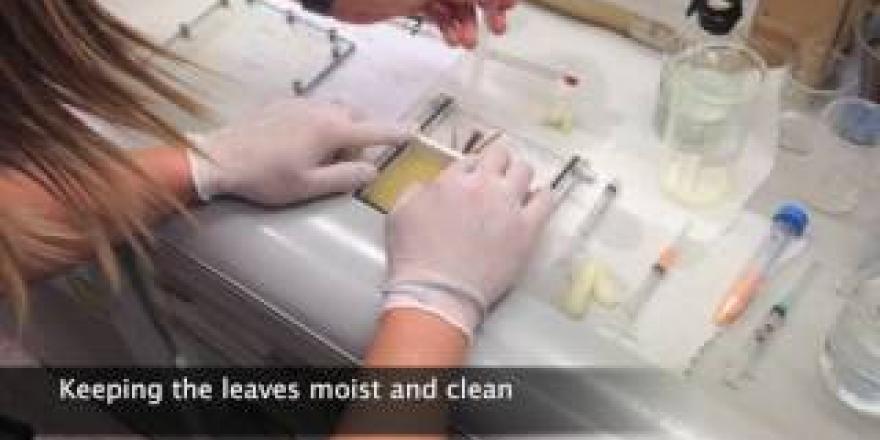

[Text overlay]: Putting sensor nanoparticles into the artificial sediment

[Student gently pours the artificial sediment around the roots]

[Student puts silicone on the chamber to ensure it will be sealed]

[Text overlay]: Keeping the leaves moist and clean

[Student squeezes water onto the seagrass from a pipette]

[Student closes the chamber after the artificial sediment has solidified]

[Text overlay]: When the chamber is sealed it can be turned and filled with seawater

[Student moves the chamber to the imaging setup]

[Student aligns the camera and LED]

[Text overlay]…and the setup is ready for measuring

Seagrasses are constantly challenged to transport O2 down to their below-ground tissues to maintain aerobic metabolism and to protect themselves against sediment-produced reduced phytotoxic compounds, such as hydrogen sulphide. By means of optical sensor nanoparticles the team discovered that seagrasses alter the rhizosphere pH microenvironment. They also found that the oxidation capacity of the below-ground tissues changes as a response to light stimulation of the leaf canopy, reduced water-column O2 levels during night-time, and elevated seawater temperatures. Very low water-column O2 levels during darkness strongly reduce the below-ground tissue oxidation capacity,  thereby increasing the risk of phytotoxic hydrogen sulphide intrusion.

Ongoing climate changes are expected to lead to further seawater level rises, enhanced frequency of nutrient-driven algal blooms, and higher water-column temperatures, which reduces the light availability for underwater photosynthesis and the water column O2 levels during night-time owing to higher respiration rates. The results from this work may thus provide important information about how environmental changes affect processes in the seagrass rhizosphere and thus plant fitness. Such knowledge can ultimately help coastal managers to better manage and protect these vital marine ecosystems in future oceans e.g. by defining important thresholds for water column turbidity and other key hydrologic parameters affecting the microenvironmental controls of seagrass health.

For further information about Kasper Elgetti Brodersen’s research: elgetti.wordpress.com

Publication:

Brodersen KE, Koren K, Lichtenberg M, Kühl M (2016). Nanoparticle-based measurements of pH and O2 dynamics in the rhizosphere of Zostera marina L.: Effects of temperature elevation and light-dark transitions. Plant, Cell & Environment 205: 1264-1276.

Share
Share this on Facebook Share this on Twitter Share this on LinkedIn
Back to News in Climate Change Cluster

Acknowledgement of Country

UTS acknowledges the Gadigal people of the Eora Nation, the Boorooberongal people of the Dharug Nation, the Bidiagal people and the Gamaygal people upon whose ancestral lands our university stands. We would also like to pay respect to the Elders both past and present, acknowledging them as the traditional custodians of knowledge for these lands.

University of Technology Sydney

City Campus

15 Broadway, Ultimo, NSW 2007

Get in touch with UTS

Follow us

  • Instagram
  • LinkedIn
  • YouTube
  • TikTok
  • Facebook
  • WeChat

A member of

  • Australian Technology Network
Use arrow keys to navigate within each column of links. Press Tab to move between columns.

Study

  • Find a course
  • Undergraduate
  • Postgraduate
  • How to apply
  • Scholarships and prizes
  • International students
  • Campus maps
  • Accommodation

Engage

  • Find an expert
  • Industry
  • News
  • Events
  • Experience UTS
  • Research
  • Stories
  • Alumni

About

  • Who we are
  • Faculties
  • Learning and teaching
  • Sustainability
  • Initiatives
  • Equity, diversity and inclusion
  • Campus and locations
  • Awards and rankings
  • Leadership and governance

Staff and students

  • Current students
  • Help and support
  • Library
  • Policies
  • StaffConnect
  • Working at UTS
  • UTS Handbook
  • Contact us
  • Copyright © 2025
  • ABN: 77 257 686 961
  • CRICOS provider number: 00099F
  • TEQSA provider number: PRV12060
  • TEQSA category: Australian University
  • Privacy
  • Copyright
  • Disclaimer
  • Accessibility