

- Posted on 20 Jul 2016
- 4-minute read
D
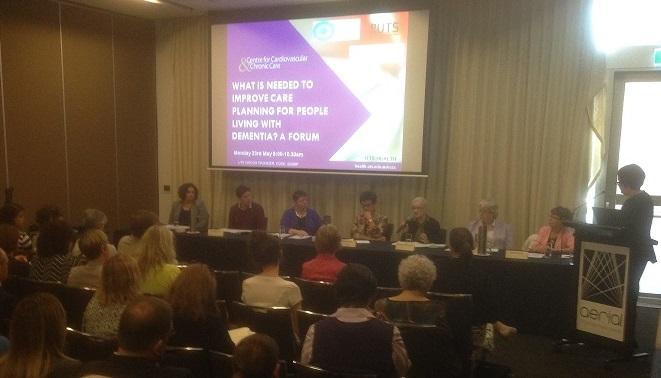
uring National Palliative Care Week, the University of Technology Sydney (UTS) hosted a forum on dementia care planning facilitated by the Director of
The Centre for Cardiovascular and Chronic Care
, Faculty of Health,
Imelda Gilmore, an Alzheimer’s Australia NSW Dementia Advocate and wife of a person with dementia, opened the forum by highlighting the importance of “getting the word out to have conversations about end of life early on”. A recurring theme at the forum was the need for care decisions to be person-centred and focused on what the person with dementia would have wanted were they able to speak for themselves, rather than the wishes of surrogate decision-makers. Lynn Chenoweth (Professor of Nursing at the Centre for Healthy Brain Ageing, The University of New South Wales) defined person-centredness as respecting the person with dementia’s “values, beliefs, history, likes and dislikes … all of the things that make them unique”.
Craig Sinclair (Research Fellow from the Rural Clinical School of Western Australia) highlighted the importance of supporting persons with dementia to be involved in decisions on their own behalves whenever possible. He criticised current ethical and legal approaches to legal capacity as being too focused on mental capacity rather than on the person’s right to have this capacity supported to enable participation: “Having an awareness of dementia is not just acknowledging that the disease is progressive, but it is about acknowledging that people with dementia should be able to make their own decisions and express their own preferences”. Craig also highlighted the social context of decision-making and the importance that decisions occur over time, starting with overall goals of care before moving to individual treatment decisions. Meera Agar (palliative care physician and Professor of Palliative Medicine at UTS) suggested that planning should begin at diagnosis, be iterative, and include facilitation and informational context from health professionals as necessary. Meera suggested that investment in experiential teaching methods might be the best means of equipping health professionals for these roles, while Deborah Parker (Professor of Nursing at the School of Nursing and Midwifery, Western Sydney University) also highlighted the importance of role modelling, given that “just telling people to have these difficult conversations is easier said than done”.
Another important theme illustrated by Imelda’s own experience concerned the breakdown in communication that often occurs when transferring advance care plans between care settings. Sue Kurrle (geriatrician and Curran Professor in Health Care of Older People at The University of Sydney) highlighted the dilemma faced by hospital clinicians in deciding whether an advance care plan should be accepted as an accurate and current reflection of a person’s wishes, and encouraged health professionals to make more use of the “the least used medical instrument”, the telephone, to help them decide. Sue also distinguished between the legal status of an advance care plan made while a person with dementia retained capacity to make decisions compared with a plan written by family members thereafter, which could be used “only as an indication.”
Dimity Pond (Professor in General Practice School of Medicine and Public Health at the University of Newcastle) highlighted the benefits of using case conferences as a means of reaching shared agreement on care, especially for persons with dementia living in aged care. Dimity highlighted the benefits of including general practitioners (GPs) in case conferences where they had an established relationship with the family and advice was needed on medical matters. However, she also emphasised that decision-making should be framed within a psychosocial model rather than medical model of care. The main aims of case conferences were identified as establishing positive communication and collaborative decision-making with the person and their family/person responsible and reviewing the person’s individual capabilities and needs.
The last word at the forum went to Imelda Gilmore: “I don’t know where I would be today if friends and others didn’t tell me about the need for care planning … I am really glad to hear that this conversation is happening - keep it up.”
New resources to support dementia care planning developed by forum participants and available online include:
- CareSearch [opens an external site] supporting family case conferencing for people with advanced dementia
- A report supporting the quality and uptake of advance care planning[opens an external site] across the dementia trajectory