

- Posted on 16 Jan 2021
- Updated on 16 Jan 2021
- 2-minute read
Ground-breaking collaborative research supports better-informed sanitation investment decisions from a public health perspective.
RESEARCH OUTPUTS
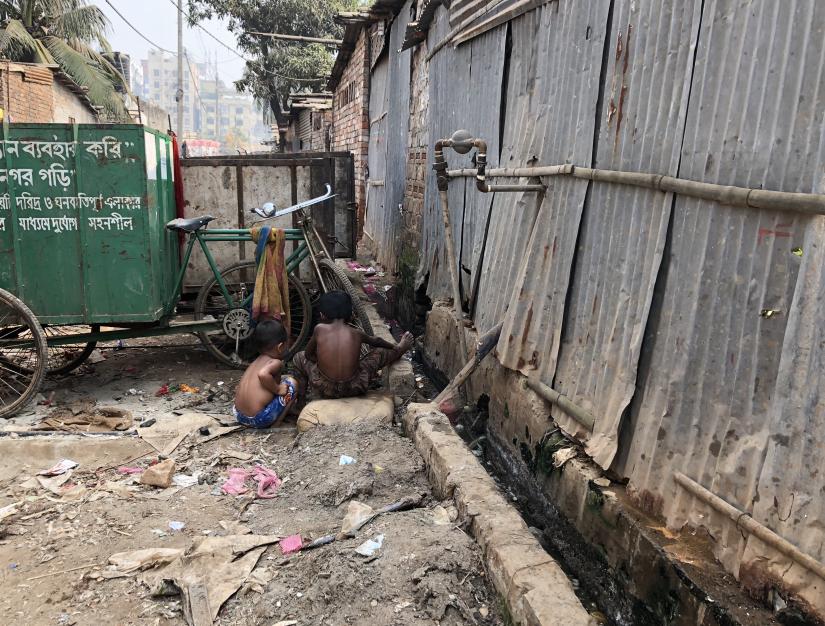
Dense urban areas suffer from challenges of faecal contamination in the urban environment, particularly in informal settlements and low-income areas. Current sanitation approaches may not be sufficient to improve public health, with a need to better understand how and where pathogens are released and how humans may become exposed.
Employing a systems modelling approach and using a low-income urban settlement in Dhaka, Bangladesh as a case study, this project considered pathogen flows in the urban environment and assessed how different potential sanitation solutions would be expected to influence health risks.
This research also provided the first detailed evidence base on faecal pathogens in environmental samples from sanitation systems, drainage systems and local waterways, raising significant cause for concern, and a need for further research on how pathogen levels can be better reduced.
Modelling faecal pathogen flows and health risks in urban Bangladesh: Implications for sanitation decision making (2021) (Journal Paper)
Modelling faecal pathogen flows and health risks in urban Bangladesh: Implications for sanitation decision making (2021) (Presentation)
Pathogen flows from on-site sanitation systems in low-income urban neighborhoods, Dhaka: A quantitative environmental assessment (2020) (Journal Paper)
What does quality sanitation look like from a public health perspective? Presented in the session ‘What is “Quality” Sanitation? Investigating Service Standards and User Experience in Rural and Urban Settings’ (Presentation)
Modelling faecal pathogen flows in urban environments: a proposed approach to inform sanitation planning - Policy brief (2018) (Report)
Researchers



- Freya Mills
SDGs


This project is working towards UN Sustainable Development Goals 3, 6 and 11
Explore International development
Institute for Sustainable Futures
Research Centre
Years
- 2018-2020
- Bangladesh
Client
- Water and Sanitation for the Urban Poor (WSUP)
Partners
- Emory University
- icddr,b (International Centre for Diarrhoeal Disease Research, Bangladesh)