
Empowering First Nations Australians with clean energy careers is essential for a successful and inclusive energy transition.
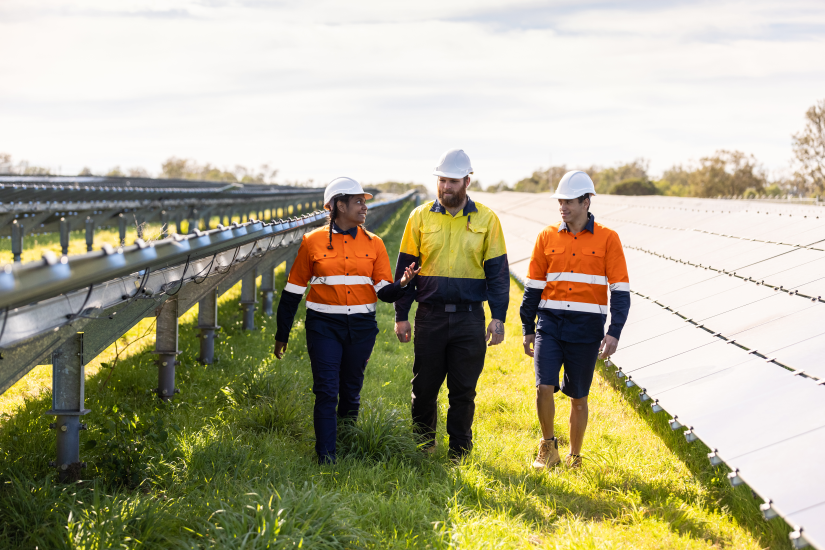
Three renewable energy workers walking through a solar panel field.

Increasing access to training, creating employment, and building career paths in clean energy is one of the key factors that will determine if the energy transition improves the lives of First Nations Australians. Building longer-term employment and skill development (‘careers not jobs’) is a primary pathway to generational wealth building for First Nations Australians.

Currently, there are low numbers of First Nations Australians working in the clean energy sector. The First Nations Clean Energy Network engaged the UTS Institute for Sustainable Futures (ISF), SGS Economics, Alinga Energy and Indigenous Energy Australia to examine the barriers, opportunities and solutions to increasing First Nations Australians’ employment in clean energy.

Through a combination of employment modelling and data analysis, literature review, interviews and workshops, ISF researchers have developed an action plan with 12 key recommendations for how industry, government and employment and training specialists and First Nations communities can realise opportunities for employment and career paths in clean energy. 

Recommendations for unlocking First Nations employment

The researchers reviewed industry and government policy, programs and targets across the nation to find out what is working, and what isn’t – demonstrating through the recommendations and actions identified in the report that there is significant potential through collective action to improve First Nations employment outcomes, right now.

Six of the 12 recommendations that can be implemented now include:

  1. mandating minimum Indigenous Procurement Policy and Australian Skills Guarantee compliance in Capacity Investment Scheme merit criteria
  2. negotiating minimum First Nations employment targets in Renewable Energy Transformation Agreements in solar farm in renewable energy zones
  3. reviewing ARENA’s and the Clean Energy Finance Corporation's (CEFC) procurement guidelines to incorporate employment and training targets for First Nations
  4. setting up a coordinated scheme for wind farm apprenticeships
  5. mandating employment and training targets in the delivery of First Nations housing retrofit programs
  6. setting up a First Nations Clean Energy Cadetship Program for First Nations school students to enter employment and training in the energy sector.
7C93edMfLpU

Transcript

There are many dimensions to improving the lives of First Nations people through clean energy, from energy security through to ownership and financial benefits, but one of the key ones is also increasing employment and training opportunities.

Only around one in two First Nations people aged 15 to 64 is employed, relative to around two thirds of the wider population. That's a big gap, and the Commonwealth Government's Employment White Paper last year noted that gap has really not changed for 30 years. Even through all the mining booms and the waves of economic development that have happened, it hasn't changed, which is quite remarkable. So there's been a long stagnation in terms of the employment of First Nations people.

In clean energy, currently the level of employment is low. There's the occasional best practice project, like the one featured on the right, the Avonlea Solar Farm, which employed 30 Indigenous people who were unemployed or had never worked before, which doesn't sound like very many jobs, but for the people involved it was transformational, in a community where you have multiple generations of families who have never worked before or who hold no job.

So the energy transition offers a great opportunity, but it won't necessarily create jobs on its own. One of the first things we noted when we started to look was that the population share of First Nations people in the RESs is higher than average, and in some of the main RESs where most of the development is going to occur, it's particularly high. It's almost one in ten in the New England RES, for example, and almost 13% in the Central West Orana RES.

Then we started to look further using employment modelling, labour market and demographic analysis as to what employment shares might be possible inside the RESs. And we looked at three, we basically broke it down into three groups.

Firstly, we looked at the workers in other sectors who are in occupations that are needed in renewable energy, so electricians, construction labourers and the like. And what we found is that in most of the RESs, the volumes of workers in existing occupations is equivalent to around 5 to 10% of the demand we project is required in the RESs. However, they're highly concentrated in a small group of occupations, especially truck drivers. So in practice, there isn't a large volume of workers with the right skills currently to work in renewable energy.

The second group we looked at were students. Over half the First Nations population in the RESs is under 19, so very young, which is on one hand a bit of a challenge, but on the other hand, it's a real opportunity to break the cycles of unemployment if we can get the right programs in place. If just 1 to 3% of 15 to 19-year-old First Nations students found their way into the renewable energy sector, in half the RESs that would be equivalent to 10% or more of the projected employment demand.

And thirdly, we looked at the unemployed and those not in the labour force. And obviously, there are a whole range of social barriers and issues here. We know many of the barriers and we spoke to people about them: access to training, health problems, literacy problems, simply getting access to transport to get to training or to jobs. But nonetheless, again, even small volumes, even small portions of this population could add up to something really meaningful in terms of an employment target.

And we know that solar farms and recycling facilities have the opportunities for entry-level jobs. Solar farm jobs might only last four to six months, but if they're a bridge out of unemployment, then they can have a really lasting legacy.

So the overall picture, the bottom line is that achieving targets of 5 to 10% now is challenging, but entirely feasible over time with the right programs to draw these groups into the workforce.

So how do we realise these opportunities? We've got a 10-point plan with a range of actions for industry and governments and how they can work with First Nations community. The core principle though is that we need to combine measures that work on the supply side with measures that work on the demand side.

So if you just do training, if you just work on the supply side, it can easily become training for training's sake. It doesn't lead to any actual employment. And we heard a lot from First Nations people about their experiences of this, and their scepticism that the renewable energy industry was actually going to create jobs for them.

On the other hand, if you just focus on demand by, say, mandating employment and training targets in procurement auctions for industry, and you don't have the sufficient supply of people with the right skills, then you end up with a situation where you're getting creative accounting exercises and the like by industry, but you're not really getting the sustainable long-term jobs.

So we need to see the two working together. So in our plan we have a group of measures on the demand side, a group of measures on the supply side, the column in the middle are enabling measures to help the two integrate, and then we have cross-cutting measures about building the capacity of First Nations organisations and improving, I guess, the culture of renewable energy workforces to employ First Nations people.

So I don't want to overstay my welcome, I won't go through all 12 of these recommendations, but I want to highlight a couple of the key ones.

So recommendation number one is that we should embed First Nations employment and training targets in the auction criteria in the capacity investment scheme, which is going to drive most of the renewable energy development in coming years, but there needs to be flexibility so the states can implement it at a RES level because they do vary. There needs to be flexibility to allow contracts with First Nations businesses to count as well as jobs directly, because they're more likely to be longer-term jobs than the construction phase, and thirdly it needs to focus on solar farms rather than wind farms at the moment because it's solar farms that have the short-term potential more than wind farms where there's less entry-level jobs.

Recommendation number two is that government broker a coordinated industry program with the operators of wind farms to get First Nations students into mechanical trades apprenticeships. We spoke to a range of wind farm operators and they more or less all said the same thing. They said we have skill shortages, we can't attract trades anymore, the barriers to entry are quite low, we really only need to get people through working at heights training and then we can start training them in mechanical trades, you just need to be handy. There is actually a higher than average number of First Nations in mechanical trades already, but we don't really know how to go about it and we want to see something coordinated that works across the industry. So there's a role there for government to help create what would be long-term jobs on country in the wind farm sector for mechanical technicians.

Thirdly, we need to integrate First Nations employment and training targets and initiatives better into climate and energy programs. So for example, we're now seeing significant investment in Indigenous housing retrofits but not really leveraging the jobs that we could be creating here. So if you combine targets in the procurement phase for the companies who are going to do the retrofits with training programs, pre-apprenticeship programs to build a supply of students who can be electricians, plumbers and air conditioning technicians, the three key trades we need for electrification and which are in shortage. And there are other opportunities too, like microgrid programs run by ARENA, but this integration of employment training is not something that's really done that much currently in energy programs.

Recommendation number four is what we're calling career trackers for clean energy. So it would involve the clean energy companies making long-term 10-year commitments to take in First Nations students in university-qualified cadetships, and on the other hand, government to provide money to specialised providers who can bring the students through, give them the mentoring and support that they're going to need to get through the program.

On the enabling side, or on the supply side, I think what we also need to see—recommendation number 10, I think it is—is an industry support program in which you embed specialist officers within the renewable energy companies to help them meet these targets. And we have a model here that already works. The New South Wales Infrastructure Skills Legacy Program has achieved seven percent First Nations employment, and what they say is often the key is the fact they've embedded these specialist training officers inside the companies. We know renewable energy companies themselves are suffering from some skill shortages and are under enormous pressure to deliver projects. They need the extra capacity and expertise to help them deliver on these targets.

And finally, in the cross-cutting section, we highlight the need for funding for First Nations organisations to build their own capacity. What we heard, and what others hear all the time, is that they don't have the resources, they don't have the expertise to be able to engage effectively with the clean energy industry, so they need to be given funding to get access to that specialised expertise and be able to play the role that we need them to play between the community and the renewable energy industry.

To sum up, it's not necessarily easy. The long stagnation in employment of First Nations people tells you it's not easy, but it would be criminal if we missed the opportunity to use the clean energy transition as an opportunity to create jobs that can materially change people's lives.

So I hope you have a good launch. I wish I could be there. I hope this is the start of something and that this report and launch leads to action by governments, by industry, to work with First Nations communities to make clean energy jobs and careers for First Nations people a reality.

Thank you.

Chris Briggs

Chris Briggs

Program Lead - Energy Futures

DVC (Research)

Rusty Langdon

Rusty Langdon

Senior Research Consultant

DVC (Research)

Sarah Niklas

Sarah Niklas

Research Principal

DVC (Research)

SDGs

Icon for SDG 7 Affordable and clean energy

This project is working towards UN Sustainable Development Goal 7.

Read about ISF's SDG work

Explore Energy

Energy; Institute for Sustainable Futures

Research Centre

Location

  • Australia

Client

  • First Nations Clean Energy Network

Partners

  • SGS Economics & Planning
  • Alinga Energy
  • Indigenous Energy Australia

| Sustainability |


Share