

- Posted on 16 Dec 2021
- Updated on 16 Dec 2021
- 6-minute read
New smart technology set to change water management practices throughout communities with Sydney Olympic Park as the first innovative project.
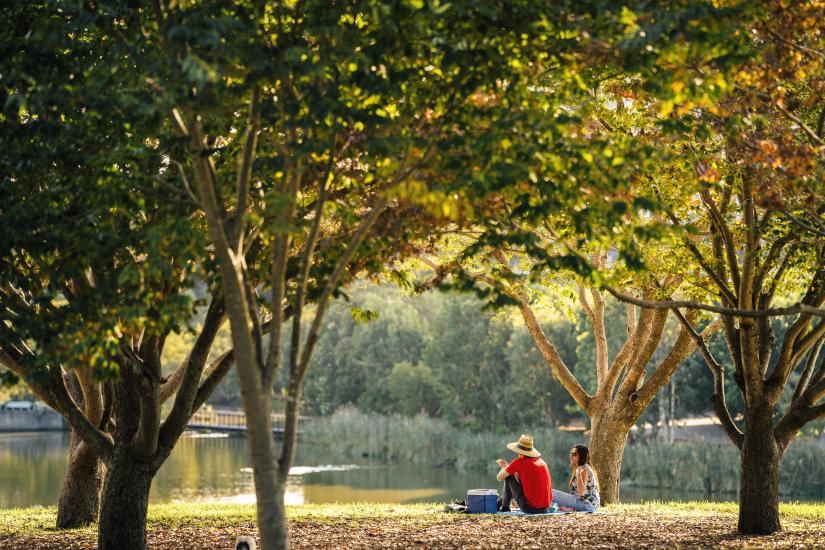
Artificial intelligence (AI) is increasingly playing a role in benefiting human lives and is now going to help make Bicentennial Park at Sydney Olympic Park a cool urban oasis.
SIMPaCT (Smart Irrigation Management for Parks and Cool Towns) is a partnership ISF is involved with between the NSW Government, several other universities and private industry.
It will merge environmental monitoring and AI across the popular 42-hectare parkland to provide the coolest possible microclimates for residents and visitors during increasingly hot summers.
It is a practical example to demonstrate how smart water management can ease the pressure on our most valuable natural resource. It is Australia’s largest smart green infrastructure project and a major leap forward in the development of heat-responsive urban design.
The Digital Restart Fund, administered by the Department of Customer Services of the NSW Government, will award $2.5 million to Sydney Olympic Park Authority to make SIMPaCT a reality.
This multidisciplinary partnership brings true innovation, cutting-edge science and technology, and ultimately greater climate resilience to Sydney Olympic Park, the state’s premier event destination.
The sensors in Bicentennial Park will record soil moisture and air temperature information and combine it with local weather forecasts. AI will then predict when and for how long different sections of the park need to be watered.
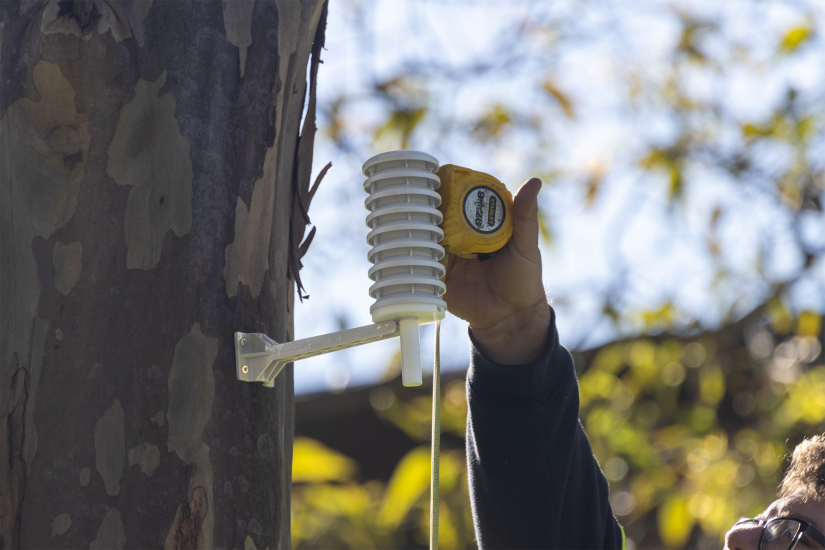
Installation of weather sensor. Photo: Tanya Xaybounheuang
This innovative project uses only recycled water and by evaluating how successful the irrigation management was in keeping defined soil moisture levels, the AI module learns over time how to provide optimal plant hydration.
Project creator and lead Dr Sebastian Pfautsch, Associate Professor at Western Sydney University believes this to be a breakthrough for the field.
"This is not science fiction. This is real. The work helps to optimise microclimate and water use in summer. Our technology will be scalable, delivering maximum coolth from plants around buildings and parks anywhere – if you have enough water to irrigate."
– Dr Sebastian Pfautsch, UWS
Environmental conditions across the park will be made visible in several forms. Park visitors can use their mobile phones to check where the coolest spot for a picnic is, or where they should exercise.
Sydney Olympic Park Authority will use this information to optimise their water management and detect technical problems in their irrigation system.
ISF project lead Andrew Tovey briefing the Bicentennial Park grounds workers. Photo: Tanya Xaybounheuang
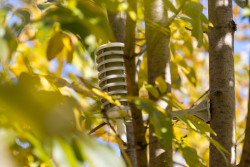
Weather sensor once installed. Photo: Tanya Xaybounheuang
This project is being delivered with funds from the NSW Government Smart Places Acceleration Program, part of the Digital Restart Fund.
more information
SIMPaCT Australia (Website)
awards
2024 AILA NSW Award of Excellence for Research, Policy and Communications – Winner
2024 Park & Leisure Australia Award – Finalist (commendation)
National Banksia Award 2024 – Healthy Planet, Healthy People Award (finalist)
National Banksia Award 2024 – Climate Technology Impact Award (finalist)
IoT Awards 2023 – Winner: IoT FOR GOOD
2023 World Smart City Awards – Finalist: ENERGY & ENVRIONMENT AWARD
InnovationAus 2023 Awards for Excellence – Winner: GOVTECH PROJECT & PEOPLE'S CHOICE
InnovationAus 2023 Awards for Excellence – Finalist: Industry 4.0
Banksia Foundation – 2023 NSW Sustainability Awards – Winner: PLACEMAKING
Banksia Foundation – 2023 NSW Sustainability Awards – Winner: CLIMATE TECHNOLOGY IMPACT
MEDIA
What award-winning sustainability looks like: SIMPaCT - Digital.NSW, December 2023
Maximising for coolth: How a popular Sydney park will create its own cool microclimate - Sydney Morning Herald, January 2022
RESEARCHERS



SDGs

This project is working towards UN Sustainable Development Goal 11.
Institute for Sustainable Futures; Urban systems
Research Centre
Year
- 2021-
Location
- Sydney Olympic Park
Client
- Sydney Olympic Park Authority
Partners
- NSW Department of Planning, Industry and Environment
- Sydney Water
- Western Sydney University