• Posted on 12 Apr 2023
  • Updated on 12 Apr 2023
  • 5-minute read

Using circular economy principles and practices to advance climate resilience and inclusion for WASH services.
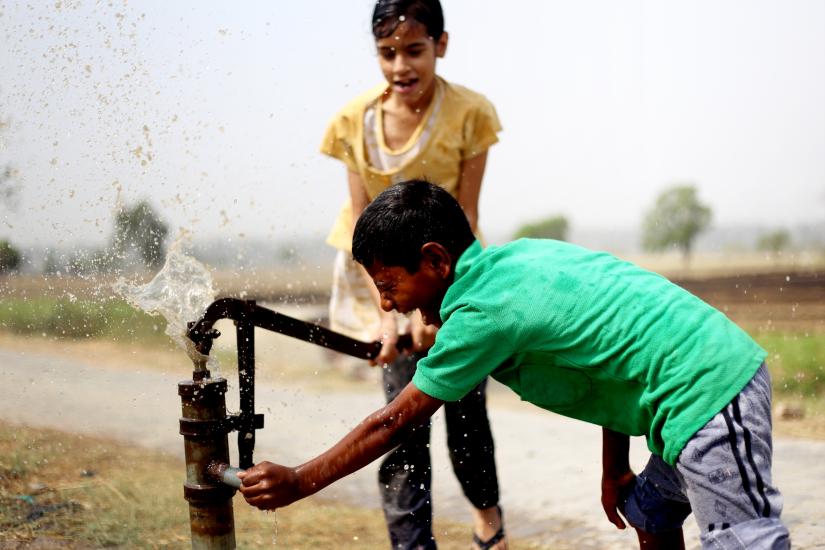
2 people and water pump

Circle WASH logo

Circular economy approaches can strengthen water, sanitation and hygiene (WASH) services while driving climate resilience, inclusion and wider sustainability. CIRCLE WASH is a two-year research project contributing new thinking and case study insights about the potential of circular economy ideas for WASH service systems.

Aims

  • Identify how WASH systems and services can draw on circular economy approaches to achieve inclusion and climate resilience.
  • Inform sector narratives about circular economy - emphasising system-wide perspectives, diverse circular options, progressive realisation, inclusion and climate resilience.
  • Bridge new thinking (conceptual developments) with practical realities (case study insights).
  • Inspire ideas, collaboration and action. Generate shared visions and coproduce knowledge about circular economy-informed pathways to realise inclusive, climate resilient WASH.

Activities

The concepts phase integrates ideas from circular economy, climate resilience and social inclusion – developing a conceptually rigorous and practically relevant frame to explore circular WASH opportunities. Timing: 2023.

Case studies in Vietnam (Ha Tinh Province) and Kiribati (Line Islands Group) will bring WASH and related stakeholders together to identify and assess a range of circular WASH opportunities for rural and urban contexts. Timing: 2023-2024

Collaborative visioning and knowledge co-production with institutions in case study contexts will articulate pathways to preferred futures. Timing: 2024.

All activities are underpinned by a transdisciplinary research approach prioritising collaboration and valuing diverse knowledge types.

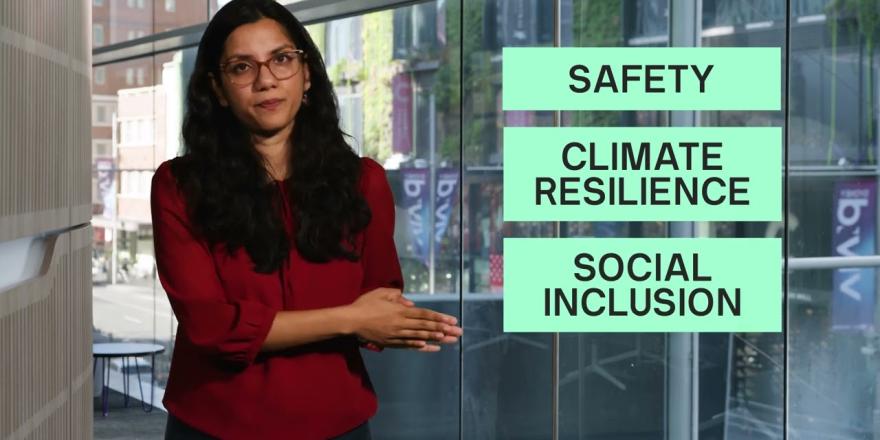
CIRCLE WASH explainer video
QRkaJZxotpQ

Transcript

Did you know that humans are naturally drawn to circular shapes? Psychologists have found that we associate roundness with warm, positive emotions. But circularity isn’t just about psychology—it’s a powerful way to rethink how we manage resources, including water and sanitation.

I'm Naomi from the Institute for Sustainable Futures at the University of Technology Sydney. In this video, my colleagues Avni, Jeremy, and I will introduce you to the 8Rs Framework—a tool designed to apply circular economy principles to water and sanitation.

Why should we care about the circular economy? For the water and sanitation sectors, circular economy principles can drive efficiency, resource recovery, and the regeneration of nature. They also directly contribute to multiple Sustainable Development Goals. By applying circular economy principles, we can align water and sanitation services with broader sustainability goals, ensuring both human and planetary health.

What is circular economy? At its core, circular economy is about systems change—decoupling economic growth from the consumption of finite resources. It's built on three key principles: eliminate waste and pollution; circulate products and materials at their highest value; and regenerate nature.

But these principles alone aren't enough. To realise the potential benefits of a circular economy in water and sanitation, we also need to consider safety, climate resilience, and social inclusion.

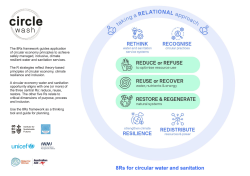
Where should we start? To drive meaningful change, we must first define the principles underpinning our ideal system. Our research identified 28 principles integrating circular economy, climate resilience, social inclusion, and safely managed water and sanitation. However, 28 principles are too complex for practical decision-making, so we created a mental shortcut to make them actionable—the 8Rs for Circular Water and Sanitation Systems.

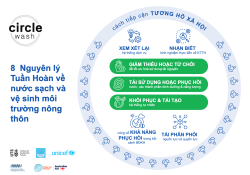
The 8Rs framework is a thinking tool that supports locally led application of circular economy strategies in water and sanitation. You’re probably familiar with the classic "Rs" of sustainability—reduce, reuse, recycle. The 8Rs build on this idea, tailoring it for water and sanitation.

There are two groups: Practical R Strategies and Purpose & Process R Strategies.

Practical strategies align with circular economy principles: - Reduce or Refuse focuses on eliminating waste and pollution. - Reuse or Recover ensures materials are circulated at their highest value. - Restore and Regenerate helps regenerate nature.

Purpose and Process strategies address inclusion and climate resilience: - Rethink challenges assumptions about water and sanitation systems, creating space for more creative thinking. - Recognise acknowledges that circular practices aren’t new, building on local knowledge while ensuring safety. - Resilience prioritises climate considerations. - Redistribute addresses inequalities in resources and power. - Relational Approach keeps the connections between people and their environments central to decision-making.

The framework can be applied to ideate a range of locally relevant circular opportunities, investigate the technical, financial, and social feasibility of opportunities, plan and implement circular strategies, or evaluate and ensure continued alignment with sustainability goals.

The 8Rs framework has already been tested in Vietnam and Kiribati. In Vietnam, government officials and researchers used the 8Rs to assess and optimise household greywater reuse systems. In Kiribati, stakeholders applied the 8Rs to explore local plastic recycling solutions for sanitation products. These examples highlight how the framework can be adapted to different contexts, making circularity a reality in water and sanitation systems worldwide.

So, how might you apply the 8Rs Framework in your work? To learn more, please get in touch. Let’s transform water and sanitation systems together.

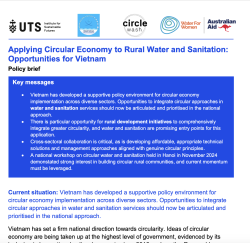
Report cover for the CIRCLE WASH policy brief.

RESEARCH OUTPUTS

Policy brief: Applying Circular Economy to Rural Water and Sanitation: Opportunities for Vietnam (2025)
(English) (Vietnamese)
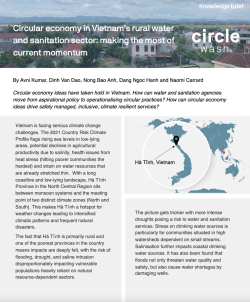
Screenshot of Circle wash masterslide presentation.

Circular Economy Water and Sanitation – Future Pathways in Rural Viet Nam (2024) (Masterslides)
(English) (Vietnamese)
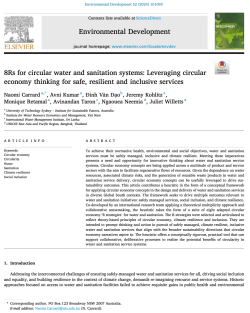
Report cover for CIRCLE WASH.

Report cover for CIRCLE WASH.

Circular Economy for WASH (2024) (Learning brief prepared with UNICEF East Asia and Pacific Region)
Report cover for CIRCLE WASH.

Report cover for CIRCLE WASH.

Report cover for CIRCLE WASH.

Report cover for CIRCLE WASH.

Report cover for CIRCLE WASH.

8Rs Framework for Circular Water and Sanitation (2023) (Framework in Vietnamese)
Report cover for CIRCLE WASH.

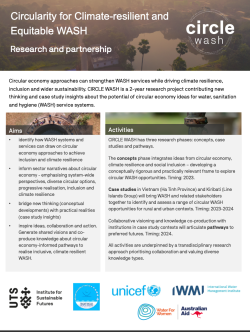
Circularity for Climate-resilient and Equitable WASH (2023) (Project brief)

Researchers

Naomi Carrard

Naomi Carrard

Research Director

DVC (Research)

Avni Kumar

Avni Kumar

Senior Research Consultant

DVC (Research)

Jeremy Kohlitz

Jeremy Kohlitz

Research Director

DVC (Research)

Juliet Willetts

Juliet Willetts

Professor

DVC (Research)

Monique Retamal

Monique Retamal

Research Director

DVC (Research)

Georgina Robinson

Georgina Robinson

Research Assistant

DVC (Research)

  • Dinh Van Dao
  • Dang Ngoc Hanh
  • Vu Thi Mai Hien
  • Avidandan Taron

SDGs  

Icon for SDG 6 Clean water and sanitation

Icon for SDG 13 Climate action

This project is working towards UN Sustainable Development Goals 6 and 13. 

Read about ISF's SDG work

International development

Institute for Sustainable Futures; International development

Research Centre

Year

  • 2023-2024

Client

  • GHD - DFAT Water for Women Fund

Partner

  • Institute for Water Resource Economics and Management (IWM)
  • UNICEF
  • International Water Management Institute (IWMI)

| Sustainability |


Share