


When Jaya Dadwal launched forEVA, she didn’t just launch a women’s health startup. She started a movement.
A graduate of the UTS Bachelor of Laws and Yale University’s Master of Public Health (Health Care Management), Jaya is the CEO and co-founder of forEVA, a biotech startup focused on women’s health. The company’s first product, FERN, is a smart toothbrush that analyses hormones like estrogen, progesterone, follicle-stimulating hormone and luteinising hormone in the user’s saliva.
Every time you brush your teeth, we run analytics on not only where you are in your cycle, what that means for ovulation and when you’re going to get your period, but also longitudinally, how these hormonal fluctuations are shaping your overall health.

Hormonal fluctuations impact every stage of women’s lives, from monthly shifts around menstruation to the longer-term transformations of pregnancy, postpartum, perimenopause and menopause. They can leave a lasting mark on almost every aspect of physical and mental health, but until now, women have had limited tools to decode them.
“What we’re trying to do to is give women a non-invasive way to track these fluctuations over time for a range of clinical applications,” Jaya says.
“FERN is a body demystification tool. Our goal is to unlock the self-awareness women need to be able to live not only healthy and happy lives but rich and flourishing ones.”
“Revolution requires rethinking”
Jaya’s passion for women’s health started during her time at UTS. As an honours student, she produced a thesis on the Australian Essure class action, which was launched on behalf of women who suffered complications from the Essure contraceptive device.
The class action was part of what Jaya saw as a bigger problem of women’s health technologies, many of which have been found over decades to be defective, hazardous or synonymous with significant side effects. Her thesis became the foundation for a bold idea: to create her own, non-invasive product that would empower women to take charge of their health on their own terms.
“Revolution requires rethinking,” she says simply.
The problem? As a law student, she didn’t have the clinical or technical knowledge to build the product on her own. As always, her solution was grand: she applied to do a Master of Public Health at Yale University, one of the world’s leading institutions (as she sees it, “women’s health is equal parts a legal issue and a public health issue,” she says). There, she was convinced she’d find herself a brilliant co-founder with the expertise her project needed.
It was a swing for the fences, but Jaya went for it, bolstered by the support she received from the UTS Law team.
Professor Penny Crofts, in particular, saw something in me that I didn't really see in myself at that time. She was incredibly supportive of my master's dreams.
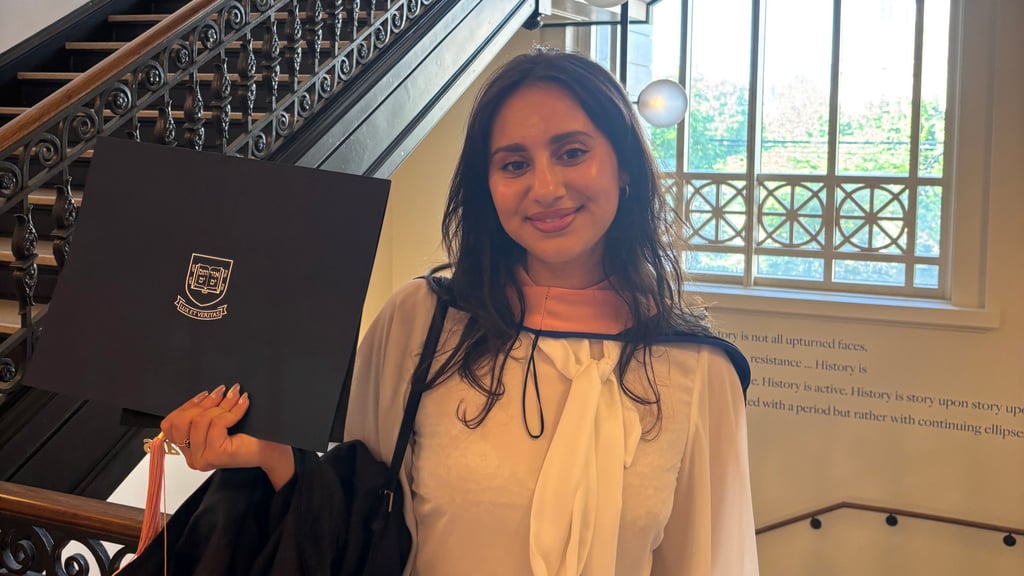
Building the foundations of start-up success
If you’ve learnt anything about Jaya Dadwal thus far, you can probably imagine what happened next: she got accepted to Yale, complete with the University’s prestigious Horstmann Scholarship; met her co-founder, biomedical engineering student Emily Deschenes, within a month of her arrival; and threw herself into building forEVA.

Nearly two years later, Jaya and Emily are in the early stages of opening their own lab, spinning out of Yale and into industry. Their current focus is on securing the next stage of forEVA’s growth. To that end, Jaya has been working on forEVA as part of Yale’s Tsai City’s Summer Fellowship, a prestigious, non-dilutive funded accelerator program that propels full-time students to full-time founders. Yale’s Tsai Center is the innovation hub where forEVA first started taking shape.
Jaya is also working on securing the company’s first round of angel funding. As CEO, she spends hours networking, pitching, speaking on panels and attending events to connect with prospective investors who share her passion for women’s health. Her UTS Law degree has been a useful tool in bringing people on board.
“I reference my thesis in nearly every investor call. Investors love a ‘nontraditional founder’. They’re really interested in the fact that I came from a law background and that I was looking at medical malpractice in my professional career,” she says.
“They appreciate that I also did a lot of research into women's health contraceptive and reproductive device class actions, so I have a good, strong understanding of why a lot of these products went wrong from a legal perspective.”
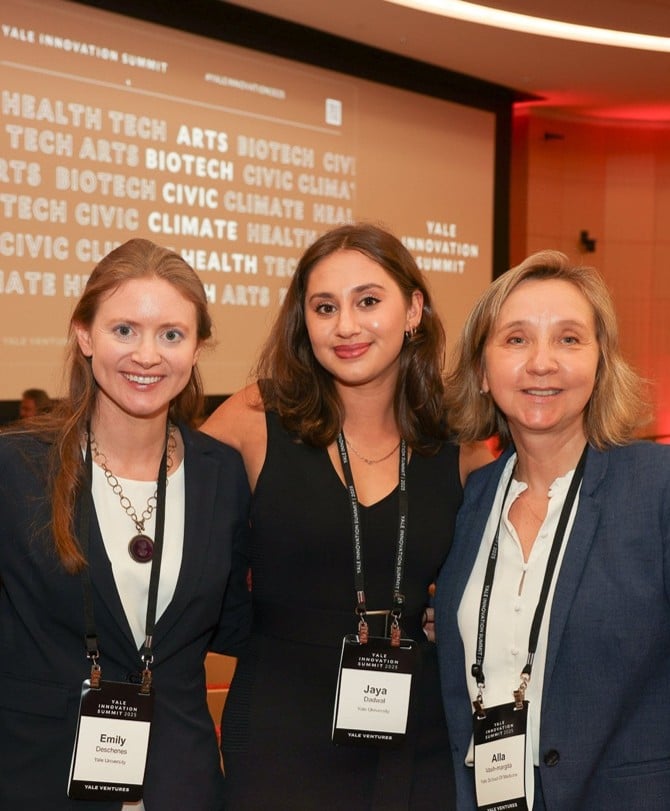

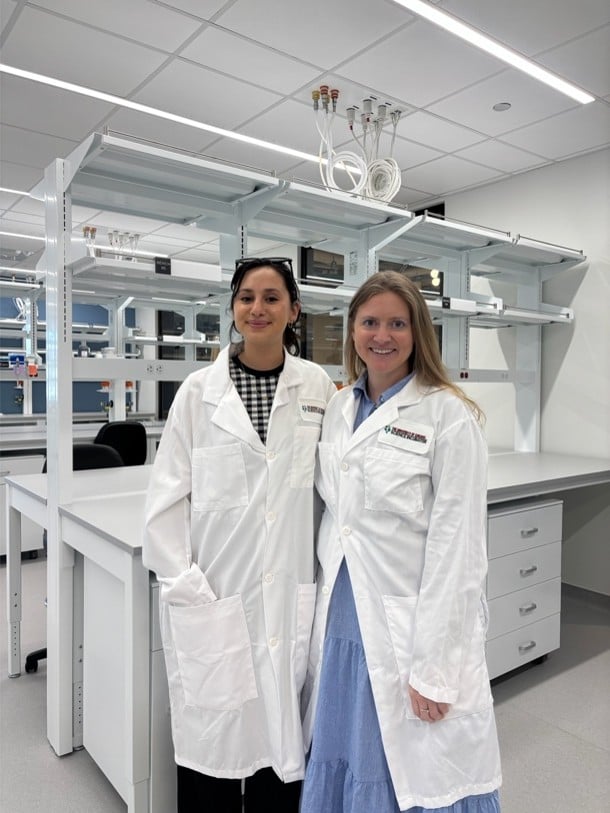
Jaya and Emily are now establishing ForEVA: networking, pitching for funding and working towards opening a lab
Taking an expansive view of the law
As forEVA continues to grow, supported by a team of UTS Marketing interns back in Sydney, Jaya’s profile as a start-up founder is growing alongside it. But her law degree is never far behind: recently, drawing on her legal expertise and the advocacy skills she gained as part of the UTS Law Mooting Team, she appeared before the Connecticut General Assembly to testify on two bills calling for better endometriosis and menopause support.
This crossover between entrepreneurship and the law has helped Jaya carve a unique professional niche. It’s something she wants other law students to consider, too. Pursuing a traditional law career path is just one way to leverage a law degree. Harnessing those same skills to tackle big, messy, human challenges is another.

I would encourage students to really explore all the different concepts or conceptualisations of law, both through their electives and by pursuing diverse professional and life experiences
“So much of what lawyers will be paid for in the future is the big picture strategy and being able to take a series of facts or pieces of evidence and spin a cohesive, compelling story. Those skills are valuable everywhere,” says Jaya.

At UTS Law, international travel is key to learning
From exchange and study abroad to overseas internships, faculty-led tours and global short programs, international opportunities are key to learning at UTS Law.

The law plus more: what will you learn in a law degree?
When you study Law at UTS, building legal expertise is only the beginning. Discover the additional skills you'll develop, to help you make an impact throughout...

Here's how mooting can make you a better lawyer
Discover how UTS Law students gain practical courtroom experience through mooting, building their confidence, advocacy skills and career-ready legal expertise.

Technology is transforming the legal sector. Graduates must transform too.
The legal sector is being reshaped by technology. Discover how UTS Law is preparing graduates to understand and use emerging technologies.
At UTS Law, international travel is key to learning
From exchange and study abroad to overseas internships, faculty-led tours and global short programs, international opportunities are key to learning at UTS Law.
The law plus more: what will you learn in a law degree?
When you study Law at UTS, building legal expertise is only the beginning. Discover the additional skills you'll develop, to help you make an impact throughout...
Here's how mooting can make you a better lawyer
Discover how UTS Law students gain practical courtroom experience through mooting, building their confidence, advocacy skills and career-ready legal expertise.
Technology is transforming the legal sector. Graduates must transform too.
The legal sector is being reshaped by technology. Discover how UTS Law is preparing graduates to understand and use emerging technologies.