

RMB internationalisation, digitisation and de-dollarisation: What Australians need to know

WHEN

18 November 2025
Tuesday
12.30pm - 1.30pm Australia/Sydney


WHERE

Online

COST

Free admission

Since Sydney was designated an official offshore renminbi (RMB) hub in 2014, Australia has held a unique vantage point in observing and participating in the People’s Republic of China’s (PRC) currency internationalisation.

While RMB use in trade and investment has grown steadily, it remains modest. A new report, RMB Internationalisation in Australia’s Trade and Investment with China, supported by the Australia-China Relations Institute at the University of Technology Sydney (UTS:ACRI), examines why this is the case. It presents the latest data and firm-level insights into the opportunities, barriers and strategic considerations for Australian and Chinese businesses.

The international financial system is also being reshaped by two powerful trends: digitisation and de-dollarisation. Digitisation extends RMB internationalisation beyond trade and investment flows to the very infrastructure of money. The PRC's central bank digital currency enables cross-border transactions that are faster, cheaper, and less dependent on traditional Western financial networks. Meanwhile, growing geopolitical tensions and sanctions risks have accelerated de-dollarisation efforts among emerging economies, with the RMB increasingly used in bilateral trade settlements and regional payment systems.

RMB internationalisation is therefore no longer just about the volume of RMB used abroad, but about who designs and governs the systems that move money globally and how shifts away from the US dollar reshape the balance of financial power.

UTS:ACRI hosted a webinar examining the complex and evolving role of the RMB and what this means for Australia.

The panel comprised report co-authors Dr Wei Li, Senior Lecturer in International Business, University of Sydney Business School and Professor Kathy Walsh, Associate Dean (Research and Innovation) UTS Business School and UTS:ACRI Research Associate; Dr Michael Murphree, Senior Lecturer in International Business, University of Sydney Business School; and Dr Marina Yue Zhang, UTS:ACRI Associate Professor - Research. 

About the speakers

Dr Wei Li

Wei Li is a Senior Lecturer in International Business at The University of Sydney Business School. Her research interests are the globalisation of Chinese enterprises and economy, RMB internationalisation, Asian diaspora entrepreneurs, and renewable energy transition in the Asia Pacific region.

Since 2011, Dr Li has co-led KPMG’s annual Demystifying Chinese Investment in Australia report series, a flagship publication informing government and industry. Her scholarly work has appeared in leading journals such as The China Quarterly and Ecological Economics. She has received multiple awards and competitive research grants from both government and industry bodies, and is a frequent commentator in national and international media.

Dr Li currently serves as Program Director for the Master of International Business and is the inaugural Program Director of the Executive Global Unicorn Program—a strategic partnership between The University of Sydney Business School and Cheung Kong Graduate School of Business—supporting high-growth ventures and cross-border leadership development.

Dr Michael Murphree

Dr Michael Murphree is a Senior Lecturer in the Discipline of International Business at the University of Sydney Business School. He has a PhD in International Affairs, Science and Technology from the Georgia Institute of Technology and a Master in International Affairs from the Georgia Institute of Technology. Dr Murphree is interested in foreign direct investment and local economic upgrading, extractive industries and international entrepreneurship in country-specific and comparative perspectives.

Dr Murphree’s research objective is to generate findings which can help firms and government authorities harness the benefits of foreign investment and technology development to facilitate broad prosperity. His research has been published in international journals such as Research Policy, Journal of Product Innovation Management, Harvard Business Review, Journal of International Management, Journal of International Business Policy and Journal of Technology Transfer. His first book (co-authored with Dan Breznitz) – The Run of the Red Queen: Government, Innovation, Globalization, and Economic Growth in China, was published in 2011 and was the winner of the 2012 British International Studies Association Susan Strange Best Book Award and bronze medalist for the 2012 Axiom Business Book Award for International Business/Globalization.

Dr Murphree has developed courses on comparative innovation systems and globalisation which help students better understand both the impact of the global movement of goods on economic and social development and the sourcing, management and development of knowledge in a global context. He serves the academic community as an editorial board member at the Journal of International Business Policy and Journal of International Management. In 2020, he was awarded the Industry Studies Association Emerging Scholar in Innovation and Entrepreneurship Award.

Dr Marina Yue Zhang

Dr Marina Yue Zhang is an Associate Professor at the Australia-China Relations Institute, University of Technology Sydney (UTS:ACRI).

Dr Zhang holds a bachelor's degree in biological sciences from Peking University and an MBA and a PhD from the Australian National University. Before joining UTS, she held academic positions at Tsinghua University, UNSW and Swinburne University of Technology.

Her research interests cover digital transformation, emerging technologies, and latecomer catch-up in innovation. Specifically, her research investigates innovation in advanced manufacturing, semiconductors, biopharmaceuticals, new energy vehicles, and the global value chain (GVC), exploring their impact on Australia-China relations.

Dr Zhang is the author of three books. Her most recent, Demystifying China's Innovation Machine: Chaotic Order (304pp), with Mark Dodgson, and David Gann, was published by Oxford University Press (2022). The book was endorsed by Lee Howell, Senior Advisor & Former Managing Director, World Economic Forum, and Justin Yifu Lin, Institute of New Structural Economics, Peking University, Former Chief Economist, World Bank.

About the moderator

Professor Kathy Walsh

Kathy Walsh is a Finance Professor and the Associate Dean (Research and Innovation) at the UTS Business School and has a critical role in fostering a vibrant research culture of rigorous, relevant and impactful research. Professor Walsh is widely recognised for her pioneering research in the field of Chinese capital markets, with a particular focus on the internationalisation of the Renminbi (RMB). Her work explores the motivations behind China's push to promote the use of the RMB in international trade and investment and its efforts to digitise the currency. She also analyses the implications of these developments and the challenges and opportunities for global markets. Her insights have helped guide financial institutions in their strategic planning and risk management efforts.

Professor Walsh holds a PhD in finance from the Australian Graduate School of Management and a first-class Honours Degree in Finance from Curtin University. Her academic career spans over two decades, during which she has held various academic roles such as the ANU, Sydney University and UNSW. She has also served as the Research Director for the Centre for International Finance and Regulation and as the President of FIRN. Prior to her academic career, Professor Walsh worked for 10 years in the financial services sector and this practical experience has greatly informed her research.
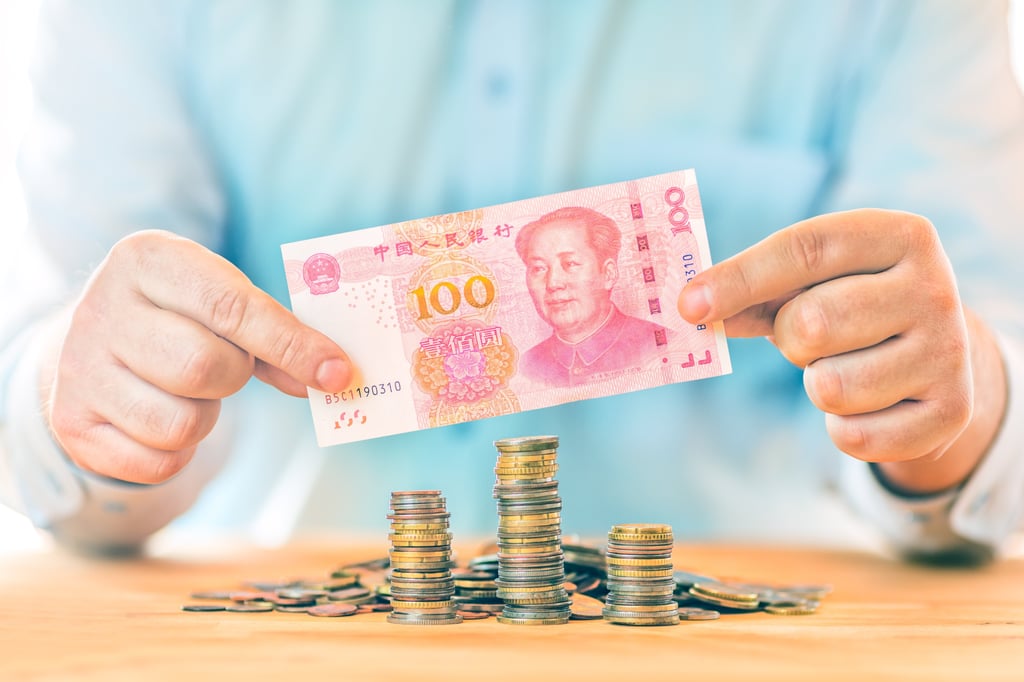
Hand holding yuan note

Video

Video transcript

E&OE | Check captions against delivery

Ms Amy Ma:

Good afternoon, members of the audience and special guests. Before we begin the proceedings, and on behalf of all those present, I would like to acknowledge that this webinar is hosted on the lands of the Gadigal people of the Eora Nation. I would also like to pay respects to the elders past, present, and emerging, acknowledging them as the traditional custodians of knowledge for this land.

This session will now be recorded. We'll record audio, screen share, and our presenters. We will not be recording any video or audio input from the audience.

Welcome to all, students, staff, and all friends of the Australia-China Relations Institute at the University of Technology Sydney. My name is Amy Ma and I am the events and communications officer at UTS ACRI.

UTS:ACRI is an independent non-partisan research institute established in 2014 by the University of Technology Sydney. UTS:ACRI is Australia's first and only research institute devoted to studying the Australia-China bilateral relationship. UTS:ACRI seeks to inform Australia's engagement with China through research, analysis, and dialogue grounded in scholarly rigor. More details are available on uts.edu.au/acri.

Today, UTS ACRI brings together Dr. Wei Li, Dr. Michael Murphreem Dr. Marina Zhang, and Professor Kathy Walsh, to examine the complex and evolving role of the RMB and what this means for Australia. They will discuss RMB internationalization, digitization, and de-dollarisation, drawing on findings from a new report, RMB internationalization in Australia's trade and investment with China, which is supported by UTS ACRI.

Professor Kathy Walsh will be moderating this discussion. Audience questions are welcome at the end, so please remember to submit your questions using the Q&A tab along the bottom panel of this webinar.

Now a little about the speakers. Dr. Wei Li is a senior lecturer in international business at the University of Sydney Business School. Since 2011, Dr. Li has co-led KPMG's annual Demystifying Chinese Investment in Australia report series, a flagship production informing government and industry. She has received multiple awards and competitive research grants from both government and industry bodies and is a frequent commentator in national and international media.

Dr. Michael Murphree is a senior lecturer in international business at the University of Sydney Business School. He has a PhD in international Affairs, Science and Technology from the Georgia Institute of Technology, and a master of international affairs from the Georgia Institute of Technology. Dr. Murphree is interested in foreign direct investment and local economic upgrading and international entrepreneurship in country-specific and comparative perspectives.

Dr. Marina Zhang is an associate professor at UTS ACRI. She holds a bachelor's degree in biological sciences from Peking University and an MBA and PhD from the Australian National University. Before joining UTS, she held academic positions at Tsinghua University, UNSW, and Swinburne University of Technology. Her research interests cover digital transformation, emerging technologies, and late-comer catch-up in innovation.

Our moderator for today's discussion is Professor Kathy Walsh, associate dean of research and innovation at the UTS Business School, and UTS ACRI research associate. Her academic career spans over two decades during which she held various academic roles at the ANU Sydney University and UNSW. She has also served as the research director for the Centre for International Finance and Regulation, and as the president of the FIRN. Prior to her academic career, Professor Walsh worked in 10 years in the financial services sector, and this practical experience has greatly informed her research. I will now hand it over to Professor Walsh to begin today's discussion.

Professor Kathy Walsh:

Thanks so much, Amy. And I also want to say thank you that I'm here on beautiful Gadigal land here in Sydney and welcome you all to the event, and very much want to say thank you to UTS ACRI for both supporting our research and also bringing this session together.

So as you've just heard, we've got this fantastic panel of Wei, Michael, and Marina who've got some deep expertise in the area of RMB internationalization and what that means in the context of digitization and de-dollarisation, which is what we're going to be delving into that today. So thank you very much for bringing your expertise to the panel and I'm going to jump straight in.

So Marina, let me start with you. Before we get into the Australian context, which I think that's what we are really concerned about, let's get a big broader picture of on the fundamental level. What is RMB internationalization and why does it matter on a global scale?

Dr Marina Yue Zhang:

A very big question, Kathy. So RMB internationalization is generally a process by which the RMB, that's China's currency, moves from being a domestic currency to being used outside China for pricing, paying for, and financing cross-border transactions, and for some countries also being a reserve asset by the central banks.

So this movement obviously has significant consequences globally, but we don't expect a very sort of abrupt shift. I mean the US dollar is being replaced by RMB, that's not likely to happen within the short space of time. And a very central challenge in this RMB internationalization is, well, there are several challenges and especially to coordinate all stakeholders together. I mean the reality is established financial institutes, banks, regulators, and increasingly tech companies in FinTech. And to coordinate these multiple stakeholders to harmonizing a sort of standards is long-term challenging. Yeah, so that's sort of very big question, very brief answer.

Professor Kathy Walsh:

I imagine that we added complication because this is the first time we've seen an internationalization of a currency at the same time as China's holding the capital controls. We've not seen that in prior internationalization processes? Does that add a complication to this or is it something they're managing quite well?

Dr Marina Yue Zhang:

Well, China has been using a different route in terms of its currency management because we know there is a sort of impossible triangle trinity where most countries actually choose for China because as we know, China is the largest trading partner for most countries in the world. So therefore China has to control its currency in the way that China's currency will. China will not experience this very abrupt and uncontrollable volatile capital flows. So that's why China is maintaining this sort of dual tracks and we see China using quite smart measures to manage its currencies. For example, some foreign investors now, they're allowed to invest in China to hold RMB onshore, but meanwhile China is also increasing its offshore RMB in regions like Singapore, Hong Kong, and London. And China is also increasing its RMB pricing and payment financing in commodity trades. I mean in Russia, in Middle East, Iran, we know that. And increasingly now we see China is demanding its trade partners to dock to settle in RMB. BHP is a good case. I can talk about that later.

Professor Kathy Walsh:

Yes, I'll pick up on that point. I think pricing and pricing conventions are a really important part of how this might transition, but let me just jump to Wei now.

Wei, you've done some deep research in this over the last 10 years, and this most recent report that's coming out I think has a lot of perspectives from Australian and Chinese businesses. Can you tell us what are the main findings of that report please?

Dr Wei Li:

Yeah. Well thanks Kathy. Actually, I'd like to acknowledge you as the co-author as well as Dr. [inaudible 00:09:18] who's also the co-author of the report. And I also like to acknowledge ACRI at UTS as well as the China Study Center for supporting the research here. I think it's really following your footsteps, Kathy, when you actually, 10 years ago, when Sydney was announced as an official offshore RMB hub in 2014, and you and your colleagues have done amazing research about talking about the potential opportunity that exists for Sydney as well as Australia in the process of RMB internationalization.

I think 10 years later, it is actually a good time to reflect on what have been the progress that made as well as what are some of the opportunities and barriers exist in this space. So that's where we started the report. And quite interestingly, I think what we have found in the research is that the RMB usage in Australia-China trade remained quite modest and also highly uneven. So despite that China being Australia's largest trading partner, and we talk about Sydney as a destination for an offshore RMB hub in 2014, RMB invoicing is still very low overall. So if we are looking through data from 2023 to 2024, only 0.2% of the Australian total merchandise exports and 1.4% of the imports by value were invoiced in RMB.

So there's a bit of usage concentrated in some niche areas, but it's not something that actually across wide range of industries that RMB has been used as a trade invoicing.

The same passion also happened when we are looking through RMB financial activities as well. So if we're looking to RMB denominated deposit and loans in Australian residence financial institutions, so it has reached to around $10 billion, but a very, very steady steadily slow increase over the years. And it is mainly driven by trade-related lending and associated deposits.

One other thing was quite interesting, if we look into Australian banks, their usage of dim sum bonds market in Hong Kong, that up to 2025 we see their 32 outstanding RMB bonds that were raised by Australian banks. However, if we look into PRC banks in Australia, so those are Chinese banks that have Australian branches, their speed of expansion is actually much faster and they are over around a hundred RMB bonds outstanding from corporations registered in Australia by headquarters overseas. So we assume that most of them are actually PRC banks.

Finally, I think we also, as part of the research, we have done some interviews as well looking into Australian companies and also Chinese companies in Australia about their usage of RMB. And it is also finding that there are huge amount of benefits as we are seeing that there are more actually trade warnings between Australia and China. And also the infrastructure is improving. However, there also require a lot of barriers as well for companies taking up. And I think the usual consideration about the capital control as well as when we look into some of the industries that are very much heavily used USD as a benchmarking in commodities, for example, will be one of the key barriers.

The other thing was quite interesting is that there's quite a lot of discussion about Australian companies being quite risk averse, and also Chinese companies as well. So each side is waiting for the other to move first seems to be a phenomenon that we are looking at now. There's quite a lot of discussion also about Chinese companies as well as various particularly state-owned enterprise actually look at the centralized treasury controls in state-owned enterprise as a way that headquarter wants to actually make sure that subsidiaries are behaving in a way that actually don't take too much risk in their currency exchange. And also a lot of centralized mechanism that being put place within state-owned enterprise to make sure that currencies are managed centrally. These give small amount of autonomy to local subsidiaries to be able to adopt RMB in their daily transactions as well.

So yeah, there's quite a lot of challenge to remain on the ground. That's what we identify. But I think as we seen over the last couple of years that the Australian-China relationships is improving at multiple level, I think there seems to be more opportunities that looking ahead in terms of where Australian companies and Chinese companies can collaborate in this RMB internationalization space.

Professor Kathy Walsh:

Thank you. Interesting you say that because that waiting game was something we experienced 10 years ago. And if you had a... Well, actually I was asked 10 years ago, what did I think would be the progress of RMB internationalization in 10 years, I'd be like, "Oh, we're done by 10 years. By 2024 we'll be pricing many, many things in RMB," but clearly we're not there. But you picked up on a really important point at the end there, whereas this can sometimes help the relationship with China in that sort of moving beyond trade and finance to a bigger ecosystem of how we transact. So I might come to you then, Michael. So what do you think this means? How important is it for Australia and how important is it for the relationship with China?

Dr Michael Murphree:

Sure. Thank you so much Kathy, and also to Amy and the organizers for bringing me onto this panel. So thank you to ACRI for organizing this, but I'm going to be putting on my political economist hat for this type of question, so I'm going to step out of my business mode and go back into where I was as a PhD student.

So in brief, the internationalization of a currency is a major aspect of national power, and so it is a source of influence and control. If you go back to the 1970s, Susan Strange, a very famous professor or scholar of finance who was also a bit of a gadfly in many of her claims, but brilliant as a scholar, made some interesting comments about the nature of internationalization. And one of the things that was discussed is that it's an extent of national power, but it also takes a high degree of international power of the country and a willingness to project that power in order to establish and maintain an international currency.

And the examples that she was using looking across the 1960s was the continuation of the British pound and the French franc in their former empires after the collapse of the empire. And the argument was that to enforce an international currency takes a willingness to use military force as part of the incentive packages. So it's use our currency for trade, for your international trade settlement, or we will either intervene in ways you don't like or we will remove the security guarantee that we are offering to your country presently. As many knows, that especially in French West Africa, the French military has been a guarantor of their security up until very, very recently. So this was part of their source of power.

So in the case of the China-Australia relationship, the main difference that we need to be very cognizant of is China has shown zero interest to date in using its military in any way to advance the cause of RMB internationalization. So this particular element of national power for encouraging, promoting or forcing the use of the currency is simply not there.

The translation for Australian and Chinese relations is that while there may be potentially benefits to an increased use of the RMB by Australian firms, given that China is the largest trading partner for Australia, and in many critical sectors, especially our all important natural resource sector, China is the main buyer.

That being said, as we will discuss later on, these markets are still predominantly made and denominated in non-RMB. And therefore the use of the RMB, while it may ingratiate one with the authorities in Beijing, many of the Chinese partner firms as we've discovered in our research, are actually not particularly keen on the use of the RMB even when they're a state-owned enterprise.

So one of the challenges is that while in principle, it would tighten the economic and even political relations between Australia and China to increase the use of the RMB. At present, there doesn't seem to be much demand from the private sector for doing so, but also there isn't much of a downside politically for not doing so either.

Professor Kathy Walsh:

And interesting and picking up on Wei's point earlier that we're doing transactions with China in very, very small amounts. It's like the firms are getting themselves ready just in case that power comes, they've got systems in place, everything is kind of been tested, but they're not really launching into it if they don't want to. But you might see something different I suppose with the Belt and Road Initiative more regionally rather than just in Australia or China, would you say that?

Dr Michael Murphree:

Precisely, and that's an interesting point that in a future extension of this research, we have discussed pending time resources and other aspects looking at Belt and Road Initiative countries, particularly in Southeast Asia and Africa. And whether or not the extent of RMB adoption is greater there, which is going with that Susan Strange framework, there is a greater extension of Chinese hard power and a much greater economic tie, a direct one through infrastructure provision, which might encourage greater use of the RMB.

This is where we are most interested to find out is while Chinese enterprises in Australia are still largely interested in using whatever is the dominant currency for either their industry, which is often the US dollar or locally, which will be the Australian dollar. Or if in these other contexts there what perhaps the local currency is very weak and maybe not even desired by local partners, then you might see greater appetite for use of the RMB. But at present, aside from some anecdotal references that we use the RMB but not in Australia, this has not been widely seen.

Professor Kathy Walsh:

I think, yeah. When you're talking about RMB internationalization, it needs to be used offshores by non-residents for it to be truly internationalized.

Dr Michael Murphree:

Yes.

Professor Kathy Walsh:

Just by being used by Australians in China, it's not sufficient for that.

Dr Michael Murphree:

Right. The real test of a true international currency is when you would see a trade deal between an Indonesian firm and a Filipino buyer being settled in RMB, that would be the true state of it becoming a true international currency. And we are a long, long way from that stage.

Professor Kathy Walsh:

Except, and this is sort of moving to the next phase of the discussion, is that if this is not just a trade discussion or a financial markets discussion, this is then sort of a digitization of the financial markets discussion. And I might come back to you, Marina, and just give me a perspective on what you think the digitization of the financial markets is and then what that means for this relationship.

Dr Marina Yue Zhang:

Well, that's a very good question. So that goes back to my PhD in which I actually started mobile payments. So the digitization of currency actually is more than crypto, and it includes both public and private initiatives. And it covers three layers. I mean, where in the future if we all currencies go digital, that means money, assets and market infrastructure, that payment infrastructure will become digitalized.

So that means that gives businesses, consumers always on and smooth seamless transactions. All those sort of sounds quite a science fiction novel type of things, but it's happening actually. So from the very early stage, we're talking about digital interface and we use Apple Pay. So that is just the interface. That means your money actually is due, the physical money, but only in the internet or mobile internet is transferring them online. And then digital infrastructure, that is a second that's more critical.

And increasingly, we have seen countries actually, they have adopted this, especially cross border interbank payment systems that will enable a digital currency to transfer. I mean, one initiative is called Land Bridge. So that is initiated by China, Hong Kong, Saudi Arabia, and a few other countries.

And then the last, the core is digital forms of money and assets. That means money. If we use digital currency, that means we're not just transferring money through the internet, actually money becomes computer codes. So they become programmable. And even the digital infrastructures become programmable. So that means for smart contracts and smart payments, settlements will become a norm. So that is kind of a new trend driven by especially digital technologies, infrastructure technologies, and increasingly FinTech startups, technologies. So that's a big asset.

Professor Kathy Walsh:

I imagine that the country that is most advanced in this space might help to then set the architecture for how things might look in the future, right? So let me come then to you, Michael. If you're thinking about things, and we just sort of touched on there, the idea of a central paint digital currency, how might that change the way we actually do banking across borders?

Dr Michael Murphree:

Certainly. And so this idea, a subset within this idea of digital currencies, we often think about the highly decentralized nature of these digital technologies, and so we immediately think towards cryptocurrency. But the fact is that central bank digital currencies are still fiat currencies. They are still controlled by the sovereign government that is issuing them. And as Marina just mentioned, since they are programmable, you have a high degree of control over this currency.

The Chinese yuan is arguably the most advanced in terms of its implementation because the Chinese yuan has actually moved somewhat beyond the interbank transfer stage of it and is actually trying to be used as a personal currency used for personal transactions, whether between firms or between individuals. Indeed, in September this year, an entire new international operations center for this digital yuan opened up in Shanghai.

So should it be globally implemented? We would definitely see a major change for Australian firms that are adopting this digital yuan in contrast with even the current offshore yuan. So currently with the offshore yuan, even though it's the Chinese currency, and even if you're trading with a partner in China, settling in the currency, it still has to go through the standard gatekeepers and checks and costs and delays of an interbank transfer and approval and settlement system.

A digital currency, a digital RMB would be theoretically completely instantaneous because you're not transferring the right to an asset. You're actually transferring this digitized asset with control. And should there be fraud in theory, you could delete the asset because it's a digital piece of code, it could even be deleted. So arguably, an Australian firm using digital yuan would reduce their currency fluctuation risk vis-à-vis their partner in China. It could be more efficient and certainly would be at lower cost, but we are definitely not yet there.

Central bank digital currencies are an interesting area of speculation. And as Marina just mentioned, in many ways, highly science fiction. We're definitely approaching the William Gibson world in many ways. But at present, the appetite for using it remains very much even within Chinese firms. This is interesting, but we really like WeChat Pay and Alipay, even though those are just, again, the rights to an existing asset. But that's a first step perhaps when you've gone completely digital in your movement of money, the next logical step would be to move to a fully digital money, but we're not quite there yet.

Professor Kathy Walsh:

And if I think WeChat Pay and Alipay sort of adopted that digital currency within their platforms, that would get you through the inertia of changing systems, which you don't really want to do. But you've picked up on something interesting there about the banks and the opportunities. If we had a cross-border trade, say between Australia and China and you didn't need a corresponding banking system, that completely changes the financial architecture of how we actually do that, reducing the cost. Yes. But way picking up from what you were saying before about the banks, and I wouldn't say missed opportunities, but there's a scope for opportunities. Did anything come out in the report specifically around digitization and the use of CBDCs and things like that that you can comment on?

Dr Wei Li:

Yeah, well, I think there's a couple of things that actually when we look at the report findings in terms of what has been changing over the last 10 years, I think our comment on the digital currency point later, but there's three main themes actually coming out as what has changed over the last 10 years. Firstly, is that when we are now looking into the Chinese policy actually, in terms of how its approach to RMB internationalization, I think certainly there's a lot more actually emphasized from the Chinese government's side to actually support RMB as an international currency.

And in some of the recent document actually, particularly there was discussion about the focus should be on two areas. One is on the Belt and Road countries that has just been discussed. The other one is actually, funny enough, in commodity that where Chinese governments seen that these are the two priorities areas for RMB internationalization.

The other thing that has evolved quite a lot over the last 10 years is that from our research, we've seen that for companies, if they have a high concentration of supply chains that are based in China, and then in the end actually a lot of those companies in their exporting or insurance, Australian company importing from China, from those type of companies, actually, RMB becomes a much better commercial case for them, because managing their supply chain costs become easier.

And now increasingly, we're seeing a lot of sectors that are emerging from China where it has a very high supply chain concentration in China. So one of the good example is electric vehicles also, when we are looking into areas such as machineries and equipments, and those are the areas where China do have a high concentration of supply chains, where the usage of RMB as a commercial case becomes clearer.

I think the third thing recent change is about the rates, borrowing rates. Now, coming from our interviews that, obviously, the RMB borrowing rates being actually lower than some of the alternatives, especially in comparison to the US dollars. And that gives companies, again, at a firm level, a commercial kind of reason to engage with RMB.

In terms of when you talk about the Australian banks, I think there's a bit of a missed opportunity when we come out of the reports findings where I gave the example about the dim sum bonds in Hong Kong, its insurance is actually much lower than some of the Chinese banks that are actually operating in Australia.

The other thing is that even when we look at some of the capabilities of Australian banks, we recently talk a lot about Australia's sovereign China capabilities, but when we look at Australian banks, I think a lot of the RMB capabilities probably is not being actually invested enough in the sense that there's a lot of discussion about Australian-China trades, but in terms of the bank sectors, how to actually actively participate in this offshore RMB funding markets from the Australian banks and trade finance, cash management, forex, and the relative products. So I think a lot of those areas is also not so much in the discussion space.

And finally, going into digital currency, I think there's lots of movement this year, particularly related to stable coins, that once it's been legislated in the U.S. And I think there's a lot of new policies as well in Australia about actually stable coins being actually seen as more as a legitimate kind of digital currencies now in Australia. But there's very little discussion, again, to see that, actually, how do stable coins enable Australian companies to be more dominant in the region that we are trading with? Because we have the legal system, we have the digital infrastructure and everything. And how does that actually link to the digital currency of RMB, the yuan? I think that has not been discussed so much.

So I think there's huge amount of capability as well as knowledge gap that is existing here, and I think there's more discussion like this will be very helpful.

Professor Kathy Walsh:

And one of the, I suppose, big theme that's coming through that we're seeing a lot of is this concept of de-dollarization and actually moving away from the U.S. dollar towards not necessarily the renminbi but to other currencies as well, just to diversify holdings away from the U.S.

Is this something that intersects with the RMB internationalization? Can you give me a bit sort of perspective of your thoughts around, excuse me, de-dollarization globally? Oh, to Wei. Sorry. Yes. Go back to you.

Dr Wei Li:

[inaudible 00:32:29]. No worries. I think that when we're looking through different markets, obviously there's different consideration about de-dollarization, right? So I think at the moment, when we're looking to some of the market, for example, that have been sanctioned by the U.S. and also by some of the European countries, I think de-dollarization really come as a security, a national strategic perspective. And then I think the alternative of using whatever other currencies that is available, and whatever bank infrastructure that is available becomes something as an imperative.

I think in Australia, what we've seen in the market that we're seeing is actually de-dollarization is more probably driven by commercial case rather than actually driven by a political or strategic consideration. So I think there's a lot of companies are thinking about using RMB in our recent discussion with Australian companies as well as Chinese companies.

But again, the kind of motivation goes back to what Michael has discussed about. It was very much companies looking into the cost structures of financing and companies looking at their supply chains. Where do they actually procure equipments and procure actually raw materials? And also companies looking into, actually, China's strategic priorities in terms of some companies want to increase their assets to the Chinese market and also want to build a better client relationship with the Chinese companies in China. And therefore, they actually prefer to use RMB as [inaudible 00:34:14] currency.

Especially, I think, in Australia it is very much driven by commercial consideration, and in the sense that actually seeing it as a diversification of currency from a corporate perspective is something that reduce risk and it is something that increase flexibility and agility for Australian company, which it becomes very important under the current geopolitical environment.

Professor Kathy Walsh:

I think the whole commercial case, I think, is very important there. Just sort of understanding whether or not it's valuable to the organization. And I think part of it, and I'll come back to you, Michael, and then to you, Marina, next, is that the stickiness of this often relies around where the pricing systems work and the inertia around changing pricing systems.

So, Michael, can you sort of give us some perspective on how that works?

Dr Michael Murphree:

Certainly. So what we have in the global political economy of trade, especially in large commodities, we're talking about energy, we're talking natural resources, talking agricultural commodities, is that the global markets for these tend to be denominated in U.S. dollars. And this is, in many ways, an artifact of 50 years or 80 years of United States economic dominance of the global financial system entirely back when it was the only convertible currency convertible into gold pre-1970s, and then post-Nixon shock where it was still the world's largest, by far, economy in the world.

What it means is that if you trade in contracts denominated in dollars, you have an advantage in that those contracts are easily convertible, you can easily sell them onto somebody else on a financial market, the secondary markets of contracts for some actual real good, but more critically, if you actually get the money, the physical currency, it's very useful. If you're an oil company, a gas company in Western Australia, and you receive payment in U.S. dollars, you can easily use that with any of your global suppliers or partners around the world to buy whatever you need, or you can turn around very easily and reinvest that globally in some sort of financial asset, depending on how you wish to settle your cash.

RMB, in contrast, other than if your relations are almost exclusively, as Wei has mentioned, with partners and suppliers in China, you don't have a lot of utility for that RMB in your bank account other than to then reconvert it back into either Australian or U.S. dollars. And with every conversion you incur a conversion fee and you also are exposed to a currency exchange risk. So keeping U.S. dollars, you know you can use those. And so there's a very high degree of inertia in these markets because those dollars are so useful beyond their use as a trade currency. And that is [inaudible 00:36:57].

Professor Kathy Walsh:

And I would also add from an Australia perspective, a lot of companies in Australia either sell to or buy from China. So they don't even have it on both sides of their balance sheet. So the idea of holding it doesn't really have that same need.

So, Marina, let's [inaudible 00:37:12]. Just give me thoughts as well around that whole idea of will we eventually see these large, especially commodities, priced in renminbi, and is that going to be a structural shift or is that just a normal sort of swing of the markets?

Dr Marina Yue Zhang:

First of all, thank you, Wei and Michael, for sharing your thoughts. I totally agree with you.

At the moment, I don't think this de-dollarization is structural. It's more a rhetoric, if we say that. The reason is... There are two factors. First is we judging by behaviors of users in trade, in foreign exchange. As Michael said, I mean, traders between Indonesia and the Philippines, if they choose to use U.S. dollars, well, that's the dominant currency, right? And we haven't seen such behavior changes in trade.

Second, non-dollar infrastructures is not existing yet. I mean, I can't remember the number. I mean, the majority of trade still goes through dollarized infrastructure. But we do see a bit of a change and maybe emerging trends. As Wei mentioned, I mean, most de-dollarization, actually, is concentrated in sanctioned economies, Russia, Iran, and we see RMB settlement between oil trade, between Russia and China for oil trade, and Iran and China for oil trade. But increasingly, we see a kind of a selective trade corridors, I mean, Belt and Road Initiative countries in which China has increasing RMB settlement for trades, and especially for commodities. So that's sort of... We see the trend, but structural change, long way to go.

Professor Kathy Walsh:

It's interesting you said that then about sanctioned countries. One of the things that I think is... The sanctions, they tend to be U.S. dollar sanctions rather than financial market sanctions. And so one way of actually getting around the system is to not use the U.S. dollars. So that sort of ends up being another avenue for or motivation for how you might trade. Do you have any thoughts on that?

Dr Marina Yue Zhang:

Well, the sanctions definitely became a wake-up call for countries which are not in the U.S. dominated camp. So those countries, including China, they realized the danger, geopolitical danger in relying on dollar dominated trade and infrastructure, SWIFT, for example.

I mean, when Russia was cut off from SWIFT system, and that was devastating. And they were forced to use RMB to settle commodity trade with China. And this is obviously a very significant strategic incentives for China to push RMB into internationalization and digitization.

So digitization obviously provides, as Michael mentioned, an alternative infrastructure. What if China is cut off from SWIFT system? Actually, China can switch to a digital infrastructure, even at a very premature stage, and to settle its trade, because trade is China's bloodline for economy. So you can see the U.S. sanction actually is double-edged sword, is sort of pushing other countries to build alternatives.

Professor Kathy Walsh:

And really, in sort of, I imagine a broader sense, it shouldn't really be a U.S. sanction, it should be a UN sanction if you want to actually see some change. Otherwise, people will move out of the system.

But, Michael, I saw your head nodding when I mentioned about the changes in sanctions. Have you got some thoughts on this too?

Dr Michael Murphree:

Just a few. I mean, Marina has answered it very thoroughly, but the main question then is if we were to look at a truly dystopian multipolar world future, how would a development of a non-U.S. dollar currency settlement network benefit a country like Australia, perhaps? Because the discussion always is about so-called rogue nations, or as Marina mentioned, countries that are not on good terms with the United States. So you're talking about Venezuela, Iran, potentially China, certainly Russia. What about Australia?

Well, in the event of a total breakdown in China-US relations, presumably, the United States would lean very heavily on its major political allies to cut or reduce their ties with China. Having an alternative financing or payment framework does enable you to get around that system because you don't have to rely on the system that is dominated by the United States.

Now, that sort of dystopian future, I don't see a realistic political scenario in which it would arise. But as Marina said, having this as a backup option means that the threat of closing a country's access to the global financial system is therefore greatly reduced, which reduces this historical lever of United States or even UN power over countries' decisions and behavior.

Professor Kathy Walsh:

No, that's really important. I think that there's so many geopolitical factors that are overlaying the issues of digitization and de-dollarization and RMB internationalization, lots of Asians there, that the geopolitical movements, I think, can't be considered in isolation.

I'm going to jump now to the Q&A section, and I'm just going to read these out. If anyone wants to jump in particularly, I might direct it to you. So you were speaking last, Michael, then. You mentioned Venezuela. Someone specifically asked about the use of RMB with Venezuela and Latin American countries. Do you have thoughts on how that's progressing?

Dr Michael Murphree:

It's not my area of expertise, but very briefly, the government of Venezuela, under U.S. sanctions, did agree that it would begin using the RMB as well as other currencies for settling its oil contracts, which again, it was mentioned that trade is the lifeblood of China's economy. Oil is the entire blood, not just the lifeblood, it is the blood of the Venezuelan economy. And so it only makes logical sense. I wouldn't even consider that to be a statement of Chinese influence. It's searching for an alternative to the U.S. system, which Venezuela could not trade under.

But beyond the Venezuela case, I have not heard about settlement of Argentinian soybeans or Brazilian commodities in RMB. At least not on any wide scale.

Professor Kathy Walsh:

No. No, that sounds great. And this one, I think, for you, Wei. Did you ask the major Australian banks why they didn't offer RMB as part of their multi-currency remittance services to the Australian bank's trade clients?

Dr Wei Li:

No, we didn't systematically look into this question with the major Australian bank. I think one of the things that we did touch upon in our interviews, particularly with the Australian stakeholders, is that when we conducted the interview, which was last year and the year before, 2023, 2024, I think there was still a bit of a tensions in terms of people perceiving the overall relationship between Australia and China, as well as there's a bit of, actually also concern about the geopolitical implications of U.S.-China trade war. So in a sense that, my assumption is that when we are looking into in general, the Australian corporates I think have adopted the China plus strategy in the sense to say we need to diversify not to over-relying on China. I think that's happening across a wide range of sector. And as a strategic consequence of that is actually a lot of companies are not investing enough in that China capabilities, but actually starting to invest in a lot of the other capabilities that actually enable them to diversify away from China. I think this is where we be without too much of surprise. That's what we are seeing some of the Australian banks is showing as well.

But what we are arguing is that this is something that's a very important sovereign capability that actually Australian banks should have. And as we've seen that China is increasingly supportive of R&B internationalization and China remain as Australia's biggest trading partner. So I think it makes sense actually for the Australian banks to reconsider actually investing in this area as a knowledge and capability kind of initiatives.

Professor Kathy Walsh:

No, that's a really good point. I think having that sort of China, that deep China expertise is something that really needs to happen from the board level all the way through the organization, by the banks in particular. Next question I think is probably also for you, Wei, for Australian companies using R&B for settlement, R&B for settlement pushes exchange rate risk onto the Australian party. So what's then the benefit, the Australian exporters to settle in R&B? And if Australian exporters do accept R&B, what can they do with it? I think we touched on this question earlier, but if you just have any particular thoughts?

Dr Wei Li:

Yeah, I think there's a wide range of Australian exporters. So what we have found is that some of the Australian exporters will find using R&B much more beneficial than the others. So again, the experience have been very uneven in terms of when we asked about the Australian exporters. So in terms of why they actually want to use R&B. So I can give one example of Australian exporter actually in agribusiness area where they found that their clients being in China and that Chinese client actually found it much easier if they're able to actually settle the invoice in R&B because Chinese client don't need to go to the bank and then don't need to actually exchange U.S. dollars as a way to actually pay for the invoice.

So for that particularly Australian exporters, they seem actually using R&B as a way of showing goodwill and also as way of their client relationship building as something that is quite important. Another Australian companies that we have interviewed really because they did happen through export to China, but also import from China as well. So this is particularly a company in mining sector, so they import large amount of mining equipment from China. So they do find that actually they're able to invoice exports in R&B so that they can use that R&B they receive from the Chinese importers to pay for their machinery's, imports into Australia. So there's a bit of a case like that. The first one is-

Professor Kathy Walsh:

I think it's balanced on both sides. I think that if you have similar sort of magnitude of funds going in and out, that makes sense. It's quite unbalanced.

Dr Wei Li:

Yeah, so I think certainly I think it does come from some of the extra benefits where the Australian exporters will perceive they would gain from using R&B adoption. Otherwise. Yeah, I agree it's an organisation inertia that people just want to keep on doing the way that they join. And also on the other side, some of the hatching tools and some of the infrastructure may not be still as strong as when we are dealing with U.S. dollars.

Professor Kathy Walsh:

Absolutely. Marina, I might come to you for the next question, which is a little bit related. Recently there was a lot of attention given to a story that BHP was being pushed by a Chinese importer consortium into settling a proportion of its iron ore trade with China in R&B. So leaving aside the sourcing of this story, because it hasn't been fully confirmed, the writer says, "I remember some Chinese commentators suggesting that it would be given importers greater pricing power." I get that by transacting in R&B, Chinese importers can mitigate exchange rate risk, but pricing power is that really an issue? And were the commentators correct? Or maybe this was just a misunderstanding.

Dr Marina Yue Zhang:

I would say largely it's correct. It is about pricing, not just about payment. I mean, certainly there are more reports. I don't know whether that's verified. I think the report suggests that BHP will start using R&B to settle its spot iron ore export to China from the fourth quarter of this year. So definitely I would see as a turning point in de-dollarization in the trade between Australia and China. I think Michael and Wei both mentioned from the corporate strategic perspective and the solvent capability perspective, I think Wei is absolutely right and dollar pricing payments for financing in cross-border trade, I mean a de-dollarization rather is definitely advantage for China because China doesn't expose itself in multiple foreign exchange volatilities and so on.

But the question is whether Australian commodity providers will benefit only if they buy a lot of heavy mining equipment from China, that's easier. Otherwise, Australian miners and commodity traders will be exposed not only to foreign exchange unpredictability, but also on China's monetary policy uncertainties. And because China can change its monetary policy, China can tighten its liquidation regulations and if a miner in Australian holding a large sum of RMB that will be a sort of increasing another layer of interdependency in already very complicated interdependency. A lot of politicians, a lot of people are commenting between Australia and China. We are relying too much on China and the currency will add another layer of that complexity.

Professor Kathy Walsh:

It's interesting you say that and just drawing back on the last 10, 12 years of discussion around this RMB internationalization, it started very early on as the opportunity to negotiate on price. The very early research that was done like 2012, 2013 was all around this expectation, there was going to be a pricing advantage. And I think there was an expectation that China wanted it to happen straight away. So they were going to offer pricing advantages in order for them to progress this RMB internationalization. But I think your answer is really fleshed out that this is such a complex and multifaceted problem that the pricing advantage probably is not the first thing that they're going to be doing because they're happy to put back a very long, slow approach to RMB internationalization because it's one of many things they're trying to achieve. Would you agree with that?

Dr Marina Yue Zhang:

I totally agree with that. And as I said, BHP is a turning point and pricing is not the most important factor, but is increasingly a very important factor. We can see this from the collective marketing power or market power for IO, for example. Because China consolidated its purchasing power, centralized power, so that gives them a lot of negotiation power in pricing and China might do the same thing in other commodity sectors. Coal for example, other critical rare earths, lithium, other critical minerals because China is tightening this centralized purchasing power. So that will push Australian miners and traders, well, and to force them to agree that to settle in RMB.

Professor Kathy Walsh:

Well, that was one of the original catch cries was finance follows trade, right? If you've got the trade relationships and you have the trade power, the financing and the remembering internationalization will come as a function of that. Thank you for that. I'm going to ask the next question of Wei, what are the milestones that you wish should be monitoring to assess the progress of RMB internationalization? And if you were at the central bank in China, what would you do to accelerate adoption?

Dr Wei Li:

Yeah, I mean the RMB internationalization actually had gone a long way, if we look at milestones, right? So let's not forget in the 1990s, China's R&B policy was very defensive. Basically everything needs to be in U.S. dollars and the aim is to actually increase USD reserve as much as possible. And then when he changed the entire discussion with the global financial crisis of 2008, where there's a very much a decisive kind of inflection point in the sense that the dollar of volatility exposed the vulnerability of the China's dollar dependent reserve strategy. And that was very much, you started to see this increased discussion about cross-border trade settlement pilots from the state council. And also when we look at Minister of Finance and Minister of Commerce and working with China's central bank, the People's Bank of China, also trying to run some pilots across areas, actually where there's a lot of cross-border trade happening. I think the 2010s, what we've been seeing as milestone is really the RMB internationalization together with China's attempt to liberalize its financial markets.

So with the Qualified Foreign Institutional Investor kind of scheme and also Bond Connect, lots of the different initiative that China is trying to, actually run, which is basically trying to run a dual system of, there's a part of the system that actually will work in the onshore RMB markets. There's part of the system that is working in the offshore RMB market. More recently, I think with the whole geopolitical change, what we're seeing is really there's a bit more kind of policy certainty to say this is something that really we want to encourage. So I think nowadays if you started to look into the five-year plans, there will be actually sentence mentioning about RMB internationalization. So if you look at the 14th Five-Year Plan, it already say that it needs to be prudent and steady promotion and emphasize risk control while expanding RMB cross-border use.

The most recent, if you look into the 20th Communist Party, National Congress report, the policy, the time has also shifted a bit more to orderly advancements. That means it needs to be linking RMB, internationalization to high-level, opening up digital trade down low initiative and free trade zones. So I mean, the next thing to look at is the next five-year plan, which will be coming very soon, but I'm pretty sure that I think RMB will be one of the area China would like to continue to promote and to see as an area to grow. In terms of trade, in terms of infrastructure building, the financial infrastructure building, but also in terms of greater initiative of actually national security and national interest.

Professor Kathy Walsh:

Well, that's actually a great place to end this discussion. We've only got one minute to go. So thank you so very much for the panelists, to Marina, to Michael, and to Wei really appreciated your insights. I'm going to pass you back over to Amy now for the final title.

Ms Amy Ma:

Thank you to Dr. Wei Li, Dr. Michael Murphree, Dr. Marina Zhang, and Professor Kathy Walsh for today's discussion. Members of the audience we'll be sending an email to everyone here asking for your thoughts on how this webinar went. If you could please fill out that feedback form, we'd really appreciate it so that we can make future events a better experience for everyone involved. If you wanted to know more about the Australia-China relationship and about UTS:ACRI's research, more details are available on uts.edu.au/acri. The discussion today will also be made available there soon. Please follow at acri_uts on X for the latest news. Thanks again, to all our speakers and attendees. We'll see you next time.

Share