

Recording: Envisioning trans futures – Andrew Jakubowicz annual lecture

WHEN

On-demand


WHERE

Dr Chau Chak Wing Building, Building 8
City campus

COST

Free admission

CONTACT

If you are interested in hearing about future events, please contact events.socialjustice@uts.edu.au

After some decades of progress, Western governments are now reversing or threatening to reverse the legal rights and recognition of trans and gender diverse people. In this context, trans and gender diverse people are often called upon to debate their rights and access to care.

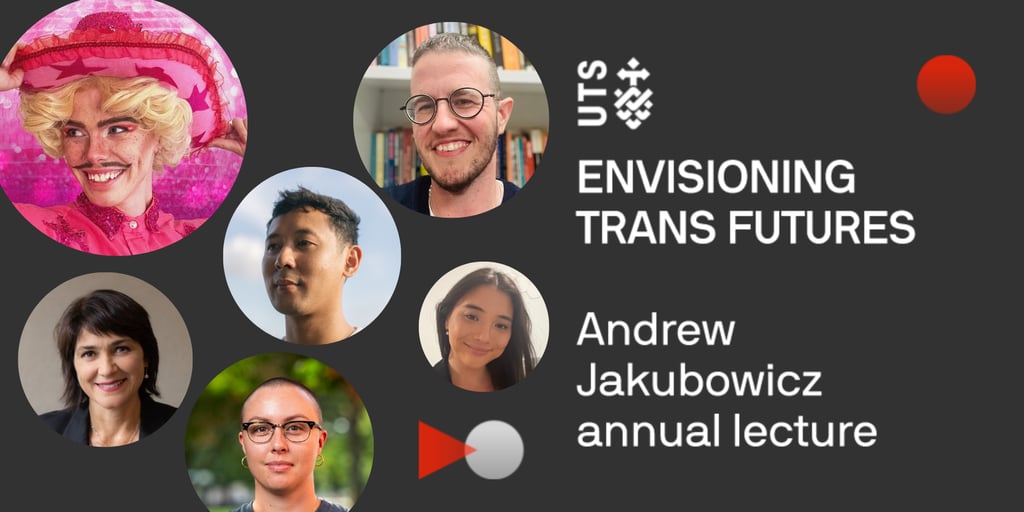
In this session, Dr Madi Day, Sidhi Vhisatya, Professor Anna Cody, Dr Archie Thomas, and Dr Sasha Bailey join Woody to refocus the lens and consider: how can we envision trans futures? What does trans flourishing look like?

Our expert panel contemplates not only the radical challenges to trans and gender diverse rights, but the joys, curiosities and possibilities of social justice-focused research and truly inclusive futures. 

This event was held on 26 August 2025 at UTS.
Thumbnail for the video

WOODY: Welcome everybody. Thank you so much for coming along tonight on this very warm 
 
Tuesday. To start us off I really want to get a lot of excitement in the room for 
 
Aunty Glendra Stubbs who is going to come up and give us a wonderful 
 
acknowledgement of country. She is the UTS Elder-in-Residence, a Wiradjuri woman 
 
from Dubbo, Mudgee and Narandara area. So give it up for Aunty Glendra. 
 
 
AUNTY GLENDRA STUBBA: Welcome everyone. What a wonderful turnout. Yeah, it's a really good turnout. 
 
Like Woody said, I'm Aunty Glendra Stubbs and I'm the Elder-in-Residence at UTS 
 
and I'm really proud to be the Elder-in-Residence. I'd like to acknowledge 
 
that we're on the land of the Gadigal people of the Eora Nation and pay 
 
respects to Elders past, present and our emerging Elders. You know, we are the best 
 
country in the world and we've come a long way but we've still got a long way 
 
to go. The work that I've done, lots of work has been around people that have 
 
been disadvantaged and marginalised and treated like crap in this country, sadly. 
 
But you know, we're growing, we're learning and we've been becoming more 
 
accepting. There was a time in this country that anyone that was a bit 
 
different was treated like crap or I think as the young ones said to me, 
 
"Shit." She's going to put 50 cents in the swear tin. So, or was it more than one 
 
shit or you only said one shit? Okay. 
 
Four. God, I'm going to be able to buy the kids 
 
an ice cream at this rate. You know, like I've done a lot of work with people like 
 
the Ambassador for Bobby Goldsmith Foundation. Being in the green room with 
 
the drag queens was something that I will never forget. I had my little lip gloss on 
 
but they wanted to make me look like Woody. And who's gonna complain to Camilla? 
 
No one. But it's, yeah, anyway, as Neil, where's my Neil? Neil. Oh, there he is, down the back. 
 
We love you, Neil. I talk a lot but I'm trying not to because I just think this is such an important event. Look, it's full house except for the front row. But if we put the people that are standing up 
 
the back in the front row, we'll be a full house. And that doesn't always happen, does it? A full house. So, you know, and especially when it's late at night and, you know, people have got lots of things to do. So, thank you, thank you, thank you. And one big hug for all of you. Hug the person next to you if you ask permission. So, thank you again. I really appreciate it. This is a really special night. So, thank you, thank you, thank you. And I feel like Nigel, no friends down the front with no one.  
 
WOODY: If anybody wants to come down the front and make friends, please, please be welcome to come down. 
 
Fill up our little front rows. Thank you so much, Aunty Glendra. That is exactly 
 
the energy that we want to start off tonight with. Big warm hugs for all of us. 
 
We're all one big community. So, yeah, thank you so much. It is my great pleasure 
 
to welcome you tonight to Envisioning Trans Futures, the annual Andrew 
 
Jakubowicz lecture. [Round of applause[ So, I am Woody, the self-proclaimed 
 
fruitness, tootiness cowboy in Sydney's inner west. Though tonight I'm giving 
 
more like dandy peacock, but I still hold up my cowboy title. And it's so exciting 
 
to be here today at UTS, to hear from incredible speakers and to also be in 
 
such wonderful company. So, I just realized I've got slides that I should 
 
have gone through. There's beautiful Aunty Glendra. That's me. Hooray, hooray, 
 
hooray. Pretty in pink. So, today we're going to be traversing questions such as 
 
trans identities and decolonial solidarities, queer futures in the Asia 
 
Pacific, in the classroom and the expansion of trans legal rights and 
 
medical care. We're going to contemplate not only the radical challenges to 
 
trans and gender diverse rights, but the joys, the curiosities, possibilities of 
 
social justice focused research and truly inclusive futures. I didn't think 
 
about how many hands I had. So, as I mentioned earlier, this is this event is 
 
the annual Andrew Jakubowicz lecture. Andrew is right down here in the front. 
 
Andrew is an emeritus professor at UTS and is one of Australia's preeminent 
 
scholars of cultural diversity, multicultural communities and racism. For 
 
over 30 years he was a professor of sociology at UTS and the UTS Andrew 
 
Jakubowicz lecture was established in 2018 in his honour. And a major theme of 
 
each event is the responsibility of academic researchers, the 
 
responsibility that academic researchers have in shaping public discussion of 
 
major societal issues of wide relevance. Before we get into it, I have a 
 
microphone and a captive audience so I'm gonna talk about myself. So, I started 
 
drag here at UTS in the Underground in 2019 at a first-timers night that my 
 
friend set up and at that point in my life I was going around saying that I 
 
knew that I was cis because I had questioned my gender for so many years. 
 
Which is absolutely something that cis people can say. I was just not one of 
 
them and with the non-binary friends that I told that to, looked at me and was kind 
 
of like, okay, all right and then let me cook for a couple more years and I got 
 
increasingly transgender over the course of my degree but I was also studying 
 
transdisciplinarity in the TD school so you can't say I wasn't working really 
 
hard for that HD. So, I've been working at UTS now for a few years, first in 
 
sustainability, then in the library and now I'm in the ed portfolio. Trans futures 
 
was a topic that I was very fascinated by in my study. I did projects on the 
 
future of trans and non-binary representation in TV and film and then 
 
at the end of my degree made a short film called Be Gay, Solve Crime which was 
 
basically what if Scooby-Doo was set at UTS and also Daphne and Velma were 
 
non-binary and T for T lovers. It's on YouTube, you can watch it, it's really 
 
good and also there's a whole scene in it that is a flash mob that is set 
 
literally like 20 meters from here so it's a fun time. For my BCII capstone, my 
 
team and I made a zine vending machine that dispensed 
 
ideas worth vending and as a part of that I made this zine in a sort of 
 
reformatted way. It was a little like a page flipbook zine with prompts about 
 
reflecting on how society perceives gender, how we relate to that and what we 
 
think is missing from that picture and on the back of the zine I put my 
 
interpretation of that. So I'm a very visual person and this is how I envision 
 
the future of gender. It's very ever-moving and changing and flowy and 
 
lots of different components and we've got threads that sort of connect 
 
different things to each other and then this sort of box around the outside that 
 
has like bits that are poking out and I think it's like kind of a silly 
 
interpretation, very artsy but it is I think it still holds true a couple years 
 
later from doing it. This is the future that I want to see for gender and yeah 
 
I'm very excited to hear how everybody else sort of frames the future of gender 
 
in the future of like trans futures tonight. Yeah so I think my favorite 
 
phrase in the way that this event has been designed tonight is trans futures 
 
on trans terms. Even in the face of a lot of governments threatening our legal 
 
rights and recognition we have the agency to shape what our futures look 
 
like. We're not here today to debate anyone like we're so often asked to do. 
 
Instead we're going to focus on how we can empower trans communities and 
 
consider the questions how can we envision trans futures and what does 
 
trans flourishing look like. I would love to invite you to keep these questions 
 
in the back of your mind as you listen to our incredible speakers tonight. All 
 
of us in this room and also out of this room are active agents in the way that 
 
we shape gender and shape trans futures in our world which kind of makes us 
 
sound like cool gender spies which I love. We're all gender spies here. So I'm 
 
excited to see and hear the ways that we all interpret these provocations tonight. 
 
So I'm very excited now to move on to our 
 
first speaker, which is Dr. Madi Day. 
 
They are a trans Murray who was raised up 
 
on Darugnara where they 
 
live and work in the Black 
 
LGBTQA plus SB community. Their work 
 
joins a tradition of 
 
Aboriginal and Torres Strait 
 
Islander trans people who continue the 
 
longest running protest to 
 
colonialism and carry 
 
an unbroken legacy of resistance and 
 
attacks on Aboriginal and 
 
Torres Strait Islander people, 
 
lives and systems of governance and 
 
kinship. Madi specialises in research 
 
and policy concerning 
 
Indigenous peoples, gendered violence, 
 
digital technology and 
 
whiteness and the far right. 
 
Sidhi Vhisatya. He is a queer art practitioner from 
 
Indonesia currently based in 
 
Sydney Australia where he is undertaking a master by research here at UTS. He's 
 
been a part of the collective management of queer Indonesia archive since 2020 
 
and is working with the Bali archive and repository. His practice focuses on 
 
curating exhibitions and experimenting with methods of material collection 
 
particularly within community based and collaborative contexts. Please give a 
 
warm round of applause for Sidhi.  
 
 
SIDHI VHISATYA: Thank you. 
 
Hi everyone I'm Sidhi and as part of my presentations today I'd like to 
 
introduce a bit of what I'm doing, how I'm connected to trans communities in 
 
Indonesia and how drawing from my previous collaborations I plan to situate 
 
the topic of trans and anti-trans in Indonesia along with possible futures 
 
and hopes we are moving towards. Since 2019 I've been working on trans issues 
 
through my art curatorial and archival practices with different initiatives 
 
both in Southeast Asia and particularly in Indonesia and while this approach has 
 
introduced me to various trans politics across the regions as well as the 
 
challenges involved my art focused and archival projects have also allowed me 
 
to learn from diverse way trans community members personally and 
 
collectively navigate the layered challenge and opportunities of building 
 
and transferring knowledge. These practices create spaces for solidarity 
 
while also collaborating with different stakeholders to insist on reclaim and 
 
protect their rights, spaces of acceptance and sources of joy. This 
 
presentation is also a reflection on how I as a cis man working within the 
 
limitations of art NGO work and academia have interacted with trans communities 
 
over the years, what I have learned and how these opportunities have 
 
shared my understandings of what it means to work with the community. And 
 
last month I had the opportunity to contribute to a panel on anti-trans 
 
politics with South and Southeast Asian scholars at the Inter-Asia Cultural 
 
Studies Association conference in Thailand and throughout our discussions 
 
we recognize the need to recontextualize the issues of trans and anti-trans in 
 
the South and Southeast Asian context and to unpack what it means to engage in 
 
such discussions. This requires us to also address the histories of 
 
colonialism and its role in disrupting or even erasing local grammars for 
 
gender diverse roles, identities and individuals in Indonesia. It also calls 
 
us to rethink trans as a transnational or even trans-local category within 
 
Indonesian context, how trans knowledge travels across the regions, how it is 
 
engaged and negotiated by the communities and how it sometimes 
 
challenges discursive power in conversations about trans issues. This 
 
also further invites us to reflect on how local trans communities personally 
 
and collectively quoting what Tom Boyles-Strauss described as dubbed, how they 
 
adapt this knowledge into their lives. And in Indonesia today this creates a 
 
complex relationship with NGO narratives, ongoing state discriminations, the 
 
emergence, cross-regional solidarities and networks, as well as unique local 
 
context. In my work I am mostly engaged with elder trans community members who 
 
often image in futures in very different ways. Many grew in collective houses with 
 
other trans members while some lived in small apartments or shelters as they 
 
have grown older, health issues have become unavoidable. And because of the 
 
lack of accessible trans-affirming health care, especially for elders, I have 
 
witnessed some trans elders enter state-sponsored nursing homes where they 
 
are required to [words in another language] or can be literally translated to return to 
 
one's natural state or in other words to forcefully the transitions in order to 
 
access care. Many trans women elders have been forced to give up their hijab, cut 
 
their hair short and perform masculinities. The futures of elderly 
 
trans people in Indonesia is fragile, they are denied basic rights and are 
 
often estranged from their families due to prejudice and shame. At the same time 
 
existing trans-affirming and trans-lab shelters in Indonesia are facing ongoing 
 
funding cuts and struggling to cover their basic expenses. Access to 
 
independent and Western funding has been one of the few ways they can continue 
 
creating spaces of care for their communities. Responding to this crisis 
 
earlier this year, Waria Crisis Centre or Crisis Centre for Trans Women in 
 
Yogyakarta and Parsato and Waria Kota Surabaya or the Transgender 
 
Communities Organizations in East Java, Surabaya East Java, organized fundraising 
 
campaigns to cover basic operational costs for running the Waria or trans 
 
women shelters at least for the next six months. These shelters work at the 
 
intersections of multiple trans issues. During the pandemic for examples when 
 
government aid packages were inaccessible for them, trans communities 
 
in Indonesia launched the initiative Katapeh Untuk Transpuan or the ID cards 
 
for trans women. This campaign pushed the Department of Populations and Civil 
 
Registrations to make the ID process more accessible for trans women. The 
 
initiative started in Jakarta and has since spread to regions such as 
 
Yogyakarta, Surabaya and Maumere. 
 
 
While recognizing the risk of violence in ID making process with only two sex 
 
categories available and the denaming in legal documents, this push for a more 
 
affirmative path to obtaining IDs represents an important step. With 
 
proper identifications, trans communities in Indonesia are finally able to access 
 
basic health care and the state health insurance schemes we called BAPJIS. 
 
 
These initiatives begin with the involvement of different organizations 
 
alongside trans women and trans men community members who tirelessly 
 
advocated for them to policymakers. The success of these programs is the result 
 
of long-term network building in trans and queer advocacy, connecting to anti 
 
discrimination bills, pushing for more trans friendly public health services, 
 
the criminalization of providers who provide care services and ensuring the 
 
inclusions of trans issues in broader movements, feminist movements, democratic 
 
movements and even the creations of trans safe space within protest. The 
 
community has also been working with health care facilities in several cities 
 
to provide trans friendly health services. This begins with educating 
 
service providers about misgendering and dead naming and navigating the limits 
 
of legal recognitions versus preferred identifications. These initiatives are 
 
also being introduced within mental health services and although the number 
 
of providers is still far from ideal, we have seen more public health facilities 
 
now listed although not publicly as trans friendly services. Some are even 
 
proudly presenting themselves as trans friendly providers on social media. 
 
There have also been efforts to compile the service into list, making it easier 
 
for trans community members to decide where to seek care. This process has 
 
encouraged trans people to slowly build trust with health care providers, trust 
 
that is often hindered by the potential for discomfort or mistreatment when 
 
accessing health services. 
 
While we are still facing depressing realities, we have also seen how trans 
 
communities collaborate with intersectional movements and insist on 
 
making space for themselves within these movements. The road ahead is long and the 
 
pushbacks are many. Some local governments are even attempting to 
 
introduce anti-LGBTQIA plus bills yet through these networks trans 
 
communities have learned to recognize patterns, identify loopholes and 
 
develop strategies to collaborate, advocate and defend their rights. In this 
 
process trans and queer communities continue to learn how to respond to such 
 
conditions with resilience and creativities. 
 
 
Recognizing care not only as a response to omissions but also as a space for joy 
 
and solidarity, trans communities in Indonesia have developed diverse 
 
approach to their activism. KAOIR as for example, a trans women's organizations 
 
from Makassar, South Sulawesi explored Pajougi, Angkong, a dance practice by 
 
Chala Bai, a local term for trans women in Bugis traditions through their 
 
documentary, Chala Bai Akantrozmonari or loosely translated to Chala Bai, Will 
 
Forever Dance. Directed by Eman, it is one of the few trans directed 
 
film on trans history in Indonesia. The film unfolds the histories of 
 
religion-based discriminations in Bugis cultures during early independence of 
 
Indonesia, while tracing how Bugis recognitions of five genders intersects 
 
with today's anti-LGBTQIA plus bills and the lived realities of trans communities 
 
in Makassar, South Sulawesi. By reintroducing Chala Bai roots and building 
 
networks with other community members, this project challenges the narrative 
 
that trans is not Indonesian and resists the recent bans on trans performers in 
 
Makassar. Another example is TransMen Indonesia. Initiated through LGBTQI 
 
plus gatherings back in the 2010s, these organizations emerged from the 
 
needs to build a trans men collective. Working at the intersections of advocacy, 
 
safe spaces and art-based activism, the group educates members about gender 
 
dysphoria, trans healthcare and hormones access while also offering peer support 
 
for those transitioning. Their collective care also extends into creative 
 
practices such as scene making, photo exhibitions and other projects that share 
 
information on trans men's issues. Active in both local and international 
 
networks, TransMen Indonesia navigates global solidarity around human rights 
 
violations while carefully maintaining local strategies in the face of 
 
potential backlash. Across these networks, safety and security remain a conscious 
 
priority, sharing strategies for care, playing with feasibility and opacity when 
 
needed and while keeping spaces open for those eager to learn about trans issues. 
 
From engaging with these trans futures in my own project, I've learned that 
 
conversations on care, joy and hope must be held with sensitivity. Narratives of 
 
discriminations often deny the agency and resilience of trans and queer 
 
Indonesians, yet alongside these 
 
struggles, communities continue to sustain powerful 
 
work and in today's climate, marked by local governments pushing anti-LGBTQI 
 
plus bills and funding cuts, collaborations and support our vital 
 
for these organizations and networks to thrive and continue their important work. 
 
Thank you. 
 
 
WOODY: Thank you so much, Sidhi, for sharing your expertise with all of us and I know that 
 
we all learned a lot from you just now, so thank you so much. So now our next 
 
speaker we have is Dr. Anna Cody. She is the Sex Discrimination Commissioner for 
 
the Australian Human Rights Commission. Before this, Dr. Cody had a distinguished 
 
career as an academic, as a lawyer, specializing in discrimination and as a 
 
passionate advocate for human rights. Most recently, she was the Dean of the 
 
School of Law and professor at Western Sydney University for four and a half 
 
years, leading education and research impact within the school to better 
 
reflect the diversity of the community and the intersection of law and justice. 
 
So please give it up for Dr. Anna Cody. 
 
 
PROF. ANNA CODY: Thank you very much. Really fantastic to be here today and I also wanted to thank 
 
you, Aunty Glendra, for that beautiful Acknowledgement of Country. I really loved 
 
that idea of growing and learning, which I think is what we're all doing here. I 
 
certainly am and also that idea of the embrace of a hug. So thank you for that. 
 
I also acknowledge our Elder Sandy Sullivan. Thank you. Great to see you here 
 
and also to you, Maddie Day, for your insights particularly. And also an honor 
 
for you, Emeritus Professor Jakubowicz, really lovely to be able to see 
 
you face-to-face and recognize the amazing work that you have done over 
 
many, many years in combating racism in our society.  
 
So I thought I would start with a small story and then I have a few points to raise around how I think 
 
trans people flourish and make futures. Most recently, I've been involved in a 
 
project documenting the experience of workplace sexual harassment and we've 
 
been doing consultations all around the country in every state and territory. 
 
One of the women who I met with who has stayed with me, I ended up meeting her 
 
twice when I went to her small rural town. A trans woman, she works as a trades 
 
person in a fairly male-dominated environment. She had transitioned later in 
 
life. She had worked really hard within the company that she worked in to make 
 
sure that it was a safe place for her. She had educated her workplace around 
 
her. She also made it her business to make sure that there was proper high 
 
vis equipment for her and for all of the workers. And she also had a particular 
 
interest in supporting First Nations apprentices and also for women 
 
apprentices coming into non-traditional 
 
areas so that it was a safer place for them. 
 
So what I take from that in terms of her future and the future of other trans women 
 
particularly was the importance of making 
 
the change at the workplace, educating those 
 
people within the workplace around what they needed to do to make it safe for her. 
 
She was happily married, was an incredible role model for everyone else who was 
 
coming after her. She was a union rep, she was amazing and she's really stayed 
 
with me because of her advocacy and the strengths that she demonstrated in what 
 
she did. So in terms of the lessons I learned from that, one is the importance 
 
to me as someone who contributes to policy making of hearing those voices 
 
and including those voices, making sure that trans people's voices are part of 
 
our public policy shaping, that it's not about a history without trans people. 
 
Also the importance of building alliances and coalitions and finding common ground. 
 
I obviously work in sex discrimination as well as LGBTQI+ equality. 
 
And there's often a false dichotomy that gets set up that we hear about. 
 
So how important it is to make those 
 
bridges, those coalitions, those alliances between 
 
women's organisations and trans organisations, particularly for trans women, 
 
and the importance of seeing those 
 
connections, that they exist and that we can continue 
 
to grow those, explore the differences, explore the tension areas, not ignore them, 
 
but actually to be able to embrace those and talk through them as well. 
 
I think that that conversation that we're having about gender equality and equity, 
 
we need to develop in our ability to have some 
 
of those conversations to respond to some of the 
 
backlash that we're seeing about the progress 
 
in all forms of gender equality, but including 
 
in reproductive health, racial justice, 
 
immigrants, refugees, that's part of the same overarching 
 
and against trans people, those overarching pushbacks. 
 
I also think my second learning would be importance of good data, good research, 
 
that we can show the evidence in a way that 
 
connects with and is meaningful to that we often 
 
talk about in influencing opinion, that moveable middle. 
 
So there'll always be those who we know are 
 
always our supporters and those who we know 
 
will always be against us, but there's that 
 
whole big piece of people, that group of people 
 
in the middle and how we move them. 
 
So how we communicate in simple, clear language messages 
 
that resonate, our ability to tell stories that resonate. 
 
And then another piece that I find helpful as a 
 
lawyer and as a human rights lawyer is drawing on 
 
human rights concepts, recognising that human rights protects all of us. 
 
It recognises our humanity, our equality, our dignity and our right to respect. 
 
That's each of us, all of us and in our communities and in our cultures. 
 
So recognising that the Convention on the 
 
Elimination of Discrimination Against Women 
 
includes trans women in particular, that it 
 
has commentaries that refer, it has decisions 
 
from 2022, its general recommendations that 
 
specifically include trans women within it. 
 
And so that means that all states parties 
 
who've signed up or ratified any of those of CDOR, 
 
but the other international instruments are also 
 
signing up to those international human rights obligations. 
 
So we know, for example, that in 2018 that 
 
the Convention on Elimination of Discrimination 
 
Against Women Committee issued concluding 
 
observations about Australia and it welcomed 
 
the provisions of that amending act back in 2013, 
 
which introduced gender identity discrimination. 
 
And also recommended that Australia abolish 
 
requirements regarding medical treatment for 
 
transgender women who wanted to obtain legal recognition of their gender. 
 
And that was to ensure the rights of transgender women 
 
to bodily integrity, autonomy and self-determination. 
 
So we need to ensure that stories, that we're 
 
able to tell stories, that we're able to connect. 
 
I loved that piece that you included, Maddie, in yours about we all have loved. 
 
If we're not a trans person, we've loved a trans 
 
person, a child, a lover, a partner, a husband, a wife. 
 
And I think that that connection is so important, that humanity that we share. 
 
But also building the capacity that we have to 
 
make coalitions. We have to keep talking as much 
 
as we don't. We want to pull back and sometimes 
 
we need to. But the importance of the alliances 
 
and the connections and the collaborations that we 
 
form in order to create and envision trans futures. 
 
And using that human rights framing, as well as a 
 
protection for all of us, it ensures that we have 
 
the law behind us and including trans voices in 
 
our policy shaping. So that we really make sure, 
 
and we're starting to do it in some areas, 
 
that when we're talking about creating policy, 
 
it includes all of us. It doesn't just include one part of our society. Thank you. 


WOODY: Amazing. Thank you so much, Anna, for those 
 
reflections. Really super valuable insights. 
 
Next up we have Dr. Archie Thomas. He is a 
 
non-Indigenous scholar and transgender man who 
 
has published widely on Indigenous and 
 
LGBTQIA+ movements, histories and policy issues 
 
in Australia, with a focus on educative institutions such as schools and the media. 
 
He is a Chancellor Research Fellow in social 
 
and political sciences here at UTS and is the 
 
lead author of ‘Does the Media Fail Aboriginal 
 
Political Aspirations?’ 45 years of news media 
 
reporting of key political moments and the 
 
forthcoming book or publication, Yip Brynya 
 
Education for Self-Determination, which will be 
 
published in 2026. So please give a warm welcome 
 
to Archie.  
 
DR ARCHIE THOMAS: Thank you, Woody. And I'll 
 
also extend my thanks to Aunty Glendra for your 
 
Acknowledgement. I would say that I think 
 
you and Woody are in competition for best dressed 
 
tonight. And he also brought some outfits for 
 
us, which we didn't take up, but we should have. 
 
Also say thanks to Andrew for being here. Andrew 
 
was a real support and a mentor for me in a project 
 
we worked on together during the course of my 
 
PhD research. And it's excellent to be here at this 
 
event bearing his name. And a shout out to my 
 
other colleagues from the social and political 
 
sciences discipline who are here tonight. So 
 
in the process of co-organising this event, 
 
I was the person who provided the prompts 
 
to the speakers about how we can think beyond 
 
anti-trans politics and discourses and think about our own visions of flourishing. 
 
And then when I started to write my own 
 
contribution, I realised how difficult that actually was. 
 
I've become so used to taking anti-trans 
 
politics and arguments as a starting point. 
 
And in some ways, I'm doing it right now, 
 
that I realised, sorry, to everyone on the panel. 
 
That I created a difficult task. I read last 
 
year a book by Naomi Klein, her book Doppelganger, 
 
which is ostensibly about her being mistaken 
 
for Naomi Wolf, who's kind of become a bit of a 
 
conspiracy theorist, tin foil kind of hat 
 
academic. But the book, more than that, I think is a really 
 
deep reflection on how we establish a sense of 
 
self and political identity in relation to others. 
 
So she talks about this idea of the Doppelganger 
 
effect, that it kind of creates a situation where 
 
the ways we have of speaking about ourselves, 
 
and even understanding and knowing ourselves, 
 
are often in relation to those who are seeking to 
 
deny us our rights, our recognition, our livelihoods. 
 
So the idea in creating this event was to try 
 
to work out how do you get beyond that pressure? 
 
How do you get beyond just articulating yourselves in response to critique? 
 
Now, I don't think we'll fully get outside of 
 
this dynamic in a room of social scientists and 
 
political theorists. I think we know that we 
 
establish our identities in relation to what we 
 
are not, the ideas of binaries and so forth, 
 
that were shaped by things outside of ourselves. 
 
I also don't want to do a kind of toxic 
 
positivity thing, because I think when I started to think 
 
about the idea of the future, well, how do we 
 
feel about how the future looks right now? If I look 
 
at rising fascist movements, if I look at 
 
genocide and starvation in Gaza, if I look at the climate 
 
crisis, if I look at the state of higher 
 
education, if I look at rising inequality in the housing 
 
crisis, I could continue to list many things that 
 
are looking quite bleak about the future that we 
 
hold. So I kind of did another classic academic 
 
thing where I was like, okay, so if I'm going to 
 
talk about trans futures, maybe I'll think about 
 
trans, not just about trans people, but trans as 
 
a kind of a verb. So in the long tradition of 
 
queer theory, how about taking trans as a verb and 
 
kind of envisioning a future that is trans, 
 
right, for envisioning trans futures? So to do this, 
 
I recruited the historian Susan Stryker, a 
 
favorite of mine, and she often argues that in transness, 
 
we see the very real embodiment or the 
 
possibility of social change and transformation. 
 
So the fact that trans people like me have lived 
 
in a world in one or more genders, and I've often 
 
joked about my attempt to get as many letters 
 
in the LGBTIQ acronym. So far, I think it's five, 
 
so getting there. But I think it's living proof that we make decisions all the time 
 
to realize and change ourselves, sometimes 
 
dramatically, that we do that outside of the 
 
bounds of conventional norms and often against 
 
denial, powerful state structures and forces, 
 
and so on. We do it anyway. And it shows that one 
 
of the most important architects of inequality in 
 
this society, in this case, the sex gender 
 
binary, isn't something stable, isn't something that's 
 
fixed. It's something that changes for many of us 
 
where there's a will for it. We do it all the time. 
 
Or as Susan Stryker says, we are members of 
 
cultures and we can decide what our bodies mean. 
 
So perhaps this is why we as trans people 
 
present as a kind of catch-all existential threat and 
 
concern for those who want to deny the possibility 
 
of a different future and deny the possibility of 
 
social change, not just for us as trans people, 
 
but for the world more generally. They tend to kind 
 
of be the same people. So perhaps if, you know, 
 
by our existence, we imagine a future where the 
 
inequality of sex and gender can be rejected, can 
 
be remodeled, can be refounded. Perhaps we suggest 
 
that there's ways of kind of taking the 
 
resources of society, you know, medical technology, 
 
creativity, and so on, and marshalling them, 
 
you know, for our own human interests, right, 
 
for the good of society. If we do that as 
 
individuals and communities as trans people, 
 
why can't we do it for so many other things? So 
 
if we've become this kind of negative stand-in, 
 
right, for a whole lot of social paranoia and 
 
crisis, perhaps we can also be a stand-in for 
 
the possibility of change. The focus of my 
 
research work is often history and social change, 
 
often focused on schools and children, and in 
 
this research I often talk about education as a 
 
crucially important site of kind of continuous 
 
contest and debate in society because education 
 
is about the future. So the idea of a trans child, 
 
a trans student, a queer student, a trans teacher, 
 
a queer teacher, you know, suggests a kind of 
 
instability and change in the future, right, 
 
if we encourage those things in schooling then 
 
we might be encouraging them to sort of fall away 
 
into the future. So envisioning trans futures, I 
 
think, in education and elsewhere could be about 
 
embracing that, embracing that instability, 
 
embracing that possibility, to quote a friend of 
 
mine, the trans education scholar J. Wallace 
 
Skelton from the University of Regina in Canada, 
 
"Perhaps what we can do in envisioning 
 
trans futures in education is we can consider 
 
Indigenous trans and non-binary themes as 
 
ways to rethink the very grounds of knowledge and 
 
pedagogy in education. By doing that we can do 
 
things like, as the saying goes, trust that the 
 
kids are all right. You know, I think there's a 
 
reason that the staple theme in so much of kind of 
 
queer and trans cultural output is about the ways 
 
that we knew ourselves as children, the ways that 
 
we were right about ourselves, the ways that we 
 
found ourselves, regardless of whether we had the 
 
language to do that, the resources to do that. 
 
I mean, my teenage self didn't have a concept of 
 
transness, right, but the decisions that I 
 
made, the ways I pushed towards an understanding of 
 
something I didn't even really know and held in 
 
that a kind of longing for justice and authenticity, 
 
you know, there's something very instructive 
 
there and in queer childhoods and queer schooling 
 
and something very powerful for thinking 
 
about how we might make a different future. 
 
And as I mentioned, I also, you know, talk a lot 
 
and focus a lot on history and thinking about the 
 
relationship between history in the present. So, 
 
you know, some of my research, for example, has 
 
explored the exclusion of gay and lesbian teachers 
 
from schooling in the way the, you know, historic 
 
discourses around that, you know, resemble a 
 
lot of what we see today directed at trans, 
 
gender diverse and non-binary students and 
 
teachers. And I look at history for many ways 
 
and to paraphrase Susan Stryker again, because 
 
we find in our own embodied histories and pasts 
 
and in, you know, queer histories writ large and 
 
in the much longer histories of colonisation and 
 
in this continent, the actual existence of 
 
social orders that are different from now, 
 
because history bears witness to the 
 
inescapability of difference and the inevitability of change 
 
and thus the future can be different too. So 
 
lastly, just to come back to the beginning and my 
 
point about, you know, a future that is trans, 
 
where everybody's trans perhaps, but a vision 
 
that's just, you know, gets beyond defending 
 
ourselves, you know, from detractors and if 
 
the future in general appears, you know, to be 
 
in crisis, then I think we are all collectively 
 
implicated in the question and the burden 
 
and the joy perhaps of creating a new one. 
 
And so I think, you know, I'd echo comments 
 
of others on the panel that I think, you know, 
 
making the future trans perhaps, making 
 
socially just futures means orienting to the world in, 
 
you know, through this lens of possibility, 
 
through thinking, you know, with our research, 
 
in our roles as educators, in our advocacy and 
 
our activism, thinking about those possibilities 
 
and embracing them and embracing the challenge 
 
and the possibilities that they hold and thinking 
 
about how to generalise those, how to be 
 
coalitional and expansive and how to kind of use 
 
transness as a possibility for changing the future as a whole.  


WOODY: Thank you. 
 
Thank you so much, Archie. I love that idea of 
 
using trans as a verb and like rethinking that 
 
way. And also, yes, you did give all of our 
 
panellists a very difficult task tonight. But yeah, 
 
thanks for acknowledging that you gave them all a 
 
really difficult job. Alrighty, and for our last 
 
speaker for tonight, we're going to move on to 
 
Dr. Sasha Bailey. She is a research fellow at the 
 
University of Melbourne working across Trans 
 
Health Research Group in the Department of Medicine and 
 
the Centre for Youth Mental Health. Her 
 
programme of public health research aims to improve the 
 
mental health and wellbeing of trans Australians 
 
through digital interventions and enhanced models 
 
of care. So please give it up for Sasha Bailey. 


DR SASHA BAILEY: Thanks, everyone. So I'm just in response to, I 
 
guess, the prompt for tonight that, you know, 
 
we're often talked about by other people and don't 
 
always control the narrative, you know, 
 
things necessary for flourishing. I think the first 
 
sort of point that I would talk to is a need 
 
for strengths-based frameworks for understanding 
 
ill health inequities among trans folks. Often we 
 
start from a point of trauma and minority stress. 
 
Minority stress models are often sort of ad 
 
nauseam. The explanation of ill health among trans 
 
folks, that is this idea that, you know, 
 
societal norms and expectations of cis normativity, 
 
you know, breeds stigma and discrimination, 
 
thereby creating, you know, higher ill health 
 
inequities. But instead, we need to sort of 
 
move towards these strengths-based frameworks, 
 
decentering the role of minority stress. And so 
 
one such example that colleagues and I sort of 
 
articulated is this idea of developmental queer 
 
and trans actualizations, whereas minority stress 
 
is directly linked with mental ill health. This 
 
strengths-based inversion instead starts from a 
 
place of the exploration of someone's 
 
gender, someone's sexuality, and encouraging that 
 
exploration and growth and curiosity as a 
 
direct pathway to health and wellbeing. Of course, 
 
that pathway being moderated and mediated 
 
with trauma and minority stress along the way, 
 
but not necessarily. That being an important 
 
caveat. And I think if we can sort of apply a 
 
scientific approach to those, for lack of a 
 
better word, and the literature is still grappling with 
 
developmental milestones, things like, you know, 
 
the first stage that you realize you were trans, 
 
the first time that you had a relationship as a 
 
trans person, or, yeah, shared that information 
 
in certain settings to various extents with 
 
different people. I feel like those are direct 
 
protective factors that we can promote to 
 
directly promote mental health above and beyond minority 
 
stress and trauma, which of course require 
 
much more long-term structural change, which 
 
isn't the easiest for all of us. And with that 
 
being said, I think a good avenue for that is 
 
schools. I think there's a notion of courage 
 
when we talk about strengths-based frameworks, 
 
this idea that it's like antithetical to like, 
 
you know, conversion therapy or like something, but 
 
I think if we can target schools where, 
 
yeah, education is provided, it's a great site. 
 
The second recommendation would be around 
 
community responsive and community led ethics, 
 
sorry, research, the response to emerging 
 
trans community needs in the moment, and trans 
 
researchers doing that research, seeking 
 
governance from trans ethics boards like ACON, 
 
and I suppose one example of that. We were 
 
successful receiving a Suicide Prevention Australia 
 
Innovative Research Grant a couple of years ago 
 
in response to the Victorian coronial Inquiry into 
 
trans deaths by suicide, which cited that wait lists were, 
 
suicidality peaked during that period. It was a 
 
really big risk factor. The time between when a 
 
trans person decides they want to medically 
 
affirm their gender and when they're actually 
 
able to receive that care. And so we received 
 
funds to co-design and evaluate via a randomized 
 
controlled trial this online peer support suicide 
 
prevention program called Thriving Transitions, 
 
and we co-designed it with focus groups, with 
 
trans people on wait lists for hormones, trans 
 
people with experience of facilitating trans peer 
 
support spaces, as well as a scoping review of the 
 
literature. How stamper. And yeah, we're 
 
currently in week five of the clinical trial. The 
 
intervention is happening, but it's, yeah, I 
 
think it's interesting to reflect on how one of the 
 
weeks, it's a seven week intervention. It's 
 
unstructured peer support, but it's loosely 
 
themed around nostalgic topics to the trans 
 
experience. We've tried really hard to combat 
 
trans normativity and gatekeeping actively doing 
 
that, but one of the topics is trans futures and 
 
trans potentialities. And that really came out 
 
explicitly from the focus groups, particularly 
 
with the people with experience of facilitating 
 
those spaces. When we think about suicide prevention, 
 
it's not that you're literally just preventing suicide or restricting means, but 
 
hope is that protective factor that is suicide 
 
prevention. If you can help people see a future 
 
and help them acquire the means to actualize 
 
that, then that is suicide prevention. That's 
 
what I understand to be trans futures and 
 
trans hope. And I guess the last point that I would 
 
want to talk to is just around data, 
 
serendipitously, Anna mentioned as well. And so we do 
 
have a long tradition in Australia of 
 
community devoted researchers generating large scale 
 
population level data sets. And I think it, 
 
but when we think about traditional notions of 
 
epidemiological rigor, we want population 
 
level, nationally representative data sets. 
 
But with that being said, I think there's a 
 
place for both because we know that those population 
 
based data sets tend to under represent trans 
 
folks due to trans folks being less likely to 
 
have households and therefore like receive 
 
the household sampling, having gender discordant 
 
identity documents, which makes it tricky to also 
 
receive it as well. But I think there's a bit of 
 
talk about like the census, which is exciting, but I don't think it's a silver bullet. I think 
 
data linkage is the big key for the trans 
 
futures to generate that next level of data. And I'm 
 
excited as a data girlie. I'm excited for that 
 
space. There's a lot of unexplored issues in the 
 
data linkage context. Yeah, usually there's a 
 
master key that you have to apply that probabilistically 
 
links participants across these data 
 
sources. And I think that's a big key for the trans 
 
but yeah, if your sex is different across the 
 
databases, if your name's different and your 
 
address is different, then that becomes tricky. 
 
And yeah, whereas in the US, there's a reliance 
 
on ICD codes to as a proxy measure for 
 
identifying trans folks, there's in the last couple of 
 
versions of ICD, there's one for transsexualism, 
 
I think, and another one similar. That has good 
 
coverage in the US, because there's insurance 
 
companies which require practitioners to denote 
 
that. But we're not, I mean, for better or for 
 
worse, that's not the case in Australia. And I 
 
think it's the next couple of decades are going 
 
to be really exciting seeing how we can come up 
 
with solutions to get that data links. And yeah, that's probably all I have to say. 
 
[APPLAUSE] 
 
WOODY: Thank you so much, Sasha. That was amazing to 
 
hear about all of the exciting work that you're 
 
doing and your team is doing. So yeah, thank 
 
you so much for sharing all of that with us today. 
 
Well, I'm going to go scooch in my chair and 
 
we'll move into a little panel mode. And while I'm 
 
doing that, I would love for all of you to give 
 
another round of applause to all of our incredible 
 
panelists. 
 
[APPLAUSE] 
 
All righty, panel mode activated. Okay, so 
 
I think what I want to do for this is ask, 
 
I've got a couple of questions that I just want 
 
to put out to the whole panel, and you can jump in 
 
when you'd like. And my first question is, 
 
what's something that's bringing you hope for trans 
 
communities right now?  


I can start while you can have some thinking time if you'd like. So I think 
 
something that I'm finding a lot of hope in is 
 
seeing the way that trans people and queers and 
 
people generally, community generally, is showing 
 
up for each other, especially through mutual aid. 
 
I think seeing the ways that people rally 
 
behind top surgery fundraisers and through, 
 
like a couple of years ago, I had a, I'm starting 
 
tea and I had a partner, I had a one year on tea 
 
party and I had a little tea party and I just 
 
like put an open call out and then a bunch of 
 
people turned up and we had a tea party because I 
 
started tea. And I like met people through doing 
 
that that like, I didn't know people just like 
 
turned up, we were going to do it in the park, 
 
ended up being at my house because it rained, 
 
but then I just had nice people in my house, 
 
we just had tea to celebrate. And I think 
 
that's sort of, like, I feel like in community with 
 
particularly trans people, I don't know, I 
 
feel like there's always something to talk about, 
 
something to connect about and there's always 
 
this like initial connection that we have. And 
 
I feel like that shows up really 
 
beautifully in the way that we engage in mutual aid, 
 
not just for within our community, but also 
 
in solidarity with other communities as well. 
 
So yeah, that's something that's bringing me hope in the world right now. 
 
Would anybody like to jump in? 
 
 
PROF. ANNA CODY: So it's a slightly backward and forward. So 
 
what brings me hope is a little bit about what I 
 
talked about, that often we hear about the 
 
really women's organisations who are anti-trans and we 
 
don't hear about the really strong women's 
 
organisations who in their large part actually 
 
really supportive of trans. So I think in my 
 
work, when I go around and meet with so many 
 
women's organisations and doing incredible 
 
frontline service work and their inclusion, 
 
and they're ensuring that they are, and recognising 
 
they've got a long way to go, but also recognising 
 
that there's a solidarity there, so a connection with trans communities. 
 
 
WOODY: Yeah, amazing. 
 
 
DR SASHA BAILEY: Yeah, I think it's so exciting that there's so 
 
many allies. I think that's genuinely so exciting, 
 
particularly allies in the government. And coming 
 
back to research, a couple of years ago, there was 
 
a huge MRFF research fund grant that got 
 
released that was dedicated, I think it was like $26 
 
million just targeting queer trans health, as 
 
well as health of folks with a variations in sex 
 
characteristics. And yeah, as you say, there's 
 
yeah, there's for every yucky person, there's 
 
like five and in all the right spots. And I 
 
think we're on the precipice of like big things. 
 
 
WOODY: Yeah, absolutely. 
 
SIDHI VHISATYA: Okay, I think for me, seeing different kind of 
 
like narratives and approaches and activisms in 
 
the way, because, you know, sometimes they are 
 
framed to be like the most resilient communities 
 
all the time, right? And some of them have a 
 
saying like, I don't want to be resilient all the time. 
 
I'm getting older, I need a break, you know, so 
 
the spaces are now created to, for them to, you 
 
know, have rest, have take care of themselves, 
 
mental health and stuff like that. So I think 
 
it's a kind of like a promising futures for 
 
them. So, okay, you know, activism, stage showing, 
 
rest, need all sort of stuff. And yeah, it kind of like also 
 
creates like the needs of the communities and also like how they finally be able to 
 
engage with the broader movements and stuff like 
 
that. Promoting like, oh, we need to safe space 
 
in protest in democratic protest, for example, 
 
we have, we started to have like a house rules 
 
in protest on don't be homophobic, there are 
 
trans folks there in the protest, so you need to 
 
respect them and how to respect the trans folk as 
 
well. So it's kind of like building this, I don't 
 
know, awareness from the grassroots. So I think 
 
it's a starting point to see trans futures as the 
 
promising futures.  
 
WOODY: Yeah, I love that 
 
saying trans futures as promising futures. Yeah. 
 
DR ARCHIE THOMAS: I would say that what we often don't focus on 
 
is actually the kind of unprecedented levels of 
 
community organizing. And having been to some of 
 
those meetings recently, I was kind of shocked to 
 
find there was all these people a lot younger 
 
than me who I'd never met before. And they didn't 
 
seem to have dated anyone I knew. And I was like, 
 
Oh my God, you know, and the people that were my 
 
age were actually the parents of trans and 
 
gender diverse children, people who I'd also never met 
 
before, you know, shout out to those people in the 
 
audience. But you know, there's so many different 
 
organizations, we've had some of the biggest 
 
demonstrations for trans rights, you know, in 
 
Australian history. And I think, you know, there's 
 
been strong kind of solidarity work that's happened 
 
there, you know, as well in terms of, you know, 
 
making sure that those are kind of intersectional 
 
spaces and so on and so forth in terms of that. 
 
And so I'd also say like, you know, cheesy, but 
 
like the people who are here tonight, and the 
 
kind of, you know, work of trans and gender diverse 
 
scholars and allies, you know, shout out to 
 
some of those in the audience tonight too, who were 
 
doing really excellent work and often actually 
 
LGBTIQ research isn't very well funded. Yeah, 
 
especially in the social sciences. Yeah, 
 
there's not, I mean, social sciences in general, but 
 
people do it, you know, regardless. And there's, 
 
you know, a kind of thriving community. And I'd 
 
also say, and you know, we have Kat Frolov, who's 
 
here tonight, who's the LGBTIQ project officer at 
 
the Centre for Social Justice and Inclusion, you 
 
know, has been working on a project about, you know, 
 
dealing with dead naming and misgendering here 
 
at this university, for example, while of course, 
 
you know, that shouldn't happen in the first 
 
place, I think it's really excellent there's people in 
 
positions of power kind of pushing those things, 
 
making institutions and organizations uncomfortable, 
 
and pushing them to kind of, you know, the 
 
shiny stuff on the websites and things like that 
 
actually becomes, you know, a real lived experience and make place makes, you know, 
 
places safe for people. And I think people 
 
are doing all sorts of little stuff all the time 
 
in higher education to, you know, to make that happen. 
 
 
DR MADI DAY: I think I draw on a different tradition in terms 
 
of hope. So for me, like, I usually refer back to 
 
Mariame Kaba, hope is a discipline, right? So 
 
hope for me is not something that I grasp for, 
 
hope is something that I practice in the tradition 
 
of my people. And so, yeah, that's what I have to 
 
offer. Thank you.  


WOODY: The next question that I have 
 
is kind of a personal question that I like to ask. 
 
I run groups with ACON as well, and this is a 
 
question we always ask at the beginning of them. 
 
And it's, do you have any queer or trans 
 
icons that you look to for inspiration or comfort, 
 
or when you, yeah, are looking outwards and 
 
need some guidance, like, who are you looking to? 
 
I can also start with that question, 
 
because obviously I wrote the question, so I have 
 
pre-prepared answers, sneaky of me. But mine 
 
is Lou Sullivan. He was a trans man who was 
 
transitioning in the 70s and 80s, and he kept 
 
meticulous diaries of his life. And then wanted 
 
them to get published after his death. So you 
 
can read them. They're out as a book called We Both 
 
Laughed in Pleasure. I highly recommend reading 
 
it. It's like an incredibly intimate, yeah, just 
 
account of a trans person's life sort of in real 
 
time throughout the course of his life. And he had 
 
to, like, he was, did a lot of advocacy in 
 
having to advocate for himself to get gender affirming 
 
care as a gay trans man in a time when that was 
 
just like not a possibility. So he was really a 
 
trailblazer in fighting for the care that he 
 
deserved. And then also making sure that there 
 
was an archive of his existence in great detail 
 
after his death. And he died of AIDS in the early 
 
90s. And there's this, like, one quote from him 
 
where he said, I don't remember the exact words, 
 
but to the effect of, they said, I couldn't live 
 
as a gay man, but it looks like I'm going to die 
 
like one. Yeah, so I always look to Lou Sullivan. 
 
When I got top surgery, I, like, brought his book 
 
with me and read it while I was in the bed. And 
 
maybe that's like very, like, I feel like it's 
 
very quintessentially like trans masc of me, 
 
maybe. But yeah, I, and I really enjoy connecting with 
 
that trans history. And that helps me a lot in 
 
envisioning trans futures as well. So yeah, does 
 
anybody else have, yeah, icons that they'd like 
 
to speak to a little bit? Anna, you sort of, like, 
 
spoke to yours as your icon, because I also like 
 
somebody that you know, but yeah, you've spoken 
 
really beautifully to yours.  
 
DR SASHA BAILEY: So this person 
 
doesn't exist. But it's from a TV show. The TV show pose. 
 
My idol is Candy Ferocity, who passed away at 
 
the start of season two. Yeah, she was just really 
 
bad and cool. And that's all I got. I 
 
actually, I loved her so much that, like, it literally 
 
helped me transition. Because I was just so 
 
inspired by, like, bad bitches, like, and I actually had my 
 
last name as pose, like, originally, and then I 
 
like started publishing and was like, Oh, I need 
 
to change this, like, pose. Doesn't sound 
 
very academic. But yeah, now I'm Sasha Bailey. 
 
 
WOODY: I love that so much. That is absolutely the 
 
legacy that pose as a TV show absolutely has to have. 
 
DR ARCHIE THOMAS: Sasha pose is great. I think you should pull that 
 
out again. I was also obsessed with Lee Sullivan. 
 
And also, yeah, when I was in San Francisco, some 
 
years ago, or yeah, reading his book there. But I 
 
mean, someone who's worked that I'm obsessed 
 
with is Torrey Peters. Anyone who knows me knows I'm 
 
obsessed with her. And I think just she's a 
 
writer, she's written two excellent novels, 
 
Detransition Baby and Stagdance. And the thing I 
 
like about them is, I mean, similar to the sort 
 
of theme I set for this panel is the way she 
 
manages to get outside the ways of sort of defend 
 
ourselves or these sort of boring narratives 
 
about I'm a human too. And but it's like, it's really 
 
deep storytelling. It's for you know, you can 
 
tell she kind of wrote it, you know, for her 
 
community, there's really unlikeable trans people in her books, and just, you know, 
 
the freedom for trans people to be jerks and just, 
 
you know, live in these worlds that we create and 
 
be mean to each other and have bad relationships. 
 
And, you know, there's just something so freeing 
 
in that because we're just so used to being in 
 
these, you know, situations where we just have to 
 
talk about, you know, our rights to exist and, you 
 
know, why we deserve them. And I just love how in 
 
her writing, she just says whatever to that and 
 
just does what she wants. Yeah, and just in general, 
 
you know, I would like to be able to do that. 
 
 
WOODY: Yeah. Yeah, I love the trans future being let's just 
 
let trans people suck. Let us suck a little bit. 
 
That's my trans future. I want to just be really 
 
awful.  
 
 
SIDHI VHISATYA: Yeah, I'll go next. I think my trans 
 
icon is Maria Belen Correa from Archive for Trans 
 
Argentina. I met her in Argentina back in 2023, 
 
and it kind of like encouraged me to, you know, 
 
like go to like the master degrees doing things 
 
with the archiving process for trans people and 
 
also like looking at the material objects and 
 
how, you know, like it's kept like the what it means 
 
for them, for the trans communities to keep 
 
their materials in order to prove that they are 
 
they've been there all the times and stuff like 
 
that. And also to receive like the the erasures 
 
from the histories itself. So I think, yeah, 
 
Maria has been having a lot of influence on how I 
 
approach archiving in the master degree that I'm doing. 
 
 
WOODY: Amazing. 
 
 
DR MADI DAY: I think everyone knows mine is Sandy O'Sullivan. 
 
That's whose tradition I'm trained in. And they 
 
were my PhD supervisor, but they're also, you 
 
know, one of the most important people in my life. 
 
And yeah, I'm incredibly privileged to 
 
have been incredibly privileged to be nurtured by them. Yeah. 
 
 
WOODY: That's so lovely. Okay, I have another question 
 
for the whole panel, which we sort of spoke to 
 
a little bit, which is, which is, do you have any 
 
thoughts or ideas about trans resilience in these 
 
political times? I think Sidhi sort of talk 
 
to it a little bit in your first answer. Yeah. 


PROF. ANNA CODY: And I think that I spoke a little bit about that the collaborations 
 
alliance forming, I think is really 
 
important. But also sometimes just being with your own, 
 
when things are really hard, I think it's important to be with people who love you, 
 
and who appreciate you and recognize you for 
 
who you are. So I think that's your backstop 
 
strategy always. But I think longer term, some 
 
of that good data, being able to tell stories that 
 
people can relate to, and creating coalitions 
 
and alliances. And I guess, you know, it's that 
 
it's that sharing of all of us, it's that 
 
common humanity and recognizing that basic respect, 
 
dignity, equality.  
 
 
SIDHI VHISATA: Yeah, I think working with the 
 
trans communities have been encountered a lot of 
 
dramas, like some, some, you know, trans members 
 
hate each other. But at the same time, they work 
 
each other, you know, they hated like, last night, 
 
and they worked together in the following days. I think 
 
that's part of the resilience, you know, like 
 
on how they kind of like, work within like their 
 
emotions, but also work for like the communities. 
 
Yeah. Yeah.  
 
 
WOODY: So we get to suck, but we also get to 
 
love each other. I love that.  
 
 
DR SASHA BAILEY: This is a very 
 
informal, like sort of response, like not evidence 
 
based about like promoting resilience as like 
 
a protective factor. But I think like, humour 
 
goes a long way with resilience, being a bit 
 
messy, as you say, being comfortable with that. 
 
I feel like humour is a really unexplored, 
 
yeah, psychosocial sort of ingredient that I think 
 
could play a big part in a lot of interventions 
 
going forwards. But yeah, humour is, I feel like 
 
that's, yeah.  
 
WOODY: Yeah, I have to agree as 
 
someone that was in, I did a lot of reviews in uni, 
 
humour was the way that I got through everything 
 
and still continue to so very much agree with that. 


DR ARCHIE THOMAS: I would say that I think that, you know, marginalisation and discrimination in the 
 
communities who experience it often have the 
 
most fantastic contributions to epistemology and 
 
knowledge and how to understand the world. So 
 
if we look at, you know, the long history of 
 
Indigenous protests in this continent and think 
 
about learning from that and acting in solidarity 
 
with that. And if we think about, you know, 
 
regardless of when rights are taken, we can 
 
regardless of when rights are taken away, 
 
people still continue to find ways to do things and 
 
resist and do it in all sorts of new and 
 
creative kind of fashions, which end up sometimes making 
 
more change than we might be able to do in, you 
 
know, the official corridors of power and so on. So I think there's actually a lot of power 
 
in being in those positions and learning from 
 
people who've been in those positions in the past. 


DR MADI DAY: Yeah, I think what I have learned from 
 
TransMob is that there is a balance that we find to 
 
simultaneously attend to one another's 
 
immediate, material needs and each other's dreams, right? 
 
You need both things. You need capacity to dream. 
 
without the capacity to dream of something better 
 
or envision and work towards something better you 
die, but you need a home and a bed 
 
to dream in, right? So both those things together for me is resilience. 
 
 
WOODY: I love that so much. And that is a wonderful 
 
note to end on that we all need a bed to dream in. 
 
As we envision TransFutures, we can dream up from our little bed. All together, 
 
hooray! Thank you so much to all of our 
 
panelists. I have some thank yous to go through as well 
 
before we finish tonight. So first, a thank you 
 
to Social and Political Sciences, which is the 
 
discipline that runs the annual Andrew Jakubowicz 
 
lecture, which Andrew was a part of. This discipline 
 
is part of the School of Communication and now in 
 
the Faculty of Design and Society. They are a group 
 
of scholars and teachers teaching into the Bachelor 
 
of Communication and other degrees and their focus 
 
on social justice, policy change, and have a 
 
strong background in history, political economy, 
 
Indigenous studies, feminism and gender, the 
 
Asia Pacific, climate change, education and media, 
 
and so much more. Also, thank you to 
 
Professor Mike Fabinyi, who is a leader and scholar of 
 
marine resource use and development in the 
 
Asia Pacific, i.e. fishing and boat stuff, 
 
in Southeast Asia, and as part of his service to 
 
social and political sciences, organized much of 
 
the event today, including so many forms, 
 
bookings, catering, furniture, rooms, and so on. 
 
Also, another thank you to Emeritus Professor 
 
Andrew Jakubowicz, also for the Centre for Social 
 
Justice and Inclusion, especially Kat Frolov, 
 
who actually shouted out before. Kat has worked 
 
tirelessly on this event, building the 
 
LGBTQIA Plus researchers network, the Ally Network, 
 
facilitating the Anti-Dead Naming Project, 
 
running events like the Mardi Gras float and 
 
our weekly staff Pride Network at CHOPs, and 
 
also being a great advocate at UTS and for UTS. 
 
And then also another thank you to the newly 
 
formed UTS Trans and Gender Diverse Staff Reference 
 
Group for bringing together staff and students 
 
to make UTS a better and safer place for trans and 
 
gender diverse people. We sort of started 
 
talking about this event through that group, and that's 
 
sort of how I got looped in as well, so I am 
 
very grateful for that group existing as well. 
 
And some other people to shout out, we've got 
 
Jo Tilly, Sonal Singh, Amy Persson, Professor 
 
Jim Macnamara, Professor James Goodman, and also 
 
Impact Studios at UTS, who are recording the event 
 
tonight for the Impact Talks podcast. So thank 
 
you all so much, everyone that I've just said, 
 
for coming and being a part of this as well. 
 
And of course, before we end, I want to give, 
 
first, actually, I'm going to give a thank you to 
 
all of you. Give yourselves a round of applause. 
 
Thank you all for coming on your Tuesday night, 
 
for listening, for thinking with us. And I hope 
 
you have lots to take away and reflect on and 
 
and marinate, macheinate all of that in your brain 
 
soup later on tonight. I know that I'll be going 
 
home and really diving through that brain soup of 
 
everything. And of course, let's also give 
 
another wonderful round of applause for our amazing 
 
speakers, Dr. Madi Day, Sidhi Vhisatya 
 
Dr. Anna Cody, Dr. Archie Thomas, and Dr. Sasha Bailey. 
 

Quotes 

Dr Archie Thomas

'We are members of cultures and we can decide what our bodies mean. Perhaps this is why we as trans people present as a catch-all existential threat and concern for those who want to deny the possibility of a different future and deny the possibility of social change, not just for us as trans people, but for the world more generally.'

Dr Sasha Bailey 

'We're often talked about by other people and don't always control the narrative… the first point that I would talk to is a need for strengths-based frameworks for understanding ill health inequities among trans folks.'

Sidhi Vhisatya

'Some local governments are even attempting to introduce anti-LGBTQIA+ bills, yet through these networks trans communities have learned to recognise patterns, identify loopholes and develop strategies to collaborate, advocate and defend their rights.'

Professor Anna Cody 

'Another piece that I find helpful as a human rights lawyer is drawing on human rights concepts and recognising that human rights protects all of us. It recognises our humanity, our equality, our dignity and our right to respect.'

Dr Madi Day 

'What I have learned from TransMob is that is that there is a balance that we find to simultaneously attend to one another's immediate, material needs and each other's dreams. You need capacity to dream. Without the capacity to dream of something better or envision and work towards something better, you die. But you need a home and a bed to dream in, right? Both those things together for me is resilience.'

Speakers

Dr Madi Day – Lecturer, Centre for Critical Indigenous Studies, Macquarie University.

Sidhi Vhisatya – Masters candidate, artist and curator, School of Communication, UTS.

Professor Anna Cody – Sex Discrimination Commissioner, Australian Human Rights Commission.

Dr Archie Thomas – UTS Chancellors Research Fellow, Social and Political Sciences, UTS.

Dr Sasha Bailey – Trans Health Research Group, University of Melbourne.

Share