Recording: Become a Data Scientist and Beyond

WHEN

On-demand


WHERE

Online

COST

Free admission

CONTACT

If you are interested in finding out more about our Data Science and Innovation courses, book a 1:1 consultation with our postgraduate team.

Held on 23 September 2025 . 

Couldn't make it to the event? Catch up with the on-demand webinar and discover how you can upskill or launch your career in data science and innovation.

On 23 September 2025, we hosted our online info session “Become a Data Scientist and Beyond”, where we introduced Australia’s first postgraduate Data Science and Innovation program — a unique blend of data science, analytics, creativity, and real-world industry experience.

If you missed the live event, you can now catch up and explore how our programs can help you build in-demand skills and open the door to exciting career opportunities in this rapidly growing field.

In this session, our academics, industry leaders, alumni, and current students shared their insights, experiences, and advice to help guide your next steps.

You’ll discover:

  • What makes our curriculum stand out — with a focus on innovation, practical experience, and interdisciplinary thinking
  • Industry trends and career pathways in the evolving world of data science
  • Details about our programs, including the Executive Master of Data Science and Innovation — a flexible one-year course designed for experienced professionals
  • First-hand stories from alumni and students about how the program shaped their careers
  • Answers to key questions from prospective students during a live Q&A

Whether you’re exploring a career move or looking to upskill, this session offers valuable insight into how our postgraduate programs can support your journey into data science.
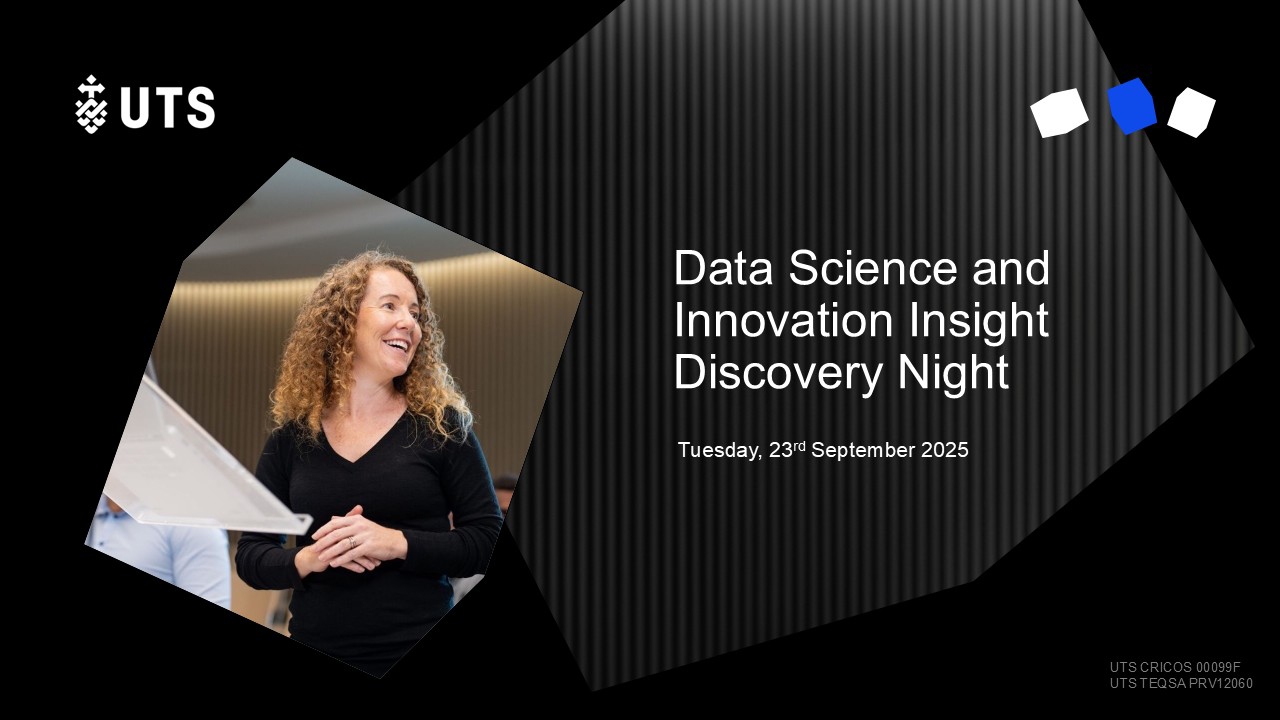
Video Thumbnail

Dr. Antonette Shibani: All right. Hello, everyone. Welcome to the info session on data science and innovation.

I'll first introduce myself. I'm Dr. Antoinette Shabani, and I'm a Senior Lecturer at the Master of Data Science and Innovation, teaching Intimate. I'm also the Deputy Course Director for this course.

And, I bring an extensive experience of working in the field of flash language processing, and my research is around artificial intelligence in education. And I've been doing quite a bit of work around responsible use of AI, particularly exploring the use of generative AI for education.

And I will be the MC for today.

I would first like to acknowledge the Gadigal people of the Eora Nation.

upon whose ancestral lands our city campus now stands. I'd also like to pay respect to the elders, both past and present, acknowledging them as traditional custodians of Knowledge for this land.

I wanted to start with a few reminders in terms of logistics. So, we will be turning off the mics and cameras for the audience. 

So we have the best experience. We would like to encourage audience to ask questions via the Q&A function, which you'll see in the Zoom.

On… at the bottom of your screen.

And we will aim to answer all questions at the end of the session, so hopefully some of them will be answered as we progress through, but we'll also come back to all questions at the end.

And these are the main topics that we'll be covering in this session today.

So we'll give some insights into the data science industry itself, including some of the current trends, opportunities, challenges, and career growth, and so forth. We'll be sharing some personal stories and experiences from our alumni and academics.

Sorry, and we'll also go through some of the study options, delivery modes, and information about the course itself.

And I would like to first introduce the panel that we have for today. I'm very delighted to welcome the panel members for today's session.

So we have, dr. Ali Anaissi?

So, he is the, dr. Ellie is the Acting Course Director for the Data Science and Innovation Programs at UTS.

And with a PhD in computer science, specializing in machine learning and bioinformatics.

Dr. Anaissi brings deep expertise to our programs. His extensive research in machine learning and data mining includes cutting-edge work in structural health monitoring, particularly in areas like damage identification.

Then we have Anthony So.

So, I've already introduced myself, so I'll go on to Anthony. So, Anthony is the head of AI and Data at Mogoplus, where he has held various analytics and managerial roles across telecommunications, media, and finance.

And in recent years, he has worked with multiple startups, contributing to their growth by implementing and deploying innovative AI-based solutions. He is the author of several books on data science, deep learning, and reinforcement learning.

And he serves as a senior lecturer for the Master of Data Science and Innovation at UTS, teaching subjects in mission learning and deep learning.

We also have Siddhi Auti.

who is a data scientist at Optus, with over 13 years of experience in IT and data analytics.

As well as an angel investor with Inflection Point Ventures.

Siddhi supports startups in sectors such as cybersecurity, fintech, ed tech, AI, and FMCG, driving innovation and growth.

As a UTS alumna from the 2021 cohort, Siddhi excels in applying entrepreneurial strategies to achieve impactful business outcomes. 

So… Very glad to have one of our alumni as well in the panel today.

So with our introductions complete, let's dive into the exciting world of data science.

So I'm gonna start with some questions for our panelists.

So the first one, I'm gonna probably throw it off to you, Ali. Thanks for joining us tonight. So with your extensive experience in machine learning, what do you think is driving the growth and rapid expansion of data science?

So, can you talk to us a little bit about, how the field evolves as well?

And… Demand for data professionals.

Dr. Ali Anaissi: Okay, thanks, thanks, Shibani, for your introduction.

Dr. Ali Anaissi: Yes, we have actually several factors now that can drive the rapid global expansion of data science. So, we can mainly talk about the data explosion, so we have now massive growth of digital data that are available in our hand.

This data, like, can be generated from social media.

From sensors, from transactions, from the banks. So we have now a lot of data available for us to analyze.

And this is, one of the main

rapidly global of expansion of data science. And plus, we have,

A lot of advances, in computing. Like, we have a lot of, now.

high-performance computing, such as GPUs, that can allow us as well to analyze this data properly and efficiently. And, another important thing is, open source tools. So now we have a lot of,

open source packages, libraries that are available for us to use, so we don't need to do anything from scratch, so you can build a very complex models within few lines of code, and all these many available, for example, like Python and Python language.

And, we also have… Lot of domains and a lot of businesses that are now,

looking for data scientists, because, as I said, most of the businesses now, they have a lot of data, they need to make, they need to analyze the data they have, they need to extract knowledge from the data they have, and all that they need to do is you need to employ some data scientists to do this kind of task for them.

That's why this is another thing that impacted, or this is another factor that

make the data science on highly demand. And, also, it's, even, again, we have a lot of, programs now that are available in universities to, to offer this kind of data science. So, you can, to summarize, it's about data availability.

High-performance computing computation availability, and the needs of data scientists in every single organization.

Dr. Antonette Shibani: Great, thank you. So that was a very, great, high-level, great overview for how the field is advancing. And it's a bit of a continuation of this question to you, Anthony. How do you see these advances and these technologies influencing organizational decision-making?

And are these changes actually changing the demand for data professionals in organizations?

Anthony So: Yeah, that's a very good question. So, as we can see, right, AI keeps changing and keeps evolving, so there's always new things that happen, so…

What I've seen, really, in the industry is that since the advent of ChatGPT or large language models.

Now, the businesses are more talking about what value we can get, what benefit we can get.

And that's why we start to shift towards agentic AI.

Where we start re-automating workflows, processes, rather than focusing only on content generation.

So, the technology is evolving theorem, we're still using ALMs, but we're using the reasoning part of the ALMs to complement

A business process, and automate that.

So that's definitely, I think the path will keep going, so it's not only, because AI is cool, it has to deliver values, it has to deliver outcome.

And more and more, we're going to see more and more adoption of AI technology, more projects going live, and have an impact on users or businesses.

Then, what I see, me, first, as a hiring manager, what I'm looking for is not so much only technical skills.

It's never just technology for the sake of technology.

The people that excel have all the other soft skills.

That can re-complement their technical skills.

So what we are looking is really critical thinking, problem solving, analytical skills.

So that you can really, work on the limitation of the technology, and put your soft skills

 to overcome some issue or this limitation. But that's what we are looking for, and I believe that we will focus more and more on that, because again, right now, AI can do quite amazing things, even coding.

 That means the bar needs to be higher.

So, entry coders can be replaced by AI right now. That means that 

We need to be better, and we need to solve bigger and more complex problems. So that's where the soft skills will be very, very important.

Even in the near future.

Dr. Antonette Shibani: Absolutely, completely agree with that, so that we do need to evolve

skills as we go with new trends in AI. Over to you, Siddhi. So, as a UTS alumna, maybe could you share your experience in the Master of Data Science Innovation? In particular, what parts of the program were most helpful to you?

And what skills or traits, did you gain to succeed in the field?

Siddhi Auti: Thanks, Shivani. So, from the faculty point of view, we had a good mix of teachers from academia and the industry, so we got best of both worlds, I would say. And secondly, the course contents were as per the latest trends, so we got to learn what was trending in the market.

We got to work with the real datasets, which were publicly available, rather than some simulated data sets. So, throughout the course, we got exposure to the problems that data scientists and big organizations were solving.

So we used to explore multiple models on these datasets to get the best outcomes, and our professors were approachable to provide guidance and always encouraged us to do better, supported us with whatever we needed.

And I could even choose from hundreds of electives.

I think I had chosen entrepreneurial experimenting as one of the subjects, through which I got exposure into… not just, like, ideation or brainstorming, but I got exposure into how to present info in front of the venture capital firms, or how to choose where to invest, and all of that, so it was…

A good experience, to have.

We got to work with industry partners for the projects, and we also had some workshops and internships, all of that.

Overall, I would say the course helped me learn how to solve real problems by using latest tools and technologies along with all these sessions, and as Anthony mentioned, we also got

Good exposure to problem solving and critical thinking through all these different projects and internships that we had.

Dr. Antonette Shibani: Great, thanks so much.

Dr. Antonette Shibani: And Anthony, I might throw this back to you. Having graduated from the program yourself, and you've connected with a few MDSI students and graduates as a senior lecturer, and you also work directly in the industry. So what do you think makes the Data Science and Innovation program unique?

And who do you think would benefit most from it?

Anthony So: Yeah, I agree with Siddhi , right? So, having, the best of both worlds, academia, research, and then applied, and, best practice from the industry, just make you more,

A better data scientist, a better professional, because it can go very deep, but as well, he can provide outcomes very quickly.

So I think that's a good strength of that degree.

The second one, as I said he mentioned, that the flexibility on how you choose your elective, it's really your choice what kind of professional you want to be, what is your passion, and we allow you to do that. So you're in control all the time, because you're focusing on yourself.

Which leads really to me, to the uniqueness of that degree, is that we are really human-centered.

And it's not just a keyword, it's really, we are focusing on the student, making sure that they are learning the right way, that they are supported and, again, in control. It's… at the end of the day, it's for them. It's not purely about the content, it's what they can get for themselves.

So what we have done is really to design this degree so that we make sure that

What we can do, and what we can achieve, is that we will make The future generation of leaders.

Well-rounded decision makers and innovators.

They really understand not only the technology, but all the responsibilities, all the limitations, all the ethical parts

That's involved when you work with that energy in a project.

So, we are really trying to help people to understand that

That technology is still very immature.

 We are far from reaching, the… the, the, the roof…

So there are still a lot of things that need to be invented, there are a lot of things that need to change.

So what we want to make sure is that when you graduate.

 You can navigate through just change. You can navigate through uncertainty.

Because that's the skills that will allow you to grow in your career, and still having good impact for businesses and people.

So we are very different from other, degrees.

We don't teach you a recipe from A to Z, and you just blindly follow it and execute it.

Which, by the way, doesn't exist, even though they do it. But it doesn't exist. Because if it does, that means that machine can already replace us. They can execute A to Z way faster than we do as humans. As we know.

 AI cannot solve all problems.

That's why we want to focus on the soft skills, to make sure that you can complement with machine, and machine can complement with you.

And that's really, I think, the key thing. When we say human-centered.

 Sounds, oh, very vague, but that's the reality of our program. And that's why we make sure that we are building the right next generation of leaders that are going to have a good impact, positive impact on society, community, and business.

Dr. Antonette Shibani: Great, thank you so much. I think your response also actually answers some of the questions from the Q&A, which was around the skills and knowledge that they need to focus to thrive in this field. I think you've answered pretty much all of them really well. And I especially want to highlight, how

Learning, lifelong learning, and being able to actually adapt to uncertainty is one of the key things, as we learn to actually evolve

Along with the evolving technologies and how they grow, and the human-centered mindset.

 I might come back to it later if we have more questions, but hopefully that answers some of that.

I have a question for you, Ali, as well. In particular, I think it has also come through in the chat.

For people without a strong background in coding or data analytics, is it still possible for them to succeed in data science?

And what skills should they focus on developing to prepare for this career?

We do know some like to transition into different carriers and are interested in data science and exploring data science for that reason.

Dr. Ali Anaissi: Yes, we have a lot of students who came from non-IT background, or some students from non… even non-practical background.

Okay, so that's why we have recently proposed a new subject in our program, and it is a production to Python programming, so this is just to teach students

from A to Z, how they can write a simple program in Python. So, mainly, this subject is, is kind of elective subject, and we

We recommend it for any students who doesn't have any programming background or any experience in programming.

So, plus, we also provide some online courses in Python, so where they can also improve their skills if, for example, we have some students who does have programming background, but maybe not in Python. In this case, we provide them with some online materials.

Rather than enroll in a fully Python subject.

And, we also have some, introduction to statistics, so this is also can help students who doesn't have a kind of practical experience in, statistics, for example, which is always… it is required for data science to have some statistic

experience, so we also offer this kind of online, materials for any students who doesn't have any, practical, background in stats or in programming. So.

 That's why, so, if you don't have experience, or if you don't have practical background in programming, which is the main thing that we're gonna use for the whole program, because every single subject

in data science, they teach, or they use Python programming, whether they are doing NLP, or whether they are doing deep learning.

or any kind of subjects that we offer is always involved in it. And this is the reason why we are actually put in our plan that we have to teach our students who doesn't have programming background

Python, subject. So, yeah, so they should be, they should be able to build this kind of experience, or, yeah, so practical experience in programming to, to succeed in our program.


Dr. Antonette Shibani: All right, thanks so much, Ali.

Anthony So: Just want to add on that, yeah, so definitely we… we want you to learn by doing, so that's why the technical skill still is important.

 But we welcome any… People from different backgrounds.

I can share an example. So, one of the students, two years ago, first session with me in machine learning, at the end of the session, comes to me.

talk to me privately, say, I don't have no coding background.

 I see your code, I'm struggling, and so on. I said, oh, you need to stick to it.

We're going to help you, we're going to share you with more content, we're going to help you.

And you will see, when you start.

Using it, you start getting results.

And you start to be proud of it.

You want to do more. You want to learn more.

 And step by step, you will see that, oh, that thing that was painful, a steep learning curve, started to be, like, a game.

 I want to be better at it.

And so that same student Two years after, when he graduated, He was able to build…

an iOS application. So, from no background encoding to building iOS applications and embedding machine learning and conventional neural network into his app.

So that was the passion that he got.

by doing our degree, learning the technical skills, but then say, I can innovate, I can create a new application, I think that was during iLab, that he can showcase and demonstrate, so…

Don't be afraid.

We are here to help you.

Coding is important, but the thing is more what you're getting, what you're learning, and finding your passion.

Dr. Antonette Shibani: Yeah, very well said, Anthony, and I can also add to this  of… from my own experience of working with students over a number of years, we do have students from very different backgrounds coming into the MBSI degree, joining us. We've had lawyers, we've had nuclear scientists, we've had accountants.

We have had teachers who all come from very different backgrounds, so it's really important that you bring the passion to learn, and…

you know, try out in this field, so once you have that, it should be doable. I know we have some more questions, but I think we might…

hand over to Ali now. So thank you, Ali, Anthony, and Sidi, for your insights. We would be taking more questions from the audience, but before that, I would like to ask Ali to first please introduce our data science programs. We want to hear a bit about the curriculum, learning, and the industry partnerships.

And then we can ask, answer any specific questions.

About, these in detail. So I might hand over to you, Ali, and I'll start sharing my screen again.

Dr. Ali Anaissi: Okay, thanks, Shibani.

All right, so, okay, let's now talk about, data science in general. So, what skills, for example, we're gonna learn in the data science, and then we're gonna talk about the structure

of our program, okay? So, as you can see in this diagram here, which is the AI hierarchy of needs for data science. So, we are going to teach our students all these kind of

technologies to reach to the top of this pyramid. So we're gonna start At the beginning, by teaching  Subjects like data engineering.

Data cleaning, data practice, data science practice, so where we can do all the

a task for data, summarization, data cleaning, data visualization. Okay, so we're gonna do… this is what we call here, is data movers.

And then after that, we're gonna start teaching students some skills in data science as a principle of data science, such as the basics,

stats, the basics, machine learning, the basics of, NLP, the basics of,

 machine learning, data mining, so we can give you all these basics in the second stage, or other subjects, and then we can move on the… up to the pyramid to start teaching you some more advanced topics, such as machine learning, engineering, AI, deep learning, NLP. So here we can go in more details

In the program. So, you can see that this is the whole navigation of the data science careers, and students, they can be specialized in any of these areas, when they come… when they go usually to the industry. For example, some students, they can be only specialized in data… in big data engineering.

We have some students, they are also… they are only specialized, for example, in deep learnings and developing the models.

So, and some others, maybe in data management. So we have a lot of topics, or we have a lot of areas where we can focus in our data science career paths, but we're gonna give you all the things that you need to build these skills from the bottom of the pyramid to the top, where you can go

up to the deep learning and AI models.

And… alright, so can you go to the next slide?

Okay, so…

data science, it's, usually it's by nature, it's considered as transdisciplinary, and we actually have it here in our, school, right? So, why we call it as a transdisciplinary? Because

To be a data scientist.

 it's not like you have to be specialized in one particular area, or one particular discipline. You should have experience in multiple disciplines, alright? So, to be a data scientist, you need to know, for example, math and stats.

Because we are going to use the statistics, that's why we're going to teach you some statistic subjects, and you're gonna have some background, or maybe you have to have some little bit of knowledge in math, especially if you need to understand some of the models that we are building.

All right? And…

 To become a data scientist as well, you should have experience in machine learning, and that's why we have subjects to teach you in machine learning in our program, okay? So we teach you multiple or different kinds of models that we use for different tasks, such as classification, forecasting.

clustering, all this we're gonna teach you in the machine learning topics. So, as well, to be a better data scientist, you should have

experience in IT. Like, when you say in IT, it's mainly like computer science, because you are gonna be… you will be writing a program, you're gonna be writing a code for developing any applications, and you also need a database, because

data. Usually, we store it in a kind of database. Can be a data warehouse, or it can be just a normal database, but at the end, you need to have a database management skills to be a data scientist.

 All right?

 And the most important things in data science is you should have a domain knowledge, because when you need to work in a data science domain, you are not going to work in a company that only does data science for data science. They're going to do data science projects for a specific

 applications, all right? For example, you might… you might build application for a bank to predict whether a transaction's

is a fraud or not. Or you might be working in an accounting company to predict the cash flow.

All right? Or you might be working in a hospital, okay? Working with a biologist to analyze the gene profiles of the patients.

So, this means that you should have a domain knowledge, and this domain knowledge is based on the application that you are going to develop, or based on the area that you are going to work in.

Because we have students.

Who are graduated from our program.

Some of them, they are working in a finance area. So, in this case, you're going to have some domain knowledge about finance. Some of them, they are working in the law enforcement for New South Wales Police, for example, so they have a domain knowledge in this area.

Some of our students, they're gonna work in the healthcare.

Okay? Or in the accounting. So, that's why you should have a domain knowledge.

And this is… you're gonna gain it by working on several projects in our program, and every project you are selecting is going to be related to one of the domain knowledge.

So, all these skills you need to have in order to become a data scientist. And on the top of that, you should know about ethics, about the privacy, security, and law, because any application you develop

Especially in data science, it involves some ethical issues.

some data privacy, some security have to apply, and some laws as well. That's why

We also teach you some topics about ethics and data privacy, security issues, and law. So you basically…

 in some subject, we get some guest lectures to teach about these topics. So, this is what we call data science is transdisciplinary, because you can see that it involves different

areas, different.

experience in different topics, okay? And in our data science program, we teach you all these skills in our

data science program, from the basic stats and math up to the most advanced one, like deep learning methods and NLP as well.

So, can you go, please, to the next slide? Yeah, so…

 Now, what are the benefits of studying at UTS? The most important benefit is the industry connections. So, we have actually access to over 800 partners across the faculty.

So… and this is… can be reflected

mainly in our iLab subject, where we got a lot of projects

From industry partners, so we have a lot of connections with these industry partners who are offering projects for our students.

All right, so now our students are working on real projects from the industry. So we got, for example, this semester, we got around 4 or 5 partners who offer different kind of projects to work on real problems.

All right? And we arrange, of course, a sub-meeting with these industry partners.

at the beginning, to give them some advice, or to give them some overview and description about the problem that they are trying to solve. And then, in that middle of the semester, we arrange a meeting with the industrial partners to follow up with our students, and if they have some questions.

And then we arranged, at the end a kind of showcase, where the students, they can showcase their projects.

To… to industry partners, so we invite a lot of industry partners to the showcase, and this is where you can

 Make some connections, so you can showcase your projects, and you might get sometimes a job, or might… you can get an internship by delivering a good presentation and delivering a good output of your projects.

this is about the industry partners. We also have… the most important thing is that our subjects, they are taught many by professionals. Like, for example, we have Anthony, who just was talking to you. He is very skilled, and he has a lot of skills

and experience in the industry. So, you are going to gain a lot of experience from him, how he can deal with real problems, and what are the current challenges we have in the industry. So, this is another important thing that we are

can… offering you in this, our, or in our program. And we have also career preparation, so…

 when it comes to the end of the, of your program, so especially when we start doing the ILAVA project, for example, we design and we arrange a lot of career sessions where we can help

students of how they can build your careers, how you can target a job, how you can prepare yourself to the industry to get some kind of jobs. For example, just last week, we have got three alumni that who offer

our students their experience of how they can… how they got the job, what thing they have done, how they built their portfolio, and we're gonna have another session, for example, in week 10, which is in two weeks' time. Again, we're gonna invite some career experts in order to help our students to prepare

for their careers, and how they can, again, hunt a job, and how they can make a connection, how they can build their portfolio. So we have a lot of sessions. We are arranging for our students for career preparation.

And we have, as well, we are focusing, because most of the time, that this kind of ethics is… and, humans, or ethics and data privacy is sometimes ignored by some programs, but here at UTS, we are focusing on these ethical perspectives.

And we ensure that students are aware of any ethics that they're gonna face where they are working on data science projects.

And plus, we are very flexible in the study options, so we have a lot of elective… we offer students a lot of elective subjects, which allow you to build your career based on what you are interested in.

 For example, if you are interested in health, you can select some subject from the health faculty. If you are interested in business, you are able to select some subjects from the business, from the finance, from the law, so we give students a lot of

elective subject where they can tailor their study based on their interest. Okay, so we have a lot of flexibility

For, our students. We also have

Hands-on learning, where we can allow students to engage with real-world data sets, study from the first

 subject that we teach you. For example, in my subject, I'm teaching, data science innovation.

which is many… it is for the first-year students. We start from this subject to ask the students to interact with real-world data sets.

 We asked them to collect data sets and to work on the problem with these data sets.

And from there, they can later on start easy-to-interact with real-world projects. And because these projects can let you, get an internship in the future, because you can build your portfolio based on all the projects you have done during your study.

 All right? So, and plus, we don't have exams in this program?

 So, it's all hands-on, as we said. So, all the assessments are based on assignments. So, you have… you are going to work on a lot of assignments.

 where you can apply a lot of skills to deal with many problems. So we don't have final exams, like, you have to sit and write, so it's all based on assignments.

And The most important things is we have a strong support from UTS.

For example, we have work integrated learning opportunities.

which allow you to build your professional networks. We have a program like UPass.

Which is available by some of the important subjects in our program. Like, we have it in my subject, Data Science Innovation, where we

allow, or where we let someone from the previous semesters who get, for example, high distinction in our subjects to help students to prepare for all the assessments we have. So that's run using, through the program, we call it UPass.

And that will be led by senior students to help you with any question you have to complete any assignments in the subject. And that will be based on… it's like weekly study sessions running

by UTS. And we also have a student-run Slack channel.

This is, like, where you can get… build a network with students in the UTS, where you can get some question and answer, and where you can find any job opportunities as well. So, you can see that we have a lot of benefits

of studying at UTS, especially at TD school here.

Mmm… Okay, so now, I'm gonna talk about the courses that we are offering.

 in our school. So, the first course we're offering is a Graduate Certificate in Data Science. This is just a half-year program.

If you are doing as a full-time student, or one year if you are doing as a part-time.

This program is only covered… you covered 3 subjects.

Okay, if you're not ready, for example, to go to the fully master.

Alright? Then you can start by doing Graduate Certificate in Data Science.

Okay, so… In this, of course, usually you can select any subjects.

related to data science in this program. You don't have any core units or core subjects in there.

Or…

 If you don't want to do that graduate certificate in data science, then you can go to do that graduate diploma.

 The graduate diploma is a one-year program for full-time.

or 2 years if you are doing it as a part-time. So, in this

Or in this program, you are going to complete 6 subjects with 48 credit points.

Alright, so again here.

That's also… so anything you do in these two programs, whether it is GCDS, I, or GD, DSI, any subject you are going… you're doing there, they can… they will be transferred into your Master of Data Science and Innovations. So if you completed one year.

in graduate diploma in Data Science and Innovation, then you might only need to do one year in Master of Data Science and Innovations.

 So, in Master, if you are ready, if you don't want to do the GZDS or GDDS, then you can go directly to the Master of Data Science and Innovation, and this is a two-year program, if you are doing it as a full-time, or four-year if you do it

as a part-time. It can be reduced into one and a half year, if you have some

 Bachelor degree in congregate course, we're gonna talk about it in the next slides.

 Or, if you have completed any kind of post-grad program, you can also get

 48 credit points of reductions in credit points. So we can discuss as well these options in the next slides. And the other program we're also offering here, it is, Executive Master of Data Science Innovation. This is only one year program, but it is mainly for

managers, so students who got experience in the industry for 3 or 2 years, and they also have experience in management, then they are able to enroll in these subjects.

Executive Master of Data Science.

You can see that it is kind of management with data science experience, means that you should have experience

With management, like, you have industry experience and you are a manager for some

project, or some teams, and you have some little bit of data science experience, then you are eligible to enroll in this one-year program, which is only 48 credit points. And, this is, again, it can be done within one year, or as a full-time, or two years, if you want to do it as a part-time.

So, which master program is right for you? So, as I said, we have two different masters. We have the Master of Data Science and Innovation. This is the two years program.

And we have the Executive Master of Data Science and Innovation, and that's… is… this is only one year.

So, now, which one? It's…

eligible to do, or what are the admission requirements for each program? As you can see here.

The admission program for the MDSI, you should have bachelor's degree or above.

 plus GPA of at least 4 out of 7.

 Or you might have… if you don't have the GPA 4 out of 7, but you have 2 years work experience, then you can get into this course, alright? In this course, you can see that it's… you have to complete 96 credit points, you have 40 credit points to do a course subject.

This is like…

The core subject, these are the subjects that you must complete them, and then you have 56 electives.

All right, so 56 elective subjects, where you can select these subjects from different schools, as I said before, so we give you the flexibility to choose subjects from different faculty, different schools, based on what you are interested in, what you want to build, what you want to achieve from this program.

And you also have 24 credit points as free electives. This is where you can select from different schools. So this 56 has to be, like, data science subjects, but 24 can be from any domain.

And with this Master of Data Science, you can get 24 RPI.

Alright, or can be even up to 48 RPL if you have post-grad studies. If you completed any master's degree in congregate field.

then you are eligible to get a 48 credit points RPI. And once you get 48 credit points RPI, it means that you can complete the program within one year on.

Alright, so you can see here.

If you have a cognate Bachelor's.

 like you said that you have bachelor in Computer Science, you have bachelor in finance, you have Bachelor in accounting. We have some courses, they're considered as cognate Bachelor. If you get a bachelor in this

cognate fields, then you are on plus, of course, you have a GPA 4 out of 7, or you have cognate Bachelor, but with 2 years experience, then you are eligible for

RPL, 24 RPL, okay? But if you have all these.

 plus master, which is post-grant, then you are eligible for 48 credit points, RPI.

 So, as of then, this will be decided by the admission… by the admission office. So, when you submit your paperwork, when you submit your transcripts, your bachelor degree, your work experience.

what things you have done, what is your area, then we can decide whether you are eligible for this 24, or maybe eligible for the 4EA. Depends on… as I said, the 4A is only eligible if you have a pre- or post-grad studies.

So, for the Executive Master of Data Science, as I said, it is a one-year program.

 If you do it as a full-time, or 2 years if you are doing it as a part-time.

And we have 24 clid points as core subjects, so we have 3 core subjects.

That you must complete, and you have 24 elective subjects.

That you can choose from different areas.

What are the admissions? You can see that you should have a bachelor.

As normal?

Or as usual, but you should have what? A 5 years management.

 work experience. So you have… you should have a work experience, and your work experience, including some management tasks.

And also, you should have 3 years of data-relevant work experience, which means that you should have experience in, kind of, data science.

then you can do this Executive of Master of Data Science within one year.

If… You have… if you're a bachelor.

 is cognate, then you can just have 2 years of work experience is enough.

Okay, so the cognate ATF Level 8 degree or above, plus 5 years management work experience. So, these are the admission requirements to get into the EDM or EMDSI.

And for this program, there's no RPI, because you already do it as a one-year program, so we don't offer any kind of RPI.

All right, so this is the course structure for the Master of Data Science and Innovations. As we said before, you have 50 critic points as a core subject, and you can see the core subjects are Data Science and Innovation.

Statistics… statistical thinking for data science, machine learning algorithms and applications, data visualization and narratives, and one of the following capstone projects.

or Innovation Lab. It can be capstone Project, it can be internship project, or it can be research projects. So, these are the four core subjects, and one core subject from the Innovation Eye Lab. Most of our students, they actually, they are doing capstone projects.

most of our students, they are doing capsule. If you have

Hosted a company to do the internship, then you are

You can enroll in this subject, internship projects. This is like, you find a company who offers you a job to do the internship, then you can enroll in this subject.

Or, if you are interested in research, and you have a project.

with a supervisor, then you are also eligible to enroll in this research project. So, but you… you have to do one of them.

As a core subject to complete the four credit points, and we have 56 credit points

That you need to complete?

And within the list of the subjects that are available on our website. So, for example.

you have Python programming, you have NLP, you have deep learning, data science practice, big data engineering, AI, and advanced machine learning, all right? So these are…

Elective subjects that you have to complete within our school.

 And then, as we said before, you have 24 credit points where you can

do some subjects cross-faculty. Like, as I said, you are… you want to do some…

subjects related to that business. Then you can select subject from the business school.

 you are interested to do subject in the healthcare, for example, to get some knowledge, or domain knowledge, then you can go and do your subject from there. So this 24, it is unspecified cross-faculty. It's like the free electives, we call them here, okay, where you can select subjects from different schools.

 Okay, so… If you are not… Ready for…

Taking a formal qualification, let's say that you don't want to do now.

graduate certificates of data science, or you don't want to do the graduate diploma or master, you just want to start

Getting in slowly into the data science.

without formally enrolled in any qualification, you can enroll in some of the micro Potential.

credentialed subjects, okay? These subjects, for example, they can be completed within 6 weeks, Alright, and we have…

 two main options to do this. We have the Applied Data Science for Innovation.

and advanced data science for innovations. So, this is…

Again, if you… you want to see if you are… you can go within this field or not. Let's say that you have some bachelor in some non-practical Domain, so… but… and you are interested to do data science, but you don't know if you can go into this field or not. So you can just prepare yourself. You can take these subjects and check how do you feel about it. Are you ready? Do you have

Can you think that you are able to do it? So you can start by taking this kind of micro-credential subjects, and that will give you… and these subjects are very flexible.

Okay, and as I said, we have different subjects, but this is one of the data science subjects that are available in our school. So, applied data science, as I said, for innovation, and advanced data science for innovations.

Alright, so… Why data science?

 Is highly demanded now, and why

we have a lot… as I said, we are having this program because data science now, it's one of the most

 Highly demanded jobs in the industry.

And you can see that we have

1,800 plus of data scientists and data analyst jobs advertised on Seek.

We have a lot of jobs as well, like on LinkedIn, we have, these jobs, as you can see, they are kind of highly salaried.

Okay, so I'm talking… if you think about the typical data science, between 115 to 135, I believe this is, like, for kind of, entry data science job. I know that some students

They are working as a senior data scientist. They are getting 150 plus.

So, you can see that it is… it's highly demanding, have a lot of jobs available, and it's… the salary is highly high as well.

 Why? Because if you go back in the slides, you can see, as I mentioned, that to be a data scientist.

you have to get an experience in many different domains, at many different disciplines. Like, to work as a software developer.

For example, they only need you to do… you have to know some programming language, some database, some front-end, back-end, done, finish. You can get this job. But to be a data scientist, you need to know a lot of skills. As I said, you need to know… yes, you need to know programming, you need to know database, you need to know statistics, you need to know machine learning, you need to know mathematics.

Okay? You need to have kind of good communication, because you need to communicate your results to some people that doesn't have any technical skills, and you need to have a kind of domain knowledge. And that's why it's highly salary, because

People who are getting these jobs, they have built a lot of skills to get to this point.

Okay?

So you can see that it is one of the top demand professions across Australia and globally, and they are based on the US Bureau of Labor Statistics.

In 2024, they are expecting to have 36% growth in data science jobs between 2023 and 2033. And also, according to the Australian Government Department Departments of Jobs and Small Business, they're expecting, as well, 20 ed, or they have seen that they have… there are… there's a 28% increase in demand for data scientists in 2024. So, that's why you have to put your foot in to start building your career to reach

 Or to get all the skills.

that you need to be eligible for these kind of shops that are now available on Seeks.

 All right? And as you can see, that most of the business, most of the industry, they need data scientists. Of course, you need to build your, as you said, you have to build your skills, you have to build your portfolio, and that will take you to this kind of

Point where you can get these jobs.

Okay.

 So, the key dates and financial support at our schools, you can see that application deadlines

for next year is domestic units will be 25th January 2026, to start,

 To enroll in the spring semester?

 And for international students who are outside Australia, the deadline will be in early November.

2025, which is very close.

And international students that are inside Australia, it's 15 January 2026.

 So, this is the application deadlines to start spring of next year.

And, classes usually commence in the 16th February 2026. This is… I'm talking about the spring semester.

I'm sorry, about, autumn semester, okay? So, I'm talking about the autumn semester here.

Starting in 6th, because now we are currently in spring, so I'm talking about the autumn semester starts in 16th February 2026, and these are the key dates and application deadlines for next year's program.

And we also have some financial support options at UTS.

Okay, so we have some fee help. Of course, you need to check if you are available for this kind of fee help. You have UTS alumni, so basically, our alumni, they can get 10% discount on non-CSP fee-paying courses.

And, the scholarship as well, we have

At UTS, we offer scholarship for domestic and international students.

To help them with educational expense, and everyone is

Free to apply, and based, of course, we have some panels that can decide who are eligible

 For these scholarships or not.

 Okay, so please note these deadlines, because it's coming very soon.

All right, so now we come back to the questions and discussion.


Dr. Antonette Shibani: Yes, thank you so much, Ali. So let's get back to our panelists to answer some questions from the audience. And thanks so much for our recruitment team, who have been answering a lot of questions in the Q&A.

And we do have some open questions, which we might… Open up to our panelists.

Okay, there's one question which is about skills and experience to apply for these jobs straight from the degree.

Ali, would you want to answer this, or Anthony?

 So once students graduate from the degree, do you think they'll have all the skills to do some of the jobs that you just mentioned? For instance, data scientist, data analyst, data engineer, different kinds of jobs available on Seek and other platforms, or will they need other experience too? Anthony, do you want to go first?

Anthony So: Yeah, absolutely. In terms of skills, yes. I believe that you will be exposed to a lot of the technology of the concepts that's currently used in the industry.

 So definitely you'll be, market ready.

Then, Is that enough to find a job? It's hard to say, because it depends on everyone. What's the…

 The past experience, which service they took, as well? What's your interest as well?

 But overall, what we can do is really to help you to maximize your chance. So we mentioned iLab, which can be the capstone project.

 That's something that you will be able to showcase

 when you go to interviews, or put into your resume. So that will be some plus.

That you can benefit from the degree, that can increase your chance of, of being,

 Selected for random interview, or being hired.

 There's no degree in the world that can guarantee you a job, we have to be honest. But what we do is really to help you optimize your chance.

And what we can do as well, as I said, the soft skills is a big plus. It's very different, it's very unique.

not only in Australia, but I think in the world.

That's something that can differentiate you against other, candidates.

Cause it… As a hiring manager, you can guess how boring it is to read similar resume.

Resume, same resume, and resume. If someone has something different, say, oh, wow, that catched my intention, that catch my interest. Now I want to learn more about that person.

That's the thing that we can help you to achieve in Git.

Dr. Antonette Shibani: Yeah, absolutely. I'll just add on a couple of things to that, because I've also been in the situation where

we, we've also looked for, you know, hiring students as data scientists as well. And really, one thing that we do tell all our students is also to build… start building that portfolio of projects for yourself, so you can showcase the kinds of work you've done.

And we are going to help students build that using kinds of coursework, the different projects they do in assignments.

So they don't just treat it as an assignment, but it's actually, you know, building your repository of work, building your own GitHub profile, actually showcasing things that you've built. So that's what hiring managers usually look for. So what have you done yourself?

And obviously with the kinds of soft skills that Anthony mentioned, that would also

be part of the degree itself with the assignments, where you're not just writing code, but you're actually writing clear reports, just like how you would present to an executive in maybe a data science firm, or, you know, do presentations in class, you know, we have in-class

face-to-face classes, so it's not just an online degree where we don't know who the students are. So we also help you practice and pitch

the kinds of work that you do, and, communication, very, very critical. So for all of those, they're also part of the degree, but obviously it's up to each and every individual student to take that additional step.

To push them really beyond and, showcase them out of the crowd.

 Ali, do you want to add anything there?

Dr. Ali Anaissi: I think you and anthony, they have covered a lot of things, so as I said, yes, so…

Dr. Ali Anaissi: We give you all the skills that can make you to be ready to get any job here. Through the subjects that we teach you, plus many…

 through the iLab, because in the iLab, this is where you can build a very strong experience that is highly related to the industry, because we get you involved with some industry partners.

And, that will give you a kind of, real applications, real challenges they are facing in the industry.

 To target any… Any job in the, in the industry.


Dr. Antonette Shibani: While I have you here, Ali, can I ask you this question about micro-credentials, that is?

 come up in the Q&A. Do you have rough ideas of when these would run? Because do you require minimum numbers, or is it available anytime online?

Dr. Ali Anaissi: These subjects, again, they are available anytime online, because… yeah.

these micro-credentials, I believe that they are available, but I can follow up with them  by emails to check the… if there are some deaths, but as far as I know, it is… they are available anytime.

Dr. Antonette Shibani: All right, thank you. I might just ask one final question to Sidi before we close up, because there's, a question

 about what useful things someone should do whilst they are studying, so maybe, Sidi, you can share.

What is helpful for students to start thinking about as they study this course, and to get the best out of this degree?

Siddhi Auti: I think… I would say that… focus on the studies, and at the same time, don't stop what you have studied in the class, just explore more outside, and that should help. And I think everyone has been mentioning about the soft skills as well. You have a lot of international students and domestic students to, you know, network with.

get that… you have that opportunity to learn from each other, and just explore that as well, the soft skills.

That's what I would suggest.

Dr. Antonette Shibani: Absolutely. And a lot of students also do hackathons and things outside of what they do at class.

So definitely keep building those skillset beyond.

Alright, thank you. If we have any remaining questions, these will be answered via email later, but… I might go to my final… Slide, just to wrap up the session, because we're on time.

 And just a reminder that the next intake is Autumn 2026, and, which is now open, and the deadlines were shared again.

So, a big thank you to all our guest speakers and everyone who's joined us tonight, so thanks so much for your participation. 

And we'll answer any reminding questions via email. And for those in the audience, our team will be hosting a consultation week, which is from September 29th to November 3rd. So if you have any questions, please scan this QR code so you can book a one-on-one consultation to get any other additional questions answered.

And, applications for the February intake are now open, and you can apply until January 25th through the UTS student portal, and the UTS website will also have more information.

So, thank you again for joining, and we hope to welcome you to UTS soon.

Thanks.

Interested in our Data Science and Innovation courses?

Book a 1:1 consult to explore study options, eligibility, fees, and get all your questions answered.

Share