

- Posted on 12 May 2023
- 61-minute read
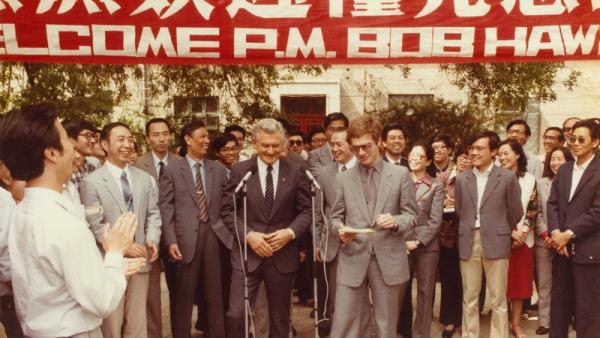
Bob Hawke Collection, Bob Hawke Prime Ministerial Library, University of South Australia

James Curran is Professor of Modern History at Sydney University and International Editor at The Australian Financial Review.
To read the full paper please download the PDF
Download
Executive Summary
While speculation continues as to whether Prime Minister Anthony Albanese will visit the People’s Republic of China (PRC) this year – making it the first such visit since Malcolm Turnbull in 2016 – the time is ripe for reflection on arguably the most consequential visit in the relationship’s history, that by Bob Hawke to Beijing in May 1986.
To that time, Hawke’s visit to the Chinese capital and four provinces represented the highest point of the bilateral relationship since the foundation of diplomatic relations in 1972. Hawke’s access to the senior PRC leadership during this visit was unmatched by other major Western leaders in that era, including US President Ronald Reagan and British Prime Minister Margaret Thatcher. No future Australian leader would ever again be granted this kind of intimate entrée to the PRC’s political elite and their thinking about the country’s modernisation and its views of the world.
At the centre of the bilateral relationship in the mid-1980s was the close relationship that Hawke had developed over preceding years with two of the PRC’s reformist leaders, Premier Zhao Ziyang and Communist Party General Secretary Hu Yaobang. ‘On the big issues’, Hawke told Hu after the 1986 visit, ‘our objectives are identical and our approach is similar’. It was new language for an Australian prime minister where the PRC was concerned, but it also built squarely on the solid foundations laid by the Whitlam and Fraser governments.
This research report will show that during this critical 1986 visit:
- the Australian government welcomed PRC influence in the Pacific and committed itself to encourage those Pacific nations which did not recognise the PRC to keep their lines of communication open to Beijing;
- Hawke personally undertook to approach US Secretary of State George Shultz on behalf of PRC leaders in an attempt to resolve the status of Taiwan;
- Hawke was given extensive and substantial insights into Chinese thinking about reforms to the Communist Party and PRC economy;
- the iron ore trade that would come to occupy a key plank of long-term Australian economic prosperity was further developed; and
- The PRC’s leaders remained suspicious of Soviet aggression, wary of Japan’s long-term military intentions in Asia and critical of US regional objectives, especially over the ongoing sales of American arms to Taiwan.
The report features four parts. Section 1 establishes the context. It argues that the significance of the visit can only be understood against the backdrop of the development of Australia-PRC relations over the preceding decade, the extent of – and limits to – the PRC’s economic reforms under Deng Xiaoping and Bob Hawke’s approach to Australian foreign policy, in particular his appreciation of where the PRCs modernisation fitted into the broader narrative of the Asian economic growth story of the 1980s. Section 2 offers an analysis of Hawke’s discussions with PRC leaders, placing these exchanges within the setting of what some historians have called the ‘golden age’ of Chinese reform and openness. Section 3 explores the foreign policy dimension of the visit and Section 4 the visit’s meaning for the bilateral relationship. A conclusion attempts to identify the overall significance of the visit for both countries.
1. ‘The great cause’
Australia emerged from the 1970s with a new confidence in its foreign policy, and especially in relation to its engagement with the countries and cultures of Asia. The achievement of Gough Whitlam and Malcolm Fraser in this regard was in their willingness to strike out in new directions that did not always follow the policy course set by their ‘great and powerful’ friends in Washington or London.
Gough Whitlam had not only recognised Communist China on coming to office but had envisaged new regional architecture that included the PRC, but not America. After his visit to Beijing in October 1973, he said that Australia was no ‘longer working in the dark’ when it came to dealing with the PRC.[1]
Malcolm Fraser, though less euphoric than Whitlam on the possibilities presented by the virtual end of the Cold War in East Asia, nevertheless saw that the PRC might be enjoined to help contain the Soviet Union, along with Japan and the US. His démarche along these lines was not realised, but his two visits to the PRC as Prime Minister nevertheless contributed to a growing sense that Australia was dealing with the PRC as a power in ‘their own right’.[2]
Bob Hawke was lured to the PRC primarily by the prospect of taking part in the great economic revolution initiated by Beijing. From the late 1970s, the PRC government under Deng Xiaoping began a process of reform, which was to lead to the adoption of many elements of a capitalist economy and to the opening up of its markets for foreign goods and investment. As Harvard sociologist Ezra Vogel put it, ‘no socialist country had successfully – and without serious disruptions – made the shift from a planned economy to a sustained open, market-based economy’.[3]
Drawing on expertise from Asia and elsewhere around the world, and especially the World Bank, Deng was testing how a market economy, where private enrichment was now being encouraged, could also work for the national interest. He called it ‘taking a look around’, and, according to historian Julian Gewirtz, his top officials ‘articulated the mantra of ‘crossing the river by feeling for the stones’ as the pragmatic, experimental guide to reform’.[4] Hawke called this process in the PRC ‘the single most important thing that is happening in the world’. Australia and the PRC, he said, also saw ‘eye to eye’ on the vast majority of regional and international questions.[5] For this new Labor prime minister, Australia’s relationship with the PRC was ‘the great cause’, the ‘ripples of which’, he thought, ‘can extend outwards to benefit others as well’.[6] The novelty here was clear: the personal relations in Australia-PRC ties now included the top officials in the Communist Party of China (CPC).
Not only did the economic complementarity between the two countries take shape – by 1984 bilateral trade had grown to AU$1 billion from AU$158 million in 1973 – but the continual exchange of high-level visits, the belief on both sides that the relationship was a ‘model’ for relations between countries with different political systems, and the leading role that Australia played in recognising the reforms in the PRC after 1978 all provided what then-Foreign Minister Bill Hayden called ‘momentum’.[7] The primary achievement of the Hawke government, at least until the tragic events in Tiananmen Square in June 1989, is that it set up the key elements of the economic and cultural relationship with the PRC – especially around iron ore and educational exchanges – that would help define ties for the following three decades. The PRC’s modernisation, Australia’s resources and its own economic restructuring were clearly making deeper integration between the two economies possible.[8]
Accordingly, the place of the PRC in the Australian imagination changed: it was now a ‘major partner’.[9] Just as Australia could be seen to be well and truly leaving behind the fears of an earlier era, so too was the PRC view of Australia being transformed. ‘Today Australia is no longer a remote and strange country in the eyes of the Chinese’, said the PRC’s Ambassador to Australia, Nie Gongcheng, at an academic conference in 1985. And ‘nor do Australians regard the PRC as a ‘terrible potential threat’ anymore’.[10]
At the time Hawke took office in 1983, the PRC was still classified as a poor, developing country, but the new Prime Minister and his advisers believed it was on an irreversible trajectory, that its economic growth would fit the East Asian pattern of reform and opening up, and that by doing so it would be rewarded with unimaginable economic prosperity. This was clearly going to be a positive for an Australian economy that, under the collective leadership of Hawke and Treasurer Paul Keating, was also embracing globalisation.
As Hawke’s principal economic adviser, Ross Garnaut, recalled, ‘Hawke’s view, and mine, was that successful global development would bring to all countries many of the material bounties that modern economic growth had brought to the then developed world; that sound policies in individual countries and in international economic relations would see that happen over a long period of time, although the path was beset by bumps in the road’. As had already been observed in Japan, Korea and Taiwan, development success was ‘good for the people of the countries concerned, for world and regional peace and especially for Australian prosperity because of the potential scale and complementarity with Australia of the Northeast Asian economies’. The PRC, Garnaut adds, was ‘simply the biggest and most consequential country in the global and Asian development story’.[11]
Indeed, in his first major foreign policy address as Prime Minister it was those rapid growth patterns of regional neighbours on which Hawke focused: Australians had to ‘recognise what is happening and accept that we either keep up or lose out’.[12] Rising Asian living standards presented opportunities for Australian primary producers, technology providers, and those in the services and skills industries. But as Australia’s exports to Japan were contracting in relative terms, opportunities were being presented in the PRC. Changes in its rural sector were giving peasants the opportunity for private accumulation; profit targets were replacing production targets and there was a much broader dispersion of remuneration according to skills and responsibility. Hawke’s conclusion was that ‘an absolutely fundamental change not merely in economic management practises but in the philosophy of China is therefore taking place’. [13] His summation went even further: [14]
More and more the Chinese system and its philosophy is becoming compatible with our sorts of values. It is not going to become a democracy in our sense, but in terms of its concepts and practises it is going to be much more compatible with the way we go about things.
As Ross Garnaut observed later, Hawke believed increased economic prosperity in the PRC ‘would bring pressures for greater freedoms and for political change’, but that didn’t mean ‘Jeffersonian democracy’ was the end point. [15] Nevertheless, Hawke assessed that the ‘outcome would be generally better for the people of China than a failure of reform and return to Maoist insularity’.[16] As Hawke was to write later in his memoirs, the PRC leadership ‘had in mind the experience of Japan and the Asian ‘tigers’’.[17] They had come to the view, via lengthy and detailed studies of international experience, that the East European model of ushering in bold reforms in one fell swoop would not work due to the difference in the PRC’s size and its conditions: the only realistic path, PRC leaders were advised by the World Bank, was to ‘open markets and decontrol prices step by step, and then to allow gradual adjustments’.[18] It is important to note that PRC economists were scouring the world for economic ideas in this period, and not only from the US, but from Hungary, Japan, the UK, Yugoslavia and Argentina. As Gewirtz has emphasised, the PRC’s growing interconnectedness with the West in this era was not solely concerned with trade and investment: they were after the currency, too, of economic ideas.[19] But until now the Australian dimension of this story has not been given its sufficient treatment by scholars.
Australia, as it had been during Japan and South Korea’s growth, was recognised by the PRC as a key supplier of raw materials.[20] A paper prepared for the Australia-China Council Executive Committee around this time speculated that the PRC might well follow the ‘often surprising, sometimes disruptive economic dynamism of the East Asian countries’, particularly Japan, but also Hong Kong, Taiwan, Singapore and South Korea.[21] If the PRC’s performance followed that trend – it foresaw good reasons why it might do so ‘given the common cultural heritage of those countries’ – then the effect on the future structure of global economic activity would be profound: a ‘politicoeconomic environment totally unlike anything Australia has known in its past history will be formed in our immediate region, with major roles played by Japan, Indonesia and China’.[22]
This then was the geo-economic stage on which Hawke was walking as Australian Prime Minister.
2. A ringside seat to reform
Both the Fraser and Hawke governments had made a special point of cultivating the relationships with these reform-minded Chinese leaders. And Hawke’s meetings in Australia with Premier Zhao Ziyang in 1983, and Communist Party General Secretary Hu Yaobang in 1985, alongside his own visit to the PRC in 1984, gave him an early introduction to PRC thinking on its social and economic reforms. Before Hu’s visit in 1985, for example, Hawke’s foreign policy adviser John Bowan briefed the Australian press that the visit was, in essence, about Australia doing ‘what it can to get itself in the best position to participate in this Chinese modernisation’ (emphasis in original document).[23]
Zhao and Hu were the leaders that Deng was grooming to be his successors. Both emerged from the Communist Youth movement. As Richard McGregor, author of The Party, has shown, they ‘encouraged discussion of political reform, including grassroots elections, a more open media and a scaling back of the role of party committees that directly managed government ministries and state businesses’.[24] Little wonder that astute PRC watchers at the time, like Vogel, discerned an ‘extraordinary excitement in the air’ in the PRC during the 1980s.[25] Or, as Gewirtz terms it, this was a ‘fierce, freewheeling debate that flourished under Zhao, about what socialism truly meant, whether markets and wealth could be allowed, and what sort of society China could become’.[26]
A key breakthrough had come in 1984 when Zhao had enjoyed success in achieving official endorsement of market mechanisms within what was known as ‘socialism with Chinese characteristics’, wherein the PRC economy was now labelled a ‘planned commodity economy’: with ‘commodity economy’ a Soviet byword that allowed a certain amount of market forces.[27]
A key question to be borne in mind here is whether as a result of the insights gained from these two leaders, Hawke expected the PRC’s political reforms to go much further, where its embrace of aspects of market capitalism would lead to greater political liberalisation. It was this question, too, which naturally exercised the minds of Australian embassy officials in Beijing at the time: what were the limits to this reform process and how would they be ultimately imposed? If Hu and Zhao did not convey during their conversations with the Australian prime minister a sense of where the boundaries were to this political change, how did Deng understand them? Given there was no agreed blueprint for reform, and that it was to be worked out in piecemeal fashion, its ultimate destination at that moment was difficult to discern.[28]
The New York Times columnist Anthony Lewis, writing from the PRC in 1985, underlined the dilemma: ‘follow the line of reform’ he observed, ‘and you begin to see the un-raveling of all kinds of rigidities: prices, material allocations, work assignments. Where will it stop? How can it stop?’[29] But Australian officials, like others in Beijing at the time, were also conscious of the pushback from conservative hardliners in the party, such as CPC elder Chen Yun, who looked at the introduction of such reforms as the infiltration into the PRC of ‘decadent capitalist ideology’.[30] Australian caution was at odds with some senior American thinking in this era, which tended to assume that the PRC’s growth story in the 1980s was both prelude to and part of its ultimate adoption of Western-style democracy.
Hu Yaobang was closely linked with more reform and open economic stances. He appeared regularly in public wearing Western-style suits, and provoked a sensation in the mid-1980s when he suggested that Chinese people should use knives and forks instead of chopsticks.[31] ‘With his forthright manner’, noted former US Secretary of State Henry Kissinger, Hu ‘consistently pushed the limits of what his party and his society were willing to accept’.[32] Zhao, appointed Premier in 1980, had been the champion of agricultural decollectivisation and, given the rising living standards ushered in by that decision, had become a hero to rural Chinese. The question, he told Kissinger during a meeting later in the decade, was how to ‘rationalise the relationship between socialism and market forces’.[33] Zhao had also instructed academics and think tanks in Beijing to research how the PRC’s political system might be gradually reformed.[34] This was to involve learning from other countries, but it is important to stress here that it was not intended to circumvent state machinery.
In 1986, Hawke was given the opportunity for a closer view of this very debate being conducted at the highest levels in the PRC. He got it not just from long conversations in the stately rooms in Beijing but from the four provinces he visited during the trip – Sichuan, Jiangsu, Fujian and Guangdong. His conversations with PRC leaders and provincial governors during this visit constitute, then, a window onto a very different era in the relationship: the talks themselves a capstone to an era when, as Premier Zhao Ziyang told Hawke at the first substantive meeting in Beijing, more than 20 reciprocal visits at ministerial level had taken place over the previous two years.[35] The 1986 talks assumed a richer significance, too, given the awareness in Beijing and globally of the reforms that were being ushered in the Soviet Union under the leadership of Mikhail Gorbachev, who had come to power the year before promising a new era of openness and global engagement.
2.1 ‘Stimulating and moving’: With Deng
Hawke’s conversation in the Great Hall of the People with Deng Xiaoping meant that he, along with Gough Whitlam, were the only Australian prime ministers to meet Deng.[36] Although by this time Deng did not have a state or party role, he remained the ‘power behind all thrones’.[37] Deng sketched to Hawke the narrative arc of PRC development past and present, from the ‘disaster’ of the Great Leap Forward to its goal of ‘approach[ing] the level of the developed countries by the year 2050’. With a likely population of 1.5 billion by that time, the targeted quadrupling of production would take average per capita income to US$4000, enabling the PRC to be ‘regarded as a medium developed country’ by the middle of the 21st century.
Deng then highlighted how the success of Zhao’s changes to the rural sector were assisting the PRC’s shift to ‘comprehensive reform’, which was ‘not only confined to the economic area but also cultural, scientific and other sectors. The political system was also involved’.[38] Where farmers had been given incentives, urban reform would prioritise ‘decentralisation’ to generate the same response: the ‘central government had less to do and could be streamlined’. The old feudal influences would be eliminated in this new process of ‘urban structural reform’. Hawke could only marvel at this grand ambition, but his question was on what effect this trajectory – if successful – might have on ideology which, as he put it, was ‘the cement of socialism’. Deng said the facts on the ground – where in some cases there had been a 300-400 percent increase in production – would have to ‘persuade the doubters’, pointing to the hesitation born of conservative and uncertain reactions to the rural reforms, and showing too that the boldness of Hu and Zhao was being met with some resistance by more sceptical officials. Deng invited Hawke to return in three years and ‘see the results’.[39]
After their discussion, Hawke emerged to tell the waiting Australian press that he had been stimulated and moved to be in the presence of this ‘great inspiration of what’s happened in recent years’, a leader who was ‘still obviously revered and will continue to be’. It was, he added, ‘one of the most remarkable experiences I have had’.[40]
2.2 What next for ‘socialism’ in the PRC?
Talking next with Zhao, Hawke likewise pushed him on where this period of economic reform was ultimately heading. The Australian leader was characteristically direct. The commitment to a more open market economy, with all it entailed for ‘an internationally competitive pricing mechanism and increasing wage and salary differentials’ meant it was perhaps no longer real for PRC leaders to be still talking about their country as a socialist society. Zhao’s response was to underline that: [41]
[T]he language is significant for us but it is not the most important thing. What matters is that our people understand that there is no longer one big pot from which everything comes. They have to understand that there will be thousands and thousands of smaller pots which must be efficient and competitive.
Hawke could only smile, recording later in his memoirs that the beginnings of this economic approach would not only transform the PRC itself, but ‘change the global economic and political balance of power’.[42] And he said to Zhao that ‘these economic changes would inevitably unleash pressures for political change’.[43]
But it was his conversation with Hu Qili that allowed the Australian leader to delve into this transformation in greater depth.[44] Hu Yaobang had told Hawke he would not accompany him to Xiamen because it was important that he get to know Hu Qili, widely tipped then to be a future leader of the PRC. In this conversation, Deng’s ‘economic development with Chinese characteristics’ was given its fullest explication. As Hu Qili explained, he and Hawke were meeting in the first year of the PRC’s 7th Five Year Plan. And in 1985, World Bank experts had reassured Deng that his goal of quadrupling economic output over the next two decades was doable.[45] The next step, then, was how to continue managing an economy in transition: from being centrally planned to becoming a ‘planned commodity economy’.
As Hu outlined it, the three crucial elements of this shift were that state and medium sized enterprises would become independent, and therefore responsible for their own profits and losses; that the market mechanism would be introduced into the areas of technology and labour; and that government would be loosening its control over enterprises via the introduction of taxation and foreign exchange rates. This process, Hu added, would necessarily bring a change to ‘the ideological attitudes and frame of mind’ of the Chinese people.[46] And in this period of transformation, neither the old nor new economic system ‘[could] get an upper hand’. The reach of the new system across the country was therefore uneven. There were ‘happy’ faces in Nanjing but in the ‘hinterland where reforms got a late start, there are more contradictions’, Hu quipped. It meant that modernisation would be competing with – and rubbing up against – China’s ‘several thousand years of feudalistic tradition’. So a driving force of the current five year plan was to accelerate the pace of change ‘so that the new economic system can get the upper hand’.[47]
It was then explained to Hawke that the leadership would ‘further develop socialist democracy’, including ‘democratic elections within the party’ as a means of rooting out corruption among an older generation of cadres and allowing a new leadership generation to emerge. Hawke was particularly intrigued by this point, asking whether it would be limited to cases of corruption or ‘to a broader concept of freedom of decision making at the local level’. While Hu emphasised that the intention was to give the people a bigger say in the election of government officials, including via the introduction of secret ballots, more research on this was being undertaken by PRC officials, including the study of international examples. But Hu was not going to take the bait either. He said that ‘socialism itself is created by the people… it is not a creation of one mind which is then imposed upon millions of people…the idea of the rural reforms was created by the farmers of Anhui. These reforms were then discovered and confirmed by Chairman Deng’. The point was that small businesses – he provided the examples of households and taxi drivers – were still being told it was ok to ‘get well off’.[48] It was a crucial development: the Chinese people were being encouraged to act in their own interest.
Hawke pushed further, asking of Hu what he had asked of Zhao. Acknowledging the combination of a democratising party and the introduction of radical economic reforms, he inquired whether Hu ‘could envisage China moving to a society which is not recognisable as this term has been historically understood…would the Party get to a stage where it says ‘this far and no further’, or is the process of reform ideologically open-ended?’[49]
The response was polite but also blunt. And it was showing that Hu Qili, perhaps more than Hu Yaobang and Zhao Ziyang, had a clearer idea of where the ultimate boundaries were in the reform process. There would no change to the state ownership of enterprises, and the PRC would ‘continue to be government on the basis of a benefit to all’. The brakes had to be applied somewhere, Hu said, because if capitalism was allowed to let rip ‘the great majority of the people would be below the poverty line’. The PRC had to, therefore, ‘stay with the socialist road, a Marxist system with particular application to the circumstances of China’. Given that its present per capita income was $US400, ‘if China does not adopt socialist distributions of wealth, many people would starve to death’.[50] The embrace of aspects of a market economy, then, had to retain some kind of moral basis.
And the other dimension to that was corruption – was it ‘containable’, Hawke asked, as the new economic reforms were introduced? Part of the Chinese case against Western democracy was its cultivation of a connection between wealth and power. They worried that money would control the political process.
For Deng, it made the decontrolling of prices essential, for a structural cause of corruption had been the dual-price system which allowed some officials to obtain goods at low state prices and sell them at higher prices on the market.[51]
Hu conceded there would be graft and theft – it was inevitable during such a transition, and examples abounded in Hainan and Guangdong provinces as well as in Beijing. His answer was that even ‘if the period over which they occur can be shortened…the problem can never be avoided entirely’.[52] It would take time, he thought, for some to accept the idea that achieving prosperity ‘by any means’ sometimes meant breaking the law, and the Central Committee had held a conference that February to look at how ‘some people had power in their hands which they can use to create illegitimate wealth’.[53] The result was that four criminal cases at Vice-Minister-level or above had been publicised. The hope was that ‘cadres at lower levels see that the upper levels are being corrected, and draw the conclusion that they too should behave in a correct manner’.[54] But his bottom line was that the new era of a commodity economy would take time to break through preexisting nepotism. This too, Hu concluded, was a ‘result of feudal tendencies remaining in China from earlier times’. Such a situation would ‘only be resolved if China further refines the legal system and further promotes competition for positions’.[55]
2.3 ‘A special sense of tragedy’
How to assess what the Australian delegation made of this aspect of the discussions remains complicated. In his public speeches Hawke gave more than enough of an indication that he recognised the road ahead would have its inevitable challenges. Australia, he said in Beijing, wanted ‘to be fully associated with China in this exciting endeavour’ and would ‘work with China both through times of difficulty and when the strategy of reform is reaping its full reward’.[56] During the most important speech of the visit, in Nanjing, he gave expression to the scale of what lay before PRC economic planners: [57]
You have the goal of quadrupling output by the end of the century. That would be a tremendous achievement, but still, as has been said, only the first hop of a triple jump. A triple jump is not, of course, the easiest athletic feat to accomplish. We are all realists. We know that planning something is different from accomplishing it. As the country with the oldest history and civilisation in the world, China has far too much wisdom to fail to understand how events and circumstances will necessarily compel adjustments to even the best laid plans. The achievement of economic growth and development inevitably involves the uncertainty and sometimes the agony of constantly readjusting and developing policy to meet new circumstances and problems.
As a summary of all that he had been hearing from his hosts, it was apt, even if the athletic references were slightly strained. And the reference to ‘agony’ was to prove all too correct three years later. To help integrate the PRC into the Western economic system, Australia also supported the PRC’s admission to the Asian Development Bank and to the General Agreement on Tariffs and Trade (GATT). It was believed that membership of these bodies would prompt the PRC to move more rapidly to transparency in its financial and trading system. By 1988, the PRC was receiving the largest share of Australia’s overseas aid in comparison to what it was already giving to Southeast Asia and the South Pacific.
Speaking to Australian journalists after leaving Beijing, Hawke stressed that the PRC leaders themselves recognised the problems and the constraints of what they were seeking to achieve. They did not, he said, ‘see it as a straightforward, uncomplicated path’.[58] Nevertheless he did admit to how ‘refreshing’ it had been to see the decisions now being taken in this ‘country of just unbelievable complexity of a billion people, of that size, with different levels of development’.[59] He told the assembled journalists of his enthusiasm at witnessing the PRC’s ‘admirable flexibility in their concepts of socialism’, as it abandoned ‘an earlier and sterile commitment to the rigidities of Marxist-Leninist dogma’.[60]
And he pointed to the ‘devolution’ taking place in state enterprises, even chiding the Reagan administration for its ‘original tardiness’ in coming to terms with the ‘dimension and the significance of the changes that are taking place in China’.[61] Australia was on the pace.
It is possible that over time Hawke downplayed or perhaps self-consciously diminished some of the initial doubts which he took from these conversations with the PRC leadership. At the very least, his optimism for the cause of reform in the PRC did not dim. During a television interview in May 1989, as Chinese students began to gather for protests in Tiananmen Square, Hawke told Paul Murphy of SBS that ‘further reform’ was still likely in the PRC. Speaking also against the backdrop of the convulsions then occurring in Eastern Europe, Hawke was delivering the last rites for the ‘historical and outdated ideologies which have as their central thesis the concept of command control of the economy, command control of the policy’. They were simply not relevant to the end of the 20th century. Pushing back against the question that developments in the PRC were not looking good for the reformers he knew so well, Hawke said: [62]
Now it is inevitable therefore and I think both in the Soviet Union and in China that there would be moves which we welcome towards a society in which there will be greater rights of political involvement and expression for the ordinary people. We’ve seen that. We’re seeing that emerging very much in the Soviet Union. I think it’s inevitable that it will happen in China as well.
It helps to explain why, in the wake of those catastrophic events, he told British Prime Minister Margaret Thatcher that Australia ‘felt a special sense of tragedy because of its close involvement with China’. The students had gathered in part to mourn the passing of Hu Yaobang and Hawke ‘hoped that Zhao Ziyang would not be executed ‘so that he could still become a rallying point for more liberal opinion in the future’.[63]
For the most part, however, Australian diplomatic feet remained firmly planted on realistic ground. Speaking on return from his posting as Ambassador in 1988, Garnaut warned that the PRC’s achievement in breaking completely with the Stalinist planning legacy would be ‘not without trauma and disorder’, and that change on this scale would come with ‘bumps in the road’.[64] More recent studies, however, have emphasised that this ‘fleeting period of astonishing openness’ was complemented by a ‘political paralysis’ in the upper echelons of the Chinese leadership, as the reformists Zhao and Hu locked horns with the conservative hardliners. Historian Klaus Mülhahn has stressed that Deng’s modernisation did not result in a fundamental or complete transformation of China’s society and economy – rather, ‘the state continued to administer a planned economy flexibly, while permitting a market economy to expand alongside it’. The reforms introduced were pragmatic and piecemeal rather than revolutionary, creating a ‘decentralised, fragmented, hybrid state-capitalist model’.[65]
Beijing had clearly followed the World Bank advice. In the early 1990s, Australian diplomat Geoff Raby borrowed from the American economist Jan Prybyla to show that the PRC’s ‘neither this nor that’ economy derived from the incremental approach followed by the Chinese leadership, especially the extension of markets while placing narrow limits on private property. It allowed PRC economic growth to be maintained despite major political crises. ‘The sum of incremental change’, Raby suggested, ‘has been the systemic transformation of the entire economy. It has not become a near-capitalist economy as many presumed it would in the 1980s, but it is slowly becoming something of a near-market, collectivist system which is capable of sustaining historically and internationally very high rates of growth’.[66]
Some further caution might be added, however, to the claims that Hawke was being given a unique or privileged insight into the PRC’s reform path. In December 1984, Hu Yaobang gave a similar overview of his country’s social and economic trajectory during talks with British Prime Minister Thatcher at Zhongnanhai. Granted, the discussions were not as extensive, nor were they as lengthy. But Hu told Thatcher that the ‘Chinese people were working hard and single-mindedly towards modernisation’. And his generation of leaders would continue the course of opening up to the world. Moreover, Hu explained, he would see to it that during the process of ‘party rectification’, large numbers of young people were promoted to leading posts. And they would have three qualities: ‘youth, learning and determination to create a new situation in everything they did’. They would replace the ‘elderly leading cadres who had taken part in the guerilla war against Chiang Kai-shek’ but ‘had not received much education’.[67]
3. The PRC’s world view
In the Great Hall of the People, Deng also gave Hawke the PRC’s ‘new assessment of the world situation’. As Deng put it, the third world constituted four-fifths of the globe’s population but ‘did not have much say’.[68] Peace was more hopeful if ‘developed countries in Europe, Oceania and Japan, and others, were not tied to the vehicle of war’.[69] It would be for Deng’s colleagues to spell out the consequences of these Delphic pronouncements for the PRC’s relations with the Soviet Union, the United States, Japan and the Pacific. What Hawke wanted to know, in essence, was what the impact of a more powerful PRC would be on East Asia.
The PRC leaders were only too willing to talk at length on these subjects. As Ross Garnaut observed Hawke and Hu ‘just talked and talked. It was completely unknown for the Chinese leadership to do this. It didn’t happen with Khrushchev or Tito’.[70] Almost at the very moment he sat down, Hu expressed frustration that American leaders were ‘always in a hurry’, their ‘eagerness to settle things quickly…restricted by how they deal with a matter in three or four sentences’.[71] What the Chinese wanted, he said, were ‘detailed discussions’.[72] And it was the Australian Prime Minister, not the US President, who received first-hand Beijing’s tour d’horizon.
Although these discussions covered a broad range of international questions, from disarmament to the situation in Cambodia and South America, this part of the paper will focus on how the PRC’s leaders viewed the current state of relations with Moscow, Washington and Tokyo. And it will show that on two critical questions, the status of Taiwan and the PRC’s presence in the Pacific, Hawke was only too willing to play the role of intermediary with Washington and encourage the Chinese in their Pacific policy. It will also reveal, too, how assiduous Hawke was in ensuring that the US was not taken by surprise by Australia’s developing relationship with the PRC. [73]
3.1 The Pacific: ‘Total support’ for PRC policy
Hawke welcomed a ‘positive and constructive’ role for the PRC in the Pacific. ‘Australia totally supported this direction of Chinese policy’, he told Zhao Ziyang, and he further advised his host that he had also made this point on the PRC’s regional role to a meeting of the Pacific Islands Forum in 1985. [74] Hawke confided too that his government had made ‘perfectly clear its attitude towards relations with Taiwan to the Solomon Islands and those other South Pacific countries which still recognised Taiwan: Tonga, Tuvalu and Nauru’.
The message Canberra had for these states was straightforward: Australia ‘would encourage them to keep their lines of communication open to China’. He added that ‘the Solomon Islands did seem to be genuinely unaware of the complexities of this question’.[75]
Hawke was concerned about the increasing Soviet presence in the South Pacific and the ‘extent of its penetration’.[76] Fishing agreements that Moscow had signed with Kiribati and potentially Vanuatu were particularly worrying. He noted with some alarm, too, that Libya was putting out feelers for regional influence.
The Australian leader did not hold back from strongly criticising US approaches to the Pacific either. He told Zhao that Washington had been ‘remiss in the conduct of its relations with the South Pacific’, a point he had already conveyed to American officials. According to Hawke, the US had left its relations with the South Pacific in the hands of the American Tunaboat Association who ‘conducted their affairs like pirates’.[77] That approach had prompted a regional backlash, but Hawke was pleased the US appeared to be in the process of formulating a more cooperative stance.
3.2 The United States and the status of Taiwan
Next, it was time for Hawke to play tutor: in an effort to help the PRC understand America’s historical view of its world role. It had a ‘sense of isolation’, Hawke said to Hu Yaobang, since ‘power, and great power, causes many people who come into contact with it to feel uncomfortable’, a situation he believed caused Washington to feel isolated.[78]
But his Chinese interlocutors were far more interested in the status of Taiwan. Hu Yaobang wanted Hawke to convey to President Reagan and Secretary of State George Shultz the need to implement the three joint communiques that would see ‘real yearly reductions in arms sales to Taiwan’, as well as to promote civil aviation, trade and mail links between Taiwan and the PRC to ‘promote a friendly atmosphere conducive to reunification’.[79] And he wanted the White House to know that after reunification Beijing would not impede Japanese or American investment in Taiwan: it would replicate the commitment PRC leaders had given British Prime Minister Thatcher on Hong Kong. ‘If Reagan and Shultz can make a step forward on Taiwan’, Hu told Hawke, ‘the Chinese people will never forget’.[80]
Hawke was ready and willing to convey the message, first because of what he called the ‘absurdity’ of maintaining ‘in any way, directly or indirectly, the fallacy that Taiwan is the legitimate government of China’, but also because of his reading of American domestic politics.[81] Hawke judged that the pressure from inside the Republican Party for a more supportive line on Taiwan, which had influenced Reagan at the 1980 presidential elections, would not be a factor in 1988, particularly if Vice President George H. W. Bush was the candidate. His reasoning here was that ‘through the 1980s the US has witnessed the reality of a China committed to peaceful processes, by example in Hong Kong, and by example through allowing a system of differences in one country’.[82] Hawke added a final reason to explain his willingness to carry the message to Washington: that ‘a process here of peaceful negotiation towards reunification is more in the strategic interests of the United States than a continued state of unresolved tension’.[83] And that, said Hu in reply, was ‘a great insight’.[84]
The Americans, however, were not so sure. Writing directly to Shultz after returning from the PRC, and attaching lengthy extracts from the transcripts of his conversations with the Chinese leaders, Hawke stressed his proximity to power in Beijing. He wanted Shultz to know that the talks were ‘remarkably frank and detailed’, totalled ‘over 20 hours’, contained ‘a great deal of substance’ and that he had been given extraordinary access to ‘genuine Chinese leadership thinking’.[85] He was clearly at pains to stress the uniqueness of the Australian access. On Taiwan, he was true to his word, advising Shultz that the US should be ‘moving positively on this now’.[86] The only beneficiary of continued tension, he pointed out, ‘would be the USSR’.[87] Hawke suggested that Shultz divert to Darwin during his forthcoming Asia tour for private talks with him on the matter.[88]
The US response came from Gaston Sigur Jr, Assistant Secretary of State for East Asian and Pacific Affairs, during a meeting in Washington with Australian Ambassador Rawdon Dalrymple. Sigur got straight to the point. First, for logistical reasons, there would be no Darwin stopover. And he set out clearly that the Reagan administration had taken a firm decision not to be involved in the PRC /Taiwan division. ‘If there were to be any movement between the two sides it would have to come from their own efforts’, he explained.[89] What had been achieved in recent years ‘had been worked out by the Chinese and Taiwanese alone’.[90] It was a cagey answer, sounding rather more like Washington not wanting to permit Australia entry to that particular US policy tent. But it did represent US policy at the time – Bush told reporters on his departure from the PRC the year before that the US was not in a position to be ‘a catalyst to solve the problem’, admitting he had spent more time discussing trade than Taiwan with PRC leaders.[91]
To soften the blow, but in a way which suggested the need for greater Australian education on the question, Sigur saw some merit in Australian officials sitting down with their US counterparts to study the PRC proposal which Hawke had conveyed. Indeed, he thought it ‘would be helpful if [the] State [Department] were to provide a detailed account of the history which… goes back to the days of the Shanghai Communique’, the document which represented the culmination of negotiations between the two countries during Nixon’s visit to the PRC in 1972. [92] Sigur concluded that he would be happy to send his deputy, James Lilley, to Canberra for further talks – but only if the Australians wanted. They could take it or leave it. Hawke’s démarche, in effect, had been given short shrift by the powers in Washington.
But some caution is needed here too. Hawke’s note on Taiwan was not the first to be despatched to the in-trays of the State Department in Foggy Bottom or the White House after talks by visiting foreign leaders in Beijing. It was standard practice for Beijing to ask guests, and especially close US allies, to intercede with Washington on their behalf. In December 1984, following her own high-level encounters with the PRC’s leadership, Thatcher told Bush over breakfast at the Naval Observatory that Deng Xiaoping had asked her to convey the message that he was a ready to seek a solution to the problem of Taiwan on the basis of ‘one country, two systems’. But Thatcher ‘did not expect that it would immediately be acted upon’. Bush replied that the ‘Chinese aspirations in this matter were probably based on their extended concepts of time’.[93] The conversation quickly moved to the Soviet Union.
3.3 The Soviet Union: ‘No change in substance’
Discussion over Sino-Soviet relations had a common starting point: whether the reforms in the PRC would influence the course of the changes then being introduced to the USSR by Gorbachev. The PRC leaders were yet to be convinced. Zhao forecast that without meaningful reform the Soviets would not be able to maintain superpower competition with the United States and that in the 21st century it ‘might no longer be able to retain its status as a superpower’.[94] Its embrace of détente, therefore, was simply to give it the necessary breathing space in order that it might continue its rivalry with Washington. Hawke was intensely focused on this question. He himself had engaged with the USSR on questions of Israel and political prisoners when leader of the Australian Council of Trade Unions (ACTU). In 1985, he tasked the Office of National Assessments (ONA) to prepare a report on whether the by then evident success of the PRC’s reform and opening policies would shape Soviet policies and lead Gorbachev in a different direction. ONA concluded that the Soviet Communist party would never reform lest that process threaten its grip on power.
Hawke asked the Zhao what effects rural reform in the PRC might have on the Soviet Union. Hawke felt that the ‘massive growth in agricultural output and very significant income increases’ for Chinese peasants would feed through at least to the Soviet border regions.[95] Hawke was leading to the conclusion – with which Zhao agreed – that change in the PRC would prompt similar reform in the USSR. As Hawke reflected later, ‘If the economic revolution had not occurred in China after 1978, the massive changes that later swept the Soviet Union would have been delayed, perhaps for several years’.[96]
Hu Yaobang was as direct as Zhao: the Chinese retained their fear of Soviet communism as an ‘overbearing, hegemonic power’. While the PRC was trying to ensure that it and the Soviet Union became friendly neighbours, they would ‘never be allies’.[97] This was essentially for two reasons: because the Soviet Union wants ‘to establish a communist alliance within which the Soviet Union is the Pope’; and since Soviet foreign policy was one of ‘outward infiltration’, or ‘hegemonism’.[98] He believed the Soviet Union could not relinquish either desire. In Marxist terms, it was all about the ‘export of revolution’, Hu added, and if Moscow took ‘action in the name of export of revolution or of outward expansion it will contradict the interests of China and of the world and will be detrimental to the prestige of communism’.[99] Given the Soviet-inspired invasion of Cambodia by Vietnam, its presence on the Chinese border since the 1960s and its invasion of Afghanistan in 1979, Hu asserted that it was too early to ‘lower our guard’ regarding Soviet intentions.[100]
3.4 Japan: The ‘economic animal’
On Japan, the PRC leaders were hopeful, though characteristically wary still. On the one hand, their worries about a political confrontation becoming militarily hot had been ‘totally resolved’. This was, after all, the so called ‘golden age’ in PRC-Japan relations: on his historic visit to Japan in 1978, Deng had said he had come to find the ‘magic drug’, drawing on the myth of a Chinese alchemist who travelled to Japan to retrieve a drug that would give eternal life to China’s first emperor, the Qin Shihuang (259-210 BCE). Deng said he was in Japan to find the magic key for how to modernise. He wanted to know especially how Japan had transformed itself in the post war period from a government led economy to a market system. And Japan was only too willing to assist: a PRC-Japan advisory group was formalised in 1981, comprising key Japanese officials who had steered the country’s stunning economic development. From 1979-99 Tokyo provided around 56 percent of all bilateral aid to the PRC.[101]
Hu Yaobang told Hawke that Chinese leaders had no trouble with Japanese rearmament – noting that Tokyo’s desire for a greater defence capability was driven not by the older militarist strain but rather by fear of the Soviet Union and the PRC. Still, however, the shadow of the Second World War, when ‘all Asian countries suffered from Japanese aggression’, loomed large.[102] Japanese leaders had to be careful therefore, that in allowing the growth of their military capacity ‘they should try their best to avoid anything that suggests their emergence as a great military power. That would put China and all Asian nations on alert’. Hu then described at length the reaction of many Chinese, particularly university students, to the recent visit paid by Japanese Prime Minister Nakasone Yasuhiro to the Yasukuni shrine. It had stirred Chinese nationalism to an extent that had even surprised the Chinese PRC leadership: ‘the Chinese people, including workers, farmers and educated youth said this was tantamount to becoming the enemy of China and the Asian people’.[103]
On economic relations, confrontation there too was not predicted to be fierce. For Hu, the PRC’s economic relations with Tokyo contained far fewer ‘contradictions’ than those between Japan and the US, Japan and Taiwan, and Japan and the Republic of Korea. He stressed too that the extent to which the PRC would import from the US, Japan or Australia would be based of whose products were most competitive: it would not be driven by a national preference. Hu’s main concern was sentiment in the Japanese business community which did not favour technology transfer to the PRC. They were trying to get the message across that a rise in PRC living standards would be good for Japan, particularly in areas such as the automobile industry. Even if the PRC’s indigenous capacity to produce cars improved, Hu foresaw a growth in demand for more high-grade consumption goods and technology from Japan. And dramas over Yasukuni aside, Hu advised Hawke in confidence that Japan had just approved a US$500 million loan to the PRC – and at a preferential interest rate of 3.5 percent. It was, Hu said, ‘so far sighted’.
What remained then was a greater effort on the part of he and other PRC leaders to ensure that their people grasped that ‘life and death military confrontation’ can be avoided.[104]
Not only did Hawke agree with these assessments, he went further. Having just come from an official visit to Japan, he had learnt that generational change there would bring future problems. To his observation about the success of the first two post-war generations fostering the Japanese economic miracle, Hu retorted: ‘we call it an economic animal’. But Hawke relayed a view from a dinner with Japanese thinkers which had put to him that ‘it will be very difficult for the next generation to sustain the same impetus and thrust’ since ‘they will have a greater demand for the satisfaction of their other needs and requirements and will not be prepared to make the sacrifice of the previous two generations’. That stress, he concluded, will dilute Japan’s ‘compulsive cohesion’.[105]
4. Australia ‘must be there’: Bilateral take-off
So close was he to his PRC counterparts that in 1985, Hawke held Hu Yaobang’s hand in the car from the airport in Perth following his arrival. The two leaders were on their way to Mount Channar in the Pilbara region of Western Australia to launch what was to become the bedrock of their countries’ economic ties: the iron-ore trade. It was to give the relationship a basis it had not known before, fuelling Chinese growth and underwriting Australian economic prosperity over succeeding decades. ‘I am standing on a mountain of iron’, Hu was reported to have said once he reached the site.[106] It led to the PRC’s first overseas investment since 1949. From that summit, for both Australian and PRC leaders, it seemed anything was possible for Australia–PRC relations.
And in 1986 it was that image that the two sides wished to see brought to fruition in the form of projects that could finally get underway. To Zhao, Hawke said that ‘magnificent photographs had been taken of the General Secretary silhouetted against the background of that resource-rich part of Australia’.[107] But he had to convince both Zhao and Hu to get the negotiations on some outstanding issues at the commercial level – principally related to prices and service fees for existing equipment – over the line. And he wanted to make sure that his hosts understood the point about Australia’s internal stability: ‘this was a factor that was not easy to translate directly into commercial terms but China could not find a country to compete with Australia in terms of political stability and stability of source of supply’. It was a crucial point, Zhao acknowledging subsequently Australia’s ‘greater competitive advantage’ with Brazil, particularly since the distance between Australia and the PRC was shorter than that between the PRC and Brazil.
To Hu Yaobang the Hawke pitch returned to the images drawn from that heady visit to Western Australia the previous year: ‘if we were able to bridge the gap’, Hawke told him – referring to other disagreements over first year payments – ‘this would still have the picture of you as General Secretary of the Communist Party and myself as Prime Minister of Australia standing on the [iron] ore site. Now I want to have the picture of us standing there when the project begins’.[108]
Hawke had brought with him to Beijing a business delegation boasting senior executives of BHP, Alcoa and Hamersley Iron. Businessman Alan Bond, too, was there, along with the chairs of the Australia China Business Cooperation Committee and the Australian Industry Development Cooperation. A luncheon at the Australian embassy hosted by Ambassador Ross Garnaut was attended by the delegation and, among others, PRC Vice Premier Wan Li and the PRC ministers for Metallurgical Industry, Agriculture, Textiles and Communications. The Chairman of the Bank of China was also at the table. It was quite a gathering, Garnaut clearly buying into the occasion by declaring at the outset of the luncheon that it was ‘perhaps the Embassy’s finest hour’.[109] And they had ditched seating protocols to ensure that the guests could talk freely with those they really needed to. What followed was full of promise and frustration: the latter being expressed by some Australian companies and consultants over the difficulties of doing business with the PRC.
The Australian miners spoke first. Hamersley Chairman Tom Barlow said that was needed for the Channar mine would be a ‘big step for China’ but ‘only the first step in a long process of cooperation in the iron and steel sector’.[110] Given that the two countries sometimes brought different perspectives to joint ventures, however, ‘time, patience and a long-term view’ was needed.[111] It was critical that the PRC’s modernisation be predicated on the acceptance of international economic principles: these were far preferable to ‘artificial special arrangements’.[112] Russell Fynmore, the executive general manager of business development at BHP, underlined his company’s role not only in the joint Australia-PRC Kwinana steelworks in Western Australia, but BHP’s work with a PRC partner in an iron and steel project on the Yangtze River and a cement plant in Fujian. And he made the case for BHP’s expertise in coal washing, coal handling and the construction of port facilities. Alcoa senior executive, Jack Diedrich, said that PRC investment in the Portland Aluminium project in Victoria would make it the largest in the Southern hemisphere. And Alan Bond wanted not only to put more Australian products – and his beer – into the hands of PRC consumers. His corporation was active in the manufacture of airships, which, he said, ‘had a ‘surveillance capacity of 40 000 square miles in 24 hours’.[113] He wanted to make the PRC the manufacturing base for the export of these aircraft to the international market, but he also underlined the concerns of foreign investors in relation to the movement of the renminbi exchange rate.[114]
Little wonder, though, that the Australian press travelling with the Prime Minister wrote that Australia was ‘getting ready for a fast ride’ with the PRC, and that it ‘must be there if it is to share in the spoils’.[115] The visit in 1986, then, was about bedding down the discussions and negotiations that had already taken place over the preceding six years. Zhao painted a dizzying picture of the growth in the bilateral relationship. Economic cooperation had expanded from iron and steel to wool, non-ferrous metals, transport and communications and coal. Technical cooperation was proceeding apace, as were sister relations between PRC provinces and Australian cities and towns. But there was a sticking point: trade imbalance. The China Action Plan which had been instituted by the Australian Department of Trade in 1985 had had some effect in reducing the PRC’s trade deficit, but Zhao wanted to achieve a positive balance.[116] As he put it to Hawke: ‘China’s demand for products from Australia was enormous but how could China improve its exports?’ He was putting the hard word on Hawke to increase its share of imports from the PRC, even if that meant Australia diversifying away from other countries. Hawke’s reply was to the effect that ‘Australia stood ready to cooperate in any sort of investigation of the scope for expansion of Chinese imports’, but he wanted the PRC to move beyond its ‘insistence that carriage of all its exports needed to be in Chinese ships, and consider allowing some of the trade to be carried in Australian ships that had been purchased in China’.[117]
The prized access to senior PRC leaders delivered. According to Garnaut, ‘Australians were amongst the first to recognise the reality and importance of internationally oriented growth in China and the opportunities it would open’.[118] And it is this very dimension that has been missed in the American scholarship on this period of Chinese transformation. ‘Economic complementarity’ populated the bureaucratic and press briefings as well as the speeches. Australia’s rich natural resource deposits, along with the restructuring of its economy under Hawke and Keating, meshed neatly with the PRC’s modernisation program. As Garnaut recounts, the Labor government had two central objectives. First, the encouragement of greater internationalisation of those parts of the PRC economy where Australia had comparative advantage, such as iron and steel and iron-making raw materials, textile fibres and grain. Second, the opening up of the PRC to Australian businesses keen to take advantage of its new trade and investment opportunities.
5. Conclusion
Some journalists accompanying Hawke on the visit attempted to dampen his enthusiasm by pointing out that only days after he had left the PRC, one of the CPC’s media organs, the China Daily, had reported the Pakistani President as saying that the Beijing-Islamabad relationship could be a ‘model for the rest of the world’. Given the familiar ring of the phrase, quipped one journalist, wasn’t this merely a ‘consistent diplomatic line that the Chinese use?’[119] Hawke was incredulous, responding that it would be a ‘stretch of the imagination and the English language’ to describe Pakistan as a parliamentary democracy.[120] He was sure that the PRC had a number of different models in mind.
It was, however, probably overly ambitious to make the relationship some kind of ‘model’ for relations between countries with different social and political systems. That surely mattered little to the PRC, and perhaps too much to Australia as the smaller partner. It fell at the first hurdle: Tiananmen Square. By then there was no doubt in anyone’s mind as to where Deng’s boundaries were in terms of reform. But the ambition, on the Australian side at least, survived. Just over two decades later another Labor Prime Minister, Kevin Rudd, who had watched Hawke from the front stalls as a young diplomat in Beijing in 1986, fell into the same trap of believing he could bring his own distinctive formula to the relationship. But he did so with less justification, based as it was almost solely on his being a China expert.[121]
But at the heart of this relationship in 1986 was not only economic complementarity but the chemistry struck in these long conversations. There can be no doubt that Hu Yaobang and Zhao Ziyang were not only sincere in their reformist ambitions, but that they had no hang-ups about Australia. Time and again they would tell Australian officials that there were ‘no problems left over from history’, or that there were ‘no historical scars in our relationship’.[122] And clearly they believed that the return of a Labor government to power offered an opportunity to strengthen relations with Australia. The investment in Channar – the PRC’s first foreign direct investment – signalled a new economic opening, and therefore the context in which political reforms in the PRC, even of the modest and cautious kind, could find a place in the developing dialogue between the two countries. There is every reason, then, to suggest that the economic and political linkages became somewhat self-reinforcing in Hawke’s connection and meetings with Hu Yaobang, Hu Qili and Zhao Ziyang.
Still, as then-Foreign Minister Gareth Evans recalled, some fatigue in relations – due in part to the difficulty of the business environment in the PRC – had begun to set in towards the end of the 1980s, and the ‘economic relationship did not develop as quickly as had been hoped…Two-way trade did not increase markedly in value.’[123] Indeed, Australia’s trade with Taiwan was ‘as substantial as that with mainland China’.[124] And after 1989, the Hawke government strengthened its trade and investment relations with Taiwan, albeit within the existing framework of Australia’s continued recognition of the PRC as the only legal government of China.[125]
Nevertheless, Evans’ broader point stands as an important corrective to the assumption that Hawke had consistently overstated the prospects for both growth in the PRC and trade with the PRC.
Garnaut recalls that, if anything, the tendency was to ‘understate expectations in public because the truth would [have] seemed romantic’.[126] The undeniable reality is that the Hawke government’s work on enmeshment in the Asian economies had put as much, if not more, effort into Japan, Korea, Taiwan, Hong Kong and Southeast Asia as the PRC in the early years. And although the focus on the PRC ultimately produced larger economic gains, it is worth recalling that both Hawke’s initiative on trade liberalisation that became the Uruguay round, and his original conception of the Asia-Pacific Economic Cooperation (APEC), did not include the PRC.[127]
But Australia was clearly a good sounding board for PRC leaders in their reform journey. And the Australians did not disappoint. Hawke was later to confide to Harvard-based Australian China scholar Ross Terrill that ‘one reason we have a very significant relationship with China is that it’s a personal thing. The Beijing leaders trust us, they don’t feel stress with us – as they do with Russia, US [and] Japan’.[128] This is backed up by several sources: Gewirtz noted that Zhao ‘rarely engaged at length’ with ‘visiting experts’, yet he had no reservations, clearly, in engaging with Hawke.[129] The British Ambassador to the PRC, Sir Richard Evans, in 1986 said that ‘the Chinese leadership spends more time thinking about the Australian relationship than about any other country other than the big three, the Soviet Union, the United States and Japan’.[130] Likewise Lindsay Watt, New Zealand’s ambassador around the same time, remarked that ‘reflecting personal warmth more than protocol, courtesies extended to Mr Hawke by Hu Yaobang on the former’s 1986 visit to China went far beyond the conventional’.[131] It was a distinctive feature of the Hawke era to extend personal relations to top officials of the CPC.
But by early 1987 Hu had been deposed. As former Australian Ambassador Garry Woodard put it, ‘the loss of Hu will be felt even if his demotion has no other effect on the relationship’.[132] Following his death in 1989, university students in Beijing were moved to gather in Tiananmen Square to lay both flowers and letters of condolence. Zhao and Hu had at times appeared almost insouciant about carrying off the reform agenda, and while it was clear that for a time they had Deng’s support, there was never going to be any kind of seriousness in giving away the Party’s monopoly.
The implications for the PRC had these leaders continued down the reform path may well have been profound, but no Australian leader or official ever bought into the American fantasies about Western-style democracy coming to the PRC. Where they did follow the American lead was on the relatively swift restoration of relations in the wake of the massacre of pro-democracy protesters in Beijing in the middle of 1989. Though there was widespread demand for trade and aid sanctions, little action was taken: a brief halt called on ministerial visits, a suspension of new aid proposals and a deferral of new loans. But within two years all these symbolic gestures were cancelled and Australia resumed business as usual. Australia was the first Western country to send a Cabinet minister to the PRC after the bloody crackdown, when Neal Blewett, the Minister for Trade and Overseas Development, visited Beijing in October for the scheduled annual bilateral trade talks. He met with Premier Li Peng and was subsequently traduced by the Australian media at his press conference in Beijing for shaking hands with the Premier who had blood on his hands.
By 1990 visiting Australian parliamentary delegations followed, and they had their necks angled towards the construction cranes in Shanghai’s Pudong district, as the skyscrapers began to reach for the clouds.
Box 1. The key players
Bob Hawke
Australia’s 23rd prime minister and leader of the Australian Labor Party. By 1986 Hawke was on his second visit to the PRC and had already met PRC leaders Zhao Ziyang and Hu Yaobang on their respective visits to Australia in 1983 and 1985. Before coming to office, Hawke had only visited the PRC once before, in the late 1970s and at the invitation of the Chinese trade union movement. On that occasion, Australian officials in Beijing noted his general anti-China attitude deriving from his concern for how workers in China were being treated.
Ross Garnaut
Australian Ambassador to the PRC, 1985-88. Garnaut had been appointed to Beijing from Hawke’s office, where he had been principal economic adviser. He later authored the pivotal report Australia and the Northeast Asian Ascendency: Report to the Prime Minister and the Minister for Foreign Affairs and Trade (Australian Government Publishing Service, 1989).
Zhao Ziyang
Premier of the PRC. As Ezra Vogel has noted, Deng ‘wanted him premier because he was a brilliant, committed reformer and an experienced official with keen analytic abilities who was able to guide the introduction of Deng’s bold economic reforms’. Zhao had been chosen by Deng to be the first party secretary of Sichuan province in 1975, Deng’s home province, and the PRC’s most populous. Julian Gewirtz writes of his ‘over-sized black rimmed glasses and graying crown of swept back hair’, while Vogel stresses his readiness to listen, ready grasp of a strategy’s implications and his ‘sense of noblesse oblige to the nation as a whole’.
Hu Yaobang
General Secretary, Communist Party of China. Had joined the Communist Youth League and the Red Army by the time he was 14. According to Vogel, he was ‘so willing to exert himself with every ounce of his energy, so willing to go the extra mile for comrades who had suffered, that in the late 1980s perhaps no high-level leader had more devoted admirers than Hu’. His speeches were ‘so bubbly, so completely open and obviously genuine, that no other Chinese leader could move an audience as he did’.
Hu Qili
Deputy to Hu Yaobang. Widely believed at the time to be a future General Secretary of the Party. Another champion of economic reform who at the time of Hawke’s visit was the Director of the General Office of the party, a member of the Secretariat and the Politburo. Was removed from office in 1989 because of his sympathy for the students demonstrating in Tiananmen Square. Vogel notes that when Hawke once asked Hu Qili ‘how he felt when Hu Yaobang began to speak without notes’, Hu Qili replied: ‘terrified’’.
Box 2. Of banana republics and ‘Manchu courts’ in Beijing: Distractions
Bob Hawke’s visit to Beijing did not pass without controversy. But the drama arose not from his meetings with Chinese leaders, but in comments made back in Australia by then-Treasurer Paul Keating. The irony was acute: Hawke arriving in the PRC from Japan and about to engage with the leadership on the scale and pace of the PRC’s reforms, while in his own country the passage of economic reform was facing its own hurdles.
Speaking in a radio interview on May 14 1986 with Sydney radio presenter John Laws about the latest current account deficit – which had then reached 1.4 billion – Keating said that Australia was ‘living beyond [its] capacity to meet [its] obligations by $12 billion’. He said the world had given Australia a ‘very swift kick in the guts’, with a manufacturing industry still labouring under the torpor of the 1970s, and low commodity prices also contributing to the problem. The Australian dollar had devalued by around 30 percent. Keating was adamant that an economic slowdown had to come – the economy could not afford to have a five percent growth rate that year. Laws had asked what would happen in the situation where high interest rates cut demand for imports and brought on a depression. ‘Then you have gone’, Keating said, ‘then you are a banana republic’.
As John Edwards makes clear, Keating’s point was that higher interest rates would risk creating a ‘banana republic’, code for the political instability that comes from over reliance on a single export. Hawke was furious. Ross Garnaut said that from the ‘point of view of an Ambassador it was a nightmare’, with the travelling Canberra ‘press buzzing only about events at home, with impromptu press conferences, messages coming from all over the place, the Prime Minister having to respond to questions and comments, at the same time as he had a tightly structured and busy programme of deep discussions with the main leaders of the most populous country in the world’. Hawke’s political adviser Bob Hogg later said that no less than three press gallery chiefs were trying to get back to Australia, believing that that was where the political issues were, where the leadership struggle was taking place and that Hawke was ‘irrelevant, and acting in a manner that was irrelevant’. He and Peter Barron advised Hawke to act swiftly to put Keating in his place and reassert prime ministerial control.
Pressed by journalists, Hawke briefed them on arrival in Beijing – at the Great Wall Hotel – in terms critical of Keating. He then called a mini summit of employers and unions to be chaired by Acting Prime Minister Lionel Bowen – the very idea that Keating himself had first proposed. The effect was to basically call a national economic emergency as a means of letting his Treasurer know who was the boss. What also followed was a telephone hook-up between Hawke and the Cabinet back in Canberra. With newspaper headlines in Australia blaring ‘Hawke pushes Keating aside’, Keating accused the prime minister of feeding the press reports. As Paul Kelly reports in his seminal account, The End of Certainty:
The ministers saw Keating’s temper flaring. ‘Be careful, the Chinese will be listening,’ they cautioned. ‘Fuck the Chinese,’ Keating replied. ‘Just what’s the point of this bullshit, Bob,’ Keating demanded. ‘Who’s that?’ Hawke asked. ‘Who the fuck do you think it is?’ replied Keating. ‘We’ve got problems here and we’re trying to solve them. Just what do you think you’re playing at’. The Chinese listeners received a graphic insight into ALP [Australian Labor Party] politics.
Hawke when he returned to Australia admitted he was the source for the press briefings. Keating, instead of criticising Hawke directly, made public his criticisms of Hawke’s office, calling it the ‘Manchu court’, staffed by advisers ‘who have never been elected to anything but think they have’.
Sources: John Edwards, Keating: The Inside Story (Ringwood: Viking, 1996), pp.[295]-299; Paul Kelly, The End of Certainty: Power, Politics and Business in Australia (Allen & Unwin; Sydney, 1994), pp. 212-217; ABC Labor in Power Series, Episode 2, ABC TV, 1994.
Related links
- James Curran, 'Revealed: Australian PM’s most consequential visit to China', The Australian Financial Review, May 12 2023.
Author
James Curran is Professor of Modern History at Sydney University and International Editor at The Australian Financial Review. He has previously worked at the Office of National Assessments, and in the Departments of Prime Minister and Cabinet and Defence.