

The research conducted at AFTER is focused on addressing questions relating to the postmortem fate of human remains from a forensic, archaeological and historical perspective. Our research is intended to be applied to the scientific, judicial and medical communities.
Members of AFTER conduct innovative and multidisciplinary research to ensure the maximum amount of data is collected from every donation. Our facility currently registers over 60 users involved in more than 40 research projects. Through our partnerships and collaborations with police and forensic agencies, we can also simulate crime scene scenarios to assist with ongoing investigations.
Research projects

Taphonomic investigation of human skeletal remains in an Australian context
The focus of this research is the taphonomic investigation of human skeletal remains in an Australian context to aid the development of improved methods for estimating time since death from bones found in forensic contexts as surface dispositions.
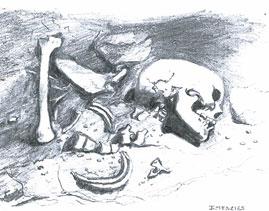
These investigations include the study of floral activity, bacterial and fungal activity, visible surface changes, changes to the endosteal and periosteal surfaces, histological changes, weight loss, isotopic alteration, amino acid racemization, limited entomology and greasiness. The proposed study will allow a degree of observation in an Australian environment that has, to date, only been possible on a small scale with the University of Sydney’s Facility near the Belanglo State Forest in the Southern Highlands.
Among the likely outcomes of the research are an improved understanding of time-dependent factors involved in the deterioration of human skeletal remains and teeth and also possible isotopic alteration preserved in different tissue types in a specific Australian environment. The experiment also represents an opportunity to compare experimental field study results with actual forensic cases. In addition, the data collected will represent a unique and significant contribution to the taphonomic study of human remains in an international context.
The following individuals are involved in the project:
- Dr Denise Donlon - Chief Investigator (USYD Senior Lecturer, Curator – Shellshear Museum of Physical Anthropology and Comparative Anatomy)
- Dr Christina Adler (Lecturer, USYD)
- Dr Kendall Bailey (Forensic Pathologist DOFM Sydney)
- Dr Claudio Corvalan Diaz (USYD Research Associate)
- Dr Sarah Croker (USYD Lecturer)
- Dr Rebecca Griffin (USYD Research Associate)
- Ms Jennifer Menzies (USYD, PhD candidate)
- Dr Louise Shewan (Hon Research Fel, Sydney Medical School)
- A Prof. Jane Taylor (Uni of Newcastle & DOFM Sydney)
- Dr Russell Lain (United Dental Hosp & DOFM Sydney)
Detecting and understanding mass graves: A southern hemisphere perspective
Lead investigators: Dr Soren Blau and Jon Sterenberg, Victorian Institute of Forensic Medicine
This project will document a number of environmental details in single and mass graves over a period of at least three years. The aim of this research is to improve our understanding about the effects of decomposition on the environment and how these changes impact the detection of single and mass graves. For the first time research will be undertaken in the southern hemisphere using human (rather than non-human) remains. This project is unique in some perspectives but is also designed to replicate aspects of research being undertaken at the University of Tennessee’s Forensic Anthropology Centre (directed by Assistant Professor Amy Mundorff). It is hoped that replicating research from the northern hemisphere will provide a comparative set of results from two different burial environments which can then be applied to augment scientific data required for real world applications.
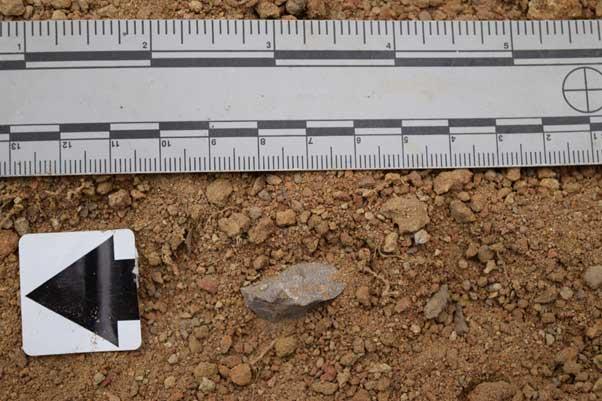
The relationship between lipid residues and stone artefact orientation
Investigators: Professor Richard (Bert) Roberts, Dr Suz Luong, University of Wollongong
Lipid biomarkers are used in organic residue analysis of stone artefacts due to their persistence over time and potential use for identifying tool function and human resource use in the past. However, the question is not always what it is, but how it got there (resource processing and/or leaching processes?). This study combines forensic and archaeological approaches to investigate the potential relationship between stone orientation and lipid deposition.
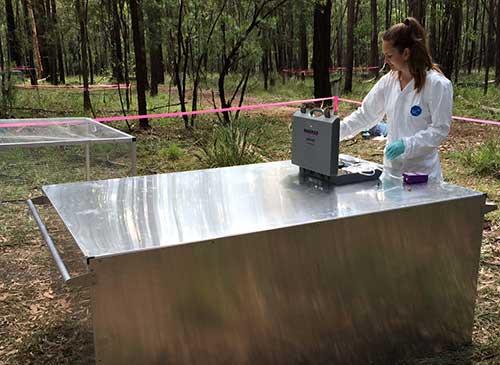
Chemical profiling of decomposition odour from human remains
Investigators: Professor Shari Forbes, Dr Maiken Ueland, Dr Katie Nizio, UTS
The aim of the research is to chemically profile the volatile organic compounds (VOCs) that comprise the odour of decomposition. The process of soft tissue decomposition produces a large number of VOCs that can vary depending on the environment in which it occurs. This study will allow us to identify a comprehensive VOC profile of decomposition in our local Sydney environment. A better understanding of the decomposition VOC profile will assist with determining the key VOCs that are used by cadaver-detection dogs to track an odour to the target source.
Post mortem dermal and subcutaneous NIR spectroscopy
Lead investigator: Associate Professor Jurian Hoogewerff, University of Canberra
The aim of the project is to investigate the potential of a low cost field NIR spectrometer to detect changes in skin colour and subcutaneous chemistry to help improve PMI estimation.
Training
AFTER can offer short courses to train students, teachers, practitioners and law enforcement. Please contact us to discuss potential courses and fees.