

• Posted on 4 Sep 2023
  • 53-minute read

The University’s Friends of Distinction Reception, held on 15 August 2023, highlighted the UTS Law Faculty and its commitment to social justice and legal education. The Friends of Distinction are supporters of the university’s vision with a strong and unique connection to UTS.

The reception, hosted by the UTS Chancellor, Catherine Livingstone AO celebrated the legacy of The Hon Sir (Francis) Gerard Brennan AC, KBE, GBS and was attended by the Vice Chancellor and President, Professor Andrew Parfitt; Law Dean, Professor Anita Stuhmcke, senior University leaders, UTS law colleagues and Friends of Distinction.

Two events of significance were celebrated at the Friends of Distinction Reception. The first part of the evening celebrated the contribution of Sir Gerard Brennan AC KBE GBS (1928-2022) to the life of the University. Preceding the event, the Faculty of Law hosted the opening of the Sir Gerard Brennan Moot Court on level 14 of Building 2. Sir Gerard’s family attended the opening, together with the Chancellor, Vice Chancellor and President, Law Dean, senior University leaders and Faculty of Law staff and students. 

Sir Gerard served as Chancellor of UTS from 1998 to 2004, following the end of his appointment as Chief Justice of the High Court. He received a Doctorate of the University in 2005. Sir Gerard’s leadership in, and service to, the Law was grounded in justice, humility and the public good. The Law Faculty was honoured when Sir Gerard agreed to the establishment of the Brennan Justice and Leadership Program in his name. This co-curricular program, jointly managed by the Law Faculty and the UTS Law Students Society, was established in 2011. The program exemplifies Sir Gerard’s lifetime commitment to service through leadership. Since its establishment, one in three law students have participated in the program with over 1,200 students enrolled in 2023.

Sir Gerard’s daughter, Madeline Brennan KC, spoke about her father’s life in the law, his connection with UTS and his commitment to public service:

Dad led by example. He did not seek publicity, but nor did he flinch to generously give of his time and talents to speak at the invitation of others. He would set out the propositions that would guide his address, identify the issue and rather than suggest an outcome or partisan view pose the questions that would resonate with all those with the curiosity of the thinker.

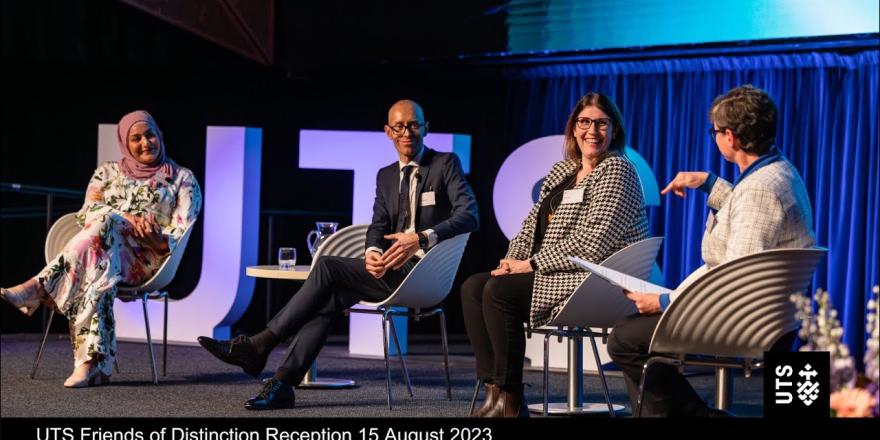
The second part of the evening celebrated the social justice advocacy and reform work of three law alumni: Amani Haydar, Nicholas Stewart and Sarah Dale. These outstanding alumni were invited toa panel discussion chaired by Law Dean, Professor Anita Stuhmcke. The theme of the panel discussion was the role of higher education in enhancing social justice across diverse communities. 

Amani Haydar is an author and advocate, a former Executive Board Member of the Bankstown Women’s Health Centre, and the 2021 recipient of the UTS Alumni Award for Excellence in Law. Her work in social justice centres on advocacy for women's rights, especially surrounding gender-based violence and trauma. Amani wrote of her own experience of domestic violence in her memoir entitled ‘The Mother Wound’. Amani completed a Bachelor of Arts in Communication (Social Inquiry) Bachelor of Laws at UTS.

Nicholas Stewart is Vice President of Australian Lawyers for Human Rights, a partner at Dowson Turco Lawyers, the 2008 recipient of the UTS Elizabeth Hastings Memorial Human Rights Award, the 2013 recipient of the UTS Alumni Award for Excellence in Community and the 2018 recipient of the UTS Alumni Award for Community Contribution. In 2022, he was awarded the Law Society of New South Wales President’s Medal for his significant contribution to the advancement of law and justice in the community. In 2023 Nicholas was awarded the ACON NSW President’s Award for his contribution to justice for victims of LGBTQA+ hate crimes. Nicholas is a prominent and effective advocate for social justice, particularly in support of the LGBTQA+ community. Nicholas completed a Bachelor of Laws (Graduate Law) at UTS in 2009.

Sarah Dale is the Centre Director and Principal Solicitor at the Refugee Advice & Casework Service, and the 2019 recipient of the UTS Alumni Award for Excellence in Law. Throughout her graduate studies and her career, Sarah has fought tirelessly and successfully for the rights and protections of immigrants and refugees, especially unaccompanied children seeking asylum in Australia. Sarah completed a Bachelor of Laws at UTS.

Professor Stuhmcke opened the panel discussion with a question as to the meaning of community and the role of legal education in enhancing social justice. Amani responded:

So for me, giving back to community is important. It’s important to me to combine my skills with my understanding of my community to do something that creates change and that’s what brought me to advocacy work.

Following, the panel were asked about the impact of their UTS legal education in relation to social justice. For Nicholas:

Social justice is in the blood of the university … making sure that UTS graduates had the skills and the capabilities to meet the demands of the industry. And that wasn’t just the corporate world … it was also in civil society and social community services.

Professor Stuhmcke posed a final question as to how we encourage, and provide opportunities in relation to, access to universities.Sarah responded:

I would love to see universities embrace their power. There are so many people who are prevented from access to universities due to their status. … I think universities have made real strides in terms of recognising there are barriers, that we provide programs and support, mentorship, that there are scholarships ... it is also about embracing the power that we as a university community have to say, ‘actually we also are standing against these policies that are preventing us from having people in our community that should be part of our community’.

The Faculty of Law is immensely proud of our eminent alumni who are effectively and passionately applying their legal knowledge and skills to improve the lives of individuals and communities.

We invite the UTS Law community to watch a recording of this special event which includes tips and advice to Law students and graduates seeking to lead a life of service:
pCLqqkc1FsI

Descriptive transcript

Aunty Glendra Stubbs: Yolamadumurrung, Galindera. That's welcome in my language, and Galindera was the name my dad gave me. But Galindera is too hard for people to get their head around in this country, so Glendra is what it is. Galindera means peaceful waters, and I am pretty peaceful most of the time, unless there is a social justice issue, as people that know me well will say, and then I'm a raging torrent.

I'm very proud to be part of UTS. I must say it's a place where I feel at home, it's a place that values what I believe in: diversity, inclusion, and giving everyone a fair go. And a place of great hope, a place of great hope. So I'm proud to be the Elder in Residence at UTS and I better say what I'm supposed to say. I would like to acknowledge and pay respects to the traditional owners of the land on which we meet, the Gadigal people of the Eora Nation, on which this university is built.

As we share our teaching, learning and research practices—because I've worked out that research is the only way you get money in this country. Am I allowed to say that? Someone tell me if I'm not. Andrew, you tell me if I say something that's not okay, darling. Am I allowed to say that, Andrew? Research practice? Okay, good.

So, because we'd like to have some more money at universities, we went through quite a difficult time where other people would know that universities are what makes people the best that they can be.

In my family, when you were the first person to go to university, there was like a close down of the whole family. No one left and no one talked, and it was like, did this really happen? Did someone in our family get to university? And at the last lot of the UniStart programs that came, when I said, "Who in the audience is the first person ever to go to uni in their family?" there was a lot of people that put their hand up. And I said to them, that's really brave to put your hand up to say that you were the first person in your family to go to university, because it's a big step, stepping outside the comfort zone, and it also is stepping into an unknown world that you've got no one to ask, "What's it like to be in a uni?"

So anyway, I haven't done anything, I don't know why I write things and never say it. And you know, I just want to say thank you to Andrew for having me here as the Elder in Residence. I'm really proud of being the Elder in Residence here and I'm really proud of what you do here. And please keep up the good work and don't go to anywhere else because they'll all want to snavel you up, darling.

Okay, so credit to everyone that's the alumni, because it's a big deal. And like any proud mummy or aunty, I need to say, when there's an award night we all feel really proud. So I'm really proud as the aunty here, I'm sure Andrew's very proud of all that you have done, and your family and your friends will be really proud of you.

Professor Anita Stuhmcke: Thank you, Aunty Glendra. I have witnessed many of Aunty Glendra’s acknowledgements of country and I always enjoy them. I always find something that resonates, and in this case I'm first in family, so I'm the first one in my family who went to university. So, thank you, Aunty Glendra.

So, good evening and welcome everyone. My name is Anita Stuhmcke and I'm the Dean of the UTS Faculty of Law. Very proud to be the Dean of the Faculty of Law, and I'll guide you through the ceremonies for the evening. It's a great privilege to have been asked to emcee this reception, and it's an honour to be here tonight with our esteemed UTS Friends of Distinction and the wider UTS community. Also our special guests that I'll come to in a moment.

Before we begin, I have a few quick housekeeping items. Our emergency exits are to your left where you came in, the bathrooms can be found directly opposite the entry to the Great Hall on the other side of the floor, and please make sure your phones are turned off or on silent. I missed my calling, I think.

Chancellor and Friends of Distinction patron Catherine Livingstone AO, Vice-Chancellor and President Professor Andrew Parfitt, Emeritus Professor Anthony Blake AM, the Honourable Michael Kirby AC, Celia Hurley Vice-President Advancement, and the Brennan family who have made their way to be with us here tonight.

The beautiful video of Gadigal lands that showed behind the lectern here tonight during Aunty Glendra’s Welcome was produced by Jake Duczynski from Studio Gilay. Jake is a fellow Friend of Distinction here tonight and he's collaborating with other Indigenous artists to support the fundraising campaign for the UTS National First Nations College, the first of its kind in the country.

So tonight we gather here to celebrate our Friends of Distinction community. We're celebrating the Honourable Sir Gerard Brennan AC KBE GBS, UTS’s role as a public university, and the contributions of the UTS Faculty of Law to social justice.

Father Frank Brennan sends his apologies tonight as he is in surgery and can't join us, but he is well, I hear. I'm delighted, however, to announce that Sir Gerard's daughter, Madeline Brennan KC, distinguished barrister at law at Roma Mitchell Chambers, will be honouring her father's legacy with us this evening.

So, I'm now delighted to introduce the UTS Chancellor and Friends of Distinction patron, Catherine Livingstone, to give the official welcome.

Chancellor Catherine Livingstone AO: Well, thank you very much, Anita. And can I add my welcome to those of Anita and Aunty Glendra. I'd like to acknowledge all of our distinguished guests here this evening and then particularly the Brennan family, the Brennan clan. For those of you who've joined our Friends of Distinction community recently, I would also add a very special welcome.

As you know, our Friends of Distinction is a very large community of about 500 people, including our UTS luminaries, our honorary award recipients, our former council members, many of whom are here this evening, so welcome, alumni award winners—congratulations to those—and many of our emeritus professors. Interestingly, about 12% of our Friends of Distinction actually live overseas, so we're spreading the UTS diaspora.

But it's wonderful to be here tonight and able to celebrate our collective enduring commitment to UTS and to bring together this remarkable community. Thank you for your continued support over several challenging years in recent times. And talking of challenging years, for those of you who might remember, the last time we met and the first time we really came together was in 2019, where we celebrated the opening of UTS Central.

Little did we know that it would be four years before we could actually get together again in person. We also, as part of UTS Central, of course, that is the new home of the Faculty of Law. And can I say it's a lovely home, Andrew, I think it's one of the best homes in the university. So, well negotiated, lawyers. But it's also where the Moot Court is, of course, and later this evening you'll have the opportunity to go and have a look at the Moot Court.

But this evening we officially, several years late, named the Moot Court in honour of Sir Gerard. And it's truly an honour for UTS to be able to do so. And we honour Sir Gerard's legacy in excellence in the law, but also his extraordinary commitment to social justice, which we know and is a very strong ethos for us here at UTS.

So we're really looking forward to hearing from his daughter Madeline shortly on Sir Gerard’s many contributions to our community. But like Sir Gerard, and I think all of us, our Friends of Distinction are a group of community-minded individuals who share a passion for education, the pursuit of excellence, and a drive for social impact.

We all know that there's a great strength and enormous value in supporting education, and particularly and increasingly, higher education as the world becomes almost exponentially more complex and, unfortunately, almost equally exponentially more unequal in that sense. So, the power of education really is inexhaustible in its ability to change lives, change our own lives, as I think everyone here would recognise, but then our ability then to give that advantage to others.

So, we know that access to higher education is uneven in Australia. So at UTS and across the university, we're working to try to remove those barriers, ensuring that students from a wide range of backgrounds have an opportunity to attend university, and this for us is social justice in action.

So again, can I thank you all very much for coming. It's lovely to see everyone, and it now gives me great pleasure to invite our Vice-Chancellor, Andrew Parfitt, to say a few words about our wonderful University of Technology. Thank you.

Vice-Chancellor Andrew Parfitt: Thank you, Chancellor, and thank you also Aunty Glendra for your acknowledgement and welcome to this Gadigal land. When I acknowledge, as I do also tonight, I often refer to what people find sometimes a surprise: that UTS has among the highest, if not the highest, number of Indigenous professors in Australia, and not just concentrated in our fantastic Jumbunna Institute, but also in mathematics, in engineering, in design, in health, right across the university.

And so, in seeking to make a difference with and for our First Nations people, UTS is absolutely committed to making sure that we support, through self-determination, through developing talent, the way in which we can make a tangible and practical difference to the future of this country. And that's something we can all be enormously, enormously proud of.

Let me also welcome all of the distinguished guests here tonight, Chancellor, of course, and to the Brennan family and Madeline, thank you for allowing us really to name the Moot Court upstairs after our second Chancellor, Sir Gerard Brennan. I think we may also have tonight, I'm not sure if he's here, Emeritus Vice-Chancellor Tony Blake.

So many of you who've made such a fantastic contribution to this university, and I hope you can be proud of the things that you see around you today, and what we're achieving. It was a great privilege to name the Moot Court after Sir Gerard Brennan. Unfortunately, I never met Sir Gerard, a great sadness to me. But I do feel that perhaps I didn't need to meet him because his fingerprints are all over UTS, whether it's through the commitment to social justice that we have and knowing the contributions that he made, whether it's through his fierce intellect that stimulates many things in our community to challenge the known world and look at things differently.

Sir Gerard is absolutely a part of the UTS past and present, and so the Moot Court is a fantastic opportunity to recognise that and continue to celebrate it. I'm not a lawyer, I'm an engineer, sorry about that. So my first exposure to mooting was more likely a group of trees talking to one another in J.R.R. Tolkien's Lord of the Rings, and the reference to mooting there, I think, is probably to the old Anglo-Saxon definition of an assembly held for debate and argument. That's not a bad definition of a university actually, because really, the contest of ideas, the creation of new ideas, the education of students to make a difference to the world through taking those ideas into practice in their professions and their lives, is fundamental to universities.

And that, for UTS, really sits at the heart of the strategy we put in place back in 2019, UTS 2027, where we had the aspiration to be a leading university of technology with global impact. And there are so many things that we can talk about, about being a university of technology. We are at the forefront of technologies in so many different areas and recognised globally for that, whether it's artificial intelligence, data science, some of our engineering disciplines, in telecommunications, robotics, the list goes on in the technology areas and then their application, importantly, in so many of the professions.

Whether it's law and the impact that technology is having on the law profession, or design, or health, technology underpins so much of what we do, not only the imagination to create new technologies, but the reality that we have to be able to bring them about, to practice, for them to be adopted by communities, increasingly with an eye to how the responsibility that we have for how we use the technologies comes into view. Really, the responsible use of technology, as well as its creation, have to be held together. And, as a university of technology, that's what we do.

And so it was a great honour, really, for the university to be named earlier in the year in the global rankings for the QS World University Rankings, as among the top hundred universities in the world. We're 35 years old as a university and yet a ranking system that looks at everything from our research impact to our commitment to graduate outcomes, to our global reach and footprint, to sustainability and our commitment to the Sustainable Development Goals; putting that package of things, that's so dear to us, together and being recognised among the top hundred universities of the world.

I hope that you can see that you've been a significant part in achieving that. And that allows us not just simply to brag about being in the top hundred, but to leverage that to make an increasingly powerful commitment to partnering, whether it's with industry, with government, with business, with other debating and arguing academics from right across the world, to really transform what we do to make a real difference in people's lives. That's what it's about. That's what UTS 2027 aspires to.

And if there were one success that we would pick this year, it is that we hold together so many of those things—not only, as the Chancellor pointed out, a commitment to equity and access, a commitment to excellence, a commitment to engaging with partners, and a commitment to making sure that the work we do both has use and can be responsibly used. So that's the achievements of the university I think that we should celebrate this year. Obviously, we strive to continue to build on that success, but also we recognise that so many of you have been a part of that.

So let me thank all of you here, Friends of Distinction, for championing the university, for being part of that incredible journey of 35 years, and extending back to the earlier organisations—I acknowledge that foundations play an important part as well. And may our mooting continue as we continue to create ideas and we continue to change the world. Thank you.

Professor Anita Stuhmcke: Thank you very much, Vice-Chancellor, and thank you, Chancellor. I think both addresses make me realise why I'm so proud to be part of this institution and to be with you here tonight at this event. It's a vibrant institution, it ensures access to all and, of course, we all share a commitment to social justice.

And that brings me to the contributions of Sir Gerard Brennan, a man who meant so much to so many, and a man that holds a special place in the heart of our university, especially for us in the Faculty of Law. So, it is with great honour that we named our Moot Court after Sir Gerard and that we also have the Faculty of Law Brennan Leadership and Justice Program, or the Brennan Program as it's colloquially and friendly known as.

It's a program that continues to thrive and it allows our law students to exemplify the qualities of professional leadership, service and excellence. The Brennan Program was championed by Sir Gerard Brennan. It was initiated in 2011. The current numbers in the students right now is 1,200, and this year alone—and remember we're only in August—these 1,200 students have performed 7,000 volunteer hours.

So, the program's aimed at giving our UTS law students both the opportunity and the privilege and the responsibility to give back to their communities, and in so doing we aim to imbue on them the understanding of the privilege and the value of a legal education. So for those of you going on tours to the Brennan Moot Court later tonight, you will be lucky enough to be guided by some of our current Brennan students.

So after tonight, if you're interested in collaborating with the Brennan Program or the Faculty of Law in any way, please do contact me. Again, I've missed my calling. Sir Gerard has assisted UTS law students to strengthen the justice consciousness, idealism and sense of service that they bring to their studies and to their later professions.

So it's unsurprising then that it's with great pleasure that I now introduce Madeline Brennan KC, a barrister with 25 years' experience as a member of the Queensland Bar. In 2000, Madeline was a founding member of Roma Mitchell Chambers in Brisbane, a chambers dedicated to providing the highest level of advocacy, advice and dispute resolution, marked by independence and a commitment to public service generally.

It's my pleasure to now welcome Madeline Brennan to speak to you.

Madeline Brennan KC: Thank you very much, Anita, for that very warm welcome and introduction. And good evening, all. I also acknowledge the Gadigal people of the Eora Nation, the traditional custodians of the land on which we are meeting and celebrating tonight. I acknowledge Chancellor Catherine Livingstone and thank you for your welcome; Vice-Chancellor President Andrew Parfitt, and thank you for the chats that we've had tonight and your acknowledgement of Dad's legacy, albeit that it's come from a slight distance, a distance which is going to increase now for the generations to come.

I'd also like to acknowledge Dad’s dear friend in the audience tonight, Emeritus Professor Paul Redmond. And while I haven't met you tonight, Emeritus Professor Tony Blake, the man I understand who showed Dad the ropes around UTS and led him ever gently into its deep bowels.

So, Friends of Distinction and friends all, for those of the Brennan family who could make it here tonight, it is both a great honour and a delight to participate in the official naming of the Moot Court in honour of our beloved father and grandfather and in this very generous tribute to his enduring contributions to UTS.

As you've heard from Anita, Frank would have dearly liked to have been here today addressing you all, and he sends his greetings and, if I may quote from him, his thanks to all of those at UTS who provided Dad with so many satisfying years, meeting young graduates imbued with a commitment to justice according to law.

In chatting to my brother Paul about today's event, his first recall was how much Dad loved the friendship and the opportunity afforded to him for his ongoing contribution to the measured discussion here of contemporary issues in public life. Dad brought to his role as Chancellor a lifetime of achievement in the service of the public good. But for Dad, still at the peak of his performance when the statutory guillotine fell, the transition to a service at a young and an innovative university was a most welcome transition.

He said, "At the end of a period of service in courts where integrity, independence, competence and collegiality of one's colleagues gave stimulus and enjoyment to every working day, I was privileged to enjoy the same environment in this university." It has been wonderful to see Michael Kirby here again tonight, and I'm sure Michael can share the sentiment of the enjoyment of every day working in the collegiality of the High Court and then the privilege of the same environment in this university.

Dad's ready involvement in university life flowed seamlessly from a life dedicated to the development of independent and critical thought in the company of others. It was in student politics that Dad first met Mum at the University of Queensland and it was a meeting of hearts and mind. Mum, with the assured capacity and intelligence to draw attention to the small voice within and without.

But on Dad's legacy at UTS, it is apposite to cite from your own citation on the conferral of the degree of the Doctor of the University on the 9th of May 2005. For six years, 1998 to 2004, Sir Gerard gave great service to this university. Throughout that period he was guided by several key convictions about universities. Foremost amongst those is the importance of universities in the life of the community.

He saw education, and particularly tertiary education, as developing the capacities of individuals, thus enabling them to attain full potential. Amongst these is the development of the capacity for independent and critical thought. With the acquisition of professional knowledge and skills, he maintained, comes the duty to use these benefits responsibly in the service of the community. It was clearly his view, frequently stated, that education benefits society as a whole as well as the individual.

Dad was afforded the opportunity to support the full range of the university's research and education programs. Eager to promote its multicultural and its overseas reach, delighting in graduate ceremonies both in Singapore and Hong Kong. He was never shy of the gentle but well thought out nudge to examine the issues of the day that could affect our future, our freedoms, indeed our self-respect, and which ought to be subjected to critical and independent thinking.

He fervently believed that the ability to think for oneself is the greatest gift each of us possesses. It was a faculty to be honed in a tertiary education. It informed his emphasis on academic freedom and the role of the university in teaching and independent research to be employed, as with all ennobling professions, in the public interest. Dad led by example. He did not seek publicity, but nor did he flinch to generously give of his time and talents to speak at the invitation of others.

He would set out the propositions that would guide his address, he would identify the issue and rather than suggest an outcome or a partisan view, he would pose the questions that would resonate with all those with the curiosity of the thinker. And he was not alone. The 1999 to 2004 years had some extraordinary highlights, well captured in the book of photos UTS so generously collated and gifted to Dad on his retirement.

The unique joint ceremony in 2000 at the University of New South Wales of the conferral of the Honorary Doctorate of Laws on Nelson Mandela; the joint conferral in 2002 of Honorary Doctorates on the Honourable Sir William Deane and the Honourable Mr Malcolm Fraser, Larissa Behrendt bearing the Mace. Frank recalls being present that afternoon, joining in the standing ovation as these two giants called on the public to resist the populist paths of exclusion and find a principled basis for what Dad then described as the compassion for the marginalised in our society and for those in other nations who, through war or famine or persecution or poverty, have been robbed of human dignity.

Twenty-one years on, and the task is only more acute, as I'm sure university researcher and granddaughter Madeline Gleeson can attest, as can all those students in the Brennan Program from year to year. Approaching six years as Chancellor, Dad ensured that he passed on the honour and the opportunity to fresh blood. But he remained close to the university and its people, particularly with his support and his delight in the Law and Justice Awards named in his honour. He was truly inspired by the ingenuity of the applicants, their generosity in community projects, and their capacity to balance their competing demands.

I look forward to hearing from some shortly. It is a program, I think, that best embodies Dad's legacy of honing fine legal skills in a context and for the purpose of the public good. A legacy that Senator Patrick Dodson, Envoy for Reconciliation, expressed as follows: "This old man's greatest achievement was that he had the courage and listening heart to seek the truth of our history and to use the law to which he was dedicated to confront the truth which was so long denied."

It was the same sentiment that was echoed by Miriam Rose Ungunmerr on the first anniversary of Dad's passing, when she explained why she painted the Pearl and the Serpent, the symbols of power, now hanging so proudly near the Moot Court upstairs for the Chief Justice. She said, "Well, he was there for everyone and he was there for us. He was involved in the Mabo decision for us all."

Where the exercise of power unifies the nation through its inclusion of all in progress for the common good, it is surely an enduring legacy to celebrate. The Brennan family, including those who are here and not here tonight, join with Dad in giving expression, as Dad did, through the gift of his robes and the Miriam Rose painting for the Chief to UTS, his expression of his profound gratitude to the friendship of all at UTS. I can only say thank you.

Professor Anita Stuhmcke: Thank you, Madeline. Thank you for talking on behalf of the family. Thank you for travelling down from Queensland and to all the other family members who've come from Victoria. Thank you, because your father's legacy is a pillar of UTS. His championing of social justice will forever be an inspiration for our UTS community, and of course, what he's done for the wider community in terms of the lead judgment in the Mabo decision is something that we will all carry with us. So, thank you.

And it's a wonderful segue into our panel segment of this evening, because I'm about to introduce to you three of our eminent UTS law alumni who will speak on the panel this evening. First, and in no particular order, Amani Haydar. Amani is an author, former executive board member of the Bankstown Women's Health Centre, and the 2021 recipient of the UTS Alumni Award for Excellence in Law.

Amani is a successful defender of women's rights, especially surrounding gender-based violence and trauma, in which she recounted her own personal experience in her memoir entitled The Mother Wound. Nicholas Stewart, Vice-President at Australian Lawyers for Human Rights, partner at Dowson Turco Lawyers, and the 2013 recipient of the UTS Alumni Award for Excellence in Community. In 2022, Nicholas was awarded the Law Society of New South Wales President's Medal.

Nicholas is a prominent and effective advocate for social justice, particularly in support of the LGBTQA+ community. He has been instrumental in uncovering and shedding light on gay hate crimes. And thirdly, but not lastly, Sarah Dale, Centre Director and Principal Solicitor at RACS, the Refugee Advice and Casework Service, and the 2019 recipient of the UTS Alumni Award for Excellence in Law.

Throughout her graduate studies and her career, Sarah has fought tirelessly and successfully for the rights and protections of immigrants and refugees, especially unaccompanied children seeking asylum in Australia. Thank you to each of us. We're about to embark on our panel discussion. As she moves seamlessly from MC to panel moderator.

So, our panel focus is on the role of higher education in enhancing social justice across diverse communities. And I couldn't think of three more wonderful panel members who are engaged in their communities to make an impact and a difference to have this discussion with. So firstly, may I ask what community means to each of you and how you've used your legal education in your community to enhance social justice? Amani, if we begin with you and we'll work around.

Amani Haydar: Thank you, and thank you for the acknowledgement of country. I live and work and raise my kids on Dharug land. So that's where I've travelled in from today and always was, always will be Aboriginal land. Community for me is inextricable from my choices in terms of my career and in terms of the work that I do today. My family, my parents migrated to Australia from Lebanon in the seventies and eighties. I grew up in an environment where there was a lot of pressure on us as the children of migrants to make the sacrifice of our parents worthwhile.

And I know this is a common experience among other children of migrants where they feel a sense of responsibility and duty to, I guess, honour their parents' displacement and their hard work and the things that they gave up by making something of our lives, by pursuing a particular idea of education and success. And as the eldest daughter in a migrant family, I really felt that all the time. I'm the first lawyer in my family, my husband is the first lawyer in his family, and I think sometimes that means a lot more than just a profession for us.

So we find ourselves in positions where we're making the law accessible to members of our community, we're explaining things, be it to our parents or their neighbours or someone who's just heard that so-and-so's child is a lawyer and we might get in touch and get some help from them. I know that we've had, at least on a couple of occasions, people knock on the door unexpectedly to ask a question about the law.

And we play a role in often translating legal ideas or concepts to people, making sure that they understand what's going on, because the law is unfortunately not always accessible to the most vulnerable and the most marginalised people. So for me, giving back to community is important. It's important to me to combine my skills with my understanding of my community to do something that creates change. And that's what brought me to advocacy work, advocating for women in the domestic violence space, contributing my legal background to the local Women's Health Centre as a volunteer on the board.

Centres like that don't receive a whole lot of funding. They definitely can't afford to have an in-house lawyer or anything like that. So it's one way in which I'm able to be a part of my community, be involved and contribute those skills in a way that I hope makes an impact.

Nicholas Stewart: Look, I think community for me is love, care, accountability, responsibility. In my life, I didn't really know what community was until I identified as a member of the LGBT community. And when my firm has Christmas parties and for clients and members of the heterosexual community come to our parties, they often say, "What is it about your community that knows how to have fun?" But there's a long story to that answer, and it comes from being resilient and being alienated by society and having to form connections which are self-regulating so that we can take care of ourselves.

And my combination of my experience as a member of the LGBT community but also having legal qualifications means that there's an intersectionality between my profession as a lawyer and my identity as a gay man and my ability to navigate the laws that regulate and govern our country to achieve justice because I've identified as someone who's benefited from people who've come before me who've fought for legal change, who've been brave and authentic in their fearlessness when it comes to the rights of the LGBT community.

Unfortunately, there are other parts of our society who dislike, who don't like members of the LGBT community and hold biases. And for the last 40 years at least, across Australia, gay men, trans people and bisexual people and women from the LGBT community were targeted for bashings and murders. And having the ability to stand up for the families and victims of LGBT hate crimes, I felt like I had no option but to seek justice and truth for those families.

And for me, my sense of community has meant that I owe it to them to expose those responsible for the hatred and bigotry and violent crimes committed against my community in the past.

Sarah Dale: I too want to acknowledge the Gadigal people and the lands on which I live and work and also in the spirit of tonight, pledge my unwavering support to the Voice at the end of this year and I really hope that that can be a step towards justice for our First Nations people. I guess my perspective is completely different. I have come from a world of privilege. Yes, I'm the first lawyer in my family, the first one to go to university. I'm not marginalised. I'm not from a migrant background. But I had the lottery of birth in being born in Sydney, Australia, and it has made n


Share