

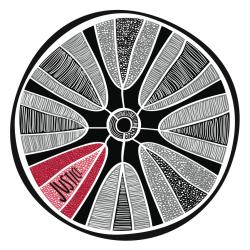
Artwork by Lucy Simpson, Gaawaa Miyay Designs, gaawaamiyay.co .
The rights of all peoples
Human Rights Watch describes social justice as being “grounded in the practical, day-to-day realities of life. It’s about waking up in a house with running water and proper sanitation; offering one’s children an education that helps them develop their potential and respect their culture. It is the prospect of satisfying employment and good health.”
"Social justice is what faces you in the morning. It is awakening in a house with adequate water supply, cooking facilities and sanitation. It is the ability to nourish your children and send them to school where their education not only equips them for employment but reinforces their knowledge and understanding of their cultural inheritance. It is the prospect of genuine employment and good health: a life of choices and opportunity, free from discrimination." Mick Dodson, Annual Report of the Aboriginal and Torres Strait Islander Social Justice Commissioner, 1993
Social justice also means recognising the distinctive rights that Aboriginal and Torres Strait Islander peoples hold as the original peoples of Australia, including:
- the right to a distinct status and culture, which helps maintain and strengthen the identity and spiritual and cultural practices of Indigenous communities
- the right to self-determination, which is a process where Indigenous communities take control of their future and decide how they will address the issues facing them
- the right to land, which provides the spiritual and cultural basis of Indigenous communities.
The Aboriginal and Torres Strait Islander Social Justice Commissioner advocates for the recognition of the rights of Indigenous Australians and seeks to promote respect and understanding of these rights among the broader Australian community.
"It is not credible to suggest that one of the wealthiest nations of the world cannot solve a health crisis affecting less than 3% of its citizens."
– Tom Calma, Aboriginal and Torres Strait Islander Social Justice Commissioner
Health justice
Since 2006, Australia’s peak Indigenous and non-Indigenous health bodies, NGOs and human rights organisations have worked together to achieve health and life expectation equality for Australia’s Aboriginal and Torres Strait Islander peoples. This is known as the Close the Gap Campaign. The campaign’s goal is to close the health and life expectancy gap between Aboriginal and Torres Strait Islander peoples and non-Indigenous Australians by 2030.
The United Nations Declaration on the Rights of Indigenous Peoples states that “Indigenous individuals have an equal right to the enjoyment of the highest attainable standard of physical and mental health. States shall take the necessary steps with a view to achieving progressively the full realisation of this right”, thus affirming the basic human right to life and health that is guaranteed under international human rights law. It also goes on to state, “Indigenous peoples have the right to promote, develop and maintain their institutional structures and their distinctive customs, spirituality, traditions, procedures, practices and, in the cases where they exist, juridical systems or customs, in accordance with international human rights standards”.
This implies a greater obligation of states to uphold not only the Indigenous individual’s right to health but also the collective right of Indigenous peoples to maintain and use their health systems and practices in pursuit of their right to health. The Declaration further specifies, “Indigenous Peoples have the right to their traditional medicines and to maintain their health practices, including the conservation of their vital medicinal plants, animals and minerals. Indigenous individuals also have the right to access, without any discrimination, to all social and health services”.
The Declaration thus establishes a framework for addressing the health situation of Indigenous peoples that includes the obligations of states both to provide accessible, quality health care to Indigenous peoples and to respect and promote Indigenous health systems, each of which must be fulfilled in order to ensure the health of Indigenous peoples.
Artwork
Aboriginal artists that comment on social justice draw attention to historical and present day inequities in the Australian standards of living. Social justice can also be illustrated through the right to maintain cultural beliefs and practices such as the use of medicinal plants and Aboriginal healers and ceremonies.
UTS ART Education and Outreach Co-ordinator Alice McAuliffe and academic Jennifer Newman have produced a series of videos that explore the cultural and social contexts of Indigenous artwork from the UTS Art collection.
‘Bawu’ by MarrnyulaMunungurr
MarrnyulaMunungurr, a Yolngu artist from North-eastern Arnhem Land has produced a work titled Bawu, which is the name of the white and blue flag (sky and water) at the centre of the piece. The Bawu can be described as a ‘sea rights’ flag. In essence it reaffirms the Yolngu peoples’ rights to harvest the resources of their traditional maritime areas, what they describe as “salt-water country”. This native title grant means that licences to fish the resources of the tidal waters can only be granted by the Aboriginal Land Council, instead of state government. Marrnyula’s work pays tribute to the importance of native title on all country, including salt water country.
Additional artwork
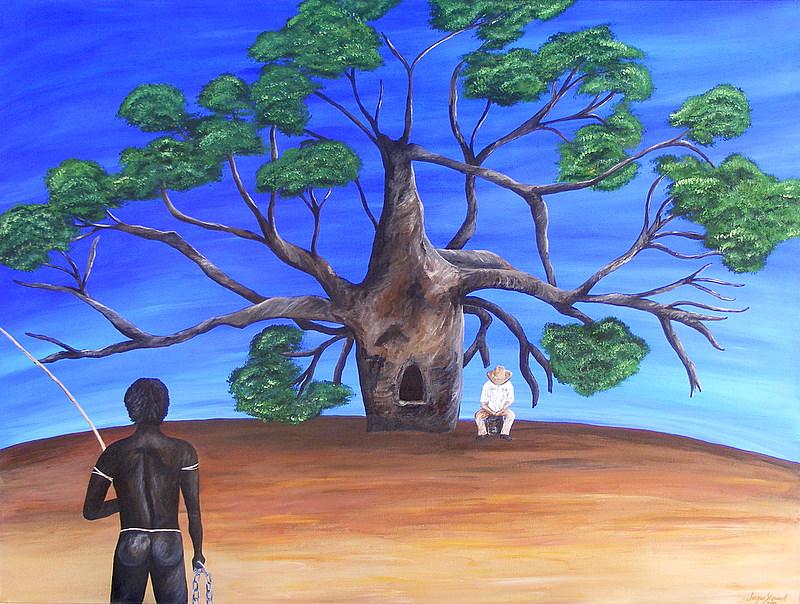
Prison Boab tree: chainless by Jacqui Stewart. Image provided by the artist. jacquistewart.com.au
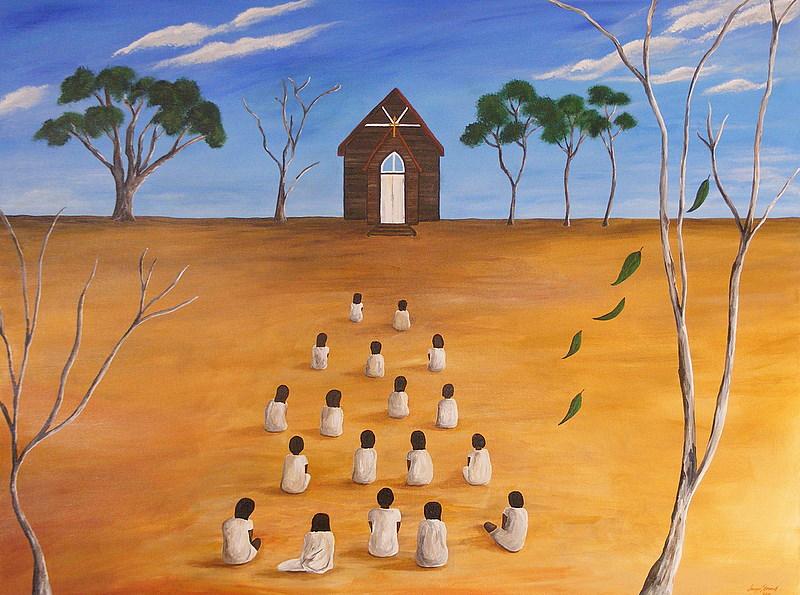
Hope Beyond the Window : a Stolen Generation by Jacqui Stewart. Image provided by the artist. jacquistewart.com.au
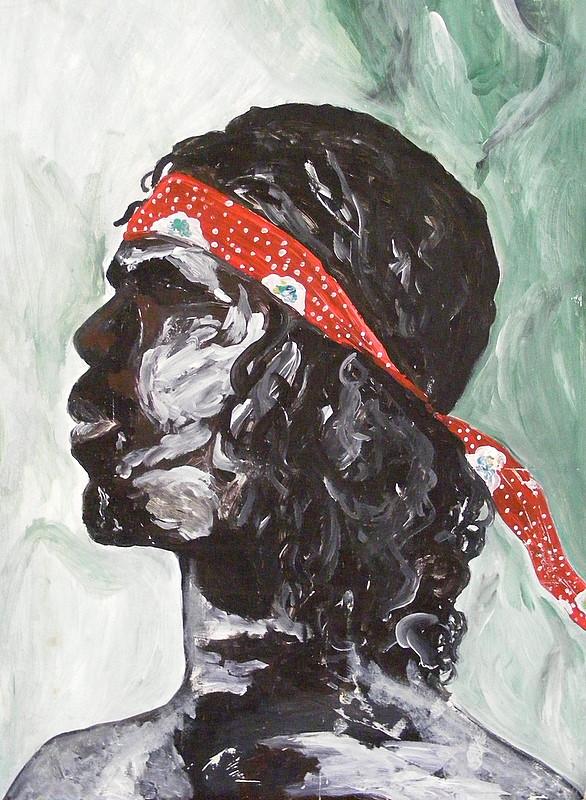
Indigenous Man by Jacqui Stewart. Image provided by the artist. jacquistewart.com.au