

Amy Wang has been making her dreams a reality, with her recent film selected for the Clermont-Ferrand International Short Film Festival.
Amy’s short film, Unnatural, was one of only 74 selected for screening in February’s festival, out of a staggering 9,000 entries.
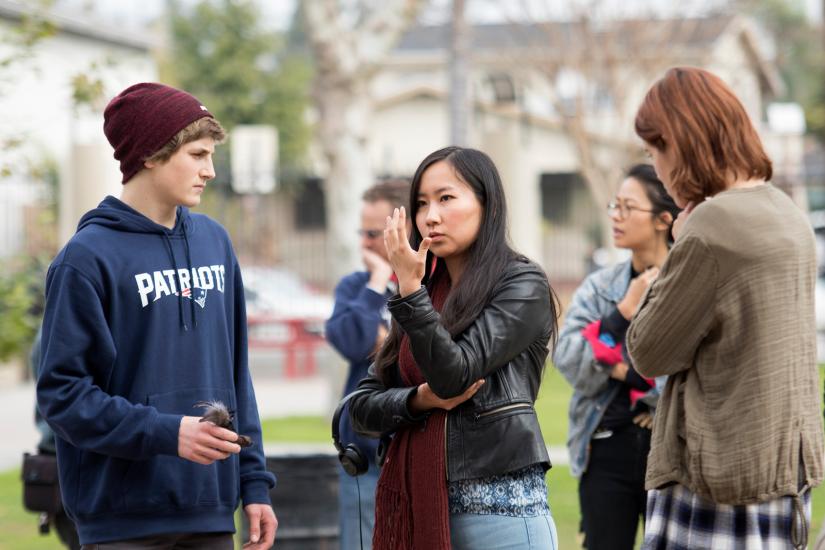
Pictured: Amy Wang with actors.
The Clermont-Ferrand International Short Film Festival is one of the world’s biggest and most prestigious film festivals, attracting nearly 9,000 entries a year from new and independent filmmakers. Less than one per cent of them are selected for screening. For young filmmakers, the exposure and legitimacy that comes from selection could be the big break they’re looking for in their careers.
One of this year’s successful entrants is UTS FASS Media Arts Production graduate Amy Wang, and she is hopeful for what it will mean for her career. Her short film, Unnatural, which she wrote and directed herself, was one of only 74 selected for screening at the festival in February. As of this writing, it is only one of 12 that have been nominated for the Grand Prix.
Born in Hangzhou, China, Wang moved to Australia when she was six years old. From kindergarten to the sixth grade, she changed primary schools five times before finally settling in Sydney’s inner west.
“Being a Chinese-Australian filmmaker has been difficult for me. Growing up in a culture that was so inherently different from my ethnicity made me hate who I was,” explains Wang.
“Ever since I was a little girl, I have not been the stereotypical Asian female who is often depicted as docile. I am outspoken and a fighter. I saw people from Caucasian backgrounds and envied how easy life was for them. I yearned to be “normal” and to be accepted by my peers.”
It was the first time I was surrounded by like-minded individuals; where I learned the most from my peers.
In many ways, Unnatural is a reflection of that experience, telling the story of a teenage boy who wrestles with desires and thoughts of paedophilia.
“I wanted to explore what it’s like for a teenager to never have acted on it, yet be reduced to the same level as someone who has committed a crime,” says Wang. “I question what it’s like hating who you are and what your sexuality represents.”
She knew from the start she’d be walking a fine line between alienating her audience and creating empathy for her character. To address this, she contacted help groups and online forums and spoke with dozens of paedophiles anonymously. She also interviewed academics and journalists in the field.
Wang’s interest in filmmaking began at the age of 12. She took up karate classes (“because at the time, all Asian female actors were good at fighting,” she explains) and attended classes at NIDA. At age 15, a viewing of Fight Club shifted her focus to being behind the camera where she could focus on the creation of stories that are political and confronting.
She took her first big step towards turning her dreams into reality when she undertook a Bachelor of Arts in Communication (Media Arts and Production) at UTS. From there, the list of filmmakers she felt inspired by expanded from the Scorseses, Finchers, and PT Andersons of the world to influential female directors such as Andrea Arnold, Lynne Ramsay, and Maren Ade.
It was the first time I was surrounded by like-minded individuals; where I learned the most from my peers. I learned about integrity and hard work from them, recalls Wang.
After graduating from UTS, she made a name for herself as a successful promotions producer at Channel 7 in Sydney – but her sights were ultimately set on the US, where she awarded a scholarship to complete a Masters degree at the prestigious American Film Institute (AFI).
“I knew Hollywood held opportunities unparalleled to anything Australia could offer,” says Wang. “My biggest fear is to settle and be comfortable. I wanted to push my potential, to see how far I can go in my lifetime.”
Unnatural is Wang’s first public work at the AFI; with her goals, beliefs and aspirations writ large at the Clermont-Ferrand International Short Film Festival.
I absolutely hope to affect change through my filmmaking. I want to bring the world closer and showcase stories from minorities that do not cross an average person’s path,” says Wang.
“I think the world is pre-occupied with putting people into categories. If you do not belong in any category, you are deemed confusing and therefore dismissed. I want people to see others as human; not a caricature or negative stereotype of their sexuality or their ethnicity.
In that endeavour, Wang hopes to work with the burgeoning community of Asian Australian and Asian American filmmakers such as James Wan and Justin Lin. “I feel like there are many common threads among Asian filmmakers. How better to tell those stories than with people who have witnessed first-hand what it’s like to be an immigrant?”
As for her immediate future, Wang intends to continue creating, networking, and self-improving – her formula for success as a filmmaker. Although she admits to being more of a feature film director, she enjoys the variety of television, and isn’t prepared to let herself be boxed into any particular category. She already has projects in both film and television, which she’ll be pitching to studios this year.
Amy says;
It is a miracle that any film gets made. The biggest lesson I learned is to never accept no as an answer. If you want to make it in this industry as a director, especially a minority director, you have to fight for your vision and your story.