Curiosities Live events 

Curiosities Live is a UTS event series bringing the latest research out of the lab and into the public conversation. Each session connects leading UTS experts with timely global issues, from fuel security to digital futures, unpacking what’s happening, why it matters, and what comes next.

Designed to be accessible, interactive and relevant, Curiosities Live invites audiences to engage directly with the thinkers shaping change. It is where research meets impact, showcasing how UTS is contributing solutions to the challenges facing Australia and the world.

Previous Curiosities Live events
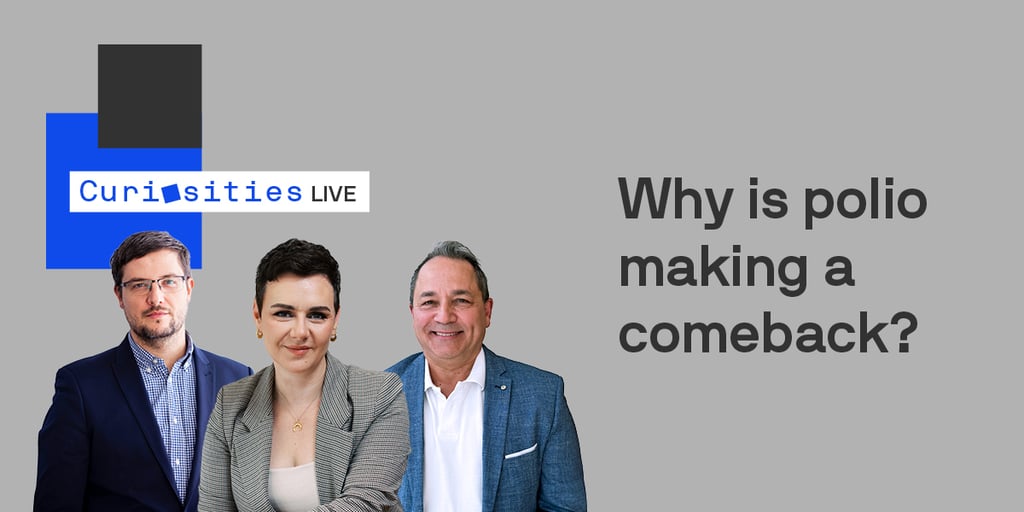
Polio hero image including speakers

Why is Polio making a comeback?

Tegan Taylor (ABC) in conversation with Professors Steven Djordjevic and Marian-Andrei Rizoiu

Why is Polio making a comeback? transcript

Curiosities Live: Why is polio making a comeback transcript

0:05

Tegan Taylor: Good evening. Welcome to Curiosities Live! I'd like to begin by acknowledging the traditional owners of the lands from which we're all joining today. Pay my respects to elders past and present. My name is Tegan Taylor. I'm an ABC broadcaster and health and science journalist

0:21

Tegan Taylor: And I'm your host for this session this evening. We're here to discuss why diseases like polio and measles, diseases we've made such strides at reducing, why they're making a comeback.

0:34

Tegan Taylor: We'll look at the science, but we'll also discuss why scientific evidence isn't always enough to influence the decisions people make.

0:42

Tegan Taylor: And what this means for all of us. So, joining me are two UTS experts who bring very different but complementary perspectives to this conversation.

0:52

Tegan Taylor: Distinguished Professor Steve Djordjevic is an infectious disease expert whose research spans microbiology, genomics, and antimicrobial resistance. Steve, please give us a wave.

1:05

Tegan Taylor: And, Professor Marin Andre Rizoiu is a data scientist whose research looks at how information, influence, and misinformation spread through online networks. Andre, wave, please.

1:17

Tegan Taylor: Here he is. This is a conversation that we want you to be part of. I would love to fold your questions throughout the discussion, and I'll also dedicate some time to Q&A towards the end. So if you have a question at any time throughout the discussion, you can see in the chat there's a link to Mentimeter.

1:35

Tegan Taylor: That is the Q&A platform for tonight, so click on the Mentimeter link. Tegan Taylor: Have it there, ask your questions, and if you see a question someone else has asked that you want to know, you can upvote it.

1:47

Tegan Taylor: That's how I'll know what you're most keen to know about. So, Mentimeter, the link is in the chat.

1:54

Tegan Taylor: But I want to start with a little bit of scenes that are what's happening, why we're seeing things like polio and measles come back. Steve, polio and measles as our examples, these are both vaccine-preventable diseases. What does that actually mean?

2:10

Steven Djordjevic: So it means that if a substantial proportion of the population, is vaccinated.

2:17

Steven Djordjevic: Then we have this thing called herd immunity, and that… that… then rates of vaccination for each infectious disease is different.

2:26

Steven Djordjevic: But once we get herd immunity, the ability of the infectious agent to spread from person to person is severely diminished.

2:37

Steven Djordjevic: And that's really important because there are vulnerable populations in the community, such as the frail, elderly, and some Indigenous populations that are in remote locations.

2:50

Steven Djordjevic: They are unable to receive the vaccine, and so when we have good blanket cover through herd immunity, they are protected.

3:00

Tegan Taylor: When I say making a comeback, what does this mean? Like, what are we actually seeing here?

3:07

Steven Djordjevic: So, what happens is, Steven Djordjevic: So, again, it's different for each of the infectious diseases. So, what's happening… one of the reasons why we are seeing infectious diseases,

3:18

Steven Djordjevic: resurging that have traditionally been well controlled by vaccination is because we are… the population is not sufficiently covered by vaccination, because people are becoming hesitant to vaccinate.

3:31

Steven Djordjevic: And so what happens then is that, the…

3:37

Steven Djordjevic: the community spread from person to person starts to creep up, and as an infectious agent replicates, it has its capacity to, I might say increase its abolence, but it becomes more virulent, more people get exposed, more people succumb to this infection.

3:54

Steven Djordjevic: And that's very problematic. Tegan Taylor: You mentioned, hesitancy there, vaccine hesitancy. Andre, what does that look like in practice? What kind of attitudes are we seeing shift?

4:07

Marian-Andrei Rizoiu: We are observing people starting to question, sometimes they question the efficacy of the vaccine itself.

4:15

Marian-Andrei Rizoiu: you know, the typical saying of, I took the flu last year, and I still got the flu. People don't… there's… there is a lack of understanding of how it actually works.

4:25

Marian-Andrei Rizoiu: The concept of… of herd immunity is very… it's kind of poorly understood also, so that's not the most… that's not the…

4:35

Marian-Andrei Rizoiu: That's not what people know more… most. But I guess where we start seeing an uptick into these alternative views is when we see penetration of online social platforms and discussion places.

4:47

Marian-Andrei Rizoiu: Where people start congregating online and exchanging ideas, and that's where they start forming these thematic groups.

4:55

Marian-Andrei Rizoiu: pages, Marian-Andrei Rizoiu: WhatsApp groups where they start exchanging these alternative views and endorsing and reinforcing, views, that are detrimental. So there will be… there will be references to authority, of how… how immunization programs are just a way of controlling, controlling, or so on and so forth.

5:15

Marian-Andrei Rizoiu: And they keep propagating this type of information, which then, in time, being repeated, leads to this hesitancy that Steve was referring to.

5:25

Tegan Taylor: I definitely want to get into that pathway in a second. Steve, what's it like as someone working in health to hear that those are the sort of attitudes that people are being drawn to?

5:38

Steven Djordjevic: Well, it's… it's sort of sad. We're sort of almost like a victim of our own success. So, I think I want to zoom out a little bit, if I may, Tegan, because…

5:48

Steven Djordjevic: we should remember the number of deaths that are associated with infectious diseases. I mean, infectious diseases is the number one killer of humans in history, full stop, and not by a small margin. It's like, you know, hundreds of millions of deaths.

6:03

Steven Djordjevic: associated with quite a large number of vaccine-preventable diseases, which have now… so vaccination is interesting, because in some instances, we…

6:14

Steven Djordjevic: don't see the organism, appearing anymore. So things like, we don't see, smallpox, smallpox being almost completely eradicated.

6:24

Steven Djordjevic: And that's because the vaccines have worked really effectively, and it's also because the infectious agent, has succumbed to that vaccination regime. Then we have diseases like influenza.

6:36

Steven Djordjevic: Which, have killed more than 200 million people worldwide, and still kill many people every, every winter, or every year.

6:47

Steven Djordjevic: And these viruses are able to chop and change their genetic makeup very, very frequently as they pass through animal populations.

6:58

Steven Djordjevic: And so what happens is every year we need to get vaccinated, okay? And the vaccine

7:03

Steven Djordjevic: may not prevent you from getting an infectious disease, to get the full-blown influenza, but what you will experience is an ameliorated form of that flu, okay? And we should also differentiate flu from the common cold, because the word flu

7:19

Steven Djordjevic: is used very, very frequently. If you have the flu, you are bedridden at least for 3 days, you have a raging temperature, you have body aches, and you really feel

7:30

Steven Djordjevic: Whereas a cold, a head cold, is very different. Tegan Taylor: Deb, you did such a good job there of explaining something very, very complicated in just a couple of minutes, and yet, it still took you a couple of minutes to explain that. You couldn't put that in a tweet, or in a simple post on social media.

7:50

Tegan Taylor: Andre, is that part of the problem here? We're so used to having such small bites of information that even, sort of, generous nuance gets lost?

8:00

Marian-Andrei Rizoiu: There are multiple components here. Yes, definitely the expectations on how we receive information is definitely…

8:08

Marian-Andrei Rizoiu: has definitely changed, and yes, there are significant chunks of, of the online population, or the population that… that will consume information in the form of, either short messages, tweets, Facebook posts, or more recently, reels on… on Instagram, so…

8:28

Marian-Andrei Rizoiu: yes, Steve did an amazing job describing it in just a minute, but then if I am used to flipping through TikTok reels, one after the other, that is not what I would expect to receive. But…

8:45

Marian-Andrei Rizoiu: the way we perceive the information and we consume it is one way. However, the…

8:51

Marian-Andrei Rizoiu: What our research… my research has shown in, Marian-Andrei Rizoiu: in the past years is that it is mainly the phenomenon on how people consume this information, which is the real culprit, which is one of the main culprits here. So, this misinformation around vaccines is actually

9:10

Marian-Andrei Rizoiu: part of the general phenomenon of misinformation at large. And our audience has probably met this term before, over and over again. We hear about conspiracy theories, we hear about

9:25

Marian-Andrei Rizoiu: political misinformation, and so on and so forth. So the question now comes on why… why the prevalence of misinformation? I guess that's one of the big… the big ticket items here is… so our… our info… our research actually shows

9:41

Marian-Andrei Rizoiu: That even the term misinformation is slightly misleading, because this… it has nothing to do with information.

9:47

Marian-Andrei Rizoiu: Misinformation is not an information problem. Marian-Andrei Rizoiu: misinformation is a, is a, sort of, is a social identity issue. So, people do not consume the inform… the misinformation because

10:00

Marian-Andrei Rizoiu: they do not have access to the right information. We all have access to it. In fact, Stephen was saying it, that information about vaccines has never been more abundant. There's… there's never been a single… a single period in the life cycle of

10:13

Marian-Andrei Rizoiu: humanity, where it would have been as easy as it is for us now, today, to find all the information I want about every other vaccine that I want, together with all the scientific results, the replication results, the field studies, and so on.

10:28

Marian-Andrei Rizoiu: it's not about that I can't find the information, it's not that our… that people that believe these alternative views cannot find the information. So if it's not an information problem, then what is it?

10:38

Marian-Andrei Rizoiu: So, what we find it is, is that misinformation is, is just one way that groups people together. Let me give you an example.

10:48

Marian-Andrei Rizoiu: Back in the days, Joel's a bit my age, there was,

10:54

Marian-Andrei Rizoiu: back where I grew up, in a small town where I grew up, I either liked soccer, or I didn't have lots of friends. So, there was not a lot of options out there. So, of course I like soccer, like everyone else. But today, with our digital… with our digital environment.

11:08

Marian-Andrei Rizoiu: no matter how fringe my ideologies and my worldviews are, I will get, I will find someone online that has… that shares those views. So what the… the digital communication environments of social media platforms,

11:23

Marian-Andrei Rizoiu: mainly the social media platforms. What they allow, they allow us now to reach… to be connected to all… to a very wide, set of individuals out there.

11:33

Marian-Andrei Rizoiu: And then I can always connect to people that think similar to me. So then I can start embracing those communities, and those communities that start functioning

11:42

Marian-Andrei Rizoiu: as both endorsers, so people there, they understand me, they feel me, they think like me. So I get the homophily, I have the feeling of belonging, I have my… it fulfills my psychological needs. But also, they function as a filter.

11:57

Marian-Andrei Rizoiu: Because the information that flows through those communities is always aligned to the communities themselves. So, on one hand, I have people that constantly endorse what I'm saying, and give me the thumb up, no matter what I say, things that probably wouldn't be acceptable in the… in my offline immediate community, in my family, my group, my…

12:16

Marian-Andrei Rizoiu: my school, but then there I get endorsed, but also I get the information through those communities, and that gets filtered. Corporate that to the fact that almost half of the adult population today gets their information

12:28

Marian-Andrei Rizoiu: from their social media groups. And you start getting these phenomena where you can actually live in these bubbles, and you get completely disconnected from reality.

12:37

Marian-Andrei Rizoiu: You… you… and then these communities can pick up, and then they can drift as much to the left, to the right, to the center as you want, so…

12:44

Marian-Andrei Rizoiu: Then we start… and that's not, and that's what partly explains the phenomena that we are seeing today, together with things like political polarization and so on and so on. But to stay within this field, it's really what explains at least partially, the

12:58

Marian-Andrei Rizoiu: The emergence of such a wide set of anti-vaccination views.

13:04

Tegan Taylor: this sense of an echo chamber, the self-fulfilling communities that we surround ourselves with. So you're asking your questions by using the Mentimeter link there. We've had a question come through that I am going to treat as if it was asked in good faith, and I think we can use it as a bit of an example

13:20

Tegan Taylor: of how to debunk misinformation. Someone has asked, don't vaccines cause autism? Can we use this as a bit of an example to

13:28

Tegan Taylor: talk about the truth of what we know, but also in a way that we know is evidence-based. Steve, I might start with you.

13:39

Steven Djordjevic: So, to just follow on a little bit from what Marian-Andre said.

13:44

Steven Djordjevic: It's important… so, the scientific process is constantly challenging information. So, we constantly debate data.

13:54

Steven Djordjevic: And we… and we re… we… we go forward in the way we… we think about a problem based on the reiteration of data that supports… even if we look at it 9 or 10 different ways, it still comes to a particular pathway that's supportable by the data.

14:12

Steven Djordjevic: Whereas I think when you're in a… when you're in an environment that Marian-Andre was talking about, then that filter, that… that ability to challenge is severely diminished.

14:23

Tegan Taylor: Hmm. Steven Djordjevic: So, to get back to this autism question, I think,

14:28

Steven Djordjevic: There, is no real evidence that vaccines cause autism.

14:34

Steven Djordjevic: there… the evidence has been widely, widely disputed. There has been a number of studies which challenge

14:43

Steven Djordjevic: That link. Steven Djordjevic: And there is no… Steven Djordjevic: Serious demonstrable evidence to support the fact that… to support the contention that vaccines cause autism.

14:56

Tegan Taylor: Alright, Andre, how do you do? Marian-Andrei Rizoiu: Hi, this is… I really like how Steve positioned this, because

15:04

Marian-Andrei Rizoiu: This… the scientific method of always inquiring, always going after what we know and questioning ourselves is actually not…

15:11

Marian-Andrei Rizoiu: Doing us a favor when it… when we talk about communication in the community at large.

15:17

Marian-Andrei Rizoiu: the number of times I hear, but the science doesn't know. The science contradicts themselves, even the researchers can't agree. This is… this is the thing that I…

15:26

Marian-Andrei Rizoiu: here, and I see in these groups over and over again, the scientists can't agree. They can't… they can't set the… they can't be on the same, on the same view. And

15:37

Marian-Andrei Rizoiu: This is not a sign that science doesn't work, it's just a sign that that's how science works, is that we keep updating our views. Now, in this context, I happen to know quite a bit about where this originated. It was… it originated to one paper that was published, that was published ever since it was retracted, debunked multiple times.

16:00

Marian-Andrei Rizoiu: it has been, it's demonstrated right now as being, invalid, scientifically, over and over again. So, as far as scientists see this.

16:09

Marian-Andrei Rizoiu: we… we have strong proof that that was false… that was proper false information. If you want, really, the term misinformation, it's… that was misinformation.

16:19

Marian-Andrei Rizoiu: Probably not intentional, but still doing the harm. The issue now with… with…

16:24

Marian-Andrei Rizoiu: With it is that once this type of Marian-Andrei Rizoiu: this type of narratives, opinions, they are released in the wild, almost like Pandora's box.

16:33

Marian-Andrei Rizoiu: And the point is that no amount of debunking is going to help.

16:38

Marian-Andrei Rizoiu: Because at that point, Sharing the misinformation, sharing this point, like, like this, like the view

16:46

Marian-Andrei Rizoiu: vaccines cause autism, or vaccines are just the attempt of Bill Gates to inject chips into my arm.

16:52

Marian-Andrei Rizoiu: They, Marian-Andrei Rizoiu: These… these type of… these type of opinions, they… when people emit them, they don't necessarily believe them, they don't document them either.

17:05

Marian-Andrei Rizoiu: emitting such opinions is usually done to signal ingrouping. It's almost like saying, I belong to this community, I belong to this group. In fact, we know that most people that share misinformation, they don't even read it. They don't even open it. There's been multiple,

17:22

Marian-Andrei Rizoiu: empirical experiments where they… we've seen that this test, they didn't, they don't even open it. So, if they don't…

17:29

Marian-Andrei Rizoiu: And now this is the conundrum, right? Marian-Andrei Rizoiu: if they don't necessarily listen to the information, and you already have the Pandora from the genie from the Pandora's box that got out, what can you do, right? So if miso… if telling them what's right doesn't really make for what

17:47

Marian-Andrei Rizoiu: For the wrong information, then what can you do? Tegan Taylor: well, what can you do? Because you're our guy on that, if… like, what… what's the approach?

17:58

Marian-Andrei Rizoiu: Well, I'll have to prefix by saying that Marian-Andrei Rizoiu: we don't really know exactly. We know… we know some things that work, but we do not have the definitive answer, which is perfectly fine.

18:08

Marian-Andrei Rizoiu: Right? For science, it's perfectly fine to accept that we don't know everything, and that we're still working on it. So, a couple of things that we do know that work. First of all, we do know that, that critical thinking, works. So, what we would call

18:22

Marian-Andrei Rizoiu: pre-bunking. So these are concepts in misinformation science. Debunking is when you're trying to correct something that is wrong, and you're essentially saying, no, no, that's not true, because here's all the facts.

18:34

Marian-Andrei Rizoiu: Debunking is good, debunking is great, it has its purpose, because it keeps us on course, it keeps us sane.

18:40

Marian-Andrei Rizoiu: It doesn't work in convincing people otherwise. And that's been repeated over and over and over again. The only people that go to the debunking websites are those that don't trust the misinformation in the first place. So it's essentially preaching to the choir a bit.

18:54

Marian-Andrei Rizoiu: That is the debunking. We do know that pre-bunking works. So, for example, teaching, teaching people proactively, giving them the information proactively, usually, usually, works.

19:08

Marian-Andrei Rizoiu: works better, not always the same way. So, what we… what we've seen is that people tend to get in the world of misinformation. They tend to go because, they are in a period in their life where they have a, they have a confusion and an unhappiness, the typical two components.

19:26

Marian-Andrei Rizoiu: And what they do at that point, let's, let's say, Marian-Andrei Rizoiu: let's say that you have a… or an individual that starts searching for information about the safety of vaccines. And honestly, it doesn't take long to be online and to search online before you find this alternative.

19:42

Marian-Andrei Rizoiu: And let's say that they start engaging a bit with the information, and they get curious, right? We're all curious, like, is this really true?

19:51

Marian-Andrei Rizoiu: So, it turns out that consuming this information is almost like a radicalization pathway, and you have different stages of how extreme the consumption is. At the beginning, I start by just curious, like, whoa, is that?

20:02

Marian-Andrei Rizoiu: Is that it? Can that be true? Marian-Andrei Rizoiu: In the second phase, there is a tentative disclosure, we call it the tentative disclosure phase, where the individual, say, goes to the GP and asks, but doctor, don't vaccines cause autism?

20:16

Marian-Andrei Rizoiu: The worst thing that can happen at this point is that the GP answers with a condescending tone, or with a condescending message, because obviously the GPs are there to give them the information. They are in the business of

20:28

Marian-Andrei Rizoiu: the scientific approach and giving them the information, and they do exactly what I just told you doesn't work. They debunk, or even worse, they have a condescending reaction, which then sends the person straight back into the arms of the alternative community, which then embraces them and says.

20:46

Marian-Andrei Rizoiu: She said that. He doesn't want you to know the truth. Marian-Andrei Rizoiu: And then from here on, something weird happens. People start living a sort of dual lives. They emerge increasingly into their communities of alternative views.

20:57

Marian-Andrei Rizoiu: While increasingly getting disconnected from their, from their, normal life. Then what, furthermore.

21:05

Marian-Andrei Rizoiu: there's a point where they become active, they don't just consume the information, but they become active parts… they take active part in the life of the newly found community, and they start emerging into the community. And that's when we see… we start seeing the erratic effects. They stop doing their hobbies, they stop seeing their friends.

21:21

Marian-Andrei Rizoiu: They sometimes even start cutting contact with their… with their family.

21:26

Tegan Taylor: Is that necessarily going… like, does one always lead to the other? Are you always going to see someone who starts on this pathway down at this very, isolated, erratic end?

21:37

Marian-Andrei Rizoiu: No, no, no, no, we don't… we find that, we find that not everyone needs to traverse the entire pipeline. We do know that it can… some people can… can move back.

21:48

Marian-Andrei Rizoiu: There is op-ramps, there is interventions at each of the stages, and we also know that the time it takes to go… to traverse the pipeline can vary a lot.

22:00

Marian-Andrei Rizoiu: It can be as little as, you know, a couple of weeks, six weeks, to go entirely. So, it is quite very dependent on each individual. What I described to you is more of a bird's-eye view of the… of how this flows, but now people will start… and actually, most people actually stop at the first and second and third phase, but why…

22:20

Marian-Andrei Rizoiu: This pipeline is relevant is because at the last stage, these individuals are capable of violent extremist acts.

22:25

Marian-Andrei Rizoiu: So that's when they… when suddenly you can… you're seeing, people that, for reasons that are not religious and not, and not political, they can start committing violent acts, which is… which…

22:38

Marian-Andrei Rizoiu: was not very common. Most of… most of radicalization literature concentrates on religious and political radicalization.

22:47

Tegan Taylor: And so, it's rare, but obviously this is a very, kind of. Tegan Taylor: It's a big deal. We want to know about that. So your questions are coming through via Mentimeter. It's really fascinating seeing them. Keep them coming. I'm going to fold as many into the chat as we can. We'll also come to them at the end. There is one person who's written, as a polio survivor.

23:07

Tegan Taylor: 73 years later, I am alive. Had an amazing life, and still significantly disabled. It's very difficult in parallel with aging.

23:16

Tegan Taylor: You don't hear many first-person stories like that these days, which is a good thing, but Steve, do you think people like that sharing their stories is a way for people to understand what they're dodging when they participate in vaccination?

23:31

Steven Djordjevic: I'm glad that person asked that question, because we have,

23:36

Steven Djordjevic: First of all, polio myelitis is Steven Djordjevic: A debilitating, viral infection that attacks the motor neurons in the nervous system, and so what happens, often they get different forms of paralysis.

23:54

Steven Djordjevic: And, many of them… many, many polio, people can survive to quite long lengths of time. And there's a very famous book, was published in 1955, called I Can Jump Puddles, by Alan Marshall, and, that's a story about how he,

24:13

Steven Djordjevic: how he, I think, Steven Djordjevic: dealt with, or dealt with his, he obtained at the age of 6, I think, if I recall correctly.

24:22

Steven Djordjevic: And, it's interesting that polio… so even though you can recover from the infection, you can have long-term, lifetime sequelae, like this person that's asked the question is, clearly indicated, happens.

24:35

Steven Djordjevic: And so, it's important that, that we…

24:41

Steven Djordjevic: try to acknowledge that people can leave, really, and contribute importantly to life after polio and other disease… infectious diseases. But if we can prevent those infectious diseases through vaccination programs.

24:55

Steven Djordjevic: Which we have done very, very successfully. And so I, I think that's… that's a really good message for people.

25:04

Steven Djordjevic: that, there are people who actually lived through that year, the last hundred years where polio was very, very important. So there are many survivors that would really understand the importance of vaccination, as I suppose, my message.

25:18

Tegan Taylor: Absolutely. Andre, so much of what we see on social media that really cuts through is story-based. An individual story is sometimes much more compelling to me than 10,000 people in a study, even though it shouldn't be.

25:31

Tegan Taylor: What is the role of storytelling in helping cut through misinformation? Marian-Andrei Rizoiu: It's one of the biggest, one of the best interventions that we see in the later stages.

25:42

Marian-Andrei Rizoiu: So, as we move into beyond just the curiosity, where simple information would be enough, as we move into an active consumption, that is what we find one of the very few interventions at work stories. And particularly for polio and vaccine-preventable diseases, I think

26:02

Marian-Andrei Rizoiu: We need to actually put our finger on one fact, is that most often.

26:08

Marian-Andrei Rizoiu: What we see is that vaccines are being withheld. Marian-Andrei Rizoiu: from children. So it's, it's… and I find that to be…

26:16

Marian-Andrei Rizoiu: You know, to be unfair, particularly since the people that consume them, that have hold these views, and will withhold vaccination, they are vaccinated themselves.

26:31

Marian-Andrei Rizoiu: Because somebody else vaccinated them. So, vaccines typically are with help from children. So, in case of polio, this is… I think this discussion, and this example, I'm really… I'm happy that our listener had the courage to… to… to bring it up.

26:48

Marian-Andrei Rizoiu: It is exactly very tragic, because polio is making a comeback, and it's affecting people that did not choose to not get vaccinated. It's affecting children that were… that for… for…

27:02

Marian-Andrei Rizoiu: For whom vaccination was withheld by their parents, due to their parents, their parents' ideology.

27:08

Marian-Andrei Rizoiu: worldviews, parents who themselves are immune to polio because they were vaccinated by the previous generation. Do you find the… do you see the irony of this?

27:18

Tegan Taylor: Yeah, and I was thinking of what we were talking about before with herd immunity, and the fact that vaccination often feels like an individual decision. I'm choosing this for myself, or I'm not choosing this for myself. We do it for the good of the herd, but we're also making decisions for other people, too.

27:36

Tegan Taylor: Steven, how do you kind of engage with that idea of who you're making a decision for?

27:43

Steven Djordjevic: Well, I have to reiterate those views. I mean, I don't know how someone could take their child to a medical center with a vaccine-preventable disease.

27:56

Steven Djordjevic: And… Particularly if it is… it is somewhat life-threatening.

28:02

Steven Djordjevic: or can have, lifelong post-infection sequelae. So I think… I think there's some serious questions that need to be asked on a whole range of moral and ethical,

28:12

Steven Djordjevic: Bright me and stay. Steven Djordjevic: But what I… what I really would like the audience here to really understand is that

28:21

Steven Djordjevic: It's concerning to me why vaccination, is being challenged more and more these days, and it comes at a time

28:28

Steven Djordjevic: When vaccination is more important than perhaps it's ever going to be, because

28:35

Steven Djordjevic: We have… we have to remember that life expectancy in a developed nation has increased by about 30, 35 years in the last century.

28:45

Steven Djordjevic: And that is primarily because of… Sanitation, clean water, nutrition, Vaccination, and antibiotics.

28:56

Steven Djordjevic: And we are now in the middle of a silent pandemic, and I really want our audience to understand that. We're in an antimicrobial-resistant silent pandemic.

29:04

Steven Djordjevic: So more and more and more bacteria have acquired the capacity

29:09

Steven Djordjevic: to counteract the effects of antibiotics. We are so reliant on antibiotics, we can't have any surgeries.

29:16

Steven Djordjevic: and expect to survive them. We can't… it's important for childbirth, it's important for…

29:23

Steven Djordjevic: Treating infectious diseases, particularly bacterial infect… Bacterial infectious diseases.

29:30

Steven Djordjevic: and also some parasitic diseases. It doesn't work for viruses at all, and there's a problem there, because when we present to an emergency ward or a doctor.

29:42

Steven Djordjevic: a doctor cannot tell whether we have a viral or a bacterial infection, and they usually administer antibiotics. So, for many infections, like influenza, colds and flus, the patient doesn't want to walk out of a GP without a script, and so that script is most likely to be an antibiotic. So, we are facing

30:01

Steven Djordjevic: an era whereby antibiotics are beginning to not work as well. We're not generating any new antibiotics, at any appreciable rate.

30:10

Steven Djordjevic: And so, the reliance on vaccination is incredibly important now, particularly for viral infections, and particularly, I think it has a lot…

30:22

Steven Djordjevic: great area to grow in our intensive animal industries, where I think vaccination really needs to take off so we can reduce the total tonnage of antibiotics used globally.

30:33

Tegan Taylor: I'd love to unpack that a little bit more, because you were talking about viral diseases, and the two diseases we're sort of headlining with today are polio and measles. They're both viral diseases. Antibiotics don't do anything to stop you from getting them or make you better if you do. Can you unpack a little bit more about the relationship between these two things?

30:51

Steven Djordjevic: Yeah, so… So, viral… viruses, things, like you mentioned, are measles, polio.

30:59

Steven Djordjevic: And then we have bacterial infections like whooping cough, and the bubonic plague.

31:06

Steven Djordjevic: So, those infections, well. Steven Djordjevic: Bacterial infections respond very, very well to antibiotics, but they also, if we can use vaccines so that we don't have to use antibiotics, that's even better. But for viruses, we only have vaccines, and we have physical things like wearing masks, hand sanitisation, distancing.

31:27

Steven Djordjevic: Because viruses are usually spread most rapidly by, aerosols.

31:33

Steven Djordjevic: fecal, oral route, or, or sexually. So, so viruses… the only other armory that we have for viruses is… is in the last 20 or 30 years, we've developed antiviral therapies, and,

31:48

Steven Djordjevic: They are available for people that have very, very life-threatening viral infections, and they can give you those, like they can give an antibiotic, but they are not antibiotics. They target specific enzymes within the replication pathways of viruses.

32:02

Steven Djordjevic: So, it's really important that we understand that, because we need to really rationalize the use of antibiotics around the world, not only for human health, but also for animal health.

32:14

Tegan Taylor: Andre, it's two big problems that are both collective problems, right? There's the vaccine push, and there's the antibiotics. Please don't use them unless you absolutely have to.

32:24

Tegan Taylor: Are we, as a society, becoming more individualistic and less collective? Is this something that is potentially behind these problems?

32:36

Steven Djordjevic: Well, I think… I would say that's potentially true, but I think Marian-Andre is probably a better expert to answer that question.

32:44

Tegan Taylor: Yeah, would you like to talk to that, Andre? Marian-Andrei Rizoiu: I'm wondering about this. They… I don't think I have a definitive answer to this,

32:53

Marian-Andrei Rizoiu: society definitely feels more divided. It almost feels like we can't… it's increasingly difficult to get to

33:01

Marian-Andrei Rizoiu: To agree, just thinking of politics, but…

33:07

Marian-Andrei Rizoiu: Does it mean that our… that our… that our society of our… or our… the way we function, the way, as humans, anything change? It's unlikely. Humans don't evolve that fast, so it's… there's…

33:21

Marian-Andrei Rizoiu: I haven't thought about this, actually, in those terms, so I would assume this came from a question from our audience, a really astute question, but.

33:29

Tegan Taylor: It's come from me, so I'm the astute one. Marian-Andrei Rizoiu: I would probably go with the underlying… the underlying stratum of what makes us as humans. Our psychology, the way we interact, our needs, has not changed. That has not changed in probably tens of thousands of years, or more.

33:48

Marian-Andrei Rizoiu: Things did change, and that are really the way we mediate interactions.

33:53

Marian-Andrei Rizoiu: And now, increasingly, what will change also is the introduction of generative AI and chatbots and personal assistance in the form of artificial intelligence. That is probably going to be the new wave of societal altering technologies. So we are in the middle of a technological revolution, not as much as a human and societal revolution, per se, so I would

34:16

Marian-Andrei Rizoiu: If I would… if I would have… if I would summarize that, I would say I don't think that we as humans, the way we interact… we interact change, but what… it may look like we are more egoisting, more individualistic, because of the… the information we are exposed to and the way we… we interact, and some of our cultural evolution, probably some of what we expect out of life.

34:36

Marian-Andrei Rizoiu: And, so it's very contextual and societal, and more… mostly technological, I would say.

34:42

Tegan Taylor: Well, let's talk a bit about technology. There's a couple of questions coming through about social media. One person says, what role do social media platforms have in monitoring this misinformation? Another says, I can't help but think

34:56

Tegan Taylor: that whatever we do to help solve these problems, they will pale in comparison to what could be done if we had better regulation on social media platforms. Andre, what do we need to do in the social media space?

35:09

Marian-Andrei Rizoiu: I'll need to… in order to tell you Marian-Andrei Rizoiu: what… the reluctance and what can be done. I'll need to tell you, maybe take a step back and tell you how social media platforms work.

35:19

Marian-Andrei Rizoiu: There is a saying in the… in the… in the web research and in the IT world, if you don't… if you don't pay for the product, you are the product. And, social media platforms are free to use for ev… for everyone, but how… but they require a lot of… they have large costs.

35:36

Marian-Andrei Rizoiu: uploading all those images takes a lot of space, and so on and so forth. So, there must be a reason why that product is offered for free, to us to use.

35:48

Marian-Andrei Rizoiu: And the answer to that is actually quite simple. It is not offered for free. They are just, we are paying with something else. What we are paying with is our attention.

35:57

Marian-Andrei Rizoiu: So, the currency of the social media world is human attention.

36:04

Marian-Andrei Rizoiu: Attention is simply where do we… what are we concentrating, what are we looking at right now? For example, I like to think that our audience is concentrating their attention fully on us, on our discussion here, and that is the currency that we are, we are, we are holding.

36:22

Marian-Andrei Rizoiu: Now, what do you do with attention? Marian-Andrei Rizoiu: well, social media platforms, they transform into money via advertisement. So, you know, that little adverts that go on the side of our screen, they will keep popping us and try to sell us products, exactly what happens on TV, like, exactly what happens on billboards, on… on the street. So…

36:41

Marian-Andrei Rizoiu: It is important to understand that in social media world, attention is everything, because attention is directly monetized and transformed into revenue.

36:50

Marian-Andrei Rizoiu: Now, and that explains a number of things, for example, that we start seeing. The design of the social media platform is not… is not by chance. A lot of the designs are actually designed for… for keeping people hooked.

37:04

Marian-Andrei Rizoiu: the way the recommender of social media platforms works. It is done to recommend new products that the individuals would like to see, therefore stay more on the platform, therefore give more of their attention.

37:18

Marian-Andrei Rizoiu: The infinite scroll of TikTok, Instagram, and similar platforms, it is being shown to be one of the most addictive, addictive patterns. Regular, regular stimuli, irregular,

37:32

Marian-Andrei Rizoiu: Sorry, I have a lapses here, but the idea is it's been shown that when the stimuli comes repeatedly, but then the reward comes intermittently, that's intermittently, that is the most addictive pattern. And you know how we know it?

37:46

Tegan Taylor: shades. Marian-Andrei Rizoiu: pokey machines, exactly. You keep pulling the lever, and the money comes every now and then completely unpredictable. So it's been shown over and over and over again that that is the design of addiction. How does it work on TikTok? I scroll, I scroll, I scroll…

38:03

Marian-Andrei Rizoiu: Oh, something good, I like it! I scroll, I scroll. Oh, something else I like! I scroll, I scroll.

38:08

Marian-Andrei Rizoiu: And so, Pokemachine, TikTok. Marian-Andrei Rizoiu: Same design, not the same… not the same thing, but same design. So… so where… then… the first question was, what is the role of social media platforms in regulating this information?

38:22

Marian-Andrei Rizoiu: It depends. If in the absence of… in the absence of, regulation, their… their natural… their natural instinct of regulating misinformation is precisely zero.

38:34

Marian-Andrei Rizoiu: And the reason for it is… there's… it's twofold. One, they've… all the social media platforms, they span out of the technology… the technological world, mainly the Silicon Valley in California.

38:47

Marian-Andrei Rizoiu: So, they see themselves as enablers. They see themselves as the providers of the piping.

38:53

Marian-Andrei Rizoiu: And… and they charge for the usage of the piping with attention. So…

39:01

Marian-Andrei Rizoiu: there's… that has been, for a long time, the position that social media platforms have adopted, that they have no role in controlling, moderating anything that flows onto their platform. There's been exceptions, they've… they control quite well what's being, what's being advertised.

39:19

Marian-Andrei Rizoiu: So, for example, they will have Marian-Andrei Rizoiu: a lot of controls around political advertisement, paid advertisement. But the organic content, so what regular people post on their social media, it's completely unmoderated.

39:32

Marian-Andrei Rizoiu: But there is a reason for it. We know that Marian-Andrei Rizoiu: they optimize everything for engagement. The moment when you introduce any controls, any controls, anybody that has tried to solve a problem where they have competing interests.

39:48

Marian-Andrei Rizoiu: For example, you want something… you want to buy something good, but you also want it to be cheap.

39:54

Marian-Andrei Rizoiu: It turns out that the solution you get, the optimal solution, is neither the best nor the cheapest that you can get on the market.

40:01

Marian-Andrei Rizoiu: Logical, right? That's called multi-objective optimization. So, when you're trying to optimize multiple objectives at the same time, you end up with a solution which is the best on both objectives, but on each of the objectives, it is inferior.

40:14

Marian-Andrei Rizoiu: Now, think about it. I have a company that optimizes on attention, and then I want them to suddenly start optimizing on safety.

40:23

Marian-Andrei Rizoiu: Truthfulness. Marian-Andrei Rizoiu: Doesn't matter what. It is a second objective. You'll end up with a solution which, on the original criteria, which is simply attention equals money, it will be inferior. Essentially, and then I'm translating this.

40:38

Marian-Andrei Rizoiu: The moment when you ask a company to regulate into the content to make it safer, you're asking them to reduce their income.

40:45

Marian-Andrei Rizoiu: by default. Marian-Andrei Rizoiu: Which then leads us to what can we do? And this is the second question of our audience. Shouldn't we regulate and legislate it? And that is increasingly

40:57

Marian-Andrei Rizoiu: the… the understanding of communities that that is increasingly the pathway forward. I mean, Australia has been… has been done the… some of the bravest first moves in treating… in,

41:07

Marian-Andrei Rizoiu: delaying social media, access, the… the infamous

41:12

Marian-Andrei Rizoiu: ban on access to social media for… for children under 16, which I'm a big… I'm a big fan, I'm not gonna hide it. And I think that it… it is that type of approach that we need to take. We need to understand and recognize that these platforms, they have

41:30

Marian-Andrei Rizoiu: they have effects on our mental well-being, so at the personal level, but also the societal level. And, if I'm not mistaken, there's been a big landmark process that was… the suit that was just settled in the US exactly on this type of harm.

41:44

Marian-Andrei Rizoiu: So the mo… which basically makes us in the… in the research world say that, social media platforms have their… their big tobacco moment, right now. And…

41:57

Marian-Andrei Rizoiu: The same way as the tobacco industry did not regulate itself. Marian-Andrei Rizoiu: And it had to be regulated,

42:04

Marian-Andrei Rizoiu: There's a significant chunk of the scientific community in the web research that is of the opinion that regulation is the way to address some of these symptoms.

42:16

Tegan Taylor: So we have some regulation coming, but if I'm understanding you correctly, it's never going to be a perfect system. There's always going to be a trade-off, not just on the quality side, but also on the regulation side.

42:27

Tegan Taylor: Steve, how do scientists and health professionals need to rethink how they communicate evidence in the light of this?

42:36

Steven Djordjevic: It's a really good question. Steven Djordjevic: Well, I think… I think the scientific community, the medical community, use the sciences as a base for its decision making, and I don't think we wavered from that. You saw during the COVID pandemic, we got sort of scientific updates almost daily coming through.

42:54

Steven Djordjevic: So, I still think that's the best way to come through. I don't know how you inform the consumer of that knowledge.

43:03

Steven Djordjevic: And how they process that knowledge. Steven Djordjevic: Other than… other than to let them know that there is a lot of shortcomings to having uncontrolled

43:15

Steven Djordjevic: uncontrolled access to social media platforms without doing the due diligence to… to… to look at the validity of the information that they're consuming, and to ask questions, and to self-interest… but not only to self-introspect, but also to understand why… why this information is relevant to it, and why they're reading it.

43:32

Steven Djordjevic: And I don't know if that's the role of the scientific community to do that. I'm not saying

43:40

Steven Djordjevic: I'm trying to wash my hands of it. I'm just saying that I don't know how… how we can do that from a scientific perspective.

43:48

Steven Djordjevic: But there is certainly something that needs to be done. Tegan Taylor: I do know that someone who works in infectious diseases loves washing their hands of things, Steve, so I'm gonna…

43:58

Tegan Taylor: call you out on that. So what role, if any, do you see scientists having, Steve?

44:04

Steven Djordjevic: Sorry, what was the question? Tegan Taylor: what role, if any, do you see them having? Like, surely you've got to be part of the solution.

44:10

Steven Djordjevic: Well, look, I just think we… well, we do it all the time. We debunk the autism, you know, vernacular. I mean, I can't believe one deep… well, actually, it's actually two papers. I can't believe that two papers debunked from the Lancet Journal, has… has that… that,

44:30

Steven Djordjevic: misinformation providers have grappled onto two papers. I mean, any scientist worth their salt would probably read 50 papers a week, and like… and we would rank them, and and so two papers that have been

44:43

Steven Djordjevic: thoroughly debunked. I mean, they have been debunked by enormous,

44:50

Steven Djordjevic: patient number studies, the two ones that I read recently that completely debunked that whole concept of autism. So, if people want to grab onto that, I mean, I don't think that scientists have a solution for how they deal with

45:07

Steven Djordjevic: And the validity and quality of the scientific data. Steven Djordjevic: And to get back to that whole concept that scientists don't agree on things, well, you know.

45:16

Steven Djordjevic: If you look at a mobile phone today, and you look at a mobile phone 20 years ago, they're remarkably different, and different mobile manufacturing companies, you know, had different strategies on what's the best way to move their mobile technology forward. Some of them failed, some of them did…

45:32

Steven Djordjevic: did really well, and now we have a product that's infinitely better than what it was 20 years ago. And it's the same for car manufacturers, so I think a process where you've got vigorous debate.

45:44

Steven Djordjevic: And you've got… you have to have certain scientific standards before you can… you can posit a hypothesis or a theory, and then you continually test that hypothesis with reiterated data over… over… over many years. And then you've got technological developments that occur in science, so we could do things today that we couldn't do 20 years ago, because we've got

46:03

Steven Djordjevic: Absolutely new technologies, like genomics technologies. Steven Djordjevic: And so, it's a good thing when scientists change and modify hypotheses. It's actually the system working. It's like evolution, it's…

46:16

Steven Djordjevic: It's like… it's like data evolution, okay? It's like everything on this planet has gone through a really severe process of evolution, and what is here?

46:27

Steven Djordjevic: Has… has gone through Many failures before it's got to where it's got to.

46:33

Tegan Taylor: Passionate accuracy, Steve. Andre, I could see you put your hand up before. Marian-Andrei Rizoiu: Yes, I did, I did, because… because I really love the point that Steve made, and I wanted to… I didn't want to… I didn't want to interrupt, but there were two points there. One, Steve mentioned the… mentioned the communication, for example, during… during the change in communication, and the updating, and the evolution in the communication.

46:57

Marian-Andrei Rizoiu: I think… Marian-Andrei Rizoiu: The answer that I would put to it, before I go into the detail, I think that we need to make a distinction between science and science communication.

47:06

Marian-Andrei Rizoiu: And they tend to be very different branches, right? A good… a good scientist will know how to communicate to other scientists, because we speak pretty much the same language. Then science communication to the general public, I think it's…

47:18

Marian-Andrei Rizoiu: completely different skill set, to be honest. So, just picking up on an example, right? Let's think the COVID times, the early COVID days,

47:28

Marian-Andrei Rizoiu: what… Marian-Andrei Rizoiu: we… what you saw in this… what we saw in the scientific world is that we kept seeing the scientific hypothesis being refined and updated and improved, and the process, the evolutionary process that Steve was talking about, that was science at its finest, working and delivering those results in… in incredibly short times.

47:49

Marian-Andrei Rizoiu: That was… that was probably one of the apex of… of our… of our, of our…

47:55

Marian-Andrei Rizoiu: medical research community producing that, that, that…

48:01

Marian-Andrei Rizoiu: the shot in such a record time. But let me tell you how it was seen in social media.

48:07

Marian-Andrei Rizoiu: Social media groups, first of all, you have a bunch of people that are… that are scared of a new development situation. Then you… then you start having contradictory advice.

48:18

Marian-Andrei Rizoiu: Wear masks, don't wear masks, stay 10 kilometers, stay 5 kilometers. And then they start seeing the scientists. This guy says that we should wear masks, the other guy says that we should stay 5 kilometers away, and then they… and then a third guy comes out next week, and he contradicts both of the previous two guys, and what the public sees is not evolution.

48:37

Marian-Andrei Rizoiu: The public sees confusion, because in… we need to understand that what… we need to make a difference between what society needs and what we need to solve the problem, which was a scientific approach.

48:49

Marian-Andrei Rizoiu: Exactly as Steven. Marian-Andrei Rizoiu: described it. But then, what does the public need? The public also needs leadership.

48:56

Marian-Andrei Rizoiu: Right? And we started conflating the… they were conflated at the time. The public needed reassurance, they needed leadership, they needed more than just a solution. They wanted to understand what is happening, but most of the public was not equipped with the… with the

49:12

Marian-Andrei Rizoiu: With the knowledge to understand, and that's often a problem… that's often actually an issue, is that a lot of these concepts

49:19

Marian-Andrei Rizoiu: That the misinformation, consumers and sharers push are quite complex.

49:26

Marian-Andrei Rizoiu: And then… Our… our… every human's immediate instinct is to simplify the question.

49:34

Marian-Andrei Rizoiu: So, what am I to believe? I'm gonna… am I gonna believe that science is this complex machinery that keeps updating its hypothesis, and then… and then we have genomics, and we have all these new tools, or am I gonna believe that they have no clue what they're doing, and in fact, it's a big plot?

49:48

Marian-Andrei Rizoiu: Conspiracy theories are always simple, are extremely simple. And this is where debunking them with science makes it an impossible task.

49:58

Marian-Andrei Rizoiu: I mean, how can you convince someone whose entire belief system is around 3 or 4 points.

50:05

Marian-Andrei Rizoiu: in the space, and how can you use scientific knowledge to… it's not… it's not usable, so…

50:12

Marian-Andrei Rizoiu: that's what I wanted to make the difference between the, the… Marian-Andrei Rizoiu: the science and science communication, that's where I… there is… there is a… this leads me to the second point, is how do we actually communicate? And this is very important, and that brings you to what we said earlier, where… where we discussed how do you talk to people.

50:29

Marian-Andrei Rizoiu: is by meeting them where they are. So what we found that works best is when communication is adapted to the environment, or to the cohort that you are targeting. So if I'm targeting an academic population, then I will talk as expected by the academics. But if I'm talking to the public.

50:46

Marian-Andrei Rizoiu: If I'm talking to a particular… a particular segment of the population. Marian-Andrei Rizoiu: that I want to address, then I need to adapt my language, not only to what they expect, but also to the platform. We see that the same population, when you reach them via different social platforms, they will have different… they will have different expectations. If you want to reach users of TikTok, then it needs to be 60 seconds long.

51:12

Marian-Andrei Rizoiu: filmed… Marian-Andrei Rizoiu: filmed, up in front by the phone, saying, hey guys, I just got out of the show, but let me tell you how to vaccinate, to be sure, right? But if I do it on YouTube, then we sit down at a big desk with a bookshelf behind us, and we make a one-hour video in good lighting, and… right? So even those little cues are extremely important to get our message across.

51:38

Marian-Andrei Rizoiu: to the audience. We actually find that when you customize your message to the audience as they expect it, you improve the penetration of the message by at least three times to up the… up to 6 times. So even by just adapting the message.

51:54

Marian-Andrei Rizoiu: we get to where we want. And then, whenever I tell this to people in marketing, they tell me, great, Andre, you just rediscovered hot water. That's what we've been doing for all this time.

52:06

Marian-Andrei Rizoiu: But that's what us scientists, we need to start getting good at. Also, we need to… we need to get our science communication up to speed and make the distinction between the science and how we communicate it.

52:17

Tegan Taylor: I'm never going to say, it's a bad idea to talk about how important science communication is. So you've been asking your questions via Mentimeter, I've been seeing you upvoting them, I want to get to as many as we can now. So we might do a bit of a rapid fire round, Andre and Steve. I might start with this one. Steve, for you.

52:36

Tegan Taylor: What could be the worst case scenario if we continue with these declining vaccination rates?

52:45

Steven Djordjevic: Well, declining vaccination rates would be disastrous, so we will see diseases that…

52:52

Steven Djordjevic: have been well controlled. Things like measles, diphtheria,

52:59

Steven Djordjevic: We've all seen polio research, and then we're going to actually go backwards. So, as I mentioned right at the beginning of my talk.

53:08

Steven Djordjevic: We're a victim of our own success, and we've lost… we've lost corp… we've lost memory, social memory, of what it was like to live in an era before, before the 1900s, right?

53:20

Steven Djordjevic: So, life expectancy worldwide was 32 before 1900, okay? So, and in developed countries, it was 56. So.

53:31

Steven Djordjevic: if you want to go back to those… those scenarios, then, I don't, and I… and I think

53:40

Steven Djordjevic: That's a… that's a real threat that we really need to be making sure we meet.

53:46

Steven Djordjevic: Our… our herd… herd immunity levels of vaccination. Steven Djordjevic: Because our children.

53:52

Steven Djordjevic: And our elderly, and anyone who's immunocompromised on cancer therapies are all extremely vulnerable, and more so now because of antibiotic resistance.

54:04

Tegan Taylor: Great answer. This one I'm going to put to you, Andre. Are younger generations more vulnerable to health misinformation because of social media, or are we all equally susceptible?

54:16

Marian-Andrei Rizoiu: Hmm. Marian-Andrei Rizoiu: We actually find that younger generations tend to be a bit more resilient.

54:21

Marian-Andrei Rizoiu: The… some of the, some of the more, some more susceptible cohorts are the older cohorts. And the reason is actually quite simple, if you think about it. The young generation, they are digital, they, they, they, they were born in social media. They were using phones before they could speak.

54:38

Marian-Andrei Rizoiu: So, their… their resilience is, is significantly higher, because they will question it. Whereas the older cohorts, there's… they have less,

54:51

Marian-Andrei Rizoiu: defense mechanism. Marian-Andrei Rizoiu: But the same was true before, right? When the printing press came out, that was… it was also used to spread ideas, at that time religious ideas, of course, but still ideas nonetheless. So, we do find that the younger… the younger people are… are more resilient to…

55:08

Marian-Andrei Rizoiu: conspiracy theories and… and these more run-of-the-mill, anti,

55:14

Marian-Andrei Rizoiu: misinformation. However, they do… they do have other… they are exposed to other issues, particularly the… the mental impact of social media use, constant comparison with… with any… with impossible beauty standards, and so on and so forth, and… and AI chatbots and assistants.

55:35

Tegan Taylor: Lots of… lots of questions… lots of questions along the lines of, if I'm talking to someone.

55:41

Tegan Taylor: who's starting to talk about these views, how do I respond to them? So, for example, Ugh.

55:50

Tegan Taylor: Faced with someone who holds onto misinformation or disinformation, is there space for patience, curiosity, and care when faced with them? Andre?

55:59

Marian-Andrei Rizoiu: Yes, yes, awesome question, awesome question. And honestly, it's probably one of the most important ones out there, because the way we react

56:08

Marian-Andrei Rizoiu: ease. Marian-Andrei Rizoiu: going to decide whether there is a chance to come back from it, or whether… or whether we are pushing down that line. And it's misinformation in general. So, anti-vaccination is one.

56:21

Marian-Andrei Rizoiu: But we see… we start seeing increasing, increasing, levels of toxic masculinity and, and, you know, the type of manosphere, Andrew Tate-type content among our children. It's…

56:33

Marian-Andrei Rizoiu: they tend more to be more like life values and life worldviews rather than misinformation per se. There is some falsehoods in there, but it's just more like opinion, toxic opinions, harmful opinions. The way we react to those is the same way that we react to any type of misinformation.

56:49

Marian-Andrei Rizoiu: The worst thing you can do, and remember what we were talking about earlier, is, Marian-Andrei Rizoiu: Is the stigmatizing response.

56:57

Marian-Andrei Rizoiu: So, the way to approach is, with… with understanding. Try to… trying to understand the reasons why the person

57:04

Marian-Andrei Rizoiu: starts, embracing these, these ideologies, which is… Marian-Andrei Rizoiu: Remember, it's not an information problem. Don't go and counter the information. There is a reason why that family member, that friend, that colleague, that student, is starting to exhibit those ideologies, and that's because they start hanging out in those groups. Why are they hanging out in those groups?

57:28

Marian-Andrei Rizoiu: And that's going… going and understanding… going and asking questions,

57:35

Marian-Andrei Rizoiu: with empathy, things like, why… why is it attractive to you? Trying to understand the logic behind it. Why is that person joining there? What do you find interesting in it? What does it give you? How do you feel when you… when you engage in these bits? So.

57:51

Marian-Andrei Rizoiu: Just relating and consider… those people are people, and they are there because of a series of events that happen in their lives.

58:00

Marian-Andrei Rizoiu: That is the only way to get to the bottom of it. I'm going to give you an example of why what happens is not what was real. For example, we were tracing during the Melbourne lockdowns, we were tracing this lady online that was organizing online protests, and she was single-handedly responsible for a number of

58:20

Marian-Andrei Rizoiu: a number of these actions. But what we find is that she was actually… what we found via looking through it is that she was suffering from a condition that was… that she could not get treated because of the hospital

58:33

Marian-Andrei Rizoiu: Of the hospital lockdowns. So, the real reason why she was pushing this, this, this entire organization, which seemed to be, which seemed to have a

58:44

Marian-Andrei Rizoiu: A ideological view was actually the constant suffering she was going through. Tegan Taylor: the.

58:50

Marian-Andrei Rizoiu: there is, you know, give her the procedure, and you're removing the real reason of why that's happening.

58:58

Marian-Andrei Rizoiu: Please, please, please, please do not stigmatize that person, because that's the surest way to make sure that they go straight back into that community that they came from.

59:08

Tegan Taylor: Empathy. Marian-Andrei Rizoiu: Empathy, trying to understand what they gain out of it, why are they there? What do they find? Trying to decompose what are the positives that they actually draw from that community, because you need to understand, when they spend time in those communities, they get something back. It's not as simple as saying, stop doing it.

59:26

Marian-Andrei Rizoiu: Because they will be giving out part of themselves, they will be giving up true friendships, kinships, they will be giving up the endorsement and the moral support. You can't just tell them, stop doing that. It's not as easy as that, so understanding the pluses that they get from that community, and working backwards from there. So, absolutely empathy.

59:46

Marian-Andrei Rizoiu: Absolutely empathy. Tegan Taylor: Fantastic, such a good, having that script there. A question here that I might put to you, Steve. This one says, there are many evidence-based strategies healthcare providers can use to help reduce misinformation. However, it requires training, and they are already time-poor.

1:00:04

Tegan Taylor: How, Steve, do you see this being able to be incorporated into a health practitioner's very busy training practice?

1:00:12

Steven Djordjevic: Yeah, there's… there's a lot of demands on being, on… on… on becoming a medical professional.

1:00:19

Steven Djordjevic: You know, there's… there's all… there's… it's so vast, the amount of information they need to consume, and remaining up-to-date is very important, so it's sad that

1:00:29

Steven Djordjevic: that that's… that is happening. We all… budgetary constraints are a problem for many, many things, and I… it would be good… it would be good to have that, supported, because

1:00:42

Steven Djordjevic: I think people like to listen to Steven Djordjevic: I mean, if you… if you read some of the reasons why people go to GPs, a lot of times they don't go to GPs necessarily because they're seriously ill, but because they're a little bit lonely, they want to have a chat, and I think that is the best avenue to educate them the way,

1:01:04

Steven Djordjevic: To improve how they're feeling and their lot in life, rather than necessarily coming from a scientist like me, which is going to give it to fans.

1:01:13

Tegan Taylor: Andre, what kind of training would you like to see those Tegan Taylor: GPs, those kind of first port of call practitioners get.

1:01:24

Marian-Andrei Rizoiu: recognizing symptoms, by recognizing the sim… being informed of what happens, of what's happening, and being informed of the best… the best, way to address it. So.

1:01:39

Marian-Andrei Rizoiu: And, you know, the… Marian-Andrei Rizoiu: the member of our audience pointed out very, very well that they are already very busy. And when we go to a GP, the question is always, what's wrong? What can I help? What's the symptom? Let's debug it. Let's try to get to the bottom, and let's fix it. Whereas.

1:01:57

Marian-Andrei Rizoiu: Steve already pointed out that people don't necessarily go to the GP just for that. GPs are also seen as sources of authority.

1:02:04

Marian-Andrei Rizoiu: So, we need to understand the doctors, the… Marian-Andrei Rizoiu: for some of the communities, the religious leaders, the teachers, they are sources of authority in our life, and then we will turn to them when we have those questions. So.

1:02:19

Marian-Andrei Rizoiu: I may go to the GP because I think that I have something, and I would like them to, to be the final decision maker. They'll say to me, no, you don't. So then I'll go home and I'll sleep… I'll sleep, happily. But… so they are these… they are the sources of authority, and people will come to them.

1:02:38

Marian-Andrei Rizoiu: So they are perfectly placed. They are really perfectly placed. Marian-Andrei Rizoiu: to address this. But they need to recognize it, they need to know how to react to it, and what works and what doesn't. And it's not, again, like with many things, you've heard me digressing in other types of misinformation, because the solutions are not specific to this type of misinformation.

1:02:55

Marian-Andrei Rizoiu: toxic masculinity for our adolescents is the teachers and the peers. And peers are extremely important. Each other, we do have our… the Are You Okay? Day. We already know how to do it. We have programs that train us how to spot… how to spot mental health issues in our peers.

1:03:13

Marian-Andrei Rizoiu: Why shouldn't we have programs that teach us how to spot these harmful ideologies in our peers?

1:03:20

Marian-Andrei Rizoiu: And what to do. Like, the first, right, the first respondent. Tegan Taylor: Couple more questions, before we wrap. Two that I might put together to put you to put to you, Andri. One says, I'm doing my PhD on health misinformation. I found evidence that while debunking can help, the way it's done can reinforce the false narratives. For example, it strengthens the links between concepts.

1:03:44

Tegan Taylor: And another person saying, I don't understand what pre-bunking is, and what it works. Can you give us a refresher?

1:03:51

Marian-Andrei Rizoiu: Yeah, so debunking can work in those… in those initial… in those initial phases, right? In that initial phase where I have an uncertainty, I… I generally want the information.

1:04:02

Marian-Andrei Rizoiu: And then the pre-bunking… debunking can work because, that… that helps, for example, search engines to deprioritize the information. And even if it's presented to the individuals, it will help up to a point. But our, our,

1:04:17

Marian-Andrei Rizoiu: our PhD student here is right, that it can make things worse. And it can make things worse in a couple of ways. First of all, it draws attention. Most things online

1:04:28

Marian-Andrei Rizoiu: have a limited life cycle. And that's because our… remember, again, the online attention? That's a finite resource. It's one of the few fin… no, it's a very finite resource. We all have this limited cognitive capacity. We can't hold more than X things in our head at the same time.

1:04:43

Marian-Andrei Rizoiu: So, as a society, we have this fixed capacity, so for new things to come in, obviously other things need to fade out, which means that most things, they just fade out by themselves. Now, when you're doing debanking.

1:04:56

Marian-Andrei Rizoiu: You are essentially trying to put out a fire with a bucket of petrol. Marian-Andrei Rizoiu: With a button. Marian-Andrei Rizoiu: That's pretty… that's usually what happens. So, you're drawing even more attention to it. And then there is bad ways of doing debunking.

1:05:10

Marian-Andrei Rizoiu: So, how do you debunk vaccine spaus autism? Marian-Andrei Rizoiu: The wrong way of doing it is

1:05:16

Marian-Andrei Rizoiu: vaccines do not cause autism, because our, our, our… what the audience hears is, vaccines, blah, blah, blah, blah, blah, autism, right? So we don't repeat the… the fake information. And I already forgot the second question, sorry.

1:05:30

Tegan Taylor: pre-bunking. Marian-Andrei Rizoiu: Pre-banking. What is pre-banking? Pre-banking is a tricky one. Pre-banking is when you have hints that some information will be… will appear in the population, and you're sort of… you're seeding the right version of it. So, for example, it happens often in electoral process, where you sort of have ideas of what

1:05:49

Marian-Andrei Rizoiu: What the electoral misinformation will be about, and you're starting to give the right information.

1:05:55

Marian-Andrei Rizoiu: But… Marian-Andrei Rizoiu: Another way is not on information, the pre-banking, but rather on skills. What we find is that giving people critical skills, critical thinking skills, is

1:06:06

Marian-Andrei Rizoiu: even more important. So, how do you… the same way as you… as you give skills to people to identify, to identify hawks… hawks emails and… and, and, not spam, but, the phishing emails, right? Is it too good to be true?

1:06:22

Marian-Andrei Rizoiu: do you see things that are… that are wrong? So, teaching them to decompose a claim instead of just accepting it wholeheartedly and then parroting it back.

1:06:33

Marian-Andrei Rizoiu: So, pre-banking is… is… usually is understood in this more limited form, is giving the… trying to seed the correct version of the information, or the date… the scientific-backed version of the information. Let's put it this way, because in online there is no correct and incorrect, it's just…

1:06:49

Marian-Andrei Rizoiu: different views. Or developing the critical skills.

1:06:54

Tegan Taylor: One more question from the audience I might put to you, Steve. This person says, will we ever be brave enough to mandate vaccination?

1:07:05

Steven Djordjevic: Nope. Steven Djordjevic: That's 51. Nope.

1:07:17

Steven Djordjevic: People don't like to be told what to do, that is what I've sort of… Steven Djordjevic: In my own, just through my interactions in life with different types of people, so…

1:07:27

Steven Djordjevic: I don't know… I mean… I, I think for,

1:07:33

Steven Djordjevic: the vaccines that are given to children, like, you know, rubella, measles, diphtheria, I think that they should be mandatory.

1:07:42

Steven Djordjevic: Because, that child, It's vulnerable.

1:07:47

Steven Djordjevic: And it's vulnerable to the decision-making of the carer. Steven Djordjevic: And I think society has the fiduciary responsibility to look after that child, irrespective of whether or not a parent wants to override it. And I know that's a very controversial thing to say, but I think that's in the best interest of that child.

1:08:08

Steven Djordjevic: So, I mean, I would probably be in favor of it being mandatory, and even if we do get people who conscientiously object, so long as we reach that herd immunity level, you know, there is a bit of room for tolerance there.

1:08:23

Steven Djordjevic: About you. Steven Djordjevic: That's about the best way I can answer it. Tegan Taylor: Fair enough. Well, we have covered so much ground in the last hour and a bit. It's almost time for us to say goodbye, but before we go, I just wonder if you could distill all the things we've talked about today into one thing. One thing that anyone listening could do tomorrow?

1:08:43

Tegan Taylor: What would it be? Tegan Taylor: Steve, I might start with you.

1:08:49

Steven Djordjevic: Embrace vaccination. Steven Djordjevic: 2… To alleviate the scourge of antimicrobial resistance.

1:08:59

Steven Djordjevic: That's because that's my area, that's my deep area of expertise, and I know probably better than most people on this planet how bad the AMR problem is.

1:09:08

Tegan Taylor: Yeah. Tegan Taylor: Andre? Marian-Andrei Rizoiu: It's a very good question. I would go with, question everything.

1:09:18

Marian-Andrei Rizoiu: If in doubt, Google it. Marian-Andrei Rizoiu: And, and one of the most important lessons that I learned, coming again from science is

1:09:28

Marian-Andrei Rizoiu: Go get your news directly from the… from the main webpage of the news producer.

1:09:36

Marian-Andrei Rizoiu: So… Marian-Andrei Rizoiu: essentially going beyond… trying to bypass the information… the news sources of… from social media. So if you want to know what's going on within the world, get… pick your favorite news producer, doesn't really matter which one. There's… there's paper… there's scientific papers that show that it doesn't matter which one you pick.

1:09:54

Marian-Andrei Rizoiu: As long as you go directly on their… on their main page and you read from there.

1:10:00

Tegan Taylor: Well, I'm gonna add my own, based on things that both of you have said, but particularly you, Andri. Tegan Taylor: empathy and curiosity in the way we approach these conversations with the people that we love, or that we come into contact with. Well, thank you so much for joining us tonight. Thank you, Steve and Andre, for such a fascinating and timely discussion. I thank you for your questions, they've really helped shape the conversations. You can continue exploring this topic in our Curiosities video series on the UTS website.

1:10:27

Tegan Taylor: But we'll leave it there for now. Thank you again for joining us. Tegan Taylor: Have a great evening!


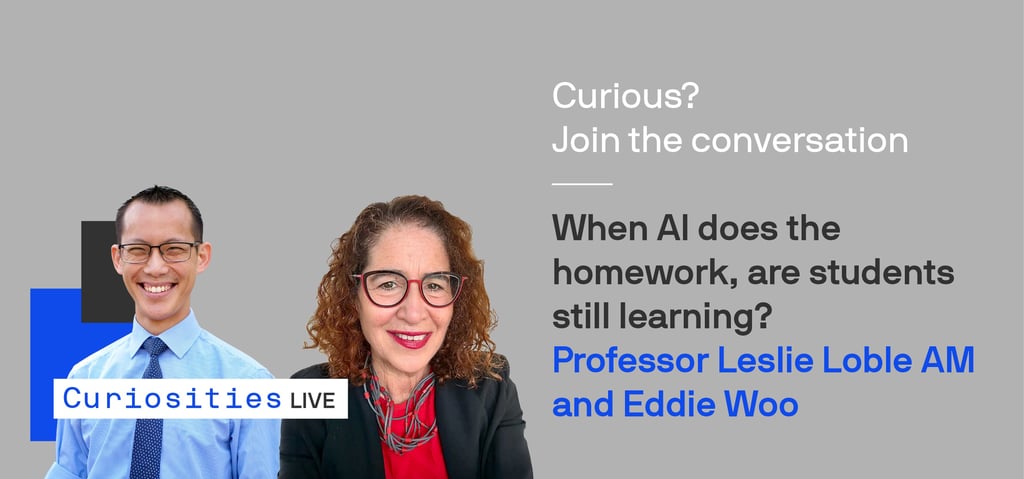
Leslie Lobel and Eddie Woo

When AI does the homework, are the students still learning?

Professors Leslie Loble and Eddie Woo.

When AI does the homework, are the students still learning? transcript

So. Okay. Good evening and welcome to Curiosities Live here at UTS central. We are on the lands of the Gadigal people of the Eora Nation. And I want to begin today formally by acknowledging the traditional owners of the land on which we meet. And as someone who lives and works on dark land, it is a real treat to be able to come over to the lands of the Gadigal, to a saltwater people.

I want to pay respect to elders past, present and as a teacher, those elders who are emerging, who we have the great opportunity and privilege of growing, caring and cultivating. And Leslie, you and I are going to have a wonderful conversation in that wonderful knowledge sharing tradition of the Gadigal people.

Tonight, let's get curious with Professor Leslie Lobel, a leading voice in education reform and policy for all of you who are in the room tuning in online or listening in on ABC Radio National, we are grateful to have you. My name is Edward. I am the leader of Teacher growth for the New South Wales Department of Education across 2200 of New South Wales public schools. I'm also a professor of practice at the School of Education and Social Work at the University of Sydney, just down the road in Camperdown, and I am delighted to moderate tonight's conversation. Lesley and I are here to explore one of the biggest questions facing not only schools but all of society today.

How is artificial intelligence changing the way that students learn? And AI tools are already being used in classrooms in homes around the world. They can support learning, spark ideas, and improve efficiency. But they also raise important questions. Questions about critical thinking, effort, independence, and also how young people develop lasting knowledge that is secure and will make a difference in their lives. Tonight, Leslie and I are looking forward to unpacking what the research tells us, what risks and opportunities are emerging, and how schools can respond in ways that place learning at the centre.

Now, even though I know there are many people tuning in online, I am very grateful for them. Hello to all of you there. I'm actually going to spend over the next 90s a moment privileging the people who have made the journey into night, braid public transport, or somehow found parking in the Sydney CBD. I'm going to ask for your help, for Lesley and I, to situate ourselves and make sure we're having the right conversation for the people who are listening here today.

So this is going to be a quick pulse check, and I would love you to participate by show of hands. Firstly, I wonder if you could raise your hand for me for us, if your work is being affected in some way, shape or form by AI today, could I get a show of hands? Okay, a few hands. I'm looking at the proportions. Wonderful. Thank you.

Hands down. So that was from a professional sphere. I wonder how many people have family, perhaps a young person in their lives and in your conversations with them? I'm thinking, perhaps, of my three children who are all high school aged. I wonder if anyone can say, oh, it's my family, actually, that I'm interested in the world. They're growing up in.

AI is going to affect them. Hands up. If that's you. Okay. Excellent. Another proportion.

Thank you. Hands down. Bit of both. That's okay. One last show of hands here. As an event.

That's at an event where we're focused on education. I would love to see where the educators in the room. So I know there are people who are teachers, past and present, people who are supporting education in universities or other organizations alongside schools could get a show hands where the educators are wonderful. Okay. Thank you so much. That was my show of hands plus audience participation for now.

Anyway, instead of my show of hands, I wonder if by show of thumbs you might tell me how it is that you are feeling about artificial intelligence at the moment. Are you optimistic? Pessimistic? Some mixture of the two. I wonder if everyone would raise their fist for me. Everyone in the room would be really helpful.

Okay, and let's get a thumb position. So I wonder where you are at. Oh, this is so interesting. Leslie, are you sitting on the fence?

That's okay. All right. Thank you. All right. Hands down I really appreciate that. So for those joining us online and also in person, you can see we have a QR code here.

And we would love for you to place questions in the Q&A. Please do that throughout the session. If you're anything like me you'll think of something really interesting. And by the time Question Time arrives, you will have had that thought. Evacuate your mind by that time, so we'd love you to be doing that as you go. But as the moderator for tonight, I'm absolutely going to abuse the privilege.

I have to ask the first few questions. So, Leslie, any this conversation about AI over the last couple of years, it has been full of grand statements.

80% of students say they use it in one form or another of courses across different ages. But, certainly as they get on in their schooling and education, lives, and two thirds of teachers. So the third highest usage in the OECD is amongst Australian teachers. So once AI has become, a universal aspect of education, we can't we can no longer say, let's go back and not have it at all. And what we have to think about instead is what are the core aims that we have the goals for education in Australia, the excellence and equity that we seek from education. And then where does I play a role in getting us closer to that?

That's the fundamental frame in which we need to see it. Now, as you said, I can have a lot of positive benefits, workload reduction. Australian teachers on average, getting close to 50 hours a week and a lot of that on less than half of that is face to face teaching. So there's a lot of administrative work, and I can help reduce that. We know that AI and it's adaptive and data presentations can assist with differentiation. And that's become so important.

And more and more complex classrooms, in which teachers are working, it can help with students with disability and special, learning needs. It can help with students who have fallen behind and need extra tuition. And in fact, some of the strongest evidence is around the use of adaptive tutoring tools and how they can lift and underscore, learning gains in areas, particularly maths, for example, where students have fallen behind. That said, there are some pretty big cautions around AI, and we have to take them seriously. I'll say they they kind of fall into three buckets. The first is governance, safety, security, privacy, absence of bias, all those things.

That is where in both policy and other spheres, we are spending the bulk of our time talking about AI in education. There are two other risks that are important, and we cannot put them in the too hard basket and ignore them. The first is equity. I can either compound or counteract the underpinning conditions that are driving what we already know is a terrible learning gap in Australia. Things like, teaching shortages or the uneven distribution of beginning teachers into areas of disadvantage that the concentrations of disadvantage, so on and so forth. I can either counteract or compound those.

And the third bucket of risks or cautions are learning risks. And those are going up the charts with a bullet, I have to say. And we're going to spend a lot of our time tonight talking about that. But those learning risks with AI are concerning, and we have to take very specific and concerted action to counteract them. I feel as though one of the major themes that we've hit here on the first at the first milestone, and we're going to keep on going throughout this conversation, is this is paradoxical, sort of, dualistic nature to this immense power that we hold in our hands. But as most powers are, you know, can be used for good and for ill is going to erode and enrich learning in equal ways.

I particularly think about you talked about differentiation. Just now and the ability to give a diverse range of students a different set of experiences that is attuned to their needs is extremely exciting to me. As a time poor educator. I know that the school that I personally teach had more than two thirds of the students have English as an alternative language or dialect, and to be able to produce resources and materials for them on a lesson by lesson basis, that I has helped me to be in their mother tongue as well as in English. That's a game changer. It's extremely exciting, but some of the risks that you mentioned are also very, very disconcerting.

I wonder if I can go back to something that you mentioned about the fact that the genie's out of the bottle and we can't go back. This world is irrevocably changed. And as a classroom teacher, the thing I want most for all of my students is that they can leave at the end of year 12 to navigate the world successfully, and also be equipped to contribute and make a positive difference to their communities. So given that that will that they move into, as you have put a is is changed and isn't going back, can you give us a sense of how AI changes the knowledge and skills that our students are going to need to be able to flourish in that new world? Well, firstly, I'd say it's a fool's game to try to answer that question and say, as of today and, June 2026, I can predict what somebody in kindergarten is going to need 12 years or 13 years later. The technology is changing so rapidly.

We tried that in the past. We, for example, not too long ago said that if we taught kids coding, that's that would take care of it and they would be prepared for a digital future. And the fact of the matter is, AI can code itself. And so those those skills are are not the ones I'll say. There's a few things, though, that we absolutely know we need to do. The first is we all will need to know how to use AI to amplify our talents, our interests, our creativity, our knowledge, experience, and so forth.

We need the tool to help us get even further and not diminish our own humanity and our capability. That's more than tapping, buttons on an app that takes real understanding and importantly, skills and knowing how to use it. I mentioned equity. I'm going to continue to mention equity all the way through this. I want to make sure that all students are getting the skills to use those tools really well, and not those who already have educational advantage. I think more importantly, or at least as importantly, the basic tenets and, evidence around what matters for education and learning is the most important ingredient in how we will prepare students for the future that you desire and envision for your your own students.

Literacy and numeracy. To access learning, you simply cannot access learning if you don't have it. We must start with that. And very high levels of it. We need knowledge and content, mastery built on a quality curriculum. And then we need particularly critical thinking.

We need the thinking skills that allow you to build upon your your basic skills and your knowledge to then understand more deeply new concepts. Learn them, apply them, evaluate them, discernment and judgment. All those things that are so important will become even more important in an AI world. So for me, that's the really good news is that in the midst of this new technological vector that is affecting education, just as everything else, the fundamentals remain exactly the same. And in fact, it's a moment where we have to double down on just how important great teaching is, and we have to give teachers the tools and support to be able to do that. That is becoming increasingly complex and challenging because this world is changing under our feet constantly.

The AI is doing a new thing every single week. I do think about the fact that this new world that we're going into, even just rewinding just a few years, I mean, I wonder how many people here in the room or line can resonate with the fact that I grew up in a house with an Encyclopedia Britannica set proudly displayed on the shelf for some of our younger people in the room. An encyclopedia is a kind of book I call a book is an object with paper page. I won't keep on going, but as Google became, it began to be this incredible new tool that we were excited to have access to, but also brought with it and a new set of skills that we had absolutely not yet mastered. In much the same way you talked about how a real understanding of what these large language models and artificial intelligence chat bots can do, and how they're doing it is very important, I promise. I'm not just saying that as a mathematics teacher, looking at the statistics that underlies all these models, but it influences what we're actually getting out and how we interpret that.

Leslie, one of the things that I love about the many conversations you and I have had about this topic is that we've seen that there's this tendency over time, AI's in this at the current end of a long list of technologies whereby it's been the development of a new technology that has been driving many of the decisions in our schools and homes. The technology rises and then we we react, we respond. And of course, it's very natural in a way, but we've both seen the danger of that happens over and over again. And we've discussed the importance of not the technology being in the driver's seat, but of sound education or thinking being in the driver's seat. So I wonder if you can help us understand some of that sound educational thinking. I'm particularly interested in something.

I know you and your colleagues here at UTSA have looked at a lot, which is cognitive offloading, which I know is a phrase some people in the room because you're here and you're interested have heard of, but not all of us have. So can you help us understand the educational thinking under that and its implications? I'll try to do this without making people fall asleep. So essentially. Well, I think I personally have played right into your hands by talking about how important education is. But I absolutely, as you said, we we've had many conversations the, the, the power and the compelling nature of AI, and we're all all sucked in by it.

I mean, it's just an amazing set of tools, is so compelling that it does start to drive us towards thinking that we have to respond to it, rather than thinking about how that set of tools, like any piece of technology, including a book or a textbook, supports the learning, cognitive offloading, essentially all that is, is when we, hand over to some sort of external, it doesn't have to be a piece of technology, but we externally, shift some of our memory stores to an external device, to free up cognitive space for us otherwise. So cognitive offloading can be positive and beneficial, or it can be negative and detrimental. So, for example, when you write a shopping list, when you write down, a phone number, when you're a student and you take notes in class, rather than try to or this working memory is very limited that we have and all brains are basically built in the same way with this small working memory for new information that holds very little. In fact, by some studies, we can't handle much more than four things at once in that working memory or we get stressed and we have, excess load. And then there's our long term memory, which is boundless, and it contains all of our experiences, where activities, the things we've learned. And that's our stores of, memory upon which we build knowledge.

So when cognitive offloading is detrimental, it's essentially sort of short circuiting that process and stopping us from building those mental structures upon which we not only continue to learn, but we think. And I unfortunately, part of its beauty is that it is designed with all the incentives in the world to push us more towards the detrimental. Essentially, it takes care of a lot of things for us, and we defer to it more and more. And that's where the worry is about cognitive offloading, which is that the risk is not just that somebody cheats by using AI to write an essay. The real risk of AI and cognitive offloading is that we erode those mental structures. And for younger learners, we potentially don't even build them robustly enough at all.

Bear with me, because I know we're going to unpack this a lot. Let me just tick through some of the evidence we've got on it, and then I'm sure we'll get down the track into what we can do about it, because we can do something. But the evidence is starting to mount, to mount that this is a real, problem. So, for example, we know from studies that there's what's called a performance paradox. AI gives you a short term boost, but then when students are tested later, they haven't retained it. And so we get this boost, but we don't have the learning.

There's, an illusion of competence that comes with using AI, which leads to a false sense of mastery. We feel like we know it and we think we've know know it, but we don't really. And in turn, those that dynamic pushes what some have called a metacognitive laziness. In other words, we lose touch with our metacognition, which is essentially understanding what we know and what we don't know. And our self-discipline to get us from ignorance to knowledge. And when we have a tool that just makes it feel like all that information is at our fingertips, it creates an incentive to avoid the productive struggle that is the foundation of learning.

So this is what is going on with AI, but it's not inevitable. And that's really important. And we'll get into this later. First and foremost, there are ways that, we can structure the technology itself to be a positive incentive towards learning and not a negative one. And most importantly, we can support teachers in how, to effectively and intentionally teach around AI. Let's say I have one more question.

If you just to build directly on what you just said. Before I ask it though, you've just prompted my memory of, a colleague of mine. His name is and Tony Martino Trust. Well, he's at the University of Sydney. He's a behavioral ecologist. And one of the things that he's helped me to learn is that one of the quintessential human characteristics is that we make and almost obsessively invent tools to make our lives better and easier.

It's part of what has enabled our species to absolutely dominate the planet. Not the only thing, but it is one of the characteristic human qualities that enable us to do so many amazing things. It reminds me of the fact that calculators and computers used to not be objects, but people. And cognitive offloading is something that is enormously powerful because it allows the students who I teach every day with a few presses of a calculator to be able to solve problems that would have made a mathematician's eyes water just 40 years ago, but now are in the reach of your average 15 year old students. Or there's some wonderful things that that enables, but still many questions. And this brings me back to your question, which I want to let you close on, which is you have given us a portrait of cognitive offloading, some of its dangers, some of its risks.

What are we going to do about it, Lesley, in practical terms? Well, and by the way, following this, I've got some questions for you because I want to know what your answer is, that I didn't expect you'd let me off the hook. That's fine. So I mentioned before that let's let's start with just the technology itself. The vast majority of, I backed, learning tools, are not connected to the Australian curriculum for example. And Unesco, amongst others, has found that they very rarely, sadly, are built on strong evidence based pedagogical design principles.

So they may be, you know, all that user testing was all fine and good, but it was all about the technology and not about the pedagogical structure of the tools. And what we are seeing in many of the studies I mentioned on cognitive offloading, those studies also show that when it's a well designed tool, it in fact can flip that equation so that it can prompt and deepen student thinking by not providing an answer. For example, by challenging a student's reasoning and all sorts of ways you can design it so that it can be a positive influence and drive deeper learning. But the most important thing is going to be, for example, what teachers can do. And this is where if we go back to the things that you and the teachers in the room were trained on, you would tell me exactly what we need to be doing. Even when we talk about AI.

So one of the foundational aspects is that you start with a highly structured and scaffolded learning, and you build through progressive amounts of information, practice repetition and the like. You move students towards mastery and progressive independence. We have to take that same principle to how we teach students about using AI, and how we structure the use of AI, highly structured and guided at the beginning. And I we and I think especially for the youngest learners and then more and more independence once those metacognitive skills and other and knowledge stores have been developed, things like checking for understanding, very important in an AI context, you do it reflexively as the great teacher that you are. Every good teacher does. We need to do that very intentionally, explicitly.

Now with AI, we need to rather than saying things like, don't trust de ai. It's dangerous or it hallucinates, we need to build into the muscle memory of every student verification processes so that they aren't having to verify everything that A.I. has given them. But maybe 2 or 3 sources go to the primary source and see whether it's accurate, so that you're building a verification mindset, which, by the way, is part of critical thinking as well. So these are some techniques that build on the fundamentals of what teachers already know how to do. Metacognition and self regulation as a core part of what teachers are doing.

Because we are imparting skills to young learners about what it means to take initiative, to understand where they need to learn more. And so forth. This is what I meant by saying we need to double down on that quality teaching, and the way we learn isn't changing because of AI, but the context means we have to really focus on it and we have to, make it the centerpiece of what we're doing and give teachers the support and the agency to do that. Can I ask you my questions? I suppose I should let you have the yeah, I should, because I want to just building on that to get your view of, you know, I'm saying teachers are essential. I bet you anything you're going to say, they're essential as well.

So what do you see as the things the teachers are going to be able to do and do already, that I just simply won't. You're right. I do have an opinion on this one, Leslie.

Shock, horror, surprise. And, obviously I should plant my flag in the sand. You'd expect someone like me to say yes, teachers are indispensable, but I'd like to say it's not just because of, you know, some vaunted sense of self-preservation that I believe that I've got a couple of thoughts in my mind. One directly builds off of something you just said about the pedagogical principles that you can. People don't always, but you can build into an AI model that will help it be more effective. You talked about, not always being as helpful as necessarily a user would like a chat bot to be and instantly gives the answers.

So this is a known thing, right? And so much of, you know, Claude, you copilot, it's quite well-established how, sycophantic these models are because they are trying to drive continued use and engagement and our fragile little psyches are quite easy to manipulate in those ways. And one of the things that's interesting to me, as I've seen students use AI models that have more, say, for example, Socratic models built into them, and those principles are there. We absolutely see the difference that those principles built into the models can have. We also notice students often do not like using said models, because the sycophantic model is much more friendly and and affectionate to us and makes us feel amazing. And one of the things which I note is a distinction which perhaps one day we will cross that boundary.

But I sense that at the moment we are a long way off from that. Is that as a teacher, what am I doing in the classroom to help my students? Well, there a a set of things which I do from the front of the classroom, but that makes up perhaps a third, ambitiously, a half of the actual teaching, learning that I'm helping to lead. Much more of it is actually happening. As I wander around the classroom, I'm looking at what students are doing. I'm listening to the conversations they're having, and I'm making choices in the moment about where I will intervene, which questions my students will give to me that I respond to, and which ones I will return with.

Another question, which again students learn to dislike but realize it is fundamental to their own learning processes, at least for now. One of the key things that all AI models, all language large language models share is that they wait for us to come to them. They wait for us to prompt. And if you're a good prompt, if you're effective at prompting you to be better at using that. But if you do not prompt the model to begin with, or if you don't like the prompts and the responses and you walk away, the usefulness of that model, well, it may not, as it may as well no longer exists. And that activity and initiative and choice of the teacher is something we are still quite distant from AI being able to mimic an analog.

I'll give you one other, because I promised to. I love building the knowledge and skill and understanding of my students, but any teacher who has spent any amount of time in the classroom and loves what they do and are good at it will tell you very quickly that knowledge and skills and understanding are a subset of the teacher's role in the teacher's privilege. In the classroom, we are there to help grow human beings, not just aspire to academic outcomes. And I say that as someone who loves aspiring to academic outcomes, but knows that it's a slice of what I care about for my students and we haven't talked at all about AI for companionship tonight. And that's probably a discussion for another, another evening. But, while we have a facsimile of something that looks like it resembles a relationship.

Yeah, that is all that it is. It's a facsimile that resembles that. And as human beings, our cognitive framework and our affective framework is all built to have relationships with other human beings. That is not a thing that I can produce, and I don't think it ever will. Yeah. And and, Well, well well put.

And backed by tons of evidence that humans learn from other humans better than in any other way. And that is especially true for younger learners. And, and, and the risks of AI, are especially great when we are talking about, school aged learners. It's bad enough for us as adults. And just imagine, for younger learners. So I want to ask you as well then that you said you're right.

I mean, I as it's just so compelling and as you said, it's designed that way, and makes people want to use it more and more. And that's another thing this the cognitive offloading studies are showing is increased dependency on it. So your students, I'm sure, use AI in one way or another. They're very clever. What would you say to them about how they should approach using AI in the context of learning? Leslie, the way you framed that question, what would I say supposes that this is a hypothetical idea for me, and it is not, it's a reality that I see in the classroom every day.

I see in my home every day. What do I actually say to my students? It it's of course, worth acknowledging. And all of the teachers here in the room and tuning in online know, there is no silver bullet that is going to work for every student in every context so far be it for me to claim that I've got the thing which everyone should go back to their schools and say, well, this will solve everything with the diversity. The students who I have for me, probably the key drivers, number one, about motivation and number two, about what is it that students are actually wanting to get out of school? There's only so far I can get saying to my students, trying to convince them, well, this is going to be on the exam.

I'm not going to let you have AI on this exam. It's like, well, that motivator is going to last for a little while and then it will fade and evaporate off into the distance. So let me take them one at a time. Let me think about the motivation part. Are the tasks and activities that we have our students engage with, that our young people are doing every day? Are they more like a job, or are they more like a gym?

Is the thing that we care about the output? There's a task. It must be completed. I went to an agricultural school, for six years of high school, and every time we would head down to the plots and I would sort of groan as I looked at the weeds that had grown there over the last seven days, and I would think about this bare, barren plot that I would need to prepare for planting the next lot of crops. There was a job to be done. And look, those in the room and those online can say, I don't really have a physique built for a horticultural farmer.

And so for me, if I had a tool, if I had a machine that could help me produce the same output, I would take it. My agriculture teacher seemed less sympathetic to that. But that's okay. We'll give Mr. Anderson a pass for that. If you have a job.

And the primary thing that we care about is the quality of the output, then use whatever tool is going to be appropriate to help you reach that goal. However, can we not all feel the ludicrousness of going to a gym and having the personal trainer walk you through the equipment and say, oh, by the way, here's a machine you might like to try out. We've just brought it in. It will lift the weights for you. It will do all of the reps. You can watch it go.

That would feel a little counterproductive to us. And even though I'm not an English teacher, I loved English when I was at school, I still do, and the whole point of writing an essay, for example, is it an essay is a proxy for thinking, for analysis or understanding a text, what it's really about and saying something important about it, something important, something true. That essay writing activity is a gym. And so that motivator, I think, which admittedly takes some work because I know there are lots of my students who will look at an essay, or they will look at the exercise that I set for them, and they'll say, actually, that looks more like a job than a gym to me, which means there's some work for me to do to show you the value of actually putting that effort in developing those muscles. That's the first thing that I would say. And then the second.

There's a wonderful book, called 10 to 25. 10 to 25 is in the the ages 10 to 25, which is this protracted period of adolescence which we're now seeing in young people. And it talks about how between the ages of 10 to 25, one of the key things that drives a young adolescent brain as that prefrontal cortex is forming, is maturity is developing, is I want to have something that I care about in this, and I don't really want the person in authority to be telling me what to do, because that's actually a real disincentive for me. And we have seen many marketing and ad campaigns around all of the maladies of young people drugs, alcohol, smoking, all the things and how ineffective they are when there's an authority figure saying this is bad for you, don't do it. In fact, if anything, that can sometimes serve to drive that behavior because every adolescent brain is somewhat wired a little bit for that rebellious streak, that finding of independence away from the family unit generally, which has defined them. So how can we tap into that in the context of I?

Well, I'd like to think that helping people see, I don't know how many of you have heard the phrase if if you're not paying for a product, you're not getting a product. You are the product. And to help young people realize, actually, hold on a second, I'm I'm the business value here. And my attention and my language, these large language models famously need tens of millions of words to be able to produce the effect. Similarly, if human logic, I'm being taken advantage of here to be able to tap into that, I've found to be a very powerful signal to a young person that I'm not just going to sit here and be taken advantage of. There's something I want to take for myself here and own my education, so hopefully that is helpful for educators listening it.

I thought you were headed to saying we need a bunch of influencers. I wasn't not saying that. Sorry. Anyway, I we have some questions from the audience. All right, let's, And now's a good time to remind you, if you haven't already, to, submit your questions. I've got a few here, and I'm going to start with one that's gotten a lot of of us.

So it's obviously resonating with people. Yep. So, Leslie, I'd love for you to start this.

I've got some thoughts on this too. But the question from the audience is, is there a framework, strategy or tools to balance the use of AI whilst also making students think critically? So you just talked about the importance of critical thinking. I'm an earlier in the conversation. We were talking about Google and this vast array of information out there that really requires, some healthy skepticism. Do you have any thoughts to share on how we help our students to to balance that, those two tensions?

Yeah. Well, great question. And I think it's, as I said, very intentionally and explicitly teaching around how I can provide us with, positive beneficial boost to our learning, and then being quite explicit and intentional in our teaching around, where that is. And so I started to go through some. So, we have to move from so a lot of that is built off of, to be honest, a basic learning principles that are well researched and, cognitively quite sound. So critical thinking depends first and foremost on knowledge.

You can't think critically in the abstract. It has to be based on some, foundational content and knowledge and the processes that underpin critical thinking. Things like reasoning, problem solving, evaluation, judgment. Those also can be explicitly taught in the context of content knowledge. And so we need to amplify that. And in our education.

And we need to explicitly bring in those aspects of structuring the use of AI in learning. I'd also say we should be quite serious about looking at primary years, and whether we should have AI in them at all, or let's at least say in K to three, that we should be saying there's important things that need to be developed before we're talking about using this tool. And that fits in what I was saying before of building more skill and progressive independence and how to use this, because we're confident that students understand it and understand, have the knowledge to be able to, use it and evaluate it. Well. So the balance this is not a one off, and there's not a formula that we can package up into, you know, a one sheet piece of paper that goes out to all classrooms and says, here's how you balance it. This is an ongoing process, but I just think we have to come back to over and over again that when we reflect on where the strongest evidence is about effective teaching, that that is where we can build in more balance around using AI.

And I'm just going to give you just another example. I rattled off a few before, but if a teacher says, okay, you can use AI, but just make sure you documented or cited when you've used it. Again, that could be turned slightly to be more specific, to help students under stand how the tool could be used in a positive way. It could be. Use the tool to ask you questions before your test based on what you've been learning. It could be use the tool to challenge your thinking and your reasoning.

So on and so forth. So it's putting that tool in balance and saying and acknowledging that at least, as students have progressed through their learning and in their, you know, secondary years, for example, they're going to be using it and rather than say, let's forget about it and not and pretend the shadow use outside of the classroom isn't happening, let's bring it in and intentionally structure and scaffold and teach how to be using it in a productive way. So I'm I find that so helpful. Leslie.

And I want to add, an extra practical layer to that answer for whoever is posed the question here. One of the things which I think is so fascinating, it's one of these old wineskins, new wine type, situations, is that you know, we are headed towards, you know, it's tend to at the moment. We're headed towards the end. It's been a long 11 week term, but we're headed towards these formal assessments that are coming in terms three and in terms of the HSC rolls around here in New South Wales. And I wonder how many of you for some of you, it's quite recent and others we have to cast our minds back. But think about the last time you sat and were formally tested on something, and I feel very confident in saying that for all of us here in the room and online and listening on the radio, when we were tested, we were posed questions and we provided the answers that resonate with people.

That's kind of a format, right? Questions, questions, questions. How good are you at answering? That's the theme that we are assessing and measuring and therefore what the assessment is valuing. Now, do you sense the imbalance there because, you know, as you were just talking to Lesley, one of the key skills for using a large language model effectively is actually how to pose effective questions, which in fact is not new to a large language model.

I think every great thinker, problem solver, you know, in a work or in a, individual context knows how to ask the right question. That can then lead to the work that we need to do to work out with the answers. I think Bloom's Taxonomy here is one of those wonderfully powerful tools that, again, we are going to find doesn't fit these these old wineskins to fit the new ones. So for those who don't remember, picture of the pyramid down the bottom of Bloom's Taxonomy are the least sophisticated skills we want to develop in students. We thinking about just remembering, recalling facts when we have to understanding, applying, analysis, evaluation and then creation. Where exactly is questioning in that hierarchy?

I think we could make an argument that it is somewhat sprinkled through, but perhaps this is a good opportunity for us to say it deserves its own place. So that's, I think, a helpful kind of practical thing to add into. There. I'm going to ask an expression, unless you want to build on that said. Okay, great. All right.

So this next question here, this is this is a bit of a tricky one. Do you think the integration of AI into education changes what we as teachers need to value? So I just made a reference to assessment before. And that often, you know we measure what we care about. Do we need to change what we as teachers value? Do we need to start looking at the thinking behind the answer rather than just the answer itself to us today, I think you answered that perfectly.

Say more on that, Lesley. Well, not just for my ego. I want to know more detail from Lesley right.

Look, You just went through Bloom's Taxonomy. I mean, what we're doing, if we're structuring, learning. So it's just about you. Reference task before. If it's just about. Let's see how you perform on this task.

That's not really learning. That shows that you've learned that you've, you know, mastered how to perform on that. But the learning that is the more the deeper learning, the longer term learning stores to go back to our memories upon which future learning is built, is something deeper and more significant than just knowing how to multiply. So I'd say in that sense, I'm going to sound like a terribly old fashioned here in the face of this incredible technology. But I I'd say, and you, you you could tell me if I'm wrong. The teachers have never really been about.

Let's just see how you perform. It's been about let's see what you understand. Let's test you on how you apply it in different circumstances. There's an automaticity that comes from learning your facts, upon which, you know, makes it easier to learn other things. If you don't have to think about four times 416, you know, means you can take on more complex mathematical learnings. But I'd say that's why I think you've answered it.

It's really what teachers are aiming for. Here is something much more than just task completion. It has always been the aspiration that doesn't make it easy to reach, though, of course, which I think is part of what's implied in the question. This next question has actually, interestingly been phrased to me, so I'll take my first bite at it. But I'm I'm interested in your opinion on this. So the question is, how would I advise my students and my children to use AI to excel in their work and enhance their learning?

So what's the advice to students as they, you know, sitting in front of their copilot or Claude or ChatGPT or blinking cursor? In addition to what we've already sort of established tonight, I think that the the most helpful litmus test that I use for my students and for my own children is is this helping you to think more, or is it helping you to think less? I have to go to something extremely simple because, frankly, my children will tune out, any time I get more than 15 words into a sentence. And it's a very helpful heuristic. I think if we are using the technology because I'm really struggling to come up with something, maybe it'll just give me a kickstart. Well, in that case, it's helping me think less.

And if I'm really up against the wall, sometimes I will reach for that. But I know that that is a lesser use of the AI. Then you actually referenced this before going to something like notebook LM. I wonder how many people in the room have given it a go, actually providing it with my own notes that I've taken by hand and saying, okay, you can read this. I would like you to test me. One of the most famous, studies in psychology around memory and retention was from Roediger and Copic in 2006, if I recall, and they were testing how good students memory was of a certain, you know, passage and they would be asked questions.

And one of the things they noticed was that they were diluting and interfering with the results. Every time they brought students in to test them, the more students were brought in to be tested, the more they recall improved, because it's the active retrieval which actually helped to reinforce a signal to our brains. You need to build some synaptic pathways here, because you seem to be needing this information over and over again. I'm going to make it accessible to you, as you mentioned, in that automatic way. So if we are able to employ the tool to help us to do the work, this just goes back to the gym analogy. I'm going to be putting weight on to there, because I know this is what's going to develop my muscles, that I think is probably the simplest way to go about it.

But Leslie, I'm keen to know your first thought on how you would advise students. No, I think you've answered that incredibly well. I'm just going to say this is why the cognitive offloading evidence that's emerging is so concerning. Because it is short circuiting that very process that you're talking about, and the incentives push towards using it as a substitute, and not an enhancer. And as a result, I mean, this is you know, I do have to say it's reasonably serious, right? Especially as I said, when we're talking about younger learners, that if the cognitive structures you've just described, which are built from that productive struggle that we don't like to do, nobody likes to do, it's not just kids, you know, it's why make it hard.

Just tell me what the answer is. And that's what a high does for us. So it really is why the technology is so disruptive, and risky when it comes to this cognitive offloading. You just prompted me to remember the words of, Danny Kahneman, who wrote thinking comma, fast and slow. Fantastic. Great.

I mean, deservedly Nobel Prize winning for literature. And he said, I remember he wrote it. I've probably read this from ten years ago, and it just confused me so much when I first read it. So I wonder if you were respond in this way, he said. We often think brains are an organ for thinking, an organ designed for thinking, but the brain is an exceedingly efficient machine at helping to minimize the amount of thinking that we have to do. Because thinking is effortful is resource intensive, and if the brain can come up with a quick response to something that doesn't require that that hard work, it will absolutely take it.

And I and large language models are absolutely taking advantage of that. So sugar hit absolutely okay I have I want to close on a question that is costing towards the future and and some hope as well. But before I do that, just one final one from the audience. How do we address the threat that AI poses to the validity of most assessments other than the in-person Invigilator exams? Here is the way it's provocatively being put by this question. Oscar, is the extended take home essay.

Now, did your thoughts, Leslie? Not if we have, intentionally, a couple of things. One, if we have successfully and intentionally built, strong skills in how to use AI productively, then I would like to think that, students might use it. You know, every parent here says this as well, right? When some, you know, your your child asking you for the answer, the question, you say, well, you try it first, honey, you know. Right.

And they hate that. They just want the answer. But it's like, that's what we do because we know getting that initial thing first. So if we have already sort of structured, and scaffold scaffolded the learning about AI in the context of our broader learning, then if it's right, your essay first, then use a AI to challenge the reasoning, or use AI to point out errors. In your thinking, that's a very different story. And I understand what you said the before about your own children.

But sometimes, especially if you've moved towards, you know, progressive independence, there's nothing wrong with that. Getting the tool to be the provocateur, to help you be better. So, journalists, when we released our report, I wouldn't say that. What I'm about to say was the most popular thing with journalists, but, using. If you've never learned spelling, I'd say don't use spellcheck. But if you're sitting there, as a 16 year old and you're writing your essay use, you could use a grammar check or a spell check.

And that is this is a big thing. If it's freed up space for you to spend more time thinking about, well, what's your unique analysis of this or what's your great insight here? And our assessments can reward that. We know that, the, plagiarism technologies just simply don't work in the face of AI. So that's a waste of time. But I would say we shouldn't exclusively be using those.

So at a level of understanding that we want to see if students have we need to couple. If we're going to use something like a take home test, we need to couple that with something that isn't so that we can genuinely know. Has that has that concept been understood and applied in a different way? Let's say I said I wanted to end on a note of hope. So I'm going to pose a question to you, and I'm really going to supply my own impression of an answer from my vantage point as a teacher in schools, as a leader supporting teachers around New South Wales. And then I'd love for you to give us paint us a vista of what the future can look like.

The question is really around, you know, I had a quote from Google's recent event where they were talking about their newest products and all the the new features that they were releasing, and I believe that's where it was the head AI officer who said, we may look back on 2026 and say, they were in the foothills of the singularity. This idea of this oncoming superintelligence that will eclipse human and human thought and usher in potentially some new golden age or Skynet and Terminators. Who knows? We'll find out. The foothills of the singularity was this image, where we're looking out into the future. And there are lots of exciting vistas.

So I want to share one very small personal one. And then I'd love to for you to take us home. Leslie.

And then we're looking forward to getting to have some interaction with you here on the floor as well. One of the things that I have wrestled with, for many years and I it's probably going to sound biased as a mathematics teacher, but in fact, it is is all classroom teachers who feel this struggle. I think mathematics teachers just know the tools and therefore this we realize the gravity of this problem, perhaps more than others. It's that we we rush to quantify. And when it comes to student achievement, we love to be able to to score students, to be able to put them on a scale and be able to say, all right, I can, sense how well I can report to you how you've achieved. And that's really helpful for formative feedback.

But I think about the, the work of dealing William in formative assessment, how he said it's more valuable to give students qualitative feedback than quantitative feedback, give them comments and instructive ideas rather than just a score. But if you give them both qualitative and quantitative feedback, our studies show they might as well have not received the qualitative feedback. Such is the power of when we see a number and it might say, for example, 49% on the front of an exam and we rush to make a to draw a conclusion about ourselves as students and as learners, and also from a teacher standpoint, one of the things I'm excited about, I potentially helping us with, is that we are more awash in data today than we ever were. And I think for a long time we viewed qualitative data as nice to have. We use it when we can, which for a time poor teacher is almost never because there is there are oceans of this data, which we would love to dig deep into. And for the average high school teacher who has 150 plus students every year, that's an intimidating task to go about.

Could there be a world where actually we could have an equal grasp and mastery of our students, what they need, where they can develop, and where we as teachers can support them? Not just on the numbers, but on a much richer sense that a large language model could help us to develop. That's not going to be taking the teacher's place, but supercharging and amplifying the ability of a teacher to know the student, how they learn the content, and how to teach it, and do that with the element of an extremely able help. I wonder, Leslie, what would you like to finish on?

Well, I'm going to start with the foothills of singularity is not exactly Shakespeare. And, And I say that for a reason. Because my sense of hope is, comes from, from things like that, where the human creativity, our passions, our knowledge or insight, it's boundless. It is absolutely boundless and doesn't need to be invented by somebody twiddling with ones and zeros. And I think in the end. That will win out.

I don't think it's a small thing. You may have seen. There are lots of graduations happening in the US in May and June, and you have some of, or, you know, Eric Schmidt from Google in the like, commencement speeches and speech. And so I said graduation because we can't really say commencement in Australia. Do we? Anyway, students booing about the great future of AI.

Now, partly when you're sitting in, Silicon Valley, you're in the belly of the beast and, and we can see what's happening with employment, around some of those, some of those highly, well, what we once thought were completely immune, like coding. We see resistance. I was talking to a colleague over there, before the session. We see resistance, as well, developing in farming communities, and others around the US, around data centers. I think this is not a moment for, Luddites, because I can be such a powerful tool. But it is a moment and an ongoing moment where we must constantly recognize and ensure that human agency is shaping where this technology goes, and that is not beyond our means.

We are impressed daily with these incredible machines and what they can do, what we need to constantly come back to three levers that will make a difference, at least in education. And if we, enact our policies and our practices around these three levers, we will have AI in a subsidiary position, not in the forefront. And those levers are the governance levers that I mentioned before, privacy and so forth, the design of the tools. We have fantastic work that's been done by arrow. Australian Education Research Organization, and the education services body. And they've developed standards for AI based educational tools in Australia that are also educational quality.

We simply need to bring these standards into reality and connected to our procurement of tools, so that every classroom can be, confident they've got the best tools for Australian kids. That's lever number two. And lever number three is the effective use. And that's where we have to spend an awful lot of our time. And we have to make sure we are providing the resources, resources to teachers to intentionally structure the use of this tool. It's not beyond our capabilities.

And that is why I am hopeful. But we have to be active to make it happen. It's incredibly powerful call to action, Lesley, and it is going to need that call to action because as we've just discussed earlier tonight, if we abdicate our responsibility to take an active role in how this technology is shaping us, how we are shaping technology, the technology will shape us.

We are so grateful for all of you having joined us for this discussion tonight. I hope you have found it at least half as interesting stimulating as I have up here on the stage. Would you join me in thanking Professor Leslie Lowe all tonight?

Kathleen. Thank you so much. Audience. To those of us joining online as well for your thoughtful question questions and your engagement, this is, of course, part of a series. So you can continue exploring ideas that are about shaping our future through the curiosity series on the UTS website. Thanks again for joining us.

We look forward to engaging with you here on the floor. Have a great evening, everyone, and safe travels. Thank you.

Sanjoy Paul

Could Australia run out of fuel – and what needs to change?

Associate Professor Sanjoy Paul.

Could Australia run out of fuel – and what needs to change? transcript

Welcome to Curiosities live here at UTS. Before we start, we would like to acknowledge theGadigal people of the Eora Nation, upon whose ancestral lands the UTS campus now stands. We would also like to pay respect to the elders both past and present, acknowledging them as the traditional custodians of knowledge for this land.

I would like to begin by welcoming our audience tonight. Thank you for joining us for a discussion on oil and shipping route disruptions as part of the Curiosities live event series hosted by UTS. Does Australia run out of fuel? If you're interested in the answer to this and other related questions, you've come to the right place. Tonight, we invite you to learn from and discuss with Dr. Sanjoy Paul, who's associate professor of management and supply chain expert here at at the UTS Business School. My name is Gerhard Hambusch. I'm also an academic in the UTS Business School. My research and industry engagement interests lie in finance, ESG and governance related topics. Tonight, I will be your that is the audience wingman to get your questions answered and to navigate our discussion from supply chains and oil to impacts on Australian consumers and businesses. Stand will be our expert ready to answer your questions. I'm sure some of you have started feeling the pain of increased fuel and other prices. So, it is time to unpack current events to help us better understand the complex world of oil supply chains and short-term and long-term impacts on consumers and businesses. Tonight, we aim to deliver to you, the audience, the following discussion highlights. First, we will talk about the shipping closure of the Strait of Hormuz, an important waterway for global oil shipping routes. We will then shed light on the impacts of this closure on Australian businesses and consumers. Third, we will also explore steps that can be considered in the future to improve Australia's ability to manage similar disruptions. And of course, most importantly, we look forward to tackling your questions that can leave that you can leave in the Q&A chat window as we move through the first half of the event. Please don't forget to leave your interesting questions so that we can then address them. Excuse me. So that Sanjoy can address them later. So let's dive right in and start with one important question. Sanjoy, can you explain to us what experts mean when they talk about supply chains? And of course, together with our audience members, I'm specifically interested in those supply chains related to oil. Yes, thanks Gerhard for these you know nice introduction and connecting our audience. So I would like to welcome them in this event. So yes, so when you're talking about supply chain then we need to explain how we are globally connected. So we all understand that it is a very connected connected world. Goods and products are not produced and consumed in the same locations. So that forces the businesses to transport materials and products from one place to another and form the chain of suppliers, producers, transports and logistics providers, distributors and finally retailers before it's coming to us. This structure is broadly known as a supply chain. But as we are interested to look at oil supply chain for Australia, I would like to highlight how it works. For example, we import crude oil and refined oil and crude oil is produced in some other regions of the world including Asia, American and Middle Eastern countries. And those oil, crude oil transported to refineries in both Australia and Asian countries for example in um Singapore, Malaysia, Japan, Korea. Then we refine we transport that refined oil to our well pump and from where consumer can buy it. So in short this is a brief summary how a supply oil supply for Australia works but if you d it down then we can little bit more understand about the complexities for example we import about 95% of our oil needs including refined and crude oil we import refined oil significantly which is about 80 to 90% of our demand. Those refined oil comes from many countries but most of them are from Asia. They are Singapore, Japan, South Korea, Malaysia, India. So you could see that our suppliers of refined oil located in different parts of the world still we are connected. So if you look at the other side we also import crude oil little bit process here locally and that can fulfill only 15% of our demand. So those crude oils come from Malaysia, USA, Vietnam, Brunai and other Middle Eastern countries. And after we import that crude oil, we refine them here using our two refineries located in uh Brisbane and in Geelong. So you could see combination of these crude oil and refined oil forms a complex network like dependencies on many other countries for crude oil refined oil and finally it flows through our transportation and logistic system until to petrol pumps where we buy it. So that's why Australian oil supply chain connect with multiple countries shifting routes for both of our oil needs and that's why the structure is very complex. Go ahead Sanjoy thank you so much for for getting us started here. So it seems like not only are we within a network of neighbors that we closely work together and also uh receive oil, crude and refined oil from them, but the difference between crude and refined oil seems to be very important. And what stuck out to me here was that you said lots of the refined oil needs to be imported and that we can only basically provide a smaller amount through local production. So I think that's we come back to this, but that really stuck with me. So thank you very much for getting us started here. So, let's now turn our attention uh to this waterway that we've read about so much in the news every day for a few weeks now. Um I had to Google it and a quick Google tells me that this waterway we're now talking about is about 167 km long and maybe between 40 and almost 100 km wide. Right. So, Sanjoy, can you please uh explain the role of this straight of Hormuz for the global supply of oil to us? Why is it so important? That's a very good thing to discuss because we need to understand the geography of it. As you said, it's a narrow wide waterway. So though we have a range of 24 to 39 kilometer of wide but we can use only 2 to 3 kilometer of it for transportation of ship. So that's why it's a very narrow waterway and shipping route and it is located between Iran and Oman. So both share the uh uh the Strait of the Hormuz. However, this shipping corridor is also used by other Middle Eastern countries including Saudi Arabia, United Arab Emirates, Qatar, Kuwait and Iraq to transport their oils and LNG mostly. Why it is important? Because the global energy defendency on this corridor is very significant. On average about 20% of global energy needs such as oil and LNG are transported using this coroner. Those middle eastern countries are the suppliers and other countries around the world are buyer. Some refineries buy them, some buy crude oil directly from them. So this is roughly around 20 millions barrels per day of oil and LNG get transported through that corridor. So that's why this corridor is very important for our global energy needs. In case of Australia, how much we dependent on them? So Australia has both direct and indirect dependency on this shipping quarter. directly very less 10 to 15% of our crude oil out of 100% crude oil we import from middle east. So it feel that okay only 10 to 15% of crude oil coming from directly from middle east may not be significant. However, if you look at our indirect dependency, we import most of our refined oil, 80 to 90% of our refined oil from our Asian refineries. Those Asian refineries they bring they import crude oil from Middle East countries. So that is why our indirect dependency is way too much compared to our direct dependency. So if you add them all together overall dependency considering direct and indirect for our energy need I would define it is very significant and critical. Not only that because of oil and and crude oil and refined oil uh coming from that corridor this shipping route is also critical for some other products for example prochemical products which are used to produce fertiliser such as urea. So our farmers depend on that urea and fertiliser too much to produce our fresh produce and that is why the dependency and on this shipping corridor is too much important for us and also critical because if something happened like the disruption we have seen the impact would be coming to us.

Thank you Sanjoy. This this really helps us to understand the critical role of this waterway the Strait of Hormuz uh in in the in the global context of the supply chains of oil. So I think uh I think that really allows us now to better understand the uh the importance of that area but also now the impact on Australia and let's start with Australian consumers if you don't mind. How how does this disruption of oil shipping routes impact Australian consumers? Because that's really what we're interested. I trust the audience is interested in that very question as well. Absolutely. How can you connect these two? The shipping way that you characterised in terms of its importance. I read that 100 chips per day went through there on a normal day. 3,000 a month. None of this is happening now. How do Australian consumers now are impacted? I think our audience can answer on that question as well. So they can feel the better about the pricing and shortages they can see. But I can elaborate a bit more about how we can be impacted and are impacted by this disruption. So roughly it is uh more than 6 weeks now. This shipping route is effectively closed as you said uh supposed to 3,000 ships passing through before this disruption. Now 10 or so. So effectively closed and we can say that nothing is coming from that route. It means no oil, no LNG for the other part of the world. So it has devastating impact on the consumers globally. No doubt about that because of the shortage and the crisis. It's very very devastating. But if we come to our consumers in Australia specifically, there are flow on effects as well. For example, if we can roughly defined it by supply shortage like 20% less for the global, it could be even more shortage for us. Global market reaction to price price gone up. We can see that. So this is something um uh we have been talking that price is a form of impacts but the most dangerous one is stockout like sometimes price go up we can manage with our you know savings and other critical sectors can manage it for a short time but if there is a stock out or critical shortage then it become a a problem and also consumer reaction during this time they react sometimes overreact and you know through panic buying to create demand surge and that is a problem for our overall system. So what we have so so far seen that increase in price of diesel and petrol no doubt. So this is the direct impact on us. But if we go deeper down on it, what is really happening? This increase cost of because because of this increased cost, farmer farmer farming cost will increase, production cost will increase, transportation cost will increase that increased cost of fresh produce, transportation and other products and services are likely to pass on to consumer. So businesses will not you know cover all of it. So they can cover it for product time but eventually it will pass on to consumers in form of price increase and also in form of a stockout because some critical products if we can't produce them because of these oil shortages eventually it will be unavailable for us and if I break it down for our consumer for the regional areas they are likely to be impacted. most because they have less options for public transport. This is something because our transport system cars and trucks rely on diesel and petrols and regional area. It is hard to fulfill demand or replenish you know oil in regional area. It take long time and there is a high chance that there would be chronic shortage there and in that form the consumer from there could be potentially impacted and interestingly I have seen some fuel s searches on some services like um uh queries and other form of services they started adding that fuel searches in it means that we started to paying more for our services. Eventually it will flow through on many other services not only ferries or buses. It could be our restaurant, our you know emergency services, cars, Uber, any other form of transportation we could see that could be you know impacted and ultimately we need to bear that extra prices or extra burden. Recently I was just reading a news article very interestingly that council are planning to increase rates because of their transportation cost increased like waste collection and management system and they started to you know impose that extra charge and pass on to uh the citizens. So this is something you could see consumer all coming to us flowing through us at the end of the day. So most significantly oil price is part of consumer price index. So the increased oil price and associated increased service cost can increase the CPI and contribute to inflation and we know the impact of it. more inflation, more interest rate rise and eventually it will bite all of us through that you know um damages happening in the economy. So cumulatively if you sum it up the impacts on consumer could be severe and cost of living crisis could be worsen. So because of this crisis and it would be for a longer time this is something I predicted. So uh it could be for month to year. We need to look out for these impacts and the disruption continues longer like the closure and you know uh uh if there is no shifting from that corridor the impact would be even more devastating and severe. Oh dear, Sanjoy that doesn't make me feel better tonight. I'm being honest with you. you explained to us the the direct consumer impacts um you know the the rising prices just last weekend I went to an all like a car-free island north of Sydney and I felt I could escape the fuel crisis but as soon as I went to the water taxi they asked for I I remember 15% or so extra fuel charge so exactly what you're saying is is now you know hitting all of us in different ways for example with respect to transport I think what I was also interested and you already touched on it was the impact on Australian businesses So you mentioned that you know transport businesses and other businesses will be will be facing these higher costs likely bringing them to the consumers who consume their services. Is uh is is that the impact that will be delayed then on the consumer because the businesses are still holding their breath as you say I don't think so. So if you see these uh six weeks of disruption and we already started feeling the you know pressure and higher prices and stock out the you know uh reaction to it. So, so what I feel that from perspective of transportation cost I believe uh it would be very soon to buy us significantly through the disruption through the increased price in all our all other services.

Fantastic for explaining this and of course it it doesn't uh help me now to uh to to see a a quick change of this if if we don't get the supply chains back up and running. By the way, I'm seeing from the audience here fantastic questions coming in. If I can kindly ask the audience to keep these questions coming after our short uh contextual introduction here, we will then refer to your questions and many of these I'm already burning to present but we'll wait to do this in a block um at the end. Senjo, um before we get to these questions, let's focus on Australia being part of the global community and some of these questions will exactly uh uh hit this spot. Can you explain how exposed Australia is in this current disruption? Are we relatively more exposed or vulnerable than other countries or maybe less? You explain to us how much oil comes from which part of the world on on uh just looking at the plain numbers, it sounds like a small amount is only coming to us from that region. So therefore are we in a better position and and can feel confident about this also for future shocks? Uh I think uh in terms of Australia's position I think Australia is very much exposed here. So I would say we are not in a good position unfortunately because because of our you know respond and you know preparation all impacted our position. So if I you know break it down bit further. So Australia has about 39 days of oil reserve of petrol and 30 around 30 days of diesel at this moment. But compared to other countries if you see we are sitting on the very lower side of the ladder. So for example our Asian neighbors Japan and South Korea have more than 200 days of reserve. On the top end, the Netherlands has 450 plus days of reserve of oil. Many European countries and developed nations, they have more than 100 days of reserve of oil. Even our neighbor New Zealand, they have more than 85 days of reserve. So that positioned us and exposed us too much to this disruption because we are not in a good position to respond it. I know and take time to respond it. In my opinion, our reserve is too low to respond to this kind of crisis. We need to understand that both crude oil and refined oil deliveries takes weeks not days. So if you place an order and with with from any any refineries or any any uh you know source countries for crude oil it will take few weeks. So it means we need to plan few weeks advance but we only have around 39 days of reserve. It means a delay which is common in this you know situation in the world. A delay of one week just one week could have been devastating and impact our uh you know entire oil supply significantly. So that's why I believe we need more preparation, more understanding and increase our oil reserve significantly. Thanks Sanjoy for for showing this out so clearly here. When I read the first time the the 30 plus days in the news, I felt quite confident, right? like 38 days sounds great, like more than a month, plenty of oil, plenty of fuel, plenty of uh resources around. But as you compare it now with our friends, for example, in Japan or Korea, South Korea, more than 6 months, uh the Netherlands, I just typed it in my my calculator, 450 days, 15 months. They seem to be the variance seems to be great uh in terms of the uh the cushion that is available to each country. So I hear your your concern about maybe uh 38 days not or 39 days not being complete. Once again thanks for for pointing this out. So what comes to my mind now is before we get to questions and we probably have a couple of more points to talk about audience please keep these questions coming. We have a great list already. Um what comes to my mind is how can we prepare ourselves in Australia better for such shocks related to oil in the future? What can we manage? What can we do to better manage these shocks? Shell such a shock you know come come around again say the year after next or even next year. What can we do better? Which steps do you foresee? Yeah. So it is an important aspect and policy start you know matter as well because we need to rethink about what we are doing how much we exposed as we explained and accordingly we need to act. So in this situation as per future shocks as well we can consider both short and long-term strategies like we need to prepare and develop something in the short term to you know react or respond to these immediate crisis maybe we can work from home avoid unnecessary troubles you know utilizing government rebates on public transports you know go on public transport travel using public transports not having panic buying or something like that, you know, not overreacting. Those are the measures will help to release some pressure on oil consumption because if we can release those oil consumption, we can pass that savings to our other services like agriculture, emergency services, waste collection. Those are the businesses. they need more oils than individuals because at the end they will provide services using those oils and if their services are impacted ultimately we will be impacted. So that's why we need to understand that uh what we can do as a consumer and not overreacting to the situation but this is not our target as as a country. The country is we need to think for the long term. We must rely on less oil because lower demand will decrease the impacts of future shocks. What we can do to in in in the long term as we see we have reserve of around 40 days or 39 days. We should try to improve our oil reserve. This is the first task for 90 days as said by the international energy agency more would be better. Then what else we could do? We should try to diversify our crude oil sources from different regions and connecting to improving refinery capacity here so that we can have diversification of oil sources, crude oil sources and local refinery for you know producing refined oil because our local refineries can only produce 20% of our demand. So that's why we should build up more costefficient refineries here to compete with the world. Further in the long term we should target mass adoption of renewable energies and electrification of transport, logistics and other critical manufacturing sector for for example agricultural equipment. It will help us to less rely on oil. I believe using these cumulative strategies and you know restructuring our policies we can better respond to this kind of crisis in future. Thank you very much Sandroy for pointing out the short-term measures that can perhaps be put in place that relates maybe to our everyday lives and each of us could make those choices rather probably ad hoc or more easily than the long-term suggestions you had. Um now tell us since you started I'm trying to now come full circle before we come to a fantastic list of questions. We started by learning from you about supply chains what they really mean from the experts point of view to our daily lives. Um in that sense since you started by explaining to us the role and importance of oil supply chains for consumers and businesses. How can these supply chains react to changes such as the changes you described including also maybe electrification and the other suggested changes that you had? Are supply chains able to adapt quickly or not so quickly? What will be the the difficulty and the challenge when it comes to to this? Okay, so that's a very good question in supply and perspective. So before that I would like to highlight that there were warnings of this disruption. Many analysts warned in the last couple of years about this disruption. Even I wrote a media analysis in last year July in the conversation suggesting alternative plans and preparation needed for our energy security. Australia should have been prepared better but that did not happen. So, so that's a very unfortunate things but I want to emphasize here that we are not going to run out of oil because the other part of the oil supply chain is still working. So that's why we always say that supply chain always adapt and replan when there are changes in the system. But this adaptation and changes become easier if we all prepared with alternative plans and mitigation strategies. I believe that kind of adaptation we need to look forward in the future. Fantastic. Sure. So I think we now have a good basis to address our audience questions and a nice number of questions has come in. I will try to address them by uh in um in the order of the votes that other uh audience members have assigned to these questions. So, thank you very much for your engagement and for the questions themselves. And I would like to just one more time remind ourselves that our focus here is on explaining basically the the impacts on businesses and we we're we're trying to stay clear of any political questions that are clearly outside of today's event. But I think we have a good framework now to work with thanks to Sanjoy starting with supply chains going through the impacts and ending with supply chains. And allow me to to start with the first question um Sanjoy that comes in here. I have to move the questions in the right direction. And I'm I'm going to paraphrase them to to keep uh them focused. So the Strait of Hormuz carries around 20% of global oil supply roughly 20 million barrels a day. Where does the other 80% come from and what would it actually cost to diversify supply chains away from that 20% risk? This is a fantastic question Sanjoy because it allows us now also to to work with the flexibility agility of of supply chains. Maybe you can uh take this question first please. So yeah, so if you see the other 80% it is you know around the globe. So including African countries, American countries and Asian countries. So we have all continent contributing to this crude oil. So Mexico, America, Canada, Nigeria, from Africa and other countries from Asia, Malaysia, Brunai, they produce crude oil. So that's why other 80% are not isolated in some part of the world. It is distributed throughout the world. So that's why I'm very confident that other 80% of the supply chain is still working and we are not going you know run out of fuel uh you know in near term. So so that's why yeah so crude oil has diversified sources around the world. Would it be easy to diversify to change their supply chains towards the other 80% to stay clear of maybe this geographical area that that perhaps could you know repeat a similar problem? uh you know supply chain has a has established structure for example for us we buy refined oil from Asian countries most of our refined oil 85 to 90% and we bring import little bit of crude oil so when there is a change needed it's hard to change this structure because of the complexities and involvement of multiple parties multiple parties means you need that shift shipment, shipping, you know, services. You need to source crude oil from somewhere else. You need to organize your refineries and then finally you can use that oil after refining it. So it is not a easy not an easy task to change the structure immediately. It needs lot of preparation alternative plans and you know having diversification of our you know sources. So having diversification will help you to work on better and you know source crude oil more effectively easily quickly to respond to this crisis. So if we knew that this crisis is coming we may have contacted some of our cr crude oil suppliers in African countries or other Asian countries to better manage it. So this is kind of scenario planning we need to make sure that we have backups. We know where to go and we know that if we go there we can access our need. So this is something is important. That's why preparation through scenario planning is very crucial for any supply chain because we need to plan and replan our supply chain. So, so, so that part of adaptation as well because when you have are prepared when you know who are your friends who can supply you can better restructure it quickly but if you don't have the that plan that restructure become very complex and sometimes infeasible. Thank you San Jo. So the importance of planning, it relates to the long-term steps that you that you earlier laid out and it seems to be important that that a that a significant amount of planning is put into place to perhaps change the supply chains as they are at the moment. Allow me to then add um a very practical question here that came in from the audience. Uh when refined oil is imported, where does it land across the country or just in Brisbane and Melbourne? And maybe I can add to that, Sandro. Maybe you can you can also talk about the maybe the cost effectiveness of our ability to do refinements to crude oil. Are we competitively set up there? Do we need better setups? This relates to the idea, you know, where does it come in? What do we do with it? So take it away. So in ter in terms of refined oil, it's coming throughout the Australia like uh everywhere where we have the distributor and wholesaler and through retailers. However, in terms of crude oil which fulfill our 10 to 15% of demand, it comes to two locations. One in Brisbane and other one is Jillong because we have refinery there. So when we bring crude oil, we need to refine them and those refineries are located in only in two locations. So definitely they going directly over there. But refined oil, it comes everywhere in Australia. And in terms of our ability to to do the refinement services here in Australia, are we Yes. So we we have closed some of our refineries before mainly due to cost effectiveness you know uh it's very expensive and you know we can't compete with our our uh you know competitive refineries in Asian countries. So that's why we close them but we use some of them as import terminal like when oil's coming uh that terminal that um refineries are used as to handle those shipment coming from other countries. So currently we have only two active refineries but to make it more effective we need to focus on how can we produce or refine oil in in a cost effective way otherwise we can't compete with our cost effective refineries in other countries. So if we refine here and become very expensive what is the point? There is no point. So that's why it is important that we build up those automated refinary systems. I am not a technological man here. I don't know about those technologies. But it is possible as other countries did. For example, Singapore did then we can do that. Those technologies are may not be a rocket science. Those are available. So we can bring them and you know produce in a large volume to uh uh make it more uh cost effective and that way we can respond better to the crisis. Excellent. Thanks Sanjoy for connecting the engineering and also the economics of this while in the business school we are neither engineers but we do have an idea about the economics. I I take your suggestions as some that that should be the basis for maybe a future discussion here. Let me uh continue with another question and I'm I'm encouraging the audience to submit additional questions. We have still some space uh tonight. So uh I have a question here and I'm paraphrasing it again. Hi Sanjoy. Regarding the new government advertising campaign telling people to save fuel, do these public campaigns telling people not to waste fuel actually make a measurable difference in a crisis or do they risk creating more anxiety and unintended behavior like stockpiling? I think this is an excellent question as it relates to your short-term suggestions and can this backfire on us if people you know start doing the panic buying like we experienced in the COVID pandemic with toilet paper. I've seen canisters being f being filled sorry being recharged at uh at petrol stations and I could tell that at a petrol station these days there's a bit of a tension in the air. my friendly Australian uh neighbors and and uh co- community members are are getting a bit upset about the the petrol prices. Do we see bad behavior? Is this encouraging bad behavior? Is this backfiring? The the question is a great one. Yeah, I have seen reports on panic buying. So so there were few incident but the government role is creating awareness among the consumers that we are not going to run out of fuel. you need to behave responsibly. The question is is that actually working? I believe so because there are we know that many of our consumers are very responsible and they behave positively and react well. But there are few other consumers they could overreact and respond you know through panic buying and stockpiling oil. I think that number is not too much. So that's why it has those advertising and promotion has a big role to create community awareness and I am a big fan of that. I believe those kind of advertisement and promotion works very well for for our consumer like us educated consumers who understand well still yes there is a risk that that could create you know psychological pressure on some consumers and they could overreact but overall it works positively. So my suggestion would be not overreacting or panic buying because we need to consider others and other critical services. So that's why if we can be more responsible and better you know respond to this crisis through not panic buying and you know when we need then we fill our you know cars and other things then I think it would be better but yes it is working and allow me to attach another audience members question here that also relates to the panic buying how much is panic buying contributing to the crisis as it happens does it does it have a big impact Do you think is it is it spreading like a wildfire? I'm I'm just referring back to the toilet paper days of Yeah. Yeah. So it not like that. I can say I can say that it's not like toilet paper we have seen in during the covid 19. So it's not a toilet paper. So uh how much contributing is hard to evaluate at this stage because we we I haven't modeled those using numbers and other things. But I can tell you that supply chain works on supply and demand. So we know that our supply chain is struggling very significantly at this moment because of supply shortages. Even a little bit panic buying from a significant number of consumers could make a devastating impact on that because our system is already struggling. So that's why how much we don't know but we have seen out of stock to many of our browsers like fuel pump farms and station in both metro and regional areas and that I believe many of that things came through panic buying in regional areas. I know that many many uh consumers and businesses they stockpiling it. I'm okay with if if a farmer stockpile them I'm big supportive of that but if a consumer buy few gallons like you could see uh in Bunnings there is a shortage of gallons so this is interesting fact that you could connect that Bunnings has shortage of gallons it means a number of people they buy bought them and they use those gallons to stockpile and if it is not significant But still it influence those things that we have having out of a stock in some of our uh you know station uh nationally. Thank you Sanjor and there's a question that relates to this straight away and it speaks to us loudly. I want to provide that question to you. It's a new question that came in San you're helping us tonight by engaging on behalf of UTS with the public. Uh we love to engage with the public. We love to advance knowledge with impact in discussion with the public and this question is exactly aiming at this. The question is do you think academics and industries should work together to educate consumers to behave wisely in this kind of situation and how could we probably achieve that? Yeah, I could add more. So it's not only businesses and academic, it should be government as well. So these three parties should work together and you know creating awareness among consumers how to behave, how to react in in this kind of crisis. Yes, we as an academic as is saying that it's a it's an impact we would love to do that. So I am trying to do that through you know writing in the media for general public how they should react how they should behave. So this is something maybe contributing very little but if you can do it collectively by you know including our businesses and government in a in a in a in a a greater scale I believe the impact would be more and consumers would be more uh you know award about this situation and will behave more appropriately. Great. So, so there's definitely a space for this on the research side to better understand consumer behavior and then of course on the policy um ad advice side I would like to be careful to maybe find find ways of allowing consumers to understand the the effect of their doings for example when buying canisters and filling them with with fuel at the petrol station. So I think that there's definitely room for that and we hope that tonight's discussion of course can contribute to that. Allow me to now since we mentioned the word policy. We're not policy makers here. Um but there was a question that came in and I would like to touch on this. Uh it says do you think restrictions will be imp implemented for fuel? If so, what do you think will be the tipping point? And the the question writer did not tell me what tipping point. I mean probably relates to the extreme one I believe. I I I leave you to to uh interpret this. It could be meaning you know when is this coming or if it comes what would make us consumers really upset about it. I I don't want to interpret it in a wrong way. So that's a good question in terms of restriction. So if you see here this increased price already imposed the restriction because some of our consumers and people they trying they are using alternatives like public transports and avoiding unnecessary travels working from homes. So this is a form of restrictions but government has four level of restriction. as at this moment we are level two. It means there is no formal restrictions but I don't believe that we'll have you know another further extreme level of restriction because uh supply chain is adapting changing and coping up with this situation. So it means we'll see uh you know improvement slowly maybe slow but we'll see improvement. So that's why I don't expect any extreme point or tipping point to impose further restriction. But if does it if does if it happens then we'll see restriction in forms of how much quantity you could buy. So this is something could be the next things but I don't expect we will be there. Okay. Thank thank you Sanjoy. And that that gives hopefully us some hope that we're not going to be told what to put in terms of fuel into our vehicles hopefully. Um let's switch a bit gears because we we talked about the waterways and the importance of it and we learned you know how much petrol gone through there but uh the waterways you may have mentioned it before are also important for other goods that are critically important for other industries. And so here we have a question. I'm going to uh read out the question and I'll let you then answer it and provide the background knowledge to it. What is the position of petrochemicals? Are our farmers worried about fertilizers? When should we expect shortages in fresh produces? That is the natural reaction to this, right? Yeah. So, yeah, petrochemicals are, you know, element of of those uh uh products that used to produce fertilizer. So this is something I believe very crucial part because we rely on middle countries for 50% of our fertiliser. So this is significant number if you see here. So uh if you see fertilizers coming from uh UAE is significant and also we import fertiliser from China. So the problem is here if China gets hit from the shortage of those petrochemicals and fertilisers they could impose you know restriction on exports and that could be the be a devastating point for our farmers because we need those fertiliser especially ura we dependent so much on on those countries. So winter season is coming. So farmer are preparing for their new plants and you know uh uh they their plan for subsequent seasons as well. So I believe the winter season would be very crucial for us to overcome this crisis because that is the immediate one we could see how farmers would be impacted from that fertiliser shortage. So uh my suggestion would be here that uh if they stockpile enough if we had reserve of fertilizer if we can have other sources I don't have enough study in this context because fertiliser is a different one maybe we could respond to that shortages uh in a better way. Thank you San Joy and that that makes clear that the waterways we've talked earlier today about are important for not only oil but also for example about fertilisers with big big flowing effects and on for example agricultural production which is of course important again to plan I guess ahead. So since since you mentioned agricultural production maybe we can uh also talk about electrification for a second. Um you and I are member of the UTS Center for Climate Risk and Resilience. And just recently uh in connection with the Institute for Sustainable Futures here at UTS, we had David Horchield visiting from California. He's the chair of the California Energy Commission. And he was able to to show to us what California is doing. Um and explained to us that not only is California the fourth biggest economy, but they've been making big advances in electrification of the economy. My question to you is when I think of agricultural production that we just discussed that is also impacted. It is almost impacted at least in two ways. One was the fertilizer discussion you just presented. The other one is if I'm not mistaken most of the farming machines that I have on my mind are are run by fuel by diesel or by other petrol resources. So could you explain to us and maybe we can take the agricultural he has a hook to understand more about electrification and reducing the the dependency on oil. Yeah. What can what can Australia do about electrification? Would would it help us to uh to solve this crisis or at least future crisis if we we are better? Yeah. So that's a good example of agricultural equipment. We use harvester, tractor, irrigation systems. Currently those are mostly operated by diesel. So if we can you know make it electrification like electrifying all those equipment through EV, electric vehicles, electric truck, electric harvester. I know it is still in experimented phase but I believe that that adoption should be uh you know speed up to make sure that we can electrifying those things uh those equipment quickly. So if we can electrify those uh uh you know uh equipment I believe they would be less rely on reliant on oil. So this is one kind of release of pressure or tension they currently having. So this is one aspect. Second aspect is not only those agricultural equipment our transportation sector overall. So currently our 99% of freight truck operated by diesel. So there is a big scope of improvement if even if we can slowly make our transportation system through electric truck you know uh convert them to electric truck replacing them slowly I believe the pressure on diesel would be reducing so that's how slowly we will in the future if we can continue to do it uh we can have some less pressure on oil consumption so as you given the example from California, not only in California, in Australia, in Melbourne, we are experimenting electric truck uh you know in terms of you know how we can make them on the road and you know have better efficiency and having less oil consumption. So that's why we are going to submit um some of the grant uh to the government and government should support it because we need that future freight system that can be done through the electrification and I believe that is a point we should focus on making as much as possible and electrifying them and become less reliant on oil. And maybe maybe Senro thank you for for showing this and explaining this to us. Can we take it also to the consumer level? For example, for an ordinary Australian watching tonight and listening to the conver conversation here, what do you think is the single most useful thing they can do to reduce their personal exposure to fuel shocks? I'm I'm playing on the word electrification. We've read in the news, you know, people think maybe of vehicles. There's other electrif electrification opportunities in the household. Um what is your view on how can Australian consumers respond to that maybe with big decisions in their life because as we know a vehicle is no no small decision to make but uh maybe you can comment on that too. Yeah. So I don't expect that that transition would happen in overnight. So this is not my expectation but I said gradual transition like uh electric vehicles is an option. I believe we are also experimenting hydrogen car. So this is something would be in in I don't know how far we are but uh would be in a very long term we could see hydrogen car as our alternative fuels or you know uh uh energies as well. So consumer can help in that aspect that as much as using you know electric cars transitioning towards you know uh electrification of our system and also uh our public transports need to be electrifying. Not only we have buses and other form of transportation fairies those are not still um they run still on diesel. So there is a biggest scope for improvement. So consumer, government and you know private sectors they can work together to make it happen. That uh that uh resonates what David Hield said and I'm just referring to California because it's such a big economy. He said that the every public school child child child in the city of Oakland across the bay of San Francisco is driven by an electric bus basically to school and back and these buses also then support the grid and we don't want to uh now mentioned too too many details about the engineering details but um I found that interesting that maybe communities uh and also governments can learn from each other maybe to to transition into this electrification world that then reduces the demand for oil therefore the the dependency on oil. really like that. So that's why that's why government is giving now rebates or some support when they buy you know electric cars, electric vehicles. I believe NSW government is also giving subsidies if any business want to buy electric vehicles from $5,000 to $50,000 if it is a big truck you know electric truck. So this is a good thing that uh you know policy makers are thinking about our future and that is our future. It's interesting uh just like you have children at home. So I I I thought I'd play with my 5-year-old son for a minute and ask him if Australia runs out of fuel what shall we do? And he looked at me he said papa we do electric then right? There was a natural reaction. I'm not saying he's he's trained or understanding the background. It was just an interesting interesting point. There's another question from the audience. Um, and this relates to also the things we can do and it's probably one of our last questions here. Um, we see how the schedule goes. Um, this relates to our personal behavior and perhaps the uh the employee employer relationship and the way we we do work. Uh, so if the government imple implements a 4-day work week, could this negatively impact the overall economy? That's interesting. I'm guessing the 4-day work week implies also that we don't have to drive 5 days into the office. There's many topics that connect to this question. Working from home, I can work 5 days from home or 3 days from home or one day from home. But I think this question aimed at the idea and there's some research done in the business school to this would this negatively impact the economy because we're working only 5 days uh for for many reasons. Um, and also we don't have to drive into the city uh or wherever we live for one day. How do you see the the uh the trade-off here of benefits and costs of of such a relationship? And once again, we're not policy makers here. We're just trying to respond to our audience's question, of course. Yeah. Yeah. I have been you know reading some of these news related to four days a week days in a week and I found I found that had lot of attention to public and you know and also businesses as well. So I'm not sure because I'm not expired of what would be the impact on productivity or other things of this four days a work uh you know four days of work week. So this is something I can't comment on that because this is not the things but I can comment on that if 4 days a work it is mandated if it is mandated it would help to save oil consumption. This is a very direct relationship I love the answer because that is exactly what we try to do tonight. We try to keep it uh in the in the scope of what we're trying to achieve tonight. In the interest of time, as I know some people may still be at work or they may be at their working from home office desk or they may already had dinner or not or they have children like myself waiting downstairs. We do respect our schedule. I would like to perhaps close the event at this point by thanking you Sanjoy for a fascinating and timely discussion we had here. I know you're a busy researcher right now. you you explained the grand projects you're involved and from our personal prep discussion I know that uh Australian Broadcasting Corporations and others are chasing you to get onto their screen. So thank you for your time. Most importantly, of course, we thank you, the audience, for your thoughtful questions, for your attending, for you attending the event that really shaped the conversation and allowed us to revisit those points that Sanjoy made. And we hope that we have contributed to this. And of course, you can continue exploring this topic in our Curiosities video series at UTS. There will be also a variety of outputs coming from this discussion. Once again, we thank you for joining us and wish you have a great evening and we hope to see you next time when we have another Curiosities live event here at UTS. Thank you and have a good night. Be safe.

Anthony Burke

The changing home with Anthony Burke

Professor Anthony Burke.

The changing home with Anthony Burke transcript


0:22

Shows that we nine go could be a that way give Anthony Burke a big round of applause

0:28

ladies and gentleman. Thank you for all, being here in the room.

0:35

Thank you for everyone who is joining us. Online. It's so good to have you here at the wonderful UTS building in The Great Hall.

0:42

And, of course, it's really important for me to do a couple of things that I. I think it's really important, of course,

0:49

is acknowledging the Gadigal people of the Eora nation, where we are today and paying respects to elders, past and present.

0:58

I also like to say, I think it's really important the stories that we will share with you will resonate with many of us very deeply.

1:08

But it's also important to say that they're just wafer thin when it comes to the stories of this wonderful country.

1:14

And I love to quote my friend Jeffa Greenaway, he's an extraordinary indigenous architect in Melbourne who quite simply and quite poetically

1:19

says we can concrete over country but the stories still remain. And so we salute those broader stories today.

1:26

This is good fun, isn't it? Anthony Burke, give him a proper round of applause. Professor Anthony Burke,

1:34

he was just telling me backstage that he remembers every one of his students that he's taught here in 20 years.

1:39

Every single one. Did. It's off topic, but it's important.

1:45

Like, this has been been one of your homes over that period of time. The buildings have changed over time.

1:50

But, have students changed in those 20 years? Yeah, I think they have.

1:55

I think there's a different kind of mood across that generation. Right now that it was, is distinct and very different to 20 years ago, certainly.

2:04

But I would say even six years ago, which is probably pre-COVID. Yeah. Yeah. And we're seeing a kind of a lot of very different questions

2:10

or different motivations that are coming through in the students. They're still bright, talented, enthusiastic, all those sort of great things.

2:17

But the kind of, let me say, the moral compass is changing the reasons for doing architecture, for investing in design, moving in different directions.

2:25

So, you know, the big and obvious tickets, sustainability. And so on are front and center now then a peripheral, they're right there in the middle.

2:31

And the idea of making positive change somehow. Not quite sure how yet because we've just got here kind of thing.

2:37

But that positive change thing is really front and center, which is great. Because they can see it in.

2:42

They see the need front of them. They're living the need themselves. Yeah. You know, it's around them every day.

2:47

So when you do bump into one in someone in the street. Yeah, thanks. They say. It's I mean, it's a lot of them, but yeah.

2:55

I mean, what did the though is there a theme to the ones that you remember the. Oh, I was like like we were saying, you know,

3:02

you remember the good ones and the bad ones, you know. I mean, sometimes the bad ones become good ones and the good ones become.

3:08

Yeah. You remember some certain conversations more than others, you know, they don't necessarily all the best conversations, but you remember them.

3:14

But I think the way to remember the students is I remember through their projects, of course, because we spend hours talking about their work, their design work in studio.

3:21

And you just you just come to identify the thought process with the drawings, the drawings with the models and all of that, with the ambitions.

3:27

Yeah. Which is very personal in the end. And that's great. I it's having a conversation recently with a bunch of sort of design

3:35

students in year 12 and, you know, varying degrees. The first couple of years of architecture.

3:41

And we were talking about their desires for home, and,

3:47

affordability. And the one thing that really shone through with all of them, which surprised me, was the top of the list for them was community.

3:55

Yeah. And they, prepared in terms of affordability. They're prepared well like they can't change how it is.

4:03

But the way they say it is that they're not designing the quarter. I could block. No that's history.

4:09

Now this is a territory. It's Burma territory. Yeah. And and also they have what it looks like

4:15

as long as it's close to where they want to be in the community. That's top. Top of mind. Do you think that, you know, when we were students,

4:23

we were thinking similar things about community. I'm not sure we were thinking too much, but we've seen fiction.

4:29

Yeah. We weren't. I mean, it was it was, it was. There was that was the pathway, wasn't it. Yeah. I mean whoa is that a is that a similar thing that you're

4:38

finding with students and people you talk to on the street about their desires? I do think the unlike you say, I think the idea of who one is designing for

4:46

and who one is ultimately living with, the kinds of community people are, constituting through design is open territory once again.

4:54

Yeah. And it hasn't been that way for a good 20 years. So we're kind of back in, I would say the 60s in that kind of social moment.

5:02

Yeah. And it's you're absolutely right. It's not like it's some far away sort of like nice,

5:07

you know, cream on the cake kind of idea. It's like the first things first, who's going to be the neighbor. How close somebody the other person I want to be with.

5:14

The people that I want to spend time with, that I love, and I want the people around me in a certain way. So the kinds of questions

5:19

that we were addressing from the get go, apart from the environmental ones, very much the sort of the social coherency that they are craving,

5:28

I think the social connection that they want more of. Yeah. And I see the kind of and again, I'm just speaking sort of generalizing here a bit,

5:34

but I think the digital turn has only made that even more important rather than less.

5:39

Like, we're not feeling that connection digitally. It's a whole other space, a whole other thing. But the physical presence is taking on a white and a gravitas,

5:46

which I think is great, but it it hasn't got a contemporary expression yet. We're still borrowing models from back then in the 60s, and that is the current.

5:55

I think that's a really great moment for the current innovation in design. Is those new models of that community.

6:01

Yeah, all this that we're going to actually kick off. We should talk about technology and sustainability

6:07

while we're while we're talking on here. Of course we will be taking your questions. They've given me and I for it as well.

6:15

God help. Yes. Yeah. I don't know how to use it because I'm, you know, I'm not a boomer, but I do know how to use it.

6:21

We're using Slido for this event. Is there there we go.

6:27

You can fit your online. It's very easy for you to find if you're in the room. Please. Yeah. I just noticed everyone under the age of 25 just took a finds out of their pockets.

6:35

Yeah? Yeah. Great. Yeah, I'm old fashioned. I'd ask you to put your hand up, you know, because we're talking about community.

6:44

I mean, we. And that's all human contact is not the sort of idea,

6:51

the the similarities of what we want from a house and home, to be close to people.

6:56

You know, you're talking about.

7:01

Technology. And we that desire for how people want to live in the future. What is there now? What's happening?

7:07

What can you say? And what's in the crystal ball? Yeah, I mean, I think we all we're all pretty aware of the current crisis that we're in.

7:14

So let's we can kind of almost pocket that a little bit like assumed knowledge in a way. We've got a. So just like an out of I have a coma.

7:22

Yeah. Things aren't great. And the housing affordability works. It is. Yeah. So looking ahead what's happening ahead.

7:27

Like I reckon there are a couple of different avenues. The first one's the obvious. As I mentioned before, the sustainability agenda that's manifesting now,

7:35

not just in the kind of big policy space you're really seeing it. I'm seeing it out there every day with homeowners, and I'm talking to,

7:41

and the students again, bring it to studio with a whole raft of new materials. These are reconstituted, recycled, upcycled, all the rest.

7:48

Half of the people I meet on telly, basically, they've been on Facebook Marketplace last night and bought their land suite.

7:54

You know, they are shopping in these sorts of forums and looking for the, the used stuff. They want to repurpose.

7:59

They, they there's no stigma on that. It's not like, oh, you can't afford. It's like, nah, that's what I want. That's, that's the way I'm going to do this.

8:05

I'm going to make this fantastic because I can, spend time in that kind of place in a way that I've never been able to in a showroom or through a catalog or through Vogue living or whatever it is.

8:13

Yeah. But I mean, this niche is interesting because of that shift between back in the day when people couldn't afford things,

8:19

like in my neighborhood was full of people who'd have sheets for curtains. Yeah. And I would save up on when they had them.

8:25

And then of course, we had this sort of consumer boom of the late 90s, early 2000. Yeah.

8:31

Exploded that that pushed us into a world that where everything had to look perfect. So we've we've pushed back.

8:36

I mean, that's because of the obvious financial, you know, situation that we're in, the cost of living and all the rest of it. But I think on the plus side of all of that, we've got some great manufacturers

8:44

now really trying to rethink the basic material palette. Now, I mean, you're right across the mid-century modern stuff,

8:51

but when you think about the housing from the 50s and 60s, for example, a lot of it was based on really simple available materials that had come straight

8:58

out of industry use simply but very well, cleanly, clearly, you know, elegantly, I would suggest,

9:03

but not in a kind of like an overly decorative or fancy kind of way, just sort of honesty of materials. Yeah.

9:09

So now imagine that same kind of attitude, but with a whole new raft of materials, you know, the new versions of the, I don't know, the Bakelite or the,

9:16

you know, fiber cement boards, they're now made out of recycled cotton or out of, straw offcuts or these kinds of things.

9:23

And we're seeing this happening around us. Manufacturers are starting up in this space. They're getting their foot in the door for the first time in the last year or two.

9:30

I've seen them now appearing on site, which is great. So there's those materials which I think are fascinating

9:35

to watch emerging to market. How much more of, say cross laminate laminated timber are we going to say?

9:41

And I think everyone's house. You think a lot. Yeah. Yeah. I mean, the again, you know, reconstituting at the moment,

9:47

if you're going to use straight up timber out of a, on a house, like for framing, you're basically committing to using about 30% of a tree.

9:53

So you cut down the tree to get the timber to get those sticks of timber, using about 30, 35% of the tree to make those pieces of timber.

10:00

We can't do that. We've got to use the whole tree. If we're going to knock the tree down, we've got to use the whole thing. So every piece of fiber in that tree trunk is being now interrogated

10:09

for what it can produce. And might help us to make, if you like. So, you know, cross laminated timber, all those kinds of engineered

10:16

timber products that we're seeing out there now. I think that's just the tip of the iceberg. We're going to be seeing a whole lot, a much bigger range of that kind of material, finding its way

10:25

firstly into the obvious stuff, the sticks and the sheets. Yeah. But then we're going to start seeing people really kind of go the next step.

10:31

So because you're kind of reconstituting things, you can actually then start to really enjoy

10:36

a whole different kind of idea of for making, for example, a whole different idea of environmental performance, for example.

10:41

And that's the kind of the scope of the material change is going on right now. We're at the tip of that or the very beginning of that process.

10:48

I think. What about I'm always cynical about, you know, someone coming around with the machine and printing me a house.

10:56

We know it's there. We don't want. A 3D printed house. Know that. I'm not sure that we do.

11:01

And I think that's where now I understand that new materials people are going to because they're cheaper. They're easier to do.

11:08

You know, you can see what you can get them to do with your frames. And they precut and you can build them together

11:13

and they fit perfectly in this chamber. And it's the all those sorts of things. But the idea of someone coming around and printing

11:21

you house, there are always things that we don't quite respond to. Do you think that's one or is it?

11:27

I might be for pool, but. Well, I think you're. What are you really touching on? There is like, the house isn't just a physical thing.

11:32

It's a whole emotional commitment and and a whole cultural kind of enterprise. So those two parts of this bigger question.

11:39

Yes, technology is changing. Yes. It's delivering new product, but it's a bit like this sustainability thing. You know, we had the science in the 60s and 70s.

11:46

We had the technology in the 2000, but we're still arguing about climate change because it's a cultural change

11:51

that, you know, we're still not fully committed to for big, big sections of the planet, if you like not mentioning any names.

11:59

Yes. So in that sense, you know, there's this cultural commitment to those ideals. We've got the means, we've got the science.

12:05

We know it has to happen, but can we politically let ourselves to it? Still, there are barriers in our way to do the same with the materials.

12:12

So you've got you've got this scope for new materials, better materials, more sustainable materials.

12:20

But some of the mechanisms of putting them together in terms of trades stock.

12:25

Yeah, you know. We're still building houses like we did 150 years. Ago. Like we are still waiting for someone to ring, someone to tell them that they.

12:32

It's that they're not available on this. Label, is it? Can we change that? Can we have a is there a

12:37

is there a calendar system? Is there a label system. Is there something is there an app? Is there a is there going to be an app that that can get your tiler

12:44

there on the day that you want him to be there? You think so? I don't think that's going to change anytime soon. They're in way, way too much demand right now.

12:51

So actually I think what's interesting, I was talking to an architect this morning and we were comparing what's going on in the building industry

12:57

with what's going on in the tech sector with employment right now. So all of those coders who thought they had great jobs

13:02

because they studied Stem at uni five years ago, thought they would use it at home, and he was working for Atlassian or whoever they're all now out on their asses is taking their jobs.

13:10

20,000 layoffs here, there and elsewhere, a little bit the same in the construction industry. That way, that same kind of wave will hit, because the people who are installing

13:19

the materials now on site are not actually doing the craft work that we use. We use we think of when we think of the trades back in the day.

13:26

Real skills really experience real talent, even, you know, to make beautiful things.

13:32

But all of that kind of difficult high sweat labor is being sort of ported back to factory, back to machining those sort of things.

13:39

So there's a kind of an installing skill set on site, but not a lot else because it's happening in other places now.

13:45

There's probably a good in a bad in that, you know, but it does mean we've got this kind of moment where we've got to decide what are these skills worth,

13:52

which skills are worth keeping, which skills can we kind of lean into? And you have this conversation with the Lost Trades Society

13:57

and people like that who argue about things like, boot making or, you know, armory or making knives and things from,

14:04

from the old days keeping those skills alive. And, you know, when you need a line, plasterer, you go to the lost trades.

14:09

Yeah. Yeah, guys. So I needed someone who could do traditional plaster work place, you know. So I think there is a sort of interesting question about labor.

14:16

I don't have a clear answer for you now, but the change is imminent and it's going to be massive. Yeah, because many people would say I wouldn't.

14:23

I would rather I would rather a robot that would come on Tuesday to tile my bathroom.

14:28

Yeah. Than something they can. Yeah. Mike, because the. Robot will show up. Will replace my toys.

14:34

Yeah it doesn't, it doesn't. Then these don't go give way. But we're also that's not fair to people who want to work and and do that.

14:40

I mean, there's all sorts of disruption going on which is one of those things. What about this idea that

14:46

in terms of the craftsmanship of things, we we talk about community with young people.

14:52

You're talking about designers with sustainability. And we are saying whether they they're true or not, you know, this,

14:59

return to analog things. I read something today about Gen Z. Z wanting, you know, loving DVDs. Yep.

15:07

Is that going to be do you think that this is like, we pull back into humanity all the time whenever we're we're cornered in some way.

15:14

We we desire the handmade, the beautiful. We're never going to lose touch with that. Yeah. I think for all the reasons that you're kind of alluding

15:20

to, those emotional connections are still strong. Yeah. What I worry about in this space is we're going to get two ends of the spectrum.

15:26

We're going to get the high spec, high manufactured offsite factory, blah, blah. On one end. Yeah, we're going to get the absolute bespoke handmade, fully crafted, you know,

15:35

artisanal, kind of small, sour dough loaf kind of architecture on the other end.

15:41

And this big chunk in the middle, which is 90% of we'll what kind of miss out on on what's happening.

15:46

We'll be kind of lost between those two poles. There'll be a messy a messy kind of middle, if you like. So you can imagine someone with a lot of money

15:53

spending the money to get the craft because the craft equals time. And that happening at the high end of the market.

15:58

Then you can imagine kind of a lot of, system wide change going on at the other end of the market.

16:04

That's what the government is trying to incentivize, not really working right now, but there is sort of a lot to be offered in that space.

16:10

Let's say the, the mass housing end of the spectrum. So this is sort of middle space, which most of us live living right now,

16:17

the majority of Australians in right now. And that doesn't seem to have a kind of a qualifier either way. So we borrow a bit from here,

16:23

we borrow a bit from there, a little bit lost right now, I think. In terms of different housing models, you know, we talk a lot about this

16:30

idea of the missing middle. And then we talk about, the high density. Yeah, we talk about boomers having to come out of the house

16:37

and, move on and leave where they are so we can free up houses for people.

16:44

What are the best solutions you've seen in terms of new housing models that

16:51

work for boomers? Like the people in Gen X? And I suppose most importantly, will work for people who want to get into the market.

16:59

Yeah. So I well, the best examples, I mean, what we're talking about, just to be kind of clear in my mind in that that moment that we're in,

17:08

the way I talk about it is we've got a generation of change in front of us. That's 20 years of change that we have to now invest in.

17:15

We need to change. All the factors around us are saying the environment, the money, the social, the health.

17:21

All of those things are saying we need to change the way we think about our homes, not just in this country, but around the whole world. Yeah.

17:27

So with that in mind, where are we going? I think we've got a kind of

17:33

we've we've got a moment here where the, I don't know how to say it. The, the type of houses that we're imagining

17:41

type of logically, they're just simply not the 60s and 70s anymore. We can kind of understand that. And yet we still idealize, idolize those sorts of houses.

17:49

And that's the sort of like a three bedroom, two bathroom carport number, you know, that's still home to all of us.

17:56

Really. That's the image that comes to mind. But the people that that's only 43% of the Australian population, though,

18:02

that would be a nuclear family that would be in one of those homes or those homes were designed for. So if you think about designing for purpose or fit for purpose design,

18:09

we're really designing for something like, say, the, the 15% of us who live in apartments we're designing for the rapidly

18:17

growing number of single women over the age of 55 who can't afford that home, that typical home

18:23

we're designing for Generation Rent, as you say, everyone under the age of 35 who doesn't know how to get into the housing market.

18:28

So they're struggling with like, well, I can't afford this, and this is but this is all I can imagine. So this is why I talk about this kind of generation of innovation.

18:35

We've got to sort of stop providing new models. So what are the models? Today again, I mean, I saw one on site today

18:41

where it's a housing model and a very tight site, 100m² of the house on a 80 square meter site in Alexandria, here in Sydney.

18:49

The actual house is a bit like a it's for a blended family. Yeah. So the kids, there's four kids from the two partners who are now together,

18:57

but the kids are only in the house half the time. Yeah, and in different mixes. So there might be as many as six people

19:03

in the house on any given evening, or they might just be two. And that changes daily, you know.

19:08

So the way that this has been built is like four very small bedrooms for the kids. They're not even bedrooms.

19:13

They're more like sort of a closet big enough for a bed and some storage under the bed. Yeah. And then the mum and dad live upstairs.

19:20

They've got a regular kind of bedroom and all the rest. But this kind of adjustable, these sort of full bedrooms, they're fully adjustable.

19:25

You can close bifold, you can open sliders, you can put two of them together. You can have them all as four or make them 2 or 3 and one.

19:32

All these options are now being built into the house. And it's a real you can't point to these spaces and say, well, there's a kid's bedroom.

19:39

It's just it's simply not. And I say to the architects, I want you to. But he keeps thinking about this. It makes me a bit, you know, annoyed at the fact

19:45

you're only giving them, like, a bed. It's 2.5m wide by 2.5 minutes. That's not a bedroom like now. What? We don't want the kids in their bedrooms, and we don't want the kids at home

19:54

when they're 28. We want the kids to sort of have independent lives. We want to help them be out in the world.

20:00

And look, we live in Alexandria. There's great pools, there's great libraries, there's great facilities all around. It's great parks.

20:05

We don't want them kind of just in their bedrooms, on their phones or whatever. So we're going to kind of get them to sort of, you know, our family behavior model

20:14

to try and draw them out into the the house itself and also that out into the community itself, you know, so that designing it that way, it's a fabulous idea.

20:21

I like to see if it's going to work. I mean, that scale of House of kids, bedrooms way,

20:27

you know, with kids and you'd go, there's a room for bed, there's a cupboard and there's a little desk and that's it and that's it.

20:32

And and then as soon as you're out, mum turns it into the sewing room, which I just laughed, you know which I will.

20:38

Recently I was thinking whether that's mum's way of coming to terms with the not being there. Yeah.

20:43

And I never go to find a new use. Yeah. I actually think it's an emotional response to to seeing your room empty.

20:51

And then if you transfer transform it into something else, you don't miss them in some way. Kind of a domestic cultural act of grieving.

20:59

Yeah. Where is it? Where? I just thought it was. Really? Yeah. It's for. Advent. As soon as I walked out the door, she turned it into the song, or I bet

21:05

I mean those. So that's, you know, they were talking about it in a in a city, people,

21:12

doing interesting things that it's not for everyone, but these things do have a way of finding necessity.

21:19

They find a way to every day life. Yeah. And so there are new models happening to kind of like, you know, answer the question, I suppose. But they are few and far between.

21:25

And we don't do well with risk in this country when it comes to design. We don't take a lot of risks. At least we don't these days because it's quite a lot of money.

21:32

It's a big investment. So we're very safety and very risk adverse, you know, very safety conscious and risk averse.

21:39

Now, if you look around the world, there are lots of other models that are going on because different cultural situations and conditions.

21:45

And maybe it's a bit like, you know, back in the day, we'll start looking at and importing new models, backing other models back in here a little bit more regularly, a bit more loosely, hopefully,

21:54

and let them land in this country and let them change because of the country that we're in. Yeah, I mean, the, the, the classic model of granny flat out in the back,

22:03

you know, which went away and came back for obvious reasons, for lots of people. That's not perfect. For that.

22:08

We could be probably doing better than that, couldn't we? In terms of. I think we can. Yeah. Yeah. I mean, yeah, like you said, that was kind of like a basically garage

22:16

that got converted. Yeah. So now you think, oh well, Granny's going to live there. We're in a now an extended family situation.

22:22

Let's make that really work. Let's not just sort of see it as a bolt on, a bit like, again, sustainability

22:28

sort of 20 years ago was something you bolted onto the building, you know, you put solar panel on or you sort of bolted

22:33

this piece of tech here or there, and you maybe you shut it off, maybe you didn't. Now it's all integrated much more in the fabric of the building.

22:40

It's a bit the same with that idea of blended families and so on. So managing something like real privacy issues for someone who's older

22:46

in the house, who might be a single, grandparent, let's say, and the younger generation, let's say the kids of the family,

22:53

the management of that sort of privacy kind of landscape, we put it that way.

22:58

That's such a tricky design exercise, but that's the kind of thing that would change the shape of the house. That's the kind of thing

23:03

that will help us evolve into our next version of the house. And that's so that's exciting.

23:08

I mean, how dramatically different will our houses look? I think they will look quite different in the end,

23:14

but not for not for a long time. So I know that's a bit of a cast answer, isn't it? But I think that.

23:19

I mean, yeah, that. It's not going to happen because we want them to look differently. But I think there's an esthetic drive. I think what's going to happen

23:25

is just the material choices, the kinds of houses, the multi gen family houses that we're building, the 1.5 bedroom flats

23:31

that we're building for, again, single women over 55, these kinds of models change the actual DNA of the home.

23:40

Now that will find an expression. What that is right now, I don't know, but it will. And right now, it'll still be kind of like you kind of expect it to be,

23:47

but not for long. I mean, what about in terms of

23:52

what people's desires are from all backgrounds, like the, the move

23:58

to the to the suburbs in the postwar period was sort of the start of the nuclear family.

24:07

My parents, you know, and they generation grew up with, you know, Uncle Jim living in their sleep out on the front.

24:14

It was very common for people to have model members of families. And then you moved to the burbs, and you,

24:20

you're away from your families because you go where the affordability is. So that model

24:27

is not working. Still doesn't work for people, you know, being away from family. And yeah, well.

24:33

That's the choice that most people are faced with right now. Right? If you're trying to get to the market, you're 35, you're trying to put a deposit on something.

24:38

You're making choices that aren't. Well, my family's in Sydney. I'll stay in Sydney. You're making choices like, well, I guess I'm moving to, you know, four hours

24:45

in that direction because that's where I can find something affordable. So that's where I'll look for work. Yeah. So that's.

24:50

I mean, of course, this isn't just about architecture. We're talking about a whole life here that kind of revolves around the way

24:57

you want to live. So people are now not wanting to get that single, detached home. They're looking for the alternatives.

25:02

And right now they're a bit to, like I said before, few and far between. But that's where the innovation will happen.

25:07

What a, you know, the classic idea that, you know, all apartments have to be two bedrooms. You know, that's a model that's been for investors

25:14

rather than, yep, people want to live in them. How are we seeing that change and what do you think that will look like?

25:21

That's a very interesting space. I mean, that's one of those numbers that is growing. So currently it's about I think it's 16% of Australians who live in apartments.

25:28

And that number is growing year on census by census. So we're getting more of us to live in those situations in less.

25:34

Again, the people I'm talking to now, if I'd had that same conversation five years ago,

25:39

I think it would have been, yeah, there's a investors. And then there are the ideas of apartment as a stepping stone to a home.

25:45

But I think that is also flip. That's changed. Yeah. We're getting larger apartments so you can have more family, larger family groups into apartment living.

25:53

You're having people choose to live in the community, like you're saying before, you know the idea of choosing community. People are thinking about sort of coming together in smaller and larger groups

26:02

to live a little differently because they want to be around people in certain ways and even really basic stuff like, switching to an apartment designer

26:09

about a month ago and she was saying, you know, just having, an apartment where you can open the front door still feel secure,

26:15

but you see people walking through the corridor past your front door. Yeah. Means all the world of difference,

26:21

because suddenly you're connected to the people you're living with. And those small things mean so much.

26:26

And people are looking for that now. And I think the market is responding in that regard. You know, you see those games where they have a huge much like,

26:33

you know, have in space a smaller European thing because sometimes it's a climate, but where they have a really large, wide hole lie in

26:40

this kid's playing and they're going, yeah, one apartment to another. We have to get our heads around that time. That sort of thing.

26:46

So I mean, it starts with, oh yeah, we've got the gym downstairs. We all share the pool. Yeah, that's great. That's great. But then it becomes, oh look, I'm, you know, single parent.

26:54

I'm, I've got my little, little one with me. Can you. You're my neighbor. Can you look after the little one? I've got to go and do a job interview.

26:59

Would you mind just for the afternoon that starts off conversation, and then suddenly I've got actually a couple of friends in this situation.

27:05

They become really tight networks of codependency

27:10

that run across those sort of four and five storey blocks in a residential apartment situation, which is proving to be absolute genius

27:18

for people in that situation. So I'm thinking if a single mum is a friend of ours. Yeah. Who just couldn't do it if she didn't have her neighbors to rely on to look after the lady.

27:27

So it's great. And I think that's that is reciprocated, you know, tenfold that building up of trust, that building up of some kind of collegiality

27:35

that's going on in those spaces is something you don't see happening in the single detached family home. Really? Yes.

27:41

And this is a thing. And so, you know, people who are stuck in the suburbs now

27:47

chasing that community everywhere in different ways, and also the the idea that departments can be more adaptive.

27:56

You're seeing a lot more where they have a room for it beyond the family to come and stay that you can rent.

28:03

That's in the apartment and I make it a bit shitty so they don't stay for too long. But I just nice enough.

28:09

But that's an understanding that lots of people say, we were in Sydney today. You know, lots of people live in this city.

28:15

Their parents live not just interstate, but the seas. And they'll come for six weeks.

28:21

And where do you put them if you're living in an apartment? They were all really important things for a wellbeing, aren't they? Absolutely different models with that.

28:27

I mean, one of the other things we haven't spoken about yet is the big health question. And I think we've we've come to, to realize

28:34

that the way we build our homes, they're actually doing us harm right now. There's the there's the physical part of that, all the the plastics and the formaldehyde

28:42

and all those things. But the more modern thing, one to me is the, the social one that you're alluding to. So things like the loneliness, epidemic that's going on

28:50

that's tied very much to the fact that we've isolated ourselves from the street. We've pulled back from the street, we've pulled back from our edges, we've built our walls higher.

28:57

We've built ourselves completely self-contained media rooms and full car garages, all that stuff.

29:02

So we don't have to rely on anything beyond the boundary but that kind of health side.

29:07

So that social health is so critical to your well-being and your, you know, the longevity if you like, you know, living a long and happy life.

29:15

So people are really questioning that. I actually was talking to an expert from the UK the other day about AI,

29:21

and I'm thinking, I'm sorry. So how is the robot? This guy did a report for the Royal Institute British Architects. How how is AI being used in in London right now?

29:28

Expecting him to say, oh well, 60% of architects use AI to visualize their new designs. Now he says, you know, the most interesting thing that II

29:35

is doing is he's completely reassessing all the health data that's out there in these enormous databases

29:41

that we've never really had access to, to ascertain the connection between the living at homes,

29:47

the environments we grow up in and how that affects our health as we age. And he said, what we're finding already

29:53

is that the the condition of the spaces we grow up in when we're little, actually will change our life expectancy by as much as ten years.

30:01

So you will live ten years longer if you grow up in a house that is healthy when you're little, than if you grow up in one that is less healthy.

30:07

So that's the sort of one thing we can snap start to point to. So we're seeing I make contributions in this kind of way, which to me was like,

30:14

wow, yeah. Why didn't I think of that? That's amazing. Mining all this great data from a whole other field

30:20

to bring it back into architecture and then respond. That's kind of a really fascinating moment I think for this, this again,

30:26

this generational change that we're at the cusp of. We should talk about, we're going to take some questions real simple.

30:33

We should talk about you know we touched a bit on the Australian dream that affordability

30:40

what what what what can be done and can is, is better design it. It can't solve all the problems,

30:48

but it can help a little bit it we started out a little bit. Are you being optimistic there. It's like kind of please tell me this is gonna help.

30:55

I mean. When you've seen this, you've been traveling around Australia, you can see the different sort of like financial registers and impacts.

31:02

Oh, yeah. I mean, that idea that, you know, it's not a design problem, affordability.

31:08

But you, you want to hope that the those clever models would work?

31:14

Yeah. I always say to people, I, you know, I talk to young people and I go, you know, if three of you

31:20

can, four of you can buy a house together and turn it into apartments. Yeah. That might work for you.

31:25

Exactly. You know, and and get a mate who's a and if you are an architect, you'll get a mate who's studying and help you out.

31:32

I'll get on YouTube, ask I, yeah, how to turn it into it. But you need a business model. But but and that gives you two things that get you in.

31:41

And also it gives you the community that you want as well. That's what sort of smallish things rather. Than I saw something the other day in the press about a business

31:49

in Spain that's now selling up bedrooms, not selling houses, not selling apartments, selling bedrooms.

31:56

So what they do is you go online, you say, I want to buy that bedroom in Barcelona. It's horrendously expensive to buy anything in Barcelona, as you

32:02

probably imagine. But I can probably afford a bedroom. And then it sort of somehow does some sort of quality check.

32:07

It measures you up against the other people in the other bedrooms, in the apartment that you're buying into, and you buy a single room

32:14

in a in an apartment complex or in an apartment. And, you know, that's the kind of the new leasing arrangement.

32:20

I see loans going, gee. How horrified people were. I just there was this tour.

32:26

People got. Right. It's like, oh my God, I've got to buy a room. That's right. But on the other hand, like, in London there,

32:33

there are new loan arrangements for groups of people coming to the bank and saying we as a group, as a small group of friends,

32:39

want to invest together in this next property. What's the mortgage look like that's going to accommodate the four of us?

32:45

To the two of us, the four of us into this situation. So there are new structures coming through their banking system

32:50

that are starting to lean towards these kinds of things. I don't see it happening here in Australia. It may be, but I don't see it happening here yet.

32:57

But that will that will change. It won't change the cost, but it will change the access.

33:02

And I think when you talk about access and cost, I mean one of those things is we have plenty of housing in Australia.

33:07

We just don't have it available to the people who need it. Yeah. So you've heard all those sort of stats, you know, a million empty homes

33:13

every night, those kinds of things, 330,000 spare bedrooms. And you said what kind of the exact stats?

33:18

But it's like a huge amount of vacant real estate that could easily be picked up or reused or repurposed or made available.

33:25

I mean, it's not unusual. If we all our rooms were utilized 70, 80 years ago. I would someone who'd rent out the rooms to students or.

33:34

Yeah, that's whoever. Well, we were just. Building houses that were 110m². Yeah, yeah, that was small houses and that was all the rooms are full.

33:41

Kids stayed in bunk beds, you know, that kind of thing. So we had a really great sort of efficiency, if you like, back then.

33:47

But then in the 2000, we suddenly jumped from 110 square meter houses to double that.

33:53

And now we're, you know, I sort of like a bit more than that again. So the, the idea that

33:59

the apartments were transitional places or if you couldn't make it, the 1950s, it was like

34:06

on the foreigners live in flats, that stigma that went with, yeah. Early social housing.

34:12

Right. Social housing, children under the age of 7 or 8 weren't allowed to live in them that so often.

34:17

So we've seen a huge shift to that to apartments. Do you think we are closer to everyone.

34:27

Feel we've been talking about. Yeah. But yeah. Do we, have we changed? Not yet.

34:34

Not yet, but we are. Yeah. Yeah, I think that's the thing again. That's why I come back to this. It's none of this stuff we're seeing in the news is going to change overnight.

34:42

None of the great new tech we're seeing come through. The pipeline is going to impact immediately, of course. So it's a 20 year project.

34:48

So we have to start thinking, I reckon in 20 years, blocks like how can we move the needle from here to here over the next 20 years?

34:54

What do we have to put in place piece by slow piece, to make all that happen? And one of the big things I think we're not doing

35:00

right now that we never talk about is how do we incentivize innovation in our built environment right now?

35:06

Because the supply and demand conversation suits the bankers, it suits the builders, but it doesn't really suit the people who are living in those homes.

35:13

And it doesn't suit exactly what we're talking about. Homes that are fit for living this century in this country.

35:19

You know, that's what we need to be moving towards. Yeah, because we hear all these stories about this builders, they want

35:24

they want to build apartments for Downsizers, not for anyone else, because there's more money in it. And then then you get these

35:31

poor downsizers and they sell that property and they think, oh, this is going to be good, and it end up buying some apartment in the strata phase of ridiculous through the roof.

35:39

Yeah. And then they're crying too. And they hate their apartment and oh, maybe they love their apartment. I don't know, I mean, it's

35:45

it's a bit of a punishment cycle. Then I think that what I don't like is amongst

35:51

all the conversations or the, the blame, you have to move or you got that cheap.

35:59

Yeah, and I don't. That's so unfair. Deeply unfair. Yeah. Yeah.

36:05

And I don't think it helps anyone. And also what also I don't think helps anyone is

36:12

ignoring the dreams. And I can't speak for younger people, but when you hear people talk about it,

36:18

if they dream is different and understanding that it's different and not putting our imprint of what we wanted.

36:25

It's it's their job to want our job to reimagine the Australian dream. It's their job to reimagine the dream that they want.

36:31

Yeah, well, we can head and do field there. Yeah. And help them do that. Yeah. By having those sorts of conversations about it with with with the optimism.

36:39

Yeah. I can I think about this a lot actually, Tim. I think kind of there's a lot of doom and gloom in a particular space.

36:47

Yeah. As you, as you're very well aware, I think there is optimism, though, because I do think people are recognizing the need for change.

36:56

So we will be forced to change it at the first blush, because we simply can't afford the climate's telling us to change.

37:02

We're getting flooded, fires, all the rest of it. So we will make initial changes. But then the optimism to me is, and again, in this kind of moment of reinvention,

37:10

that we're kind of all of the cards are around us right now. We just haven't started reaching for them, I think, but we will

37:17

and we will soon because we will be we'll be finding ways to move past necessity back into optimism, back into a more speculative idea of what

37:25

a beautiful life in Australia could really be for everyone. And I think those kinds of things are just there in front of us.

37:32

So the process we get through this moment of real crisis and it is a genuine crisis. People are living very tough at the moment for all sorts of reasons,

37:40

all across the demographic spectrum. So this doesn't just impact the under 35 or the over 50 fives.

37:46

Everyone has their version of the housing crisis. They're carrying around with them. Right. So I think once we can kind of get past this kind of trauma, this moment,

37:54

there is a real optimism, which is kind of being. So the seeds are being sown for that right now. I have to believe that.

37:59

You have to I. Have to believe. I'm I always think that. We bring you back to the students. I see it in the students.

38:05

Yeah. I walk in the door, they're like, I'm here to fix the problem. You know? I want to get involved. You know. I think I want to work. Yes. How do I help you.

38:12

Poison your parents, move into their house? So it's not just. I say that out loud. Yes.

38:19

Something. There's a movie about that. We have got lots of questions here. Lisa said it's great to see the community

38:25

title idea reborn in development, such as Nightingale. Is the shift happening anywhere else in the world?

38:33

Perhaps the question should be. Sorry to reinterpret you. Question, Lisa.

38:39

The Nightingale model. We should talk briefly about it. And is it working enough?

38:47

Can we say more of them? Is it working enough? It's working very well.

38:54

Where? It's landed in Victoria. Yeah. Right now, the models that are down there, the buildings that are working, that have been built, a fabulous proof of concept.

39:02

Yeah. Which is now well beyond the kind of like the concept stage, you know, it's living and breathing. It's providing great amenity in sort of the higher and mid-level

39:11

kind of rise, you know, multi residential units with a fantastic town, a sense of community, community, and I would say an ethics.

39:19

Yeah, mind it, that has been latched onto by a lot of people. It's not landing in New South Wales, it's not landing

39:26

in other states yet because the housing, the missile, the land costs are different. So that doesn't quite work the same.

39:31

But as a kind of an inspiration, it is having a profound effect. You know, I think, breathe in.

39:36

Jeremy MacLeod and those guys, the whole teams that have been involved with doing all that fabulous work,

39:41

they are really they're really daring us to change, to think this way. Well, I mean, this idea of a sort of old fashioned idea, really, it's

39:49

a form of co-operative housing where if you take the money instead of it going to all the developers,

39:54

it goes back into the development and you get really great design. And yeah. They managed to take the architect, sorry, not the architect, the developer

40:01

and the real estate agent out of the pipeline and put that money back into the development. And so this yeah, plastic got affordable housing

40:07

and then just social housing and people love living there. Yeah, yeah. You there relatively recently.

40:12

Yeah. I mean, I just, I think, you know, I think many of the ideas

40:18

have been taken by developers as well in terms of how things look. I think I think it's a great model.

40:24

But yeah, we can't do anything about what's the wisdom? Oh, shit. The one in the last one and this one where they did a here locally in Sydney

40:32

where there's, they've got one where they got in bed with the church, I think did nine or something in Marrickville. Anyone just hasn't met say those words in.

40:41

That's Australia has 13 million unused bedrooms. There you go.

40:46

There we go. God, how do we how do we use them? Better, obviously. Sell them.

40:51

Yeah, yeah. On this some Spanish, you know, online marketplace for bedrooms. I mean,

40:56

isn't that idea really not about the bedrooms?

41:02

Is that how do we make Mum and Dad's house more flexible?

41:07

Yeah, that's what we again, we kind of. There's two things going on there. The first one is when we finish our homes, we tend to think right,

41:14

the build is this left. That had to be the case. We've done hand over that seat. The house is done right. Walk away.

41:20

See you in maybe 30 years when I won't need a new coat of paint or something, you know. So there is no idea of the house from that point on.

41:26

Should should evolve or change. It is fixed. I don't think of houses like that. I think houses are a bit like, like musical instruments.

41:35

They have to be tuned every so often. They need to adjust and be able to adjust. So really good designers are looking for ways

41:41

to make those adjustments really easy to do a part of the DNA of the home and back to sort of the 50s, those sort of houses.

41:47

I mean, I'm thinking of actually John Watson's house. He's first house for his family in Hollaback! In Denmark, it was made so that you could move the bedroom walls around with basically no

41:55

effort at all, like it was just for the kids rooms so you could change the sleeping arrangements with basically, it's very minimal effort

42:02

if your family dynamic needed to change in any particular way, that kind of thing. Brilliant. So that is definitely something which has to happen.

42:09

And like you say, Mum and Dad's house needs to be able to evolve and be adaptable in those ways. You know, I think the second thing is that we kind of, again,

42:16

get stuck with the kind of, the three bedroom, two bathroom model. So we think the house is only this one thing.

42:23

And this is where the kind of thing, one and a half bedroom apartments, the the little bedrooms that I was telling you about before,

42:29

they the challenges that are coming along that speak to adjustability, that speak to adaptability,

42:34

and this idea of a house will have maybe 4 or 5 lifetimes or 4 or 5 lives over your life, and your relationship to the home.

42:43

And if I had my way, I would love to think that the homes that we build for ourselves will change with us.

42:49

Yeah, and we. Will want to stay there because the house will keep finding the best fit for us.

42:55

And we don't lose the connection. We don't lose the memories. We don't lose the the histories that we spent so much effort building in our spaces around us.

43:03

Those beautiful, intangible qualities that you really want a home to be.

43:08

You know, they are the things that do not exist in a real estate kind of context, where we're selling our homes and moving on

43:14

every 7 to 11 years, you know, there's no time to build up. So that's what a home has to be.

43:19

That's why a home should be flexible so we can take on those things and keep taking things on like that and projecting them back to us on a daily level.

43:27

Yeah, I've lived in the same house for a very long time, and I can imagine myself moving, and I wonder whether that's because I grew

43:34

up, you know, what makes you do stay put, understand why people flip. But there is there is beauty with the evolution of homes.

43:43

Yeah, spare rooms become children's rooms, children's rooms become song rooms and become offices or become nannies.

43:49

But to do that, you've got to let go of this idea that the house is one thing and you've got to be comfortable with the idea of the house

43:54

will change with you, and it's going to grow up with you, and it's going to downsize with you, and it's going to change its parameters.

44:00

And we do have a great tradition of renovations here in Australia. We're all pretty good at that. We all know a way around those kinds of add

44:06

the spare room on the back kind of routines. But if we kind of design towards those things much more intentionally,

44:12

we live much more intentionally with those, those ideas as we go into a design conversation,

44:17

then I think we will see some pretty radical changes in the way that our houses will come back to us, be reflected back to us,

44:23

and I'm looking forward to that, because as you're saying, you know, you get that good fit. You just want to keep tweaking the instrument,

44:29

just keep making a little bit better a little bit. Now the kids have left. Oh no. They're back. Oh no. Mum's come over. Here's the guest. They come from the other country.

44:36

All those things can be a sort of absorbed into the house. And it sort of takes it on that idea that a house is one thing.

44:41

That's what we're stuck with right now, and that's the big cultural project of the moment. How do we get past that house into all the other houses

44:49

that we could imagine, as the houses that Australians will live in for the next 20 years and beyond? Yeah.

44:58

Here we go. The question a really easy one. As a UTS architecture grad who's

45:06

there anonymous. Because they don't want to be forgotten by you. I bought a new castle at age 25.

45:11

How do we motivate people to see the appeal of buying their first home outside of capital cities?

45:17

Well, it's sort of economic really, isn't it? Yeah, it's a good real estate question.

45:24

You want me to answer that? Yeah. Yeah. Well, well, I mean, it is this, isn't it? It's a someone like you.

45:31

Newcastle is doing the heavy lifting for itself, isn't it, in terms of. Yeah, it's, you know, it's a pretty great city, like a city on the beach.

45:38

It's like extraordinary. Having a great time right now. Yeah. Having a total glow up. And,

45:45

Yeah. And then I suppose the assumption behind that question is that the only way to get in is to start buying through a kind of like, investment kind of model

45:53

and then steppingstone your way through the property market. Yeah. What we're kind of talking about here is like, no, no, it's 4 or 5 people getting together to kind of build

46:01

where they want to live in a way that they can afford to live there. And that kind of ways. We get to those sort of small scale

46:07

commune type models or co-op models and those sort of things. The smaller version of Nightingale, you could imagine that. Yeah.

46:13

I mean. It's a couple of weeks ago I was in Perth talking to Kate from whispering. Smith is great architect and she is also does some sort of development work

46:21

where she buys okay houses and then restores them all, does nice things with them, and then carves a little bit off the back and builds an extra dwelling.

46:30

And, you know, if she could do it, she would build micro houses at the back line. So instead of a granny flat, there would be

46:35

three houses or full houses. Yeah, the one bedroom is that people. And then suddenly you think, if that was Mum and Dad's place,

46:43

and if they carved off the back where the other part of the garden that they don't need, where they just said rubbish and.

46:50

Yeah, dad, how do you lose the old car bodies or sheds? Suddenly they've got five lovely neighbors at the back there.

46:56

Life would be so much sweeter. There's a really great model that's been developed in Adelaide, called Blue housing. You probably heard of it.

47:02

Yeah. And, the idea there is it's basically a hedge against the, the NIMBYs who don't want to see the character of a neighborhood change.

47:09

They really want to maintain the heritage. So you can imagine that happening all over. Yeah. As you know, but the blue model is about actually taking up those backyards,

47:16

working with the laneways in very small, very strategic kinds of, effectively alterations and additions, plus a little, yeah, if you like.

47:24

And that the whole trick there is to kind of separate the title deed from one property to something, plus a shared thing.

47:31

So you get exactly that, that larger community. And the argument goes, if you can increase, if you can do that, you can increase the density

47:37

in a regular neighborhood without changing the character at all by double. Triple. Yeah, maybe even more than that.

47:44

And that is a total bonus, you know, that allows a whole different level of, of, of resident into those markets, which is great.

47:51

You want that diversity in your neighborhood. You want the people there that have kind of bringing the life into the lions and into the shops and all the rest.

47:57

Yeah. I mean, those line wines are fascinating because they're, you know, they're sitting there for the dunny cats, which we only had for a small period of time.

48:03

We stuck with an idea from a very long time ago, and we still don't know quite what to do with them too.

48:09

But yeah, there's my social places. I live in Annandale and our front space is like a regular street. And then on dial in.

48:14

Yeah, I see my neighbors walking up and down the street every night, but go out the back line. Oh, the guy is renovating. I'm not renovating.

48:19

He's fixing his car two doors down the landscaped gardens, photos up. Ask him about plant advice. Very much so. That's where the conversation? Yeah.

48:27

What are you going to have a bit of gossip about? You're the neighbors to us that they didn't put their bins in the other night.

48:32

Yeah, yeah. You know, so that's where the chats happen. Yeah. And I think social spaces.

48:39

Yeah. And I think people are constantly looking for that, built for rent.

48:45

Yep. Is that a solution for us? Well, it works really well in the United States. It has been working pretty well there.

48:51

I think it does one thing, which is very good. It does mean that the quality of the build in those multi

48:57

residential towers and all the rest, is much, necessarily much higher. So we can look to the products that we're creating there

49:04

and think that there is an incentive to make better apartment buildings because they have to last because the owner

49:10

is going to keep them for 30, 40 years. Yeah. So the incentive to better quality, more endurance, all those things is there.

49:16

However, does it actually then allow the people into the housing market that, currently can't get in?

49:22

I don't know if that's actually the case. I don't know if it actually puts a premium on that or not. So I don't think it's actually a solution to the housing crisis,

49:29

but I think it is a solution to better housing, if I can put it that way. Yeah. And they tend not to like if you put built to renting bond. I

49:39

that would be perfect. Yeah, but they will. There's more money to be made in not doing.

49:45

People who live in bonds worried about how much things are costing. And I think that's yeah, that's $12 that you. Would sell it rather than that one.

49:51

So it seems to me model I mean, it does incentivize some good outcomes and it does give us a different way to look at it.

49:57

But I remember Mirvac going through a maybe I'm speaking out of turn here, but there was a while back they were investigating these models, and for some reason

50:03

it doesn't quite work as easily in the Australian financial context as it does in places like the United States. Well, I think they've got to be in it for a very long haul for the return.

50:12

Yeah. Like, yeah. I'm not an economics expert. Quickly, I.

50:18

I want to get into the funny, This is an interesting one. Would the Australian housing model benefit from deep privatizing

50:24

spaces like outdoor gardens, pools, etc., and moving those functions of the home into shared spaces?

50:32

2 to 2 degree, I think. Yes. It's a bit like what we're talking about with the backyards, right? And they should have shared spaces again, talking to people who are doing these

50:40

houses for, single women over 55. A big part of that is the rebalancing of the private

50:47

and shared spaces within a very small block. So you can do this at the level of just two neighbors

50:53

sharing a garden, sharing a garden shared really basic stuff. You know, that's where a really good conversation begins,

51:00

because of course, that can evolve up to entire streets, sharing plots for gardens and all the rest.

51:05

It sounds a little bit hippie trippy at that level, a bit like, oh, that's a nice thing to do, why don't we do that? But if you start to think of it from the point of view of okay,

51:12

that then also opens up access for those people living in those multi-chain houses to their neighbors, the people living in the granny flats who are maybe on their own.

51:19

They've now got a kind of a more accessible community they're talking to in a more controlled way. So the social program changes in a way which I think is really great,

51:28

very encouraging. I think it's totally worth doing. But at the

51:33

sharing our own spaces, I think, we've forgotten some of that.

51:40

You know, with the way some when I was a kid, there was some old lady down the road who had a tennis court, and we'd all learned to play tennis there,

51:47

and I don't think anyone paid. Yeah, she didn't play tennis anymore, but I was in Brisbane a couple of weeks ago.

51:53

And so this great project where and then at the back they've got to have dual street frontage.

52:00

At the back the pool sits next to the garage, the carport, and they've got an access code

52:06

for the pool and they've got a WhatsApp group for the neighborhood. And whenever they go away they say, we're away for three weeks.

52:14

We're gone back to the UK. If you want to go for a swim. Yeah, knock yourself out. Which I think is fantastic.

52:19

Yeah. Which is much different. When I was a kid where we wait for the neighbors to go on holidays and then jump over the fence, they go.

52:24

Over the fence. But I think those sorts of acts

52:30

of community are far more common today than they were five years ago. Well, I think they're coming back.

52:35

Yeah, I don't they can be actually interesting to inside the home. One of the areas that I suppose I worry about the most is the, the evolution or the current.

52:43

Let's call it fascination with the butler's pantry. So the butler's pantry is about having a show kitchen

52:48

where you display your cooking skills for your guests. Yeah, really chat so much. You kind of put on the show and you put all the mess in the butler's pantry.

52:56

But what that does, apart from all of that stuff, is it actually takes away a space that's been in the home,

53:02

as we've understood it traditionally, where we would have those, let's call them those difficult, not quite public and not quite private conversations.

53:10

So you want to have a chat with your partner about the finances. And you kind of do that in the kitchen while you're washing up. You know, you don't do that if you're in some spooky

53:17

looking kitchen with the butler's pantry, like suddenly that's a formal space. It's a presentation space. So it's a public space in the house.

53:24

But this intermediary space where. Look, honey, I don't think the finances are great this month. We're going to have to sort of pull the reins in a bit.

53:30

Those sort of chats or, sweetheart, when you go to school tomorrow, I really don't want you to punch that guy in the face again.

53:35

Like, they sort of like conversations you have with the family that aren't for the living room, nor either for the bedroom they're in between.

53:42

They happen in those spaces, like the kitchen, the laundry, the scullery, like those old fashioned sort of spaces

53:47

between which I think we're kind of designing them out somehow. And I think that is a problem.

53:53

I think we need this kind of range of, of uses in our homes. You know, I can't it ties itself into the open plan idea.

53:58

But that's something that I realized where would you go to have that conversation with your partner when the whole family's home?

54:05

But you've got to have a difficult conversation or something, which is hard to talk about in any kind of way.

54:10

Where's the space for that? Yeah, this I was it's the same thing. I was in someone's house a couple of weeks ago as well. Who?

54:17

The kitchen is closed off. I live in a heritage house and,

54:25

you know, he's a chef, and he quite likes it because he doesn't want to be annoyed when he's doing all that. But we.

54:30

So the idea of open plan came about really, wasn't it, because we, we open up the kitchens of women on hidden away much.

54:39

That's how lives are lived. Now they're talking about closing in on now. I saw the like the breakfast hatch is potentially coming.

54:45

It's coming back. Making a comeback back. Yeah I mean yeah the the idea of separating things is important for us suddenly isn't it.

54:55

It is. And I think again, I've been having these conversations after about the work from home thing and after Covid,

55:01

we've realized that having one big open space is actually not great for everyone. And you know, all things all the time, all at once, for

55:07

everybody is not a good way to live in a home. You need more of a varied landscape in your domestic life

55:13

to handle different situations than that. So if it's a zoom call you're going to do for work or again, a difficult conversation,

55:19

you have to have those sorts of things need that variety in the home. So how do we give that range of experiences through home?

55:25

It doesn't have to be fancy, but it needs to be there. The range needs to be there. I think.

55:31

Question here, there's a couple of I'm just going to push two together that both of them are similarly talking about the cost of sustainability.

55:41

Is that a thing anymore? Are we past that? We're not past that. Unfortunately, the premium for building with sustainable approaches and materials

55:51

and all the rest right now is still probably somewhere between 20 and 30% on top of a standard build. Yeah. So you're paying for your ethics.

55:59

Yeah, yeah, you have to where you have to weigh the costs on a slave, I suppose, which is not of course not how it should be.

56:04

That's the opposite of how it should be. So yes, we're still paying for it. Is it changing? Yes, it is like everything that goes as those price differentials,

56:13

if you like, are coming closer together, like all those products I mentioned earlier on, they're making their way into the market now.

56:20

So we're seeing alternatives which are not at a price point here, but at a price point which is competitive with the other sorts of, you know, wall boards, for example.

56:27

So the very kind of ordinary everyday level there is change happening in the space.

56:33

There are now other choices. The thing I think that is still very difficult for homeowners in the sustainability space,

56:38

and why people are probably paying more than they really need to to make a truly sustainable home is because

56:44

there is so much information out there right now, it's really hard to navigate. So you kind of at the mercy of a lot of different experts,

56:50

with a lot of different differing points of view and a lot of different conversations that are kind of smooshed into one. I think, you know, we come back to a conversation

56:57

with your architect about the house you're building for your family. I bet you a thousand bucks it's going to start with the fundamentals.

57:03

You know, like what is the orientation? Where is the sun coming from? How do I use that? The absolute basics. This is not rocket science.

57:10

This is no PHC required. Right? It's just basic stuff. But this is the stuff that homeowners don't as often as I'd like to have choice around,

57:17

they kind of walk into something which has already been done for them. They buy off the plan, they buy in, you know, a housing estate, that kind of thing.

57:24

Those decisions were made way back in planning or at a different point where they have no control over that anymore. So they forever fixing the problem or moderating or ameliorating the problem

57:32

rather than actually from scratch, dealing some very basic things very neatly, very nicely. And, you know, solving it that way.

57:40

Can we win ourselves off? This is a good way to finish it. Can we waste ourselves off the urban sprawl?

57:47

What a writing. What do you think?

57:52

I think I think the problem a lot of the growing problem with the sprawl is a desire

58:02

to own the piece of it, and the those who want that.

58:08

And the reasons for this is varied and often complex and sometimes based on where you come from as well.

58:14

And, and there and this security with owning land in that way. And which is no different to how people felt when they came here

58:22

in the 1950s, in the postwar period, I feel as if I own this piece of land. I can't be moved on.

58:28

And, and I think that is part and we have to recognize that and we have to be understand those people's concerns.

58:37

And that is being compassionate. Yeah. Where people's lives around me, I'm more worried.

58:44

I think a lot of our problems in terms of how we

58:50

feel with the esthetic, I suppose, of the urban sprawl is not about the houses, it's about the landscape.

58:58

And I think what worries me deeply is we've fallen out of love with that landscape

59:05

or somewhere along the line, people are falling in love with it.

59:11

We've turned inside. Yeah. And just for. I don't know

59:18

how you can hate trees. I don't know how you can be in a situation where in a in a, in a, in a nation

59:25

that's obsessed with real estate and the idea of the leafy green suburb being the most expensive one.

59:33

Yeah, that you won't try and recreate that. And it's everywhere. And the trees. Yeah. And so what is what what

59:40

why can't we see the beauty in the bush and put that into every one of our houses?

59:47

Because it hides a lot of mistakes, doesn't it. Yeah. So I don't, I don't know and I think but you would see people all the time who understand that I do.

59:55

But I think the thing about the suburbs is a shame, because I do think that's also tied to a generational shift. It's a bit like we're saying, as you say, people grew up

1:00:03

wanting their patch of turf for the security and all the rest of it. I think the generation coming through now who are first home

1:00:09

and just before, let's say, first home buyers, like let's say under 35, they're looking at things like proximity to work to jobs.

1:00:15

They're looking at things like community. They're looking to access to lifestyle, which is not going to happen at a suburb, two hours commute from where

1:00:21

I'm going to work, and the choices that they're going to be making will actually reject the suburb rather than, sustain the suburb.

1:00:29

But they have to find the financial security through other means. So I think that is something which will change. Now.

1:00:34

Will it have a big effect on the actual suburban sprawl we've got right now? Perhaps not again, not immediately, but I think the wave is kind of

1:00:42

returning to the center, if you like, and people aren't as scared about density as they used to be.

1:00:47

It's not the stigma that it used to be. It's no longer the the the second best option.

1:00:53

It's now like, and I actually I want to live close to the city because I want to live close to these amenities that are important to me and my sports team or my my friends, whatever.

1:01:01

Those things are key, you know? So, that's, I think a change. It'll kind of like, really challenge the suburbs

1:01:06

and as you say, as the trailer suburbs that we see getting built around us. I mean, just look at the heat island effect studies instead of going on, you know, bowling greens with astroturf

1:01:15

registering temperatures of above 85°C on a hot day, on a 35 degree day.

1:01:20

The actual astroturf is so hot it will burn through your sneakers. So that is happening in those trailer suburbs,

1:01:27

because precisely, there aren't no trees and we've forgotten how to look at nature. I get me started. Okay? I, I mean, I think we'll be pulling it all up and before we know it

1:01:36

well, that microplastic our kids just breathing in and style. Anyway, that's. That's another story I. Don't let's leave it on a high positive note, shall we?

1:01:44

Ladies and gentlemen, we are out of time. It's been a fantastic conversation. Thank you so much. And he, for your insight.

1:01:51

Please give me a round of applause. Thanks, everybody. Really fascinating stuff. And thank you to everyone who's been watching at home.

1:01:58

It's been great to have your questions as well. Been a great session. Thank you.

Curiosities UTS YouTube series 

Curiosities is a UTS YouTube series where UTS academics and researchers respond to questions from the UTS community and the broader public, exploring the big ideas and challenges shaping our future and everyday lives.