


Recommender Systems for Property Service
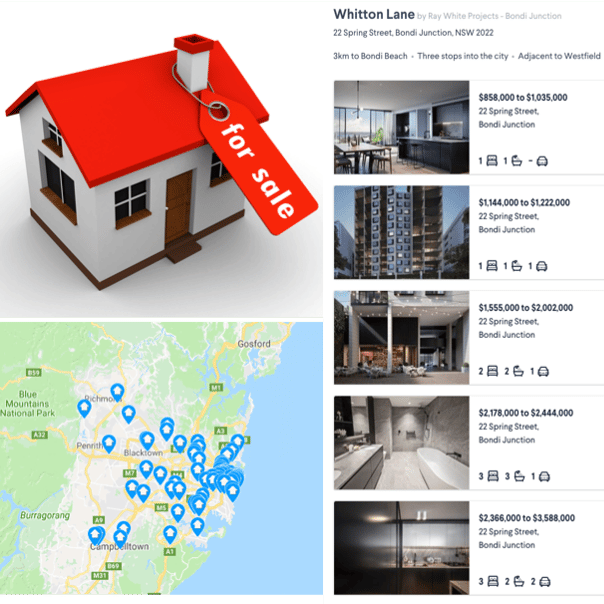
Recommendations for a new property
Research Leads: Distinguished Professor Jie Lu, Dr. Qian Zhang
AAII Lab: Decision Systems and e-Service Intelligence
Collaborators: Domain Holdings Australia Limited
The abundance of information urgently demands the development of personalized recommender systems for high quality e-service delivery. Our researchers are leading the development of recommender systems in property service, assisting Domain in the early stage of a property sale circle.
We are providing personalized recommendations in the dynamic market to multi-types of users for new properties. With advanced machine learning technology, we are launching a recommender system which adapts to fast-changing and various levels of user demands. The recommender system supplies Domain with solutions for users with different purposes – saving time and effort for home buyers, creating promotion chances for agents, and attracting potential investors.
Quescreen - Smart Human Risk Profiling Questionnaire Platform

Health screening for potential employees
Research Lead: Associate Professor Farookh Khadeer Hussain
AAII Research Lab: Decision Systems and e-Service Intelligence
Collaborators: Workforce Health Assessors
The Quescreen (pre-screening questionnaire) platform targets low risk roles in the pre-employment medical and pre-screening market. Quescreen aims to use AI to automate the process of low risk pre-employment medical health assessment. By mapping risk against different occupations and questionnaire components against the human body, Quescreen intelligently provides instant risk profiling of an individual, including their own unique factual positioning.
Through Natural Language Processing, data-driven decision making, and other AI technologies, Quescreen will deliver fast, affordable and accurate employee risk assessments to employers and organisations. This will empower stakeholders to make sound, knowledgeable and informed decisions around engaging or underwriting individuals with less risk.
Graph Modelling and Analysis for e-Commerce
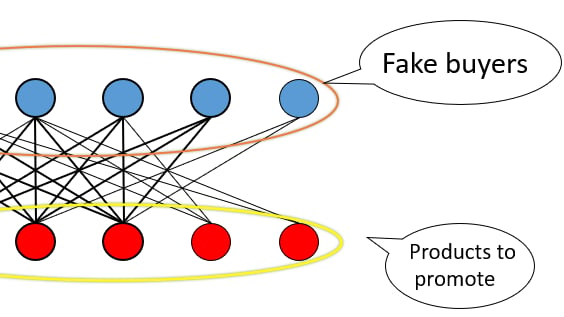
Simplified model of farm clicking detection
Research Lead: Associate Professor Ying Zhang
AAII Research Lab: Large-Scale Network Analytics
Collaborators: Alibaba Group
Graph analytics provides powerful insights into how to unlock the value graphs hold. Due to their powerful capabilities, techniques for analysing graphs are becoming an increasingly popular topic of study in both academics and industry. As such, a host of researchers in the fields of e-commerce, cybersecurity, social networks, environmental issues, defence, and many more, are turning to graph modelling to support real-world data analysis.
In one of our recent collaboration projects with Alibaba Group, we provided solutions for large-scale graph analysis of various e-commerce graph data. One example is the real-time farm clicking detection technique, which was launched in the 2017 Double 11 shopping festival, and significantly increase the recall by 40%. By developing efficient and scalable biclique detection algorithms on large scale dynamic bipartite graph with billions of buyers and productions and 10+ billions of transactions, we can identify the potential fake buyers in a real-time manner.
Dialogue-to-Action: A new way to reshape Business Intelligence

AI assistants for better business decisions
Research Lead: Dr Guodong Long
AAII Research Lab: Data Science and Knowledge Discovery
Business intelligence (BI) comprise the strategies and technologies used by enterprises for the data analysis of business information. “Enterprise-based, natural language processing (NLP)-powered self-service solutions, also known as ‘Intelligent Assistants (IAs), have gained traction and proven their value over the past ten years”. Their usefulness is evident in many enterprise application scenarios, e.g., customer care, marketing, internal workflow automation, and business analysis”. Existing Enterprise Intelligent Assistant (EIA) techniques derive from Personal Intelligent Assistants (PIAs) and heavily rely on pre-defined rules for well-specified scenarios. However, rapidly changing business and user scenarios urgently need the self-evolving capability of EIAs.
This project aims to develop a novel Self-evolving EIA system by using sequence-to-sequence modelling based Dialogue-to-Action (D2A) framework. The system will integrate Chatbot-based dialogue technology to acquire information, infer user intentions, understand languages, and determine the next actions to take. Possible actions include collecting information, providing information, conducting a transaction, or initialling a series of business operations to fulfil a user’s request in a complex enterprise management environment.
The game-changing Dialogue-to-Action research will reshape business intelligence by empowering the cutting-edge NLP with deep learning technique. Specifically, it will fundamentally transform current enterprise intelligence assistance from a massive rule-based process to neural-based seq2seq modelling. The developed self-evolving EIA will immediately enhance the broad service sector, and will enable high-quality service to be maintained at lower costs, as well as ensure fast adaptation to business changes by deploying and maintaining EIA systems. The project’s outcome will not only strengthen Australia’s world leadership in business and the public service sector but will also pave the way to Artificial Generalised Intelligence by advancing the theoretical foundations for self-evolving artificial intelligence research.