

• Posted on 1 Jun 2020
  • 42-minute read

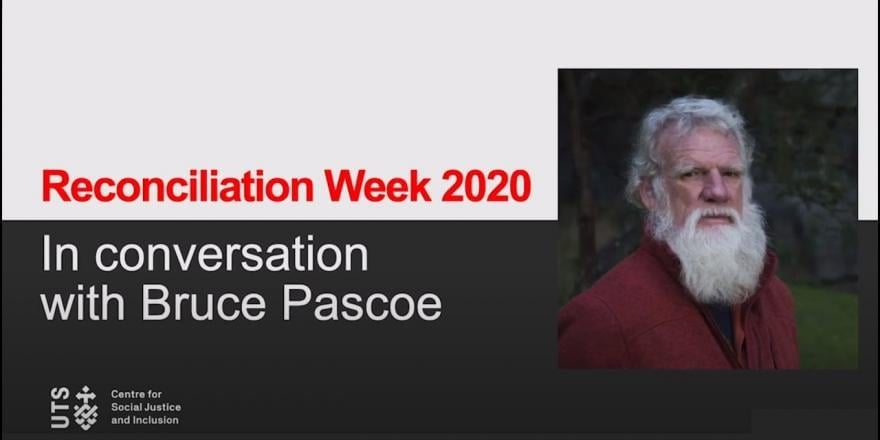
To mark Reconciliation Week in 2020, we invited author Professor Bruce Pascoe to speak with Verity Firth about his award-winning book Dark Emu, the politics of food, and pathways to justice for Indigenous peoples in modern Australia.

In his book, Pascoe reveals Aboriginal Australia's long and sophisticated human occupation.

His message had a resounding impact around Australia, shattering the colonial narrative of Aboriginal Australia as a nation of ‘hunter-gathers’, which was seen by many to justify dispossession. Since its publication he has been working on cultivating Australian native grasses for bread production and supporting action to see this review of prejudice translate into political action.

Bruce Pascoe is a Bunurong, Tasmanian and Yuin man, and an award-winning Australian writer and anthologist. He is also a Professor at the UTS Jumbunna Institute for Indigenous Education & Research.

You can watch a recording of the discussion below. A full transcript is also available.
H2wj24DOXvU

Descriptive transcript

[Upbeat music fades in. On screen: UTS Reconciliation Week event, live webinar. Verity Firth appears, looking at her screen.]

VERITY FIRTH: Thank you, everybody. Thank you very much for joining us today for this special Reconciliation Week event.

First, of course, I would like to acknowledge that I today am here on the land of the Gadigal people of the Eora Nation. This is the land that our UTS campus stands on. I want to pay respect to Elders past, present, and emerging, and I particularly want to recognise the Gadigal people as the traditional custodians of knowledge for the land that this university has been built on. It's land that was, is, and always will be Aboriginal land.

My name's Verity Firth. I'm the Executive Director of Social Justice here at UTS, and I head up the Centre for Social Justice and Inclusion.

Every year at UTS, we host a Reconciliation Week event to show our respect and solidarity with Aboriginal and Torres Strait Islander Australians. Reconciliation Australia talks about reconciliation being an ongoing journey that's based and measured on five dimensions: historical acceptance, race relations, equality and equity, institutional integrity, and unity. Now, these five dimensions don't exist in isolation. All of them are interrelated. Reconciliation cannot be seen as a single issue or agenda. The contemporary definition of reconciliation must weave all of these threads together. For example, greater historical acceptance of the wrongs done to Aboriginal and Torres Strait Islander peoples can lead to improved race relations, which in turn leads to greater equality and equity. It's all intertwined.

And we are so excited to have Bruce Pascoe here with us today, mainly because he's wonderful, but also because who better to talk to us about greater historical understanding and acceptance.

So I'll introduce Bruce properly in a minute, but before we get started, I want to do a little bit of housekeeping.

So the first thing is that this event is being live captioned. If you want to view the captions, you need to click on the link that is currently in the chat. You can find that at the bottom of your screen in the Zoom control panel. Once you've done that, the captions will then open in a separate window.

If you have any questions during today's event, please type them into the Q&A box, which is in your Zoom control panel. You can also upvote questions that others have asked. Please try to keep the questions relevant to the topics we're discussing here today, but I will have time in our conversation to put your questions to Bruce. We've also got a few questions that have already been asked that have started coming in, so I'll put them to Bruce as well.

Being an online event, there may be technical issues, so please be patient if there are, and we will work to resolve them quickly.

So now to the event. It's my pleasure to welcome Bruce Pascoe to join us here today.

Bruce Pascoe is the award-winning writer of 'Dark Emu' and 'Young Dark Emu', which is his version of the book for children. He has had a fantastic range of jobs, including as a teacher, farmer, fisherman, barman, fencing contractor, lecturer, Aboriginal language researcher, archaeological site worker and editor. He has a special relationship with UTS as Adjunct Professor for the Jumbunna Institute for Indigenous Education and Research. He's written more than 30 books spanning fiction, non-fiction and children's titles.

'Dark Emu', which was released in 2014, has been a revelation for many Australians, providing a much truer history of Aboriginal Australia's long and sophisticated occupation in this country. 'Young Dark Emu' was published last year and is a version for readers 10 and over.

I must admit, as I was rereading 'Dark Emu' before this conversation, I particularly was thinking how important 'Young Dark Emu' is, because it's at that part of the conversation where we can actually be raising our children with a proper understanding of the truth of Australia's colonisation and invasion. And that's really what's going to start, hopefully, to shift attitudes.

'Dark Emu' has sold over 200,000 copies in print and digital and has won numerous awards. 'Young Dark Emu' has also sold over 45,000 copies.

So welcome, Bruce. Now, as your introduction explained, you have worn many hats over the years. You've been a teacher, an archaeologist, a writer, a fisherman. Tell us a little bit about what you are doing at the moment.

BRUCE PASCOE: Well, we've been farming the old Aboriginal foods I talk about in 'Dark Emu', and it wasn't my ambition to be driving a tractor again at my age. But the enthusiasm for 'Dark Emu' also brought with it a problem, and that was that everybody wanted to grow the plants, everybody wanted to eat the food, and what concerned me was that we would lose control once again of our sovereign food rights, and that we needed to be in the field, we needed to be growing those to prove that we were continuing that historic tradition of food growing and agriculture.

Because we don't want to be in the situation that the Yorta Yorta were when, in deciding upon whether or not they would regain some of their own land, it was decided that their culture had been washed away by the tide of history. So we're determined here that the evidence will be on the ground, that we have maintained that link with our cultural practice, and we're employing the Yuin people here, some Gomeroi people as well, and there'll be other people—Gunai, Wiradjuri—as time goes by, because we want Aboriginal people on the ground.

We want Aboriginal people earning their money. We don't want them earning trainee wages, we want them earning wages, taking that money home to their families, growing their kids up, and we want our people eating our food. And we're doing that.

We baked this loaf of bread this morning. It's made from mamadjan naluk, which is our dancing grass bread. It's incredibly flavourful and aromatic, and it used to be that big, but the mob working here have been bandicooting while I've been working hard, and that's all we've got left. But it's a beautiful bread, and we'll be selling this. You'll be buying this. You'll be baking it in your own kitchens, and when you do, your house will smell like Australian grassland.

So this is a momentous day for us. We had our own little celebration early today, because that's our second loaf, but it's clearly the best one we've come up with so far. There's going to be a huge future in this. There'll be a lot of rich bakers running around, a lot of rich restaurateurs running around, a lot of family gardens using this stuff.

If Australia had a good heart, it would ensure that Aboriginal people are part of this new, exciting industry—not just mendicants on the edge of the industry, but part of the industry. We don't want training programs anymore. We don't want to do 35 certificates and still be unemployed, with the worst health in the world, the worst education in the Western world. We want to earn our own money from our own culture, and we want to sell it to you.

VERITY FIRTH: And I think that's what was so powerful about 'Dark Emu', actually, because it was a book that so passionately and convincingly outlined the racism of those early colonialists who refused to see the skill and economic prosperity of the people who lived there. And I was thinking that your final words in 'Dark Emu', where you talk about, "To deny Aboriginal agricultural and spiritual achievement is the single greatest impediment to intercultural understanding and to perhaps the Australian moral and economic prosperity." So this is also a way of the economic future for Australia more broadly, to actually start to understand and embrace this wisdom.

How do you feel—so just working on that a bit—do you feel that it's led to greater community acceptance of the truth of invasion and colonisation? Do you feel that it's had that impact?

BRUCE PASCOE: It's certainly had an impact, but I'm sometimes in despair of the superficiality of the Australian mind. Because if it had had a true impact, if change had actually happened, a 45,000-year-old cave of art and social and cultural and human development importance wouldn't have been blown up a week ago. If we were truly a mature nation with an intellectual rigour about the history of the country, that couldn't have happened, but it did happen. So 'Dark Emu' hasn't changed anything. I think it has the potential to. I think the people who read 'Dark Emu' and who gave it to their friends for Christmas, they are in a position to make change, but that change hasn't occurred yet. And we have to insist that our government honours our wishes. We have to vote in governments who we believe will honour our wishes in this regard.

It was very interesting for me to watch an ex-National Party member yesterday talking about the abhorrence he felt for the destruction of that cave. So we need to work with people like that. This couldn't happen in any other place on earth. If it had been the Taliban, there would have been outrage. People would have been marching in the street and spitting on Muslims in trams and trains. This happened in Australia. No one got spat on. About time we spat.

VERITY FIRTH: Yes. And we might talk about that again afterwards, actually, Bruce, so hold that thought, because we've had some audience questions in particular around how do we, I suppose, respond in a way that has political power when those sorts of desecrations occur. So we may come back to that in the audience part of the questions.

In terms of food, because we've also got a lot of questions about food. The Melbourne restaurant Attica was named by Gourmet Traveller as Australia's best restaurant last year. And when Chef Ben Shewry accepted his award, he specifically mentioned you and what you had taught him about Indigenous food and culture, and particularly about Indigenous food and the culture connected to certain ingredients.

You've also been quoted as saying, "You can't eat our food if you can't swallow our history." So can you talk a bit about that and what made you say that, and also a bit about the connection between Aboriginal food and culture?

BRUCE PASCOE: When 'Dark Emu' gained the acceptance it did through sales, I became a little bit alarmed because what I was seeing was this incredible excitement about the food, but there was no ancillary excitement about social justice for Aboriginal people. Even now, of all the food classified as a bush tucker type or Aboriginal food—I don't use the word 'bush tucker', I like to talk about agriculture. People condemn me for it, but I like to talk about things like economy and agriculture and houses and bread. I don't talk about damper, I don't talk about hovel and hut, I don't talk about bush tucker because it demeans what was actually going on in the country.

So what worried me was that with all this enthusiasm for Aboriginal history and Aboriginal food generated out of 'Dark Emu' and other things—I mean, we stand on the shoulders of giants and 'Dark Emu' is just a small bird standing on the shoulders of many, many great men and women, Essie Coffey and people like that included—of the 100% of sales of food in Australia that is classified as Aboriginal food, 1% of that is sold by Aboriginal people. 1%. They call it bush tucker, whatever they like to call it. 1%. This is a disgrace.

And so for those people who are saying that they're totally in support of the concepts of 'Dark Emu', for instance, to allow this to happen means that we have no political will. It means we're slumbering babies. We really, we live in a warm and cosy world and we don't raise our hand, we don't raise our voice in support of Aboriginal people, really. We'll raise our voice when Cathy Freeman wins a gold medal. We'll raise our voice when Warwick Thornton makes a film, or Rachel Perkins creates a great new series. We'll nod in agreement. But we can't bring ourselves to employ Aboriginal people.

The easiest thing in the world is to employ Aboriginal people by giving them jobs. I don't want to sound like an old curmudgeon—I can drop into that quite quickly—because I am a very optimistic person.

VERITY FIRTH: Well, throughout 'Dark Emu', you can see your optimism. But yeah, keep going. I don't want to interrupt.

BRUCE PASCOE: I don't want optimism to distract Australia from its responsibilities. If Australia is optimistic, they're fooling themselves. If I'm optimistic, I'm allowed to, because I'm supported by my local community and I can see the future. I'm optimistic. I've got four grandchildren and my responsibility is to make a future for them.

But the warm and cosy Australians who like their tucker and like to have, you know, bush tomato and lemon myrtle and all those things and extol it—where are you buying it from? Who is selling that to you? And the women, mainly women, who gather these things for you, they are paid a bloody pittance. If it was a sweatshop in Bangladesh, that'd be front page news. But because it's a bush community in Western Australia or the Northern Territory or Queensland, it doesn't get any traction at all. Warm and cosy Australia, pull your finger out.

VERITY FIRTH: Yeah. It's not unlike our multicultural days. It's all about food then too. Like, you know what I mean? It's like this obsession with the surface, but not about the actual where the power lies.

BRUCE PASCOE: Look, I believe in the power of food and the power of community and the power of breaking bread together. I think that's really important. And I'm optimistic because I've actually seen it work here on the farm. People come here every day. You know, it's a bit of a distraction. Yesterday, we hardly got a fence post in. We're trying to repair a fence that got burnt in the fires. We hardly got a fence post in because we were all tied up with telling the story, you know, Aboriginal people telling non-Aboriginal Australia the story again.

But we have to, we're going to have to wear that because the only way for us to succeed is for people to understand what we're trying to do and what we're trying to repair and what we can offer, what we can offer the country. To have that bread today, I can't tell you what it meant to us. I can't tell you what it meant to have a local Aboriginal man driving our harvester to harvest that grass three weeks ago. At the end of that day, I was completely emotionally overwhelmed by the thought that my brother had been able to do what his great-great-grandmother and grandfather had done 250 years later. And this loaf of bread is the first loaf of bread made from that particular grain in 250 years.

VERITY FIRTH: Yeah.

BRUCE PASCOE: It's a sobering thought that it has taken that long.

VERITY FIRTH: You write in your book—is it Mitchell who you quote as talking about the cake that he's offered to eat and you feel that that's the bread, isn't it? Is that what you think he's referring to when he talks about the cake he was offered?

BRUCE PASCOE: Well, he was eating a bread made from Panicum, a native millet. But it is very aromatic and it is very flavourful, as is this bread. Kangaroo grass is more aromatic and flavourful than both of them. But Sturt also talked about this bread and it was a different grain again. But once again, Sturt and Mitchell, unbeknownst to each other, talk about this bread as being the lightest and sweetest cake they had ever eaten. Gluten-free. All of those grains I mentioned are gluten-free. They're all aromatic, all flavourful, all make beautiful bread.

And Englishmen—and we know they can't cook, but put that aside for just one moment—two of them, without reference to each other, say lightest and sweetest cake they'd ever eaten. And they not only admire the production, the labour, the devotion of labour to this enterprise, they also talk about the civil society.

In Australia, I think if you, next time you think about having an intervention to solve the problems of Aboriginal community, think back to what Sturt observed about the sobriety and the warmth and love that he witnessed in that camp where his life was saved, and that of his horses, and that of his fellow men, by Aboriginal people who gave them roast duck and cake, gave them a house, gave them water, and gave them supper at the time when they were almost dead. They all had scurvy. Some had died on previous expeditions from the same problem. And yet they were saved by Aboriginal people who were living a life that he admired so much. He talked about the whirring of the grain mills at night, the production of the flour and the bread, the singing as people cooked their meals, the laughter of children, the barking of dogs. And at 10 o'clock, everyone went to sleep, and the town was quiet. None of this is known to Australians.

VERITY FIRTH: That's right. And the capacity for human beings to co-operate, you know, to actually co-operate, live together in a home. Don't get me started.

BRUCE PASCOE: Clans, you know, hundreds of kilometres apart, communicating with each other so that they could safely burn sections of grassland and forest so that they needed to communicate, so they weren't interfering with each other's prosperity. What a great example for a farming community when we've just seen those big cotton farms north of Brewarrina and around Brewarrina stealing the water from their fellow farmers downstream, not to mention stealing it from the marshes, stealing it from the fish, stealing it from Aboriginal people, stealing it from their fellow Australians. What kind of economic system is that?

VERITY FIRTH: In fact, that struck me in particular reading in 'Dark Emu' about the Brewarrina fish traps and how even so, the fact they didn't know, personally know the people downstream, of course, yet there was no sense that you would do anything that would stop the fish being able to continue on down the stream to be plentiful for the people who live downstream from you. And the exact opposite when you watch the fighting over the Murray-Darling Basin and the incapacity for those communities now to actually be able to all come together for mutual benefit.

BRUCE PASCOE: So, you know, on that Murray-Darling board, I'd like to see Brendan Kennedy on it. Someone who's an intimate knowledge of the waterways would be a boon to the knowledge of those people. I'd like to see some of the men and women of Brewarrina on those boards as well. They have quite an opinion on what should happen to the Murray-Darling Basin as they live in it and it is their ancestors' land. And the trauma that they have felt watching this desecration of Australian land, the Australian Commonwealth. What those people are spending is the Australian Commonwealth. They're not treating it like a commonwealth, they're treating it like personal wealth and they're dumb, they're stupid, they're not doing it well. If they were doing it well, you know, there'd be an argument, well, let them continue, but they're doing it badly. And the fish kills on the Murray-Darling system are indications that we are failing. If you want to know, if you want an indication of your success, have a look at what you've done to your other farmers, what you've done to the environment. It's appalling. Australia has a lot to learn, but I'm certain we're capable of doing it. We can come together as a people, as one nation, and it's about time we really did it. And instead of talking about coming together and actually separating ourselves into cliques.

VERITY FIRTH: So, on that point, the Bushfire Royal Commission has begun hearings this week. And in part, it's looking to understand ways, quote, "the traditional land and fire management practices of Indigenous Australians could improve Australia's resilience to natural disasters." So, sort of two questions here. First, is this encouraging news? But secondly, is this going to be another point? What about the issue of appropriating Aboriginal knowledge without recognition or compensation? Are you fearful of that in this process?

BRUCE PASCOE: Yeah, I really am. You know, we're engaged in cultural burning now across our communities. You know, it's become a big flavour of the month. But we need really good culture and science behind it. And we don't always have that. But also, people use that as a tick-the-box Aboriginal inclusion thing. So, forestry, for instance, will employ us to talk to foresters and whatever, and then immediately go and do exactly what they did the year before. But they've ticked the box of Aboriginal inclusion and consultation, and then they just go and do what they're doing.

Prior to the fires, four days before the fires in East Gippsland, when we knew they were coming, I was travelling through the forestry on the border of New South Wales and Victoria. And it was just so alarming to look at that forest and how flammable it was. Because for years, all the trash in that forest that was the result of the forestry practice was on the floor of that forest. The trees were cheek by jowl. They were only so big in their girth. They're perfect for wood pulp. They're all the same species. And the canopies of those trees touched each other. Some of the branches touched the trunk of the other trees. This was a recipe for an explosion. And yet it's called forestry, not forestry. It's called absolute craven economic banditry, because we harvest all those little trees, and we send them off to Japan through the Great Barrier Reef. And then we buy them back as hamburger wrapper from Japan through the Great Barrier Reef. And then we grow the same forest again in the same place and expect that the growth that we saw the year before to be the same. And of course it's not, because we're growing trees that deplete the soil. We're not building soil on those sites. We are spending the commonwealth of Australian soil.

I knew that forest was going to explode. My daughter was staying with me on the farm. She'd just been kicked out of Cape Conran because of the fires. She came to me and we were swimming in the river and I could hear the kids' voices singing and arguing over who got the canoe, all that sort of Christmas stuff. And I heard their voices and I turned around to my daughter and I said, "Mate, we've got to go. I can't bear this. You know, this is going to blow up." The sky changed colour. So I had to argue long and hard to get them out of there because they'd already been evacuated once. Here we are half a day into our summer holiday and I'm evacuating them again. We got up to Eden and I said, "Mate, it's too dangerous here too." I evacuated them again to go to Canberra and then I started driving back home to the farm and I drove through the same forest where I'd counted 300 trees three days before. It was like snow had fallen. There were no trees and there was just snow ash on the ground. To create white ash like that, you need an incredible temperature. That temperature had been created by Australian forestry.

You don't need to be a greenie to argue that this just doesn't make sense. But Australia clings to this idea of economic prosperity coming over absolutely everything. It comes before culture, it comes before the environment, it comes before people and what the result is, is that all that profit goes into a very few pockets. This is not an industry model that any decent economist could say is sustainable. It's selfishness and it's absolute bastardry for the environment.

Australians have to have a voice in this and they have to stop being warm and cosy babies and start becoming adults about looking after their country. National sentiment about Australia Fair, let's get going.

VERITY FIRTH: Before we started to broadcast, you were telling me about how you are restoring the forest on your property to as it would have been before the white invasion. Can you tell us a bit about that, particularly about the density of the trees?

BRUCE PASCOE: As a result of that experience that I had, driving down through the fires and seeing the white ash and knowing that that's what I was going to see because of what I'd seen the four days before, as soon as I got back home and as soon as we stopped fighting fires—and that took five weeks here—what I said to the brothers who were working here and the sisters as well, I said we were building a building. I said we're going to take all the trees for this building out of this forest here, this copse of forest, which is about four acres, and we're going to keep on doing it in this forest until we've got ten trees to the acre. Now, that job is not going to be complete in my lifetime. It'll take 40 years to do it, but that's what we need to do. We need to render our bush safe. We need to value every tree we cut down, which is what we try and do. We use the tree, we use the canopy, and we use the bark, everything in whatever we're doing on the farm. But we need to go back to that old Aboriginal practice.

We also need to value the timber like we've never valued it before. Entire Australian forests went to build sleepers for the Indian Railway in the 1880s and 1900s. Clearly unsustainable. The best timber in the world has now been run over by trains. Australia doesn't make furniture anymore, but we've got trees in this forest here that are perfect for it, absolutely perfect for it. It'll make the best furniture you've ever seen. We're going to need to pay more for it. But I think the COVID virus has exposed the folly of depending on other countries for everything. We couldn't even get sanitary masks during the COVID-19 pandemic. We'd stopped making stuff. This is not a call for nationalism. It's a call for rationality, economic rationality. I'm an absolute economic rationalist. We need to make stuff and we need to value our country and value our forests, love our forests.

The forest we're looking at now is not a wilderness. It's not pristine in any way. It's a bastard forest. It's been designed like that by people, very, very few people who are stripping our commonwealth for their own gain. We need to take control of our forests. We need to put greater value back into it. And we need to employ more people in the forest. The coops that are running now that when I was doing bird surveys there in the 1970s, where we'd sit down and have a cup of tea and lunch with maybe 20 people working in the forest, men and women, now there's two and they don't want to talk to you because they've been told they can't by their employer. And they're using these massive machines and the wheels are as high as the ceiling in this room. And every turn of that wheel is dragging up gravel from below the surface of the soil and destroying the forest floor. That's not industry. That's despoilation of our commonwealth. And we need to object to it. And, you know, if someone wants to call you a greenie or a heart on the sleeve, black armband sort of person, just say no, mate. I'm an economic rationalist. I love my grandchildren. I want my grandchildren to be prosperous and I want them to be healthy. I love my grandchildren. Do you hate yours? Do you want them to inherit a barren earth?

VERITY FIRTH: So I'm going to move to some audience questions now, because I feel like I've hogged you too much. Both Preston Peachley and Gerard Wollaston sent questions beforehand, and they're about different issues, but their question is essentially the same. So Preston is talking about the news of Rio Tinto destroying the sites in the Pilbara this week. He asks, how do we prevent this and seek justice for the continued destruction and devaluing of our sacred sites? And Gerard talks explicitly about the summer bushfires. And he also asks, how do you see us steering out of this car crash situation? And what part can the broader community play? So really, how do we start, I suppose, to seize some power in this equation? What do you think, Bruce?

BRUCE PASCOE: We have to learn our history and accept it. Because without that acceptance, every time there's a problem in an Aboriginal community, we'll have an intervention. Because we have no respect for Aboriginal people or their history, or the economy or the culture. Anything to do with Aboriginal people is not respected in this country. There's sometimes a warm and cosy feeling and we walk across a few bridges and we celebrate ourselves in champagne that Aboriginal people can't afford. But there's no future in that. That's just a momentary surge of warmth, almost like you wet the bed. Pardon the expression, but it's very frustrating to be continuing revisiting these attitudes. We have to learn history. We have to accept the fact that what happened in the war on Australian soil for possession of the land. I tell you, it can be a really wonderful experience.

I had a person sitting in my lounge room yesterday. And the last time I saw her was on the bank of the Broderib River. And we'd been taken there by Uncle Max Harrison, because that was where all but one of his family was massacred in the 1840s. We'd been looking for that site for 10 years. And one of the people who helped us find that site was a white farmer. And we were so grateful for that person. But Uncle Max said, it's not just about us, it's about those families as well, those white families who jumped on their horses and rode down to the river and massacred those men, women and children. He said, we need to invite those people as well. And he did. And they came and they spoke. And one of those women was in my lounge room yesterday, talking about grain and how we can use it.

So, I don't believe in reconciliation. I do believe in conciliation. I learnt that from that old man, Uncle Max. I think there is a future, but we have to stop this mealy-mouthed acceptance of the reality of Australian history. To talk about Aboriginal achievement is not to wear the black armband. It's to talk about economic rationality. People who last for 120,000 years on a continent, using sustainable agriculture and forestry are to be admired, not treated like poor innocents who didn't know any better, but to be admired for their iron-willed economic rationality. Of course, it's backed by spirituality and, of course, it's backed by a superb culture, but there is an economic rationality to it as well.

Until we accept our history, until we accept the fact that the social experiment that happened in Australia 120,000 years ago was the high point of human development, then we're allowing the naysayers in our community to prevent us utilising a chance to embrace a better future for the human family. I really think that's what we had here in Australia. I think we can have it again, but it's based on principles we don't accept these days. They are anathema to current Australian business and political practice.

VERITY FIRTH: So, this is related to this question, really. It's from Talia Anthony. She's asking, is it possible to have environmental protection and the thriving of First Nations cultures in a capitalist society, or are Aboriginal and capitalist societies, economies and cultures antithetical?

BRUCE PASCOE: No, they're not. Look, this experiment here, we call ourselves the company of fools because we dream too much, but we also work bloody hard. They're all in there eating my lunch now, because we work really hard here. There's mostly Aboriginal people here, but some non-Aboriginal people here, and everybody earns their money. At the end of the working week, they go home and have the weekend with their family. Most of them go home every night, pick up their kids from school, buy their tucker in the supermarket and go home and cook it with their family. And they're doing that now out of Aboriginal enterprise and Aboriginal labour, Aboriginal cultural foods. What we're trying to replicate is a model based on the old people's work, where people can live dignified, prosperous lives based on culture.

Our culture is not just boomerang and spear and face paint and dance. It's food, it's agriculture, it's labour. It's the devotion of labour over generations to a common goal. I might be deluding myself, but I don't think I am. This model is transferable to other communities, and other communities are already doing it. I've been to WA,

Reconciliation Week is about striving for justice through relationships between broader Australian communities and Aboriginal and Torres Strait Islander peoples.

Justice cannot be achieved without the support and active participation of non-Indigenous Australians. As a nation, we still have a very, very long way to go. The gains won in achieving recognition and progress towards greater respect have been hard-fought for by Aboriginal and Torres Strait Islander people, in the face of immense barriers.

For this reason, it is important for us at UTS that non-Indigenous members of our community are active in supporting, and take responsibility for organising, Reconciliation Week events. It is all of our responsibility to hold this acknowledgment not just for the week, but to acknowledge Country, recognise the rich history of Aboriginal and Torres Strait Islander culture, and support reconciliation activities for a more inclusive and just Australia in the present as an ongoing effort.

Reconciliation Week goes until 3 June. Events are listed on the Reconciliation Australia website.

Byline: Laura Oxley, External Communication Officer, Centre for Social Justice and Inclusion

Share