

- Posted on 20 Feb 2025
- 46-minute read
Everyone should have a safe, secure and healthy place to call home, regardless of your postcode or bank balance. But this is not the reality for far too many people in the community.
The starting point for the critical public discussion on housing and policy outcomes should be on people – what their needs are, why that isn’t the reality for too many in the community – and from there, start talking about the solutions so that they are people-centred and for the benefit of everyone in the community.
A new report on the right to housing commissioned by the Human Rights Law Centre and authored by Professor Jessie Hohmann from the UTS Faculty of Law, helps shifts the focus of discussion to people.
In this session, Cassandra Goldie, Professor Jessie Hohmann, Tania Thompson, Caitlin Reiger and Amy Persson (moderator) discuss the report and the difference an Australian Human Rights Act can make by placing the right to housing at the heart of government laws, policies and services.
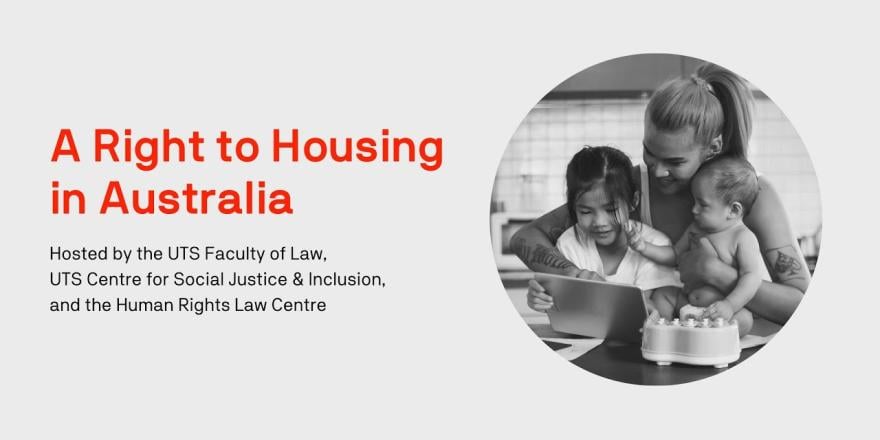
This event was hosted by the UTS Faculty of Law, Centre for Social Justice & Inclusion and the Human Rights Law Centre. If you are interested in hearing about future events, please contact events.socialjustice@uts.edu.au.
Its important to see the right to housing as a foundation for other human rights. Without access to adequate housing, our educational and health outcomes are much worse and our family and private life is diminished it's a foundation for the realisation of numerous other human rights. Professor Jessie Hohmann
There's nowhere near enough scrutiny of what happens when somebody is evicted. Theres no obligation for the State Government to turn up and say what is going to happen to this family before the eviction is allowed to go ahead. Often, it's in the hands of homelessness services who are unable to find anywhere affordable for those families to live - so they are in cars, parks and they're all over the country in regional Australia in that situation. Cassandra Goldie
Its encouraging organisations play their part and pay attention because its not just shelter that [people experiencing homelessness] are looking for. Shelter is important but its the things that come once were inside that shelter... peace, safety, and someone to listen Tania Thompson
We know that Human Rights Acts are already making a difference in relation to housing rights more broadly. In the ACT, Queensland and in Victoria, there are some form of human rights legislation in place. None of them explicitly contain the right to housing but because housing is so connected to other things, people have been able to use that legislation to hold decision makers and governments to account and get practical solutions that make a difference to being able to live with more dignity and safety. Caitlin Reiger
Speakers
Cassandra Goldie is CEO of ACOSS and Adjunct Professor with UNSW Sydney. With public policy expertise in economic, social and environmental issues, civil society, social justice and human rights, Cassandra has represented the interests of people who are disadvantaged, and civil society generally, in major national and international processes as well as in grassroots communities.
Professor Jessie Hohmann, from the UTS Faculty of Law, is a world-leading expert on housing as a human right. Her work has included lobbying the United Nations to hold governments to account for their obligations for the right to housing, campaigns with national and international housing rights and homelessness NGOs, and translating international standards into platforms for action toward fairer housing laws and policies.
Tania Thompson is a community leader, social housing resident-activist, and senior’s rights advocate. Tania was instrumental in creating the Social Housing Women’s Forum that promoted women’s health services and legal advice, as well as instigating programs during Covid targeting social isolation among seniors. She is a critical voice for tenants' rights in her neighbourhood and has forged strong partnerships between community, housing providers, and services.
Caitlin Reiger is the CEO of the Human Rights Law Centre and a human rights lawyer. She has spent the past 25 years working globally on transitional justice for mass human rights violations, international criminal law, and justice system reform. Since returning to Australia, Caitlin supported the First Peoples’ Assembly of Victoria in the design and establishment of the Yoorrook Justice Commission.
Amy Persson is the interim Pro Vice-Chancellor (Social Justice and Inclusion) at UTS. Amy is a public policy specialist who has worked across the private, public and not-for-profit sectors and was Head of Government Affairs and External Engagement at UTS. Previously, she held Senior Executive roles in the NSW Department of Premier and Cabinet and also ran the Behavioural Insights Unit and Office of Social Impact.