

- Posted on 18 Apr 2024
- 40-minute read
Global systems, climate change and the public’s health
The planet is facing multiple crises. Recently, we’ve seen the hottest years in history, wildfires sweeping across continents, record levels of food insecurity, escalating biodiversity loss, and a widening gap between the rich and poor.
How can we reverse these alarming trends?
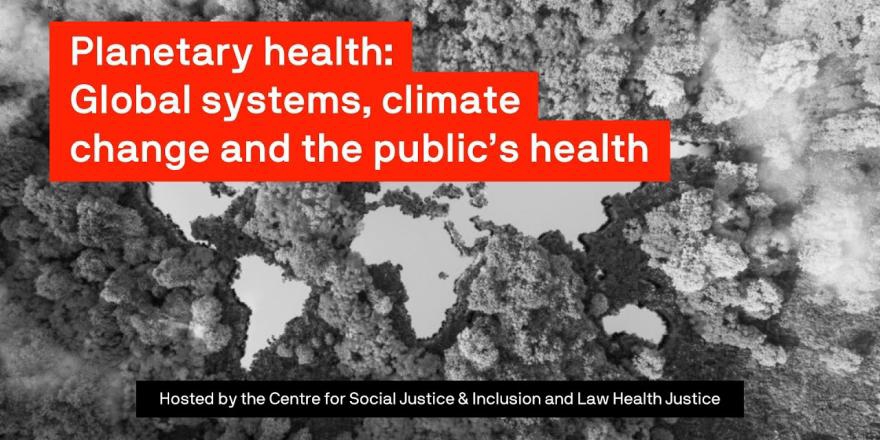
Professor Sharon Friel, Elna Tulus and Professor Jason Prior joined Professor Michael Thomson to discuss the interconnection between global systems and the public’s health and how we can move forward to a better future for people and the planet.
If you are interested in hearing about future events, please contact events.socialjustice@uts.edu.au.
There are three systems that create real problems but real opportunities: the economic system, the energy system, and the food system. These contribute significantly to driving emissions and other environmental harms but if we were to think about a recalibration within those three systems then we would go a long way to do something about planetary health inequities. Professor Sharon Friel
The health, planning, or development system wont be able to cope with all the consequences of climate change alone. They need the built environment systems and other systems to be adapted to help us cope with the changes that are coming our way and that are already here. Its about how all these different professions are moving towards coproducing responses and not just working independently. Professor Jason Prior
Powerful countries and corporations influence the affordability, accessibility, and availability of food. What is wicked about instant noodles is that its so cheap and accessible, and the flavours of the sachets have been modified to target the consumers. That cultural association with food makes it difficult to advocate for the right to food, nutrition, and health. Instant noodles are highlighting the issue that the global food system is a determinant of health. Elna Tulus
Inequalities in global systems, in international, political, and economic relations, and in the unequal causes and effects of climate change have their origins in the global colonial practices, of which the colonisation of Australia was a part. Professor Michael Thomson
Speakers
Professor Sharon Friel is an Australian Research Council Laureate Fellow, Professor of Health Equity, and Director of the Planetary Health Equity Hothouse and Australian Research Centre for Health Equity at ANU. Her work focuses on governance of the planetary, social, and commercial determinants of health inequities. She is a Fellow of the Academy of Social Sciences of Australia and the Academy of Health and Medical Sciences of Australia.
Professor Michael Thomson is Professor of Health Law at UTS and the University of Leeds. At UTS he is the Director of the faculty’s research centre, Law Health Justice. His research spans health law, young people’s rights, and legal and political theory. His current work concerns health inequalities and the role of law in promoting health justice.
Elna Tulus is a PhD candidate at the UTS Faculty of Health. Her research on the sustainability of the global food system questions its consequences on public health. Using the case study on Australian wheat and Indonesian instant noodles, she investigates how the transformation of food production has resulted in a change in dietary patterns towards ultra-processed food, which has resulted in a rise in non-communicable diseases.
Professor Jason Prior is Professor of Planning, Health, and Environment at the UTS Institute for Sustainable Futures. He is a recognised expert in research at the nexus of the environment, planning, and human and planetary health. Jason is also the lead of the Healthy Populations and Environments Platform in the Sydney Partnership for Health, Education, Research, and Enterprise.