

• Posted on 20 Mar 2024
  • 70-minute read

Wifedom: Exposing the workings of patriarchy
5duAZgBuT2s

Descriptive transcript

Good morning. Thank you all so much for joining us for International Women's Day at UTS. I'm Amy Persson, the Interim Pro Vice-Chancellor of Social Justice and Inclusion.

To begin today's event, we'll now hear from Aunty Glendra Stubbs, our Elder in Residence at UTS, who will give an Acknowledgement of Country.

Yalimundumurrung. Galindura. Hello, my name is Aunty Glendra Stubbs. I'm the proud Elder in Residence at UTS. I'm a Wiradjuri woman and my mob comes from the Mudgee, Dubbo and Narrandera areas.

UTS acknowledges the Gadigal people of the Eora Nation, upon whose ancestral lands our university stands. We pay our respects to Elders past, present and emerging, acknowledging them as the traditional custodians of knowledge of these lands.

I would also like to acknowledge the Gadigal people of the Eora Nation and pay my respect to Elders past and present, acknowledging them as the traditional custodians of knowledge for this place. These traditional custodians have cared for Country for thousands of generations, and I acknowledge that Aboriginal and Torres Strait Islander sovereignty was never ceded, that this continent always was and always will be Aboriginal land.

Welcome to all of you here in the Great Hall and the many hundreds of you joining us online. Today we have a special International Women's Day event, and I'd like to thank the Faculty of Arts and Social Sciences for co-hosting alongside the Centre for Social Justice and Inclusion.

International Women's Day has come to mean different things to different people. I think it's worth remembering that it started as a protest movement and not a morning tea. Australia's first International Women's Day was held in 1928 here in Sydney. It was organised by the Militant Women's Movement. Women were calling for an eight-hour working day for shop girls, paid leave, and equal pay for equal work. It's interesting, of course, and important to reflect on how far we've come, but it's also interesting to reflect on how much we still are fighting for, 96 years on.

I am really proud to work for an organisation that takes these issues very seriously, and I've seen that firsthand during my time at UTS. This is not a place that provides cupcakes and lip service to gender equality. It is a place that has equality and social justice as part of its core mission. It is a place that acknowledges when it can do better and it is a place that provides a platform for the incredible work of so many of our staff, some of whom you'll hear from today during our panel discussion, who are working to make our society a more equal one.

It is also a place that is welcoming to all genders and gender experiences, and I would like to recognise all people who identify as women, including trans women, in our activism and discussion today.

Today's talk is about exposing the insidious ways patriarchy transforms our relationships with one another and systematically divides us along gendered lines. Even when we think we are alert to the traps, it remains so difficult to escape them.

A big focus of today's discussion will be the burden of unpaid, undervalued and unacknowledged labour of women, which holds up families and economies around the world.

In delving into this issue, I want to acknowledge that we will often be talking and discussing hetero relationships, and that the effects of patriarchy impact every single one of us as a system of oppression, layered with experiences of race, class, socioeconomic background, disability, sexuality and body diversity.

I am hugely excited to hear from today's speakers. We are delighted to have award-winning author and UTS alumna Anna Funder to give today's keynote address. Anna's recent book, Wifedom: Mrs Orwell's Invisible Life, highlights the methods of patriarchy in microcosm through the lives of Eileen O'Shaughnessy and George Orwell. Following Anna's keynote, we'll welcome Associate Professor Ramona Vijeyarasa and Professor Peter Siminski to join us in discussion.

But first, I would now like to introduce Vice-Chancellor Professor Andrew Parfitt to offer some opening remarks and welcome. Please welcome Andrew.

Thanks, Amy, and welcome, everybody. Let me also acknowledge we're on Gadigal land. This always has been, always will be, Gadigal land and pay respects to Elders past and present.

It's always nice to have Aunty Glendra here, even virtually, such an important leader within our community as Elder in Residence and the Jumbunna Institute that we have here, the work that they do to support our students and our staff.

It's interesting that UTS has among the highest success rates for Indigenous students and a lot of that goes to the support and care that is given to that community within Jumbunna. We have a very large number of PhD students who are also working with our Indigenous professoriate, which is also the largest in the country, to make a real difference in areas from law to technology to health, pretty well all of the disciplines that we have at UTS. And it's a great pride amongst our community that we are able to materially and tangibly make an impact on those gaps that are so stubbornly refusing to close for our Indigenous colleagues and friends.

So happy International Women's Day. You can clap if you like.

It is, of course, a moment to reflect on successes as well as where there are still challenges that we face. We celebrate the success of women across our community. We reflect on progress that has been made in so many areas, but it's also an opportunity to call out where there are still gaps that need to be closed, and I'll come to the gender pay gap later on, which stubbornly persists in many places.

But the successes, it is absolutely worth us pausing to reflect on all of the terrific work of our staff and our students, over 50% of whom are women, and 10 years ago, 20 years ago perhaps, in the University of Technology that wouldn't have been the case. So over time, we've managed to make real inroads in terms of participation in professions and disciplines that have had significant underrepresentation of women.

We've taken some bold steps as a university in areas such as engineering and information technology and construction management to try to build a pipeline of young women, particularly from schools, who may not have considered careers in those professions because they couldn't see themselves in those professions. If you can't see yourself in a profession, why would you want to be there?

So by actually, controversially, adjusting our entry requirements for some of the programs—not to drop standards, but to allow more diversity in the entry to those programs—we've been able now to have nearly a third of our intakes in those discipline areas with young women, and that will absolutely transform the professions of the future. It will make a real difference to how those professions are perceived and how those professions value, accept and benefit from the diversity that gender diversity brings to them. That's a role that a University of Technology should play.

We've built leadership teams across the university that reflect the diversity that we should have. And although I could call out so many examples, I look around and I can see colleagues here, women who are making a real difference in their discipline areas. I'll just name one group. It's a small group of people.

The Australian Research Council's Laureate Fellowships are absolutely the top of the performance and the discipline. There are so few of them awarded. We have three at UTS. Two out of the three are women. Jie Lu in the Faculty of Engineering and IT is a world leader in machine learning and artificial intelligence, and she's making a real impact on that profession and not only the technology, because technologies are only as good as the way in which we engage with them, but how they're adopted and how they're used and how we responsibly manage those sorts of technologies.

Larissa Behrendt is remarkable. Her championing of First Nations justice, particularly with incarceration and particularly with the dislocation of children from families, is a remarkable effort and she uses a whole variety of tools to do that, not only outstanding academic work, which is reflected in the Laureate Fellowship that she holds, but also through film and through books and storytelling. These are just two examples of so many people who are making a difference, women who are making a difference to their areas.

But there is still work to do. Gender-based violence, prevalent across our society—way too prevalent across our society—and I'm really pleased that UTS stepped up through its Respect.Now.Always. campaign to actually raise awareness of the issues, to talk about consent amongst our community, to provide support and to ensure that we call out sexual assault and sexual harassment and address it.

There's still a way to go in that area. Domestic violence—we have the work of Professor Anne Summers, and in fact next week we have the Elsie Conference marking 50 years of the Elsie women's refuge and the work that's going on there. Anne's work has absolutely changed policy and is making an impact in these areas. Anti-slavery—modern slavery is still a plague in our society and it disproportionately affects women. It's just slightly over the horizon for many of us. It's just a little bit out there that we don't see and yet we have Anti-Slavery Australia, a group in our Law School, who fundamentally have tackled this as an issue that needs managing across the economy and has led the development that's resulted in Commissioners being appointed and this being an issue which organisations, including UTS, need to report on and ensure that we actually have in view so that it doesn't just get forgotten beyond the horizon.

Women's and children's health—I was reminded just recently we have formed a new Health Research Institute. It's a little bit different from a medical research institute because its purpose is to address particularly the public health and primary health care in our communities and how important the Women's and Children's Health Collective is within that Health Research Institute. If you haven't seen their work, I suggest you look up UTS Insight—I think that'll find it for you on whatever search engine you like—and you can see the great work that's happening in our Faculty of Health through the Women's and Children's Health Collective.

And then, of course, the gender pay gap, which we were reminded of with the publication of the results last week. UTS is at 11.7%. That's not where we want to be. It's no good being at the average. We actually want to pull this number down. And it's a reminder to us that sometimes you can have things in view and then they go out of view again. In 2019, we identified that we had a gender pay gap and we started to move it down and we actually targeted some investments which were intended to put in place in 2020. People remember 2020? Unfortunate time to do that. We're now in 2024 and it's just a reminder how easy it is to forget something, to let it slip and not get back to it.

We had three of our faculties stepping up to address the major gaps that appeared in their areas and this is just a reminder that we can't forget that the gender pay gap affects so many women and we have to make a difference and we will. That's a commitment that we've made to picking this up where we should have done some years ago.

On this International Women's Day, let me commend all the work that occurs across UTS, the remarkable women that continue to make a real difference and also the work that we do right across UTS to address the issues that exist for gender equity. I commit all of us in the leadership positions across UTS to supporting and championing that work.

Thank you. Thanks, Andrew. It is now my huge pleasure to introduce our keynote speaker, Anna Funder.

Anna is one of Australia's most acclaimed and awarded writers. Her books Stasiland and All That I Am are prize-winning international bestsellers and her book Wifedom is hailed as a 'masterpiece'. We're very proud that Anna is a UTS alumna, graduating with a Doctorate of Creative Arts from the Faculty of Arts and Social Sciences. Please welcome to the stage Anna Funder.

Hello, everyone. It's a great honour for me to be standing here today and I'd like to first acknowledge the Gadigal people of the Eora Nation and pay my respects to Elders past, present and emerging.

I'm very happy to be here today with my colleagues and friends and all of you at this great university. I thank Vice-Chancellor Andrew Parfitt, Interim Pro Vice-Chancellor Amy Persson and her predecessor, Verity Firth, as well for this opportunity and am very much looking forward to the discussion with Associate Professor Vijeyarasa and Professor Siminski.

I am part of a generation before pointy painted nails and false eyelashes were standard glamour. I have a wardrobe of fairly androgynous suits in different colours—red, blue, white, green. My husband says I dress like a Wiggle. But today I stand before you in this extremely uncharacteristic bubblegum pink get-up, doing something I never imagined I'd do in my life. I am channelling Barbie—less the doll and more the movie. Let me tell you how this happened.

Last year on my UK tour for Wifedom, we started with a publishing lunch. I was extremely jet-lagged, but had to stay awake for an evening event. So to stay awake, I took myself off to see Barbie. Afterwards, I walked straight out of the cinema and in an act of mad, sleep-deprived solidarity bought this shiny pink number. I have to say I've been looking for the opportunity to wear it ever since and today is the day.

Barbie is a work of genius. Part of its cleverness is that the movie posits two worlds: one in which Barbies—women—can be anything they choose to be; they are Supreme Court judges and park rangers, doctors and barristers, presidents, dentists and plumbers; and another world, the real world, represented by contemporary LA, where men are central and women are peripheral.

In the real world, men run the corporations and the country. They have most of the power and most of the money and most of the leisure time. When Ken, who comes to the real world with Barbie, quietly asks a businessman if patriarchy is still working as well as it did before Me Too, the man leans in and whispers, "We're doing it well, we're just hiding it better." Men working on a building site feel entitled to humiliate Barbie as she passes by, just for fun, and to make sure she knows her place in this world.

This is the kind of frontline basic abuse that is the most obvious way patriarchy tells us loud and clear—on the street or in the boardroom—that men are central and powerful, and women are to be defined by them in their interest. In our world, Barbie feels ill at ease. She says she's conscious, but "it's myself that I'm conscious of". She feels a definite undertone of violence and "a sense of fear", she says, "though without any specific object". A school mum explains that this is the normal feeling of anxiety of being a woman, as we are overloaded and responsible for so much, though relatively powerless in the wider world. (Baby cries.) Hello. All babies welcome.

Ken says, "I feel amazing." One of the reasons I never had a Barbie doll was that my mother was a feminist. In our household, we thought that things were getting better for women and girls. Indeed, my mother's work as a research psychologist contributed to changes in Australia's taxation system so that divorced fathers would contribute to the financial support of their children. We assumed that the Barbie world, where women would be central to themselves and able to do anything, was coming, at least to our progressive, rich, post-Whitlam corner of the planet, pretty soon. But it has not come, yet.

People at this great university, and many others, in think tanks and governments all around the world, are preoccupied with this question. We know that the world needs the talents and time of women to be a just place, as well as to improve our nation's economies while looking after the planet. We see progress in women's equality going forwards in some measures, though stalling or going backwards in others.

When I was a little girl in the 70s and then a teen and a student in the 80s, it would never have occurred to me that the male id of the world would express itself in tsunamis of anonymous, horrifying and pathetic misogyny online, expressing the terror, really, that being male will cease to mean being superior to a woman; or that pornography would become about choking and doing other things to women that cannot be about pleasure or love, but plainly about pain and submission; or that poverty, globally, would be predominantly female; or that Chanel Contos, who was not then a gleam in her parents' eye, would have her work cut out for her, calling out a culture of sexual assault among the most privileged, gilded youth of the nation; or, as Andrew has told us, that there would be such a thing as the gender pay gap in the 2020s, let alone in many industries of nearly a quarter pay difference and double if you include bonuses; or that women would continue, by powerful, unspoken social expectation backed by punitive tax measures and a privatised childcare system, to bear the burden of being both unsung CEO and labour force in the home, generally doing double the work of life and love and care that keeps families going, and all of this, right here, in what by many measures is the richest, but at the same time one of the fairest, countries on the planet.

In Wifedom, I also examined another world, the one of the marriage of Eileen O'Shaughnessy and George Orwell 80 years ago. It was fascinating to me how the work of a brilliant, highly educated woman could be, apparently, invisible to her husband at the same time as it was, intellectually and practically, indispensable. Eileen kept George going domestically, supported him financially, saved his life in the Spanish Civil War, had the idea for Animal Farm as a novel, which she worked with him on each day, making it, he thought, the best of his books. But he never felt the need to acknowledge her in any way, and nor, really, did his biographers after him.

As a writer, the work of a great writer's wife fascinates me, but as a woman and a wife, it terrifies me. I see in it a huge struggle between maintaining herself and the self-sacrifice and self-effacement so lauded of women in patriarchy, which are among the base mechanisms by which our work and time, which are indispensable, are made invisible. Time is valuable because it's finite. So, as with all other finite commodities, there's an economy of time. Time can be traded, bargained for, snuck and stolen. A weekend is finite, as any parent trying to juggle space and apportion time within it with a spouse will tell you. A life is finite. Access to time, as to any other valuable good, is gendered. One person's time to work is created by another person's work in time. The more time he has to work, the more she is working to make it for him. To examine a marriage of 80 years ago involves the false comfort of distance. Surely we are more evolved than that. Along with a frisson of horror, things have not changed nearly enough.

Every society in the world today is built on the unpaid or underpaid work of women. If it had to be paid for, it would cost, by UN estimates, apparently in US dollars, $10.9 trillion a year. But to pay for it would be to redistribute wealth and power in a way that might defund and defang patriarchy. How is it that this work, so indispensable, can be invisible? One reason is because patriarchy attaches the work of care to the definition of what it is to be female and not to what it is to be male.

An example from Orwell: decency was a core value to him. When we say a man is a decent bloke or a good bloke, we mean he is a man of his word, trustworthy, a good friend. When we say a woman, wife or mother is decent or good, these things have other meanings which are attached to the care, work and time that she gives those around her. You can be a decent bloke without doing any domestic or care work, but you could never be a decent woman, mother or wife without caring for others. This is the swift and dirty trick of patriarchy, to attach work done for others to the definition of what it is to be you. It's not really work, you're just proving that you're a decent female person.

There are many individual exceptions to this situation: single parent households, where one person, most often a woman, does it all; heterosexual and homosexual couples, in which the work of life and love is shared more equally. We live in an age—this gives me hope—in which the gender binary and along with it what it is to be a good woman or a real man is being challenged. Maybe a more fluid understanding of gender will eventually also free us, not only from the fictions of what it is to be male and what it is to be female, but also from the assumptions about work and care that those definitions carry.

I'm married to a wonderful man who's emotionally astute, deeply engaged with our children and our domestic life. Craig and I share the financial load, we share most things in our lives. For him, care is central. But our experience is that the patriarchy still allocates a lot more of the care work to me, either to do or to raise in conversation and to delegate.

I don't think we can or should be tackling this issue of male entitlement to women's domestic labour one marriage at a time. It is no longer a private matter. It is an epidemic of inequality and it needs a society-wide response.

In the same way, perhaps, that at the end of the 19th century, society decided that everyone should be literate—a huge social change—and instituted free public education and free lending libraries, we need to decide, collectively, that society should have the benefit of women's work and time and make it possible. Like lifting people out of poverty or into literacy, we need social measures, free childcare and reform of the tax system for a start, and measures to ensure the removal of barriers to women claiming equal representation in every sphere, including, of course, the boardrooms and parliaments of the nation. I am not saying it will be easy. Power and privilege were never given up easily, only taken justly. Possibly the most fictitious element in Barbie the movie is how easily Ken gives up power after he took it illegitimately. He says he didn't really like it. At first, he tells Barbie, "I thought the real world was run by men and then I thought it was horses, but then I realised that horses were just men extenders." Patriarchy is the man extender, the imaginary horse they ride about on.

We, especially many of you in this room, know what to do to get them off their imaginary steeds, to come and share with us the work of life and love and our time together on this planet. Time, as I say, is valuable because it is finite. It's time this was over. Thank you so much for your time.

Thank you so much, Anna, so much provocation to explore. I'd now like to invite our other panellists to come up onto the stage.

Associate Professor Ramona Vijeyarasa is a legal academic and women's rights activist. She is the chief investigator behind the Gender Legislative Index, a tool designed to promote the enactment of legislation that works more effectively to improve women's lives. Ramona's academic career as a scholar of gender and the law follows 10 years in international human rights activism, which has informed her impact-driven approach to research. She's also the Program Head for the Juris Doctor Program within the UTS Faculty of Law. Welcome, Ramona.

Professor Peter Siminski is an applied microeconomist. He has over 20 years of policy-oriented research experience and is the head of the Economics Department at UTS. Peter's work applies modern impact evaluation techniques to estimate the effects of Australian Government policies and programs on people's lives. The measurement of inequality and intergenerational economic mobility is a key theme of his work. Welcome, Peter.

Just for everyone here and online, there will be an opportunity during the panel discussion to ask questions of today's speakers. We are facilitating a Q&A through Slido, which means that you can submit your questions whether here in person or online. If you go to the link up here on the slides, which we're also posting online for people joining virtually, you can also upvote questions that others have asked, and I'd ask everyone to keep the questions relevant to the topics that we're discussing today. So much to discuss.

We've just heard from Anna about the way patriarchy minimises women's contributions and once you start pulling at the strings, you can see the erasure of so much women's work in all facets of life. So I'll start with Ramona and Peter. Ramona, I'll start this first question for you. Can you tell us a bit about your work and how it shines a light on the way patriarchy impacts all of us?

Sure. Thanks, Amy, and I just want to start by thanking Anna for such a terrific, terrific platform to have this conversation about the erasure of women in the first place. So really, I think my work could be described as trying to deal with the erasure of women from the law. So right now in Australia, a law is enacted and that law governs everyone's lives, but there's just not enough scrutiny to how that legislation is differently going to be experienced by men, women and non-binary people.

However, 18 months ago, Tasmania potentially turned lawmaking in Australia on its head when it created the first ever parliamentary committee in Australia that will focus on auditing legislation for its gendered impacts. That was partly inspired by my research and took from the Gender Legislative Index, which I created to actually evaluate: do laws make women's lives better? I think Tasmania could be trailblazing. It can be copied by other states. It can be replicated at a federal level, because it provides an institutional platform for legislators to ask gendered questions. This is the kind of shift I think we need to see in lawmaking in Australia.

So if, for example, you want to create a series of laws and policies to deal with Australia's housing crisis, we know there is a rise in homelessness among women in Australia. There's a link between family and domestic violence and homelessness, and women in older age suffer greater financial insecurity. How could you possibly design those laws and policies without a gender perspective?

This work I'm doing on trying to bring this women's rights lens to lawmaking is something I continued at UTS, but I started many years ago as a women's rights activist overseas. It's certainly not a project of one person. It builds on so many years of scholarship and activism where women have been calling out this erasure of women from the law. But for me personally, I feel very inspired by the women I met all those years ago living overseas, from victims of domestic violence in the slums of Rio through to women living in the floating villages of Cambodia, because to me their stories really demonstrated how rarely law actually takes into account women's lives.

Thank you. Peter? So firstly, thank you very much for asking me to come here. I feel very privileged to be one of maybe five or so men in the room. And welcome to all those men.

So my work in this area is mainly with my brilliant former Honours student Rhiannon Yatsenga, and it is about how couple families allocate their time—so essentially how much time each member of a couple family spends in domestic work and how much time they spend in market work—and then ultimately testing to what extent does that allocation of time conform with what you'd consider as traditional economic models of the family. The traditional economic models of the family started with one Nobel laureate called Gary Becker, who proposed that the allocation of time in couple families is economically efficient and it follows the comparative advantage of men and women, with women having comparative advantage in the home and men in the market.

Now, the other thing I just wanted to say at the outset is economics has come a very long way since Gary Becker, and just a few months ago there was another Nobel Prize given to a lady called Claudia Goldin from Harvard, and her Nobel Prize was given for her lifelong work on the outcomes of women in the labour market. So these issues have become mainstream economics and for decades now mainly women have been working in this area and gender norms have become again mainstream in what has been looked into. So it's not—even amongst academic economists, it's not all about economic efficiency in terms of what we look at—but gender norms have become mainstream. You won't hear too many economists talking amongst themselves about the patriarchy, but you'll certainly hear them talking about gender norms as a front and centre issue in this area.

I'm just going to stay with you, Peter, and just ask you to talk to us a little more about your quite recent work. So you analyse data from the Household Income and Labour Dynamics in Australia, so that's the HILDA survey of Australian households, which tracks wages and time use in the home. What were some of the key findings from that research?

Well, in a nutshell, the key finding was that gender norms completely trumped everything else in terms of the determinants of how couple families allocate their time—heterosexual couple families. So it really didn't matter what the relative earnings capacity is between the man and the woman, the woman on average always does more of the domestic work. So that won't come as too much of a surprise to anybody here, I don't think. One way to think about it is that a woman would have to have an hourly wage that is 109 times higher than her husband before the data suggests that they'd be expected to do equal housework. So the relative wage, the earnings capacity in the market, which was originally stipulated by economists as being a fundamental driver of economic efficiency, basically plays no role at all.

If you look at it a little bit more finely, when a woman has a higher hourly wage than her husband, she does do a little bit less housework as you go along that distribution, but the man does no more whatsoever.

I mean, it's really quite extraordinary, isn't it, and it's fantastic that economists are tackling this issue and upending, I think, the orthodoxy of the past. I mean, Anna, you write in the book, in Wifedom, that part of why you—you rediscovered Orwell because you were feeling this at such a pervasive level, and I think so many women feel it deep within our bones that that is the situation we confront. Did the process of writing Wifedom change how you felt or reinforce how you first felt when you went into that bookshop and rediscovered Orwell's essays?

Yes, the origins of Wifedom are very close to here. So I wrote a lot of the book at UTS, but it began at Broadway Shopping Centre not far from here, at a moment of kind of peak wifedom, where I was pushing this trolley of groceries and dragging this depressed French exchange student around and I was just feeling really overloaded and I ended up in Sappho bookstore and found this collected edition of Orwell's journalism, letters and essays. I feel like now, which is nearly seven years later, it's been a process where I've been able to find not just Eileen, who was made invisible first of all by Orwell and then by his biographers, but also have a really good look at the methods by which that happened and they resonated with me today in a way.

So after Eileen and George got married, the biographers say things like, "Well, she was an Oxford-educated graduate in literature with an absolutely brilliant mind and he'd never been to university," and the biographers say, "Well, whether by coincidence or influence, after his marriage his writing got better." Or, you know, the first letter that she writes to her best friend six months after the wedding

A copy of Anna Funder's International Women's Day 2024 keynote at UTS. Published with permission. 

In Australia, women do more than nine hours more unpaid work and care each week than men and do more unpaid housework than men even when they are the primary breadwinner. Nowhere in the world is this trend reversed.

Women’s domestic labour upholds households and economies but is too often devalued and unacknowledged. It’s a bargain few people, including men, want to be part of. Yet it stubbornly persists.

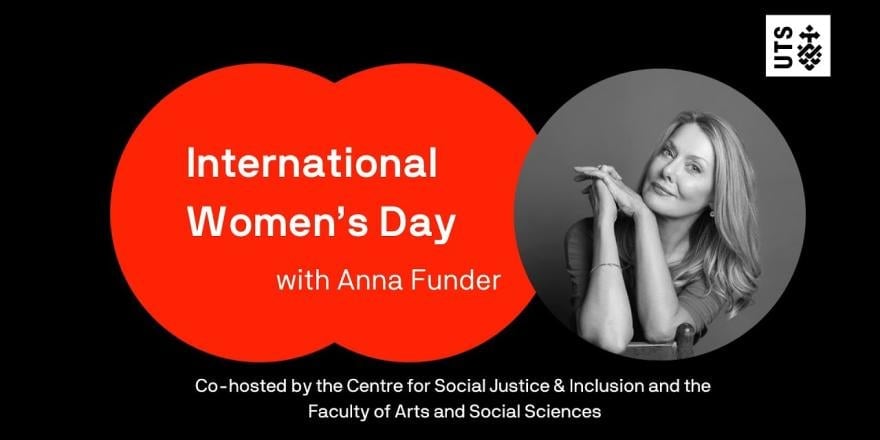
To mark International Women’s Day 2024, award-winning author and UTS Luminary, Anna Funder delivered a compelling keynote on how the patriarchy continues to maintain the status quo – using the extraordinary lives of Eileen O’Shaughnessy and George Orwell to show it in microcosm. 

Associate Professor Ramona Vijeyarasa and Professor Peter Siminski also joined Anna to share insights and expertise on how we can move towards more equitable models. 

If you are interested in hearing about future events, please contact events.socialjustice@uts.edu.au.

As a writer, the work of a great writer's wife fascinates me. But as a woman and a wife, it terrifies me. I see in it a huge struggle between maintaining herself and the self-sacrifice and self-effacement so lauded of women in patriarchy, which are among the base mechanisms by which our work and time are made invisible. Anna Funder

If we're going to make change, it has to be done inclusively. We have to include men and boys in this change because in the end the patriarchy is the way certain people hold power to control and suppress everybody else. Changing that is to the benefit of everyone. Associate Professor Ramona Vijeyarasa

The lever for change comes through policies in the realms of childcare and parental leave. Theyre the two main areas where we really could make a big difference at the national policy level to not only make it easier for women to combine work and family, but also to encourage men to do more of the unpaid work and thereby contribute to cultural change. Professor Peter Siminski

Speakers

Anna Funder is one of Australia’s most acclaimed and awarded writers. Her books Stasiland and All That I Am are prize-winning international bestsellers, and her book Wifedom is hailed as a ‘masterpiece’. Anna’s signature works tell stories of courage, resistance, conscience and love, illuminating the human condition in times of tyranny and surveillance. Anna is a UTS Luminary and Ambassador. 

Associate Professor Ramona Vijeyarasa is a legal academic and women’s rights activist. She is the Chief Investigator behind the Gender Legislative Index, a tool designed to promote the enactment of legislation that works more effectively to improve women’s lives. Ramona’s academic career as a scholar of gender and the law follows ten years in international human rights activism, which has informed her impact-driven approach to research. 

Professor Peter Siminski is an applied microeconomist. He has over 20 years of policy-oriented research experience and is the Head of the Economics Department at UTS. Peter’s work applies modern impact evaluation techniques to estimate the effects of Australian Government policies and programs on people’s lives. The measurement of inequality and intergenerational economic mobility is a key theme of his work. 

Amy Persson is the interim Pro Vice-Chancellor (Social Justice and Inclusion) at UTS. Amy is a public policy specialist who has worked across the private, public and not-for-profit sectors and was Head of Government Affairs and External Engagement at UTS. Previously, she held Senior Executive roles in the NSW Department of Premier and Cabinet and also ran the Behavioural Insights Unit and Office of Social Impact. 

Share