

- Posted on 2 Aug 2023
- 69-minute read
In the May 2023 budget, Treasurer Jim Chalmers announced an important change to the welfare payment for single parents: recipients could stay on it until their youngest child turned 14, up from the previous cut-off at 8 years old.
The campaign that took place leading up to the budget is a success story of how lived experience, independent research, media attention, and a government-backed task force combined to reform a harmful policy.
It’s a powerful case study for anyone wanting to change bad laws.
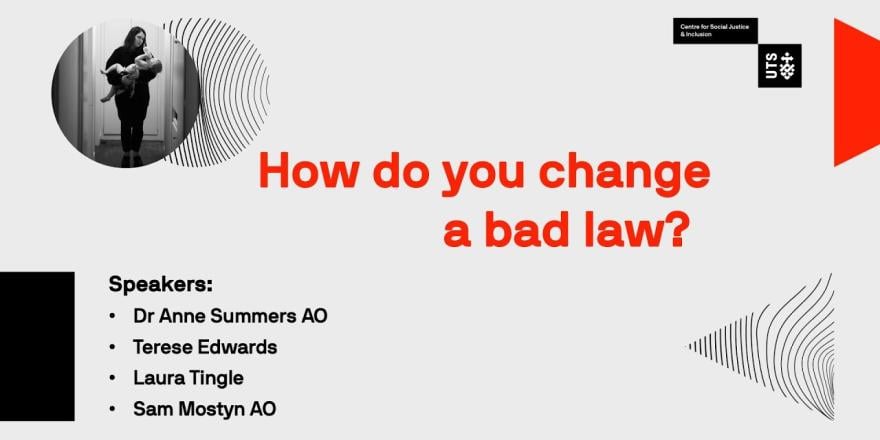
Terese Edwards, Anne Summers, Laura Tingle, Sam Mostyn, and Verity Firth sat down to discuss how researchers, activists, policymakers, and the community sector can join forces to make a real difference and navigate complex politics to advocate for – and achieve – reform.
If you are interested in hearing about future events, please contact events.socialjustice@uts.edu.au
This absolutely unspeakably sensational data showed that an extraordinary high rate of 60% of single mothers have experienced domestic violence, moreover, that the majority of single mothers were single mothers because they had left violent relationships. Dr Anne Summers AO
Basically, bashing up single mothers was something that went back, you know, and was a very fashionable thing to do in the Costello era, all those women who were having babies just so they could get welfare, and the same modus operandi was at work more recently with all the victims of Robodebt. Laura Tingle
What I would particularly like to see happen is that we seize this moment because not only did we change the Parenting Payment Single, we did slay the beast known as Parents Next and that was such a nasty, mean thing, but what I think can happen is for women to be able to capture their own portrait and write their own slate of who they are and what they want and their voices to be heard. Terese Edwards
We're dealing with gendered norms that persist no matter what we've talked about tonight. We're probably one of the most gendered normed countries in the world. We have a view about who does care, who gets to earn, who gets to be wealthy. They're tropes, they're very, very damaging and they hold us back. Sam Mostyn AO
Speakers
Terese Edwards is the CEO of the National Council of Single Mothers and their Children. She focuses on changing the dialogue on single mothers, and making sure women's strengths, voices, and respect are central to policy decisions. She assists women in navigating complex systems to gain the information that best supports and protects their families.
Dr Anne Summers AO is a journalist, commentator, and best-selling author. Anne is currently Professor of Domestic and Family Violence at UTS Business School, where she conducts innovative data-based research into domestic violence in Australia. Her 2022 report, The Choice: Violence or Poverty, influenced the federal government to make changes to the payment system for single mothers.
Laura Tingle has reported on Australian politics for more than 40 years. She has worked for the Australian Broadcasting Corporation since 2018, and previously held senior positions in print media, including more than a decade as political editor of the Australian Financial Review. She is the chief political correspondent for 7.30. Laura has written four Quarterly Essays, won two Walkley Awards, and is President of the National Press Club of Australia.
Sam Mostyn AO is the Chair of the Women's Economic Equality Taskforce, a key player in prioritising and recommending policy change to the Federal Government.