

- Posted on 23 Oct 2024
- 43-minute read
Building bridges between universities and communities to allow for reciprocity and mutually beneficial outcomes.
Universities and communities have a lot to offer each other. Research is made better when done in collaboration with the people and systems in the field. For communities, universities enable them to access invaluable resources they wouldn’t other have at their disposal.
But there is often a power imbalance between communities and universities. So, how do we ensure that the partnerships between the two are authentic and mutually beneficial?
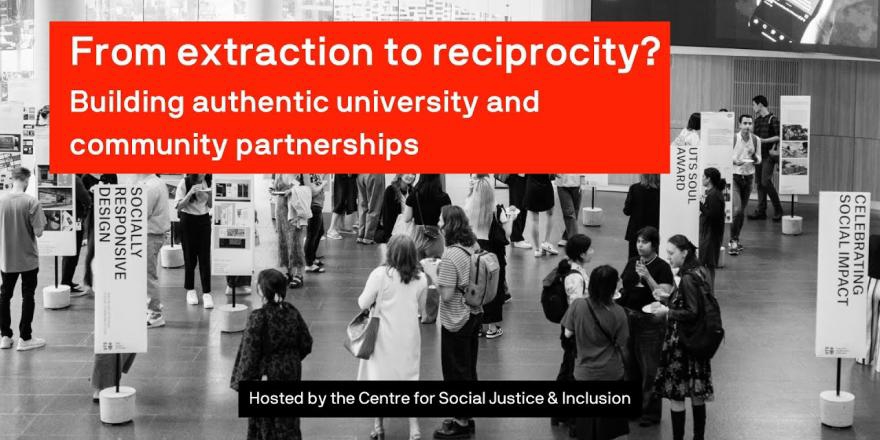
In this session, Lindon Coombes, Oscar Sanchez, Phillippa Carnemolla, Jack Kelly and Lisa Aitken discuss with Amy Persson (moderator) how to create pathways for communities to initiate research projects, and deliver social impact.
If you are interested in hearing about future events, please contact events.socialjustice@uts.edu.au.
We have taken great joy in unwriting many of the rules of who is the expert, who does what, and when. We had the opportunity to build core teams with community and people with intellectual disability became researchers, facilitators, interviewers, analysts, strategists. Associate Professor Phillippa Carnemolla
In my university work, I am building the environment to make the change that we need in the disability space. It might take a while to get there, but we will set those standards and achieve those goals. Jack Kelly
One of the major preconceptions by members of the community is that it [the university] cannot be accessed or utilised unless you are a member of faculty or a student. That is not true. It is the opposite. But there are many people who don't know that. Oscar Sanchez
One of our principles at Jumbunna is how we are not extractive. How do we engage with communities and leave them better off? That is a challenging lens for everyone but that is the sort of conversations universities should be having. Professor Lindon Coombes
We have an impact on the community around us and they have an impact on us. A challenge for us is to be a better neighbour, be a part of the community, and be a porous institution that is more open and inviting to our community. Lisa Aitken
Speakers
Professor Lindon Coombes is a Yuallaraay man who’s family is from Brewarrina in north-west NSW and has over 25 years of experience working across a range of sectors in Aboriginal affairs. He has held senior executive positions in the NSW Government and has been CEO of Aboriginal owned and controlled organisations. Lindon has also been a Senior Advisor for successive Ministers holding the Aboriginal Affairs portfolio in NSW. He has extensive experience in Indigenous policy development and engagement. He was most recently a Director in PwC’s Indigenous Consulting and is now Director of Jumbunna Institute for Indigenous Education and Research.
Oscar Sanchez is the Coordinator of the Uniting Harris Community Centre and a community leader in the area of Ultimo Pyrmont. With over ten years experience in Community Development, Oscar has managed and co-designed with the local community many diverse and inclusive projects and events to bring people together, celebrate community traditions and support our most vulnerable members. Oscar has been a long-term partner across various UTS programs, including the Centre for Social Justice’s Community Engagement and Impact Team.
Associate Professor Phillippa Carnemolla is an Associate Professor at the UTS Faculty of Design, Architecture and Building. She is interested in exploring how inclusive design and community-led research is done well in a university setting. She works on projects that identify and remove barriers to participation in our workplaces, organisations, homes and cities. She has worked in partnership with the Council for Intellectual Disability for the past six years on a range of projects about local governments, self advocacy and NSW disability institutional heritage. Phillippa co-leads the design and innovation theme for the UTS Ageing Research Collaborative, and the UTS Disability Research Network.
Jack Kelly is an Honorary Research Fellow at UTS Faculty of Design, Architecture and Building. Jack has worked in the disability research and advocacy sector since 2015, having worked with UTS and the Centre for Disability Studies Inclusive Research Network as a Research Associate. Jack also holds a position at the Council for Intellectual Disability as a project worker. Jack is passionate about advocating for the rights of people with intellectual disability.
Lisa Aitken is an experienced social impact practitioner having worked across university, government, not-for-profit, start- up and private sectors. She has extensive experience in human centred program design, leadership, strategic planning and project management. Lisa has a Bachelor of Arts/Bachelor of Teaching (Visual Arts), completed subjects in a Master of Education majoring in Aboriginal Education and a Bachelor of Behavioural Sciences (psychology).
Amy Persson (moderator) is the Interim Pro Vice-Chancellor (Social Justice and Inclusion) and is a public policy specialist who has worked across the private, public and not-for-profit sectors. She was previously the Head of Government Affairs and External Engagement at UTS.