

- Posted on 6 Sep 2023
- 46-minute read
How Multicultural Australians can advocate for Reconciliation.
Race relations in Australia are often narrativised as black and white. But many of us don’t necessarily fit into either category.
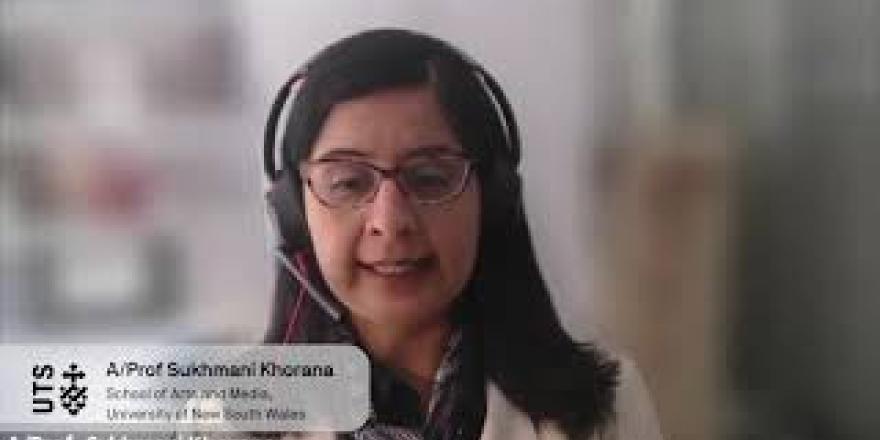
Sukhmani Khorana, Indu Balanchandran, Iva Ponton and Nour Al Hammouri joined Elaine Laforteza to unpack how non-Indigenous migrants are also part of the ongoing colonial narrative of Australia and how we can enable our communities, and ourselves, to contribute to a true reconciliation process.
If you are interested in hearing about future events please contact mwn@uts.edu.au.
As far as racism and discrimination is concerned, our struggles are intertwined. It is really important that we address the foundational violence which was committed to Indigenous peoples, and it is only then that racism and discrimination towards all other racialised minorities in this country can be addressed in a structural, systemic, holistic way. – Dr Sukhmani Khorana
We benefit from migrating to these lands. So, we are responsible for contributing to positive ways of doing and knowing how to support First Nations Peoples. Not only do we come with our cultural backgrounds, it's also most important to support the lands and traditions of those that we reside in and make sure that we are in alignment with and respectful of those traditional beliefs. – Dr Iva Ponton
A lot of multicultural people come from backgrounds where we have faced colonisation and the struggle for self-determination. For some of us, we've been successful, but for others, like from where I come from [Palestine], we're still trying to fight for that. Which is why I'm doing my efforts here because I know what it's like to not be recognised and not feel like you actually matter to the Government. – Nour Al Hammouri
There are a number of elements that are taking shape in this referendum. One is reconciliation and the other is repair. We can't keep moving forward without repairing what has been done in the past because then all we're doing is really replicating the messes of the past. – Indu Balachandran
Speakers
Dr Sukhmani Khorana is Scientia Associate Professor in the School of Arts and Media, UNSW and author of Mediated Emotions of Migration: Reclaiming Affect for Agency and The Tastes and Politics of Inter-Cultural Food in Australia. Sukhmani is a member of the independent collective, ‘South Asians for Voice’, and a co-investigator on a Settlement Services International research project exploring refugee-Indigenous connections.
Indu Balanchandran is a Global Atlantic Fellow in Social Equity and recently held a senior position as Director at the Aboriginal Housing Office. Indu is co-Chair of Community Resources, and is on the Advisory Board of WSU's Institute of Culture and Society. Indu draws on her skills and qualifications in political economy, arts, finance and social change to effect systems change for social and cultural equity, sustainability and vibrancy
Dr Vaoiva (Iva) Ponton is Senior Research Fellow at Griffith University, she completed her PhD in education. She has spent the last 25 years as an educator, and is interested in strategies to enhance student success in the transition from school to the tertiary sector. Iva is passionate about utilising Pacific methodologies when supporting communities to achieve educational and social outcomes with success.
Nour Al Hammouri is a Palestinian - Australian - Muslim studying Advanced Science (majoring in Pre-Medicine). He also serves as the UTS Students’ Association President and the student representative on both Faculty and Academic Board for Science. Nour is involved in building intersectional connections between differing cultures and backgrounds for the betterment of multicultural campaigns and initiatives.
Dr Elaine Laforteza is Equity and Diversity Project Officer (Cultural Diversity) at UTS and Project Officer, Multicultural Women's Network. She has held academic positions at Macquarie University, Charles Sturt University, and UTS. Elaine is published in academic journals, community media, and authored the book, The Somatechnics of Whiteness and Race. She also hosts SBS’s award-winning podcast, ‘My Bilingual Family’.