


- Posted on 22 Oct 2026
- 2-minute read
UTS researchers are using scent-sensing technology to help validate human-remains detection dog training.
Key takeaways
- UTS researchers tested an electronic nose to detect buried remains and validate dogs’ alerts.
- The technology could improve training by identifying decomposition odours.
- It would complement, not replace, dogs but larger studies are needed to validate the findings.
A pilot study tested an electronic nose, called NOS.E, alongside human-remains detection dogs to see whether it could detect buried remains and help confirm dogs’ signals.
Dr Amber O. Brown, lead author of the study published in PLOS One, who completed her PhD at the University of Technology Sydney (UTS), said that cadaver detection dogs are among the best tools for locating buried human remains, but little is known about the exact smells they detect.
“This study tested whether an electronic nose could detect buried human remains and help confirm alerts made by human-remains detection dogs,” she said. “NOS.E allows us to take technology developed in the laboratory into the field, while giving law enforcement an objective way to assess whether dog training is working.”
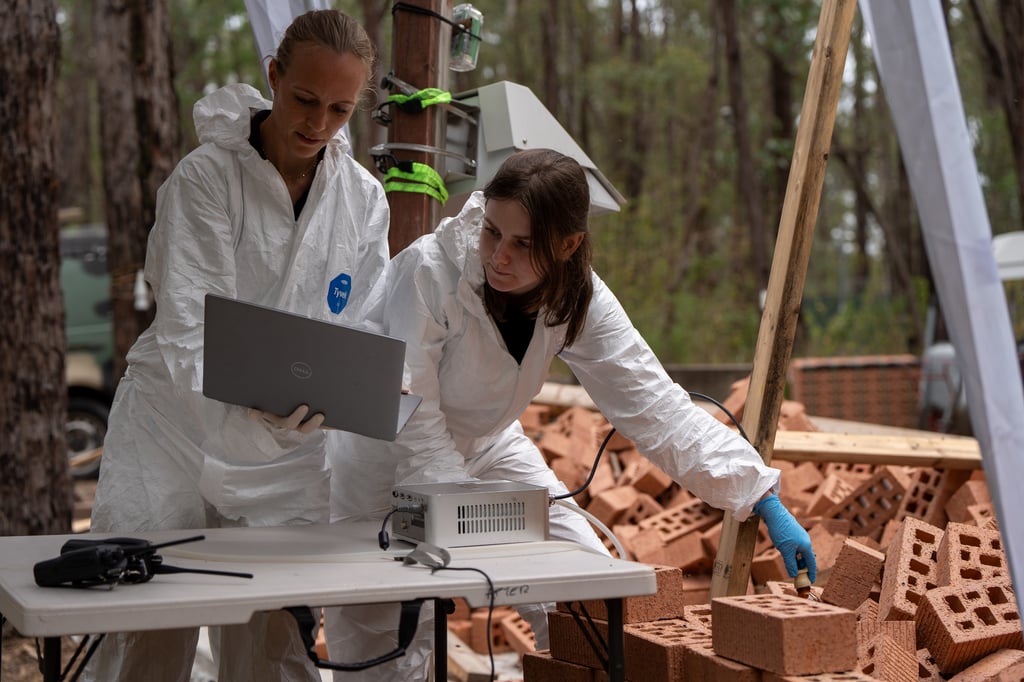
NOS.E, developed through collaboration between forensic science and engineering researchers at UTS, was tested along with police dogs on a clandestine grave in a long-term missing-person scenario, involving remains buried for more than three months.
The electronic nose sampled odours from the burial site and surrounding control areas, while police dogs searched the site independently.
Dr Brown said that decomposition passes through five distinct stages, each producing different odours at different concentrations.
“That makes training much more complicated than teaching a dog to detect a relatively stable substance,” she said. “By tracking those chemical changes in real time, we may be able to identify whether dogs need more training on the earlier or later stages of decomposition.
“For younger dogs in particular, the technology could help trainers determine whether a dog is genuinely responding to decomposition odour or being influenced by another cue.”
Police identified the electronic nose’s potential as a dog-training tool – an application we hadn’t originally considered.
Associate Professor Maiken Ueland, Director of the Australian Facility for Taphonomic Experimental Research (AFTER), said cadaver detection dogs are an incredibly valuable tool but training them is complex.
“We don’t know exactly what they are smelling – whether it’s a single compound or a combination of compounds,” she said. “The electronic nose can provide greater certainty during training by showing whether decomposition odour is present in an area, including when a dog does not alert.”
The researchers see the electronic nose as a complementary tool rather than a replacement for detection dogs.
“Dogs have a superior sense of smell and can search an area rapidly, while the technology can tell us more about the chemicals being detected,” said Associate Professor Ueland. “The electronic nose can act as a bridge between the extraordinary scent picture available to a dog and the chemical signals that humans can measure and understand.
“In mass disasters or other hazardous environments, it may be too dangerous to send in people or dogs. The electronic nose could offer another option for searching those areas safely.”
Associate Professor Ueland said the research shows the value of academics working directly with industry.
“Police identified the electronic nose’s potential as a dog-training tool – an application we hadn’t originally considered,” she said.
While this research was a pilot study, the team wants to conduct a larger, longer-term study.
“Our next step is to expand this pilot into a larger, longer-term study involving multiple donors, more dogs and repeated site visits,” said Associate Professor Ueland. “The challenge will be maintaining rigorous controls, so dogs and handlers don’t become familiar with the site or receive unintended clues.”
Featured researchers

AFTER Director, Faculty of Science
Dr Amber O Brown
News by topic

News
Australia leads the world in stuttering research, now digital innovation is reshaping stuttering care
The Australian Stuttering Research Centre at UTS marks 30 years of world-leading research.

News
Feral – and threatened? Endangered camels, banteng and hog deer have found an unexpected refuge in Australia
Wild dromedary herds no longer roam the Sahara, while wild banteng are vanishingly rare in Southeast Asia. Should we protect their feral populations in...

News
New report calls for federal reform to address harmful worker surveillance
The Australian Government must urgently address the threat to workers from new forms of AI-powered surveillance, according to a report released today by the...
News
Australia leads the world in stuttering research, now digital innovation is reshaping stuttering care
The Australian Stuttering Research Centre at UTS marks 30 years of world-leading research.
News
Feral – and threatened? Endangered camels, banteng and hog deer have found an unexpected refuge in Australia
Wild dromedary herds no longer roam the Sahara, while wild banteng are vanishingly rare in Southeast Asia. Should we protect their feral populations in...
News
New report calls for federal reform to address harmful worker surveillance
The Australian Government must urgently address the threat to workers from new forms of AI-powered surveillance, according to a report released today by the...