


- Posted on 27 Aug 2026
- 3 min read
Youtubers are increasingly a source of news, but can we trust them?
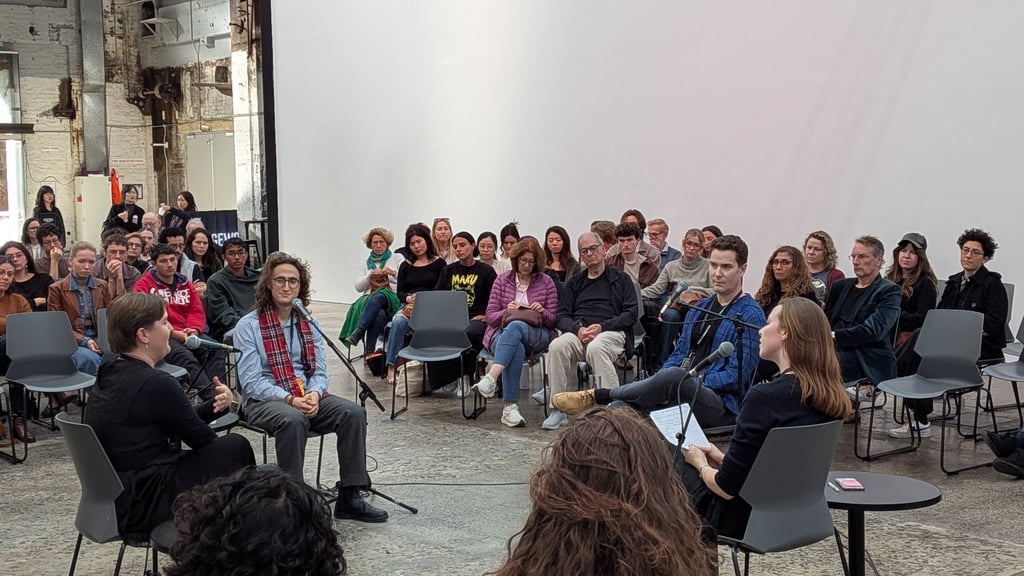
On Sunday afternoon, this was a question from the audience at a session of the Festival of Dangerous Ideas. Titled Raw Ethics, the session addressed the issue of who is allowed to be heard in our society.
I was a panellist, and the format was confronting. Together with co-panellists William Salkeld and Em Readman, and moderator Georgia Fagan, I was at the centre of a large space surrounded on all sides by the audience. Each of us began the session with a ‘provocation’ based on our research. From there, we collectively grappled with these statements.
To my surprise, my statement – ‘youtubers should receive the same legal protections and privileges as journalists’ – was not all that controversial. During the ‘audience pulse’, most people raised their hands in support. This was a contrast to four years ago, when I started my PhD. Back then, the most common reactions to my research were worry, concern or rejection.
One thing that is now clear is that many youtubers abide by ethical standards, even if they are usually not in writing or formalised. This was confirmed by a recent AI-related controversy on YouTube.
As one of the original ‘serious youtubers’, Hank Green has been on YouTube since 2009. He is a co-founder of Complexity, a studio with the goal of creating educational YouTube channels that are ‘genuinely informational and entertaining’. Channels in Complexity’s portfolio include SciShow, which has almost 8.5 million subscribers, and Crash Course, which has over 17 million subscribers. Green’s personal channel alone has more than 3 million subscribers; and vlogbrothers, the channel he shares with his brother John Green, has more than 4 million subscribers.
Despite the enormous success he’s built over almost two decades on YouTube, or perhaps because of it, Hank Green created an uproar in July. He had left some GenAI phrasing in a script and accidentally read it out in a video published on Complexity’s channel.
For YouTube audiences, who crave authenticity, this is a major sin. Using GenAI to write scripts damages the carefully constructed authenticity of a youtuber. Green’s audience instantly caught the slipup. Many felt betrayed and questions were raised about the reliability of his previous work.
Due to Green’s profile, this led to a wide-ranging online conversation about youtuber ethics. With over 2.5 million subscribers on YouTube, Adam Ragusea said that the incident, ‘offers an opportunity to examine how we are setting and enforcing editorial standards within fact-based media businesses online, especially in video form. What are the professional standards for doing the kind of work that Hank Green does, that I do?’
In response to the blowback, Green admitted to relying on GenAI for script writing and announced a new policy for his work going forward:
The Hank Green AI Policy
- No portion of any script will be written, edited, or outlined by an LLM.
- The thesis of a video will always originate with a human.
- No image or music in a video will be generated by AI. If something is accidentally included, best efforts will be made to remove it.
- LLM outputs will never be trusted as a source.
- Informational / educational videos will contain links to primary sources in the description.
This was not the first time that the standards of ‘fact-based’ youtubers had become an issue. After leaving Vox to become a full-time youtuber, Johnny Harris found himself on the receiving end of several fact-checking videos, including from Tom Nicholas, The Present Past, Money & Macro and Ryan McBeth. Harris was critiqued for his practices around factual accuracy, source transparency, and commercial disclosure. Following good faith engagement with his critics, Harris changed his practices, including by including links to sources in the description of videos.
For my PhD, I interviewed ‘serious’ or ‘fact-based’ youtubers and found there are shared norms and common practices that would not be out of place in a traditional journalists’ code of practice. These norms and common practices include: making sure that fact claims are accurate and errors are corrected; being transparent with sources of information; and clearly disclosing any commercial deals or sponsorships. It’s interesting to compare how these youtuber ethics stack up against traditional news media ethics.
The most noteworthy aspect of all this is that there are no YouTube policies or government regulators, such as the Australian Communications and Media Authority, forcing youtubers to follow such standards. Their compliance is voluntary and self-imposed. They hold themselves to account. They hold each other to account. And, perhaps most importantly, audiences hold them to account.
What’s more, creators that abide by such standards do so knowing that, in an age of rage-bait fuelled algorithms, they are foregoing significant revenue by not pivoting to more sensationalist content that is loose with the facts and bereft of ethical considerations. Green’s ‘AI Policy’ is yet another example of serious youtubers voluntarily adopting standards that go well beyond what YouTube, or any regulator, requires.

References
Festival of Dangerous Ideas https://festivalofdangerousideas.com/program/raw-ethics/
Academic article that explains ‘serious youtuber’ https://doi.org/10.1386/ajr_00178_7
Video showing audience backlash to Green’s slipup https://youtu.be/W82TeO-XXWU
Video from Adam Ragusea about youtuber standards https://youtu.be/xlM8X7KHveE
Video with Hank Greens AI Policy https://youtu.be/ssE1rmt3EpE
Fact-checking video from Tom Nicholas https://youtu.be/Dum0bqWfiGw
Fact-checking video from The Present Past https://youtu.be/pAeoJVXrZo4
Fact-checking video from Money & Macro https://youtu.be/eyCaXPcDvng
Fact-checking video from Ryan McBeth https://youtu.be/km00ulLxieE
Written by Chris Hall
CMT Researcher
Explore

News
Tell us what we want
Centre for Media Transition newsletter - Tell us what we want, what we really really want | Issue 18

News
Embedded links
Michael Davis looks at the recently announced partnership between USA Today Co. and Palantir, whose reputation has the company’s reporters up in arms.

News
A'muse'ing
Harry Craigie looks at Meta’s newly released agentic AI system Muse, which like many AI products, gives us plenty of what we want, but likely at the price of...

News
Deplatforming and deportation
Monica Attard looks at Latvia’s decision to expel exiled Russian journalist Leonid Ragozin, who had resided in the country since 2014. His reporting, while...
News
Tell us what we want
Centre for Media Transition newsletter - Tell us what we want, what we really really want | Issue 18
News
Embedded links
Michael Davis looks at the recently announced partnership between USA Today Co. and Palantir, whose reputation has the company’s reporters up in arms.
News
A'muse'ing
Harry Craigie looks at Meta’s newly released agentic AI system Muse, which like many AI products, gives us plenty of what we want, but likely at the price of...
News
Deplatforming and deportation
Monica Attard looks at Latvia’s decision to expel exiled Russian journalist Leonid Ragozin, who had resided in the country since 2014. His reporting, while...