The latest UTS Curiosities Live event brought together Professor Leslie Loble AM and Eddie Woo to explore how artificial intelligence is reshaping classrooms and what it will take to keep genuine learning at the centre.

Key takeaways

  • AI provides a short-term performance boost, but overusing it creates a "false sense of mastery" that erodes a student's ability to retain knowledge.
  • True learning relies on mental friction and the productive struggle. Students must be motivated to view school tasks as cognitive training, not just work to be turned in.
  • Technology cannot replace human-to-human teaching.

Artificial intelligence has moved from novelty to near-universal presence in Australian classrooms, with around 80 per cent of students and two-thirds of teachers now using it in some form – among the highest rates of teacher usage in the OECD.

That was the starting point for a UTS Curiosities Live conversation between Professor Leslie Loble AM, Industry Professor at UTS and author of a recent report on AI, cognitive offloading and education, and Eddie Woo, leader of Teacher Growth for the NSW Department of Education and Professor of Practice at the University of Sydney. 

Held at UTS Central and streamed to an online audience, the event asked a question increasingly on the minds of parents and teachers alike: when a chatbot can write the essay, solve the equation or summarise the reading, what is actually left for students to learn?
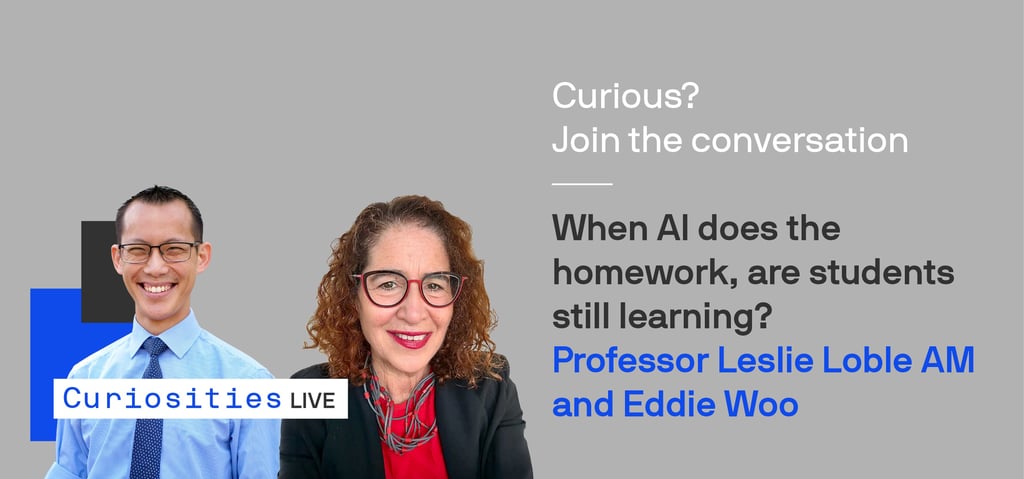
Leslie Lobel and Eddie Woo

When AI does the homework, are the students still learning?

Professors Leslie Loble and Eddie Woo.

When AI does the homework, are the students still learning? transcript

So. Okay. Good evening and welcome to Curiosities Live here at UTS central. We are on the lands of the Gadigal people of the Eora Nation. And I want to begin today formally by acknowledging the traditional owners of the land on which we meet. And as someone who lives and works on dark land, it is a real treat to be able to come over to the lands of the Gadigal, to a saltwater people.

I want to pay respect to elders past, present and as a teacher, those elders who are emerging, who we have the great opportunity and privilege of growing, caring and cultivating. And Leslie, you and I are going to have a wonderful conversation in that wonderful knowledge sharing tradition of the Gadigal people.

Tonight, let's get curious with Professor Leslie Lobel, a leading voice in education reform and policy for all of you who are in the room tuning in online or listening in on ABC Radio National, we are grateful to have you. My name is Edward. I am the leader of Teacher growth for the New South Wales Department of Education across 2200 of New South Wales public schools. I'm also a professor of practice at the School of Education and Social Work at the University of Sydney, just down the road in Camperdown, and I am delighted to moderate tonight's conversation. Lesley and I are here to explore one of the biggest questions facing not only schools but all of society today.

How is artificial intelligence changing the way that students learn? And AI tools are already being used in classrooms in homes around the world. They can support learning, spark ideas, and improve efficiency. But they also raise important questions. Questions about critical thinking, effort, independence, and also how young people develop lasting knowledge that is secure and will make a difference in their lives. Tonight, Leslie and I are looking forward to unpacking what the research tells us, what risks and opportunities are emerging, and how schools can respond in ways that place learning at the centre.

Now, even though I know there are many people tuning in online, I am very grateful for them. Hello to all of you there. I'm actually going to spend over the next 90s a moment privileging the people who have made the journey into night, braid public transport, or somehow found parking in the Sydney CBD. I'm going to ask for your help, for Lesley and I, to situate ourselves and make sure we're having the right conversation for the people who are listening here today.

So this is going to be a quick pulse check, and I would love you to participate by show of hands. Firstly, I wonder if you could raise your hand for me for us, if your work is being affected in some way, shape or form by AI today, could I get a show of hands? Okay, a few hands. I'm looking at the proportions. Wonderful. Thank you.

Hands down. So that was from a professional sphere. I wonder how many people have family, perhaps a young person in their lives and in your conversations with them? I'm thinking, perhaps, of my three children who are all high school aged. I wonder if anyone can say, oh, it's my family, actually, that I'm interested in the world. They're growing up in.

AI is going to affect them. Hands up. If that's you. Okay. Excellent. Another proportion.

Thank you. Hands down. Bit of both. That's okay. One last show of hands here. As an event.

That's at an event where we're focused on education. I would love to see where the educators in the room. So I know there are people who are teachers, past and present, people who are supporting education in universities or other organizations alongside schools could get a show hands where the educators are wonderful. Okay. Thank you so much. That was my show of hands plus audience participation for now.

Anyway, instead of my show of hands, I wonder if by show of thumbs you might tell me how it is that you are feeling about artificial intelligence at the moment. Are you optimistic? Pessimistic? Some mixture of the two. I wonder if everyone would raise their fist for me. Everyone in the room would be really helpful.

Okay, and let's get a thumb position. So I wonder where you are at. Oh, this is so interesting. Leslie, are you sitting on the fence?

That's okay. All right. Thank you. All right. Hands down I really appreciate that. So for those joining us online and also in person, you can see we have a QR code here.

And we would love for you to place questions in the Q&A. Please do that throughout the session. If you're anything like me you'll think of something really interesting. And by the time Question Time arrives, you will have had that thought. Evacuate your mind by that time, so we'd love you to be doing that as you go. But as the moderator for tonight, I'm absolutely going to abuse the privilege.

I have to ask the first few questions. So, Leslie, any this conversation about AI over the last couple of years, it has been full of grand statements.

80% of students say they use it in one form or another of courses across different ages. But, certainly as they get on in their schooling and education, lives, and two thirds of teachers. So the third highest usage in the OECD is amongst Australian teachers. So once AI has become, a universal aspect of education, we can't we can no longer say, let's go back and not have it at all. And what we have to think about instead is what are the core aims that we have the goals for education in Australia, the excellence and equity that we seek from education. And then where does I play a role in getting us closer to that?

That's the fundamental frame in which we need to see it. Now, as you said, I can have a lot of positive benefits, workload reduction. Australian teachers on average, getting close to 50 hours a week and a lot of that on less than half of that is face to face teaching. So there's a lot of administrative work, and I can help reduce that. We know that AI and it's adaptive and data presentations can assist with differentiation. And that's become so important.

And more and more complex classrooms, in which teachers are working, it can help with students with disability and special, learning needs. It can help with students who have fallen behind and need extra tuition. And in fact, some of the strongest evidence is around the use of adaptive tutoring tools and how they can lift and underscore, learning gains in areas, particularly maths, for example, where students have fallen behind. That said, there are some pretty big cautions around AI, and we have to take them seriously. I'll say they they kind of fall into three buckets. The first is governance, safety, security, privacy, absence of bias, all those things.

That is where in both policy and other spheres, we are spending the bulk of our time talking about AI in education. There are two other risks that are important, and we cannot put them in the too hard basket and ignore them. The first is equity. I can either compound or counteract the underpinning conditions that are driving what we already know is a terrible learning gap in Australia. Things like, teaching shortages or the uneven distribution of beginning teachers into areas of disadvantage that the concentrations of disadvantage, so on and so forth. I can either counteract or compound those.

And the third bucket of risks or cautions are learning risks. And those are going up the charts with a bullet, I have to say. And we're going to spend a lot of our time tonight talking about that. But those learning risks with AI are concerning, and we have to take very specific and concerted action to counteract them. I feel as though one of the major themes that we've hit here on the first at the first milestone, and we're going to keep on going throughout this conversation, is this is paradoxical, sort of, dualistic nature to this immense power that we hold in our hands. But as most powers are, you know, can be used for good and for ill is going to erode and enrich learning in equal ways.

I particularly think about you talked about differentiation. Just now and the ability to give a diverse range of students a different set of experiences that is attuned to their needs is extremely exciting to me. As a time poor educator. I know that the school that I personally teach had more than two thirds of the students have English as an alternative language or dialect, and to be able to produce resources and materials for them on a lesson by lesson basis, that I has helped me to be in their mother tongue as well as in English. That's a game changer. It's extremely exciting, but some of the risks that you mentioned are also very, very disconcerting.

I wonder if I can go back to something that you mentioned about the fact that the genie's out of the bottle and we can't go back. This world is irrevocably changed. And as a classroom teacher, the thing I want most for all of my students is that they can leave at the end of year 12 to navigate the world successfully, and also be equipped to contribute and make a positive difference to their communities. So given that that will that they move into, as you have put a is is changed and isn't going back, can you give us a sense of how AI changes the knowledge and skills that our students are going to need to be able to flourish in that new world? Well, firstly, I'd say it's a fool's game to try to answer that question and say, as of today and, June 2026, I can predict what somebody in kindergarten is going to need 12 years or 13 years later. The technology is changing so rapidly.

We tried that in the past. We, for example, not too long ago said that if we taught kids coding, that's that would take care of it and they would be prepared for a digital future. And the fact of the matter is, AI can code itself. And so those those skills are are not the ones I'll say. There's a few things, though, that we absolutely know we need to do. The first is we all will need to know how to use AI to amplify our talents, our interests, our creativity, our knowledge, experience, and so forth.

We need the tool to help us get even further and not diminish our own humanity and our capability. That's more than tapping, buttons on an app that takes real understanding and importantly, skills and knowing how to use it. I mentioned equity. I'm going to continue to mention equity all the way through this. I want to make sure that all students are getting the skills to use those tools really well, and not those who already have educational advantage. I think more importantly, or at least as importantly, the basic tenets and, evidence around what matters for education and learning is the most important ingredient in how we will prepare students for the future that you desire and envision for your your own students.

Literacy and numeracy. To access learning, you simply cannot access learning if you don't have it. We must start with that. And very high levels of it. We need knowledge and content, mastery built on a quality curriculum. And then we need particularly critical thinking.

We need the thinking skills that allow you to build upon your your basic skills and your knowledge to then understand more deeply new concepts. Learn them, apply them, evaluate them, discernment and judgment. All those things that are so important will become even more important in an AI world. So for me, that's the really good news is that in the midst of this new technological vector that is affecting education, just as everything else, the fundamentals remain exactly the same. And in fact, it's a moment where we have to double down on just how important great teaching is, and we have to give teachers the tools and support to be able to do that. That is becoming increasingly complex and challenging because this world is changing under our feet constantly.

The AI is doing a new thing every single week. I do think about the fact that this new world that we're going into, even just rewinding just a few years, I mean, I wonder how many people here in the room or line can resonate with the fact that I grew up in a house with an Encyclopedia Britannica set proudly displayed on the shelf for some of our younger people in the room. An encyclopedia is a kind of book I call a book is an object with paper page. I won't keep on going, but as Google became, it began to be this incredible new tool that we were excited to have access to, but also brought with it and a new set of skills that we had absolutely not yet mastered. In much the same way you talked about how a real understanding of what these large language models and artificial intelligence chat bots can do, and how they're doing it is very important, I promise. I'm not just saying that as a mathematics teacher, looking at the statistics that underlies all these models, but it influences what we're actually getting out and how we interpret that.

Leslie, one of the things that I love about the many conversations you and I have had about this topic is that we've seen that there's this tendency over time, AI's in this at the current end of a long list of technologies whereby it's been the development of a new technology that has been driving many of the decisions in our schools and homes. The technology rises and then we we react, we respond. And of course, it's very natural in a way, but we've both seen the danger of that happens over and over again. And we've discussed the importance of not the technology being in the driver's seat, but of sound education or thinking being in the driver's seat. So I wonder if you can help us understand some of that sound educational thinking. I'm particularly interested in something.

I know you and your colleagues here at UTSA have looked at a lot, which is cognitive offloading, which I know is a phrase some people in the room because you're here and you're interested have heard of, but not all of us have. So can you help us understand the educational thinking under that and its implications? I'll try to do this without making people fall asleep. So essentially. Well, I think I personally have played right into your hands by talking about how important education is. But I absolutely, as you said, we we've had many conversations the, the, the power and the compelling nature of AI, and we're all all sucked in by it.

I mean, it's just an amazing set of tools, is so compelling that it does start to drive us towards thinking that we have to respond to it, rather than thinking about how that set of tools, like any piece of technology, including a book or a textbook, supports the learning, cognitive offloading, essentially all that is, is when we, hand over to some sort of external, it doesn't have to be a piece of technology, but we externally, shift some of our memory stores to an external device, to free up cognitive space for us otherwise. So cognitive offloading can be positive and beneficial, or it can be negative and detrimental. So, for example, when you write a shopping list, when you write down, a phone number, when you're a student and you take notes in class, rather than try to or this working memory is very limited that we have and all brains are basically built in the same way with this small working memory for new information that holds very little. In fact, by some studies, we can't handle much more than four things at once in that working memory or we get stressed and we have, excess load. And then there's our long term memory, which is boundless, and it contains all of our experiences, where activities, the things we've learned. And that's our stores of, memory upon which we build knowledge.

So when cognitive offloading is detrimental, it's essentially sort of short circuiting that process and stopping us from building those mental structures upon which we not only continue to learn, but we think. And I unfortunately, part of its beauty is that it is designed with all the incentives in the world to push us more towards the detrimental. Essentially, it takes care of a lot of things for us, and we defer to it more and more. And that's where the worry is about cognitive offloading, which is that the risk is not just that somebody cheats by using AI to write an essay. The real risk of AI and cognitive offloading is that we erode those mental structures. And for younger learners, we potentially don't even build them robustly enough at all.

Bear with me, because I know we're going to unpack this a lot. Let me just tick through some of the evidence we've got on it, and then I'm sure we'll get down the track into what we can do about it, because we can do something. But the evidence is starting to mount, to mount that this is a real, problem. So, for example, we know from studies that there's what's called a performance paradox. AI gives you a short term boost, but then when students are tested later, they haven't retained it. And so we get this boost, but we don't have the learning.

There's, an illusion of competence that comes with using AI, which leads to a false sense of mastery. We feel like we know it and we think we've know know it, but we don't really. And in turn, those that dynamic pushes what some have called a metacognitive laziness. In other words, we lose touch with our metacognition, which is essentially understanding what we know and what we don't know. And our self-discipline to get us from ignorance to knowledge. And when we have a tool that just makes it feel like all that information is at our fingertips, it creates an incentive to avoid the productive struggle that is the foundation of learning.

So this is what is going on with AI, but it's not inevitable. And that's really important. And we'll get into this later. First and foremost, there are ways that, we can structure the technology itself to be a positive incentive towards learning and not a negative one. And most importantly, we can support teachers in how, to effectively and intentionally teach around AI. Let's say I have one more question.

If you just to build directly on what you just said. Before I ask it though, you've just prompted my memory of, a colleague of mine. His name is and Tony Martino Trust. Well, he's at the University of Sydney. He's a behavioral ecologist. And one of the things that he's helped me to learn is that one of the quintessential human characteristics is that we make and almost obsessively invent tools to make our lives better and easier.

It's part of what has enabled our species to absolutely dominate the planet. Not the only thing, but it is one of the characteristic human qualities that enable us to do so many amazing things. It reminds me of the fact that calculators and computers used to not be objects, but people. And cognitive offloading is something that is enormously powerful because it allows the students who I teach every day with a few presses of a calculator to be able to solve problems that would have made a mathematician's eyes water just 40 years ago, but now are in the reach of your average 15 year old students. Or there's some wonderful things that that enables, but still many questions. And this brings me back to your question, which I want to let you close on, which is you have given us a portrait of cognitive offloading, some of its dangers, some of its risks.

What are we going to do about it, Lesley, in practical terms? Well, and by the way, following this, I've got some questions for you because I want to know what your answer is, that I didn't expect you'd let me off the hook. That's fine. So I mentioned before that let's let's start with just the technology itself. The vast majority of, I backed, learning tools, are not connected to the Australian curriculum for example. And Unesco, amongst others, has found that they very rarely, sadly, are built on strong evidence based pedagogical design principles.

So they may be, you know, all that user testing was all fine and good, but it was all about the technology and not about the pedagogical structure of the tools. And what we are seeing in many of the studies I mentioned on cognitive offloading, those studies also show that when it's a well designed tool, it in fact can flip that equation so that it can prompt and deepen student thinking by not providing an answer. For example, by challenging a student's reasoning and all sorts of ways you can design it so that it can be a positive influence and drive deeper learning. But the most important thing is going to be, for example, what teachers can do. And this is where if we go back to the things that you and the teachers in the room were trained on, you would tell me exactly what we need to be doing. Even when we talk about AI.

So one of the foundational aspects is that you start with a highly structured and scaffolded learning, and you build through progressive amounts of information, practice repetition and the like. You move students towards mastery and progressive independence. We have to take that same principle to how we teach students about using AI, and how we structure the use of AI, highly structured and guided at the beginning. And I we and I think especially for the youngest learners and then more and more independence once those metacognitive skills and other and knowledge stores have been developed, things like checking for understanding, very important in an AI context, you do it reflexively as the great teacher that you are. Every good teacher does. We need to do that very intentionally, explicitly.

Now with AI, we need to rather than saying things like, don't trust de ai. It's dangerous or it hallucinates, we need to build into the muscle memory of every student verification processes so that they aren't having to verify everything that A.I. has given them. But maybe 2 or 3 sources go to the primary source and see whether it's accurate, so that you're building a verification mindset, which, by the way, is part of critical thinking as well. So these are some techniques that build on the fundamentals of what teachers already know how to do. Metacognition and self regulation as a core part of what teachers are doing.

Because we are imparting skills to young learners about what it means to take initiative, to understand where they need to learn more. And so forth. This is what I meant by saying we need to double down on that quality teaching, and the way we learn isn't changing because of AI, but the context means we have to really focus on it and we have to, make it the centerpiece of what we're doing and give teachers the support and the agency to do that. Can I ask you my questions? I suppose I should let you have the yeah, I should, because I want to just building on that to get your view of, you know, I'm saying teachers are essential. I bet you anything you're going to say, they're essential as well.

So what do you see as the things the teachers are going to be able to do and do already, that I just simply won't. You're right. I do have an opinion on this one, Leslie.

Shock, horror, surprise. And, obviously I should plant my flag in the sand. You'd expect someone like me to say yes, teachers are indispensable, but I'd like to say it's not just because of, you know, some vaunted sense of self-preservation that I believe that I've got a couple of thoughts in my mind. One directly builds off of something you just said about the pedagogical principles that you can. People don't always, but you can build into an AI model that will help it be more effective. You talked about, not always being as helpful as necessarily a user would like a chat bot to be and instantly gives the answers.

So this is a known thing, right? And so much of, you know, Claude, you copilot, it's quite well-established how, sycophantic these models are because they are trying to drive continued use and engagement and our fragile little psyches are quite easy to manipulate in those ways. And one of the things that's interesting to me, as I've seen students use AI models that have more, say, for example, Socratic models built into them, and those principles are there. We absolutely see the difference that those principles built into the models can have. We also notice students often do not like using said models, because the sycophantic model is much more friendly and and affectionate to us and makes us feel amazing. And one of the things which I note is a distinction which perhaps one day we will cross that boundary.

But I sense that at the moment we are a long way off from that. Is that as a teacher, what am I doing in the classroom to help my students? Well, there a a set of things which I do from the front of the classroom, but that makes up perhaps a third, ambitiously, a half of the actual teaching, learning that I'm helping to lead. Much more of it is actually happening. As I wander around the classroom, I'm looking at what students are doing. I'm listening to the conversations they're having, and I'm making choices in the moment about where I will intervene, which questions my students will give to me that I respond to, and which ones I will return with.

Another question, which again students learn to dislike but realize it is fundamental to their own learning processes, at least for now. One of the key things that all AI models, all language large language models share is that they wait for us to come to them. They wait for us to prompt. And if you're a good prompt, if you're effective at prompting you to be better at using that. But if you do not prompt the model to begin with, or if you don't like the prompts and the responses and you walk away, the usefulness of that model, well, it may not, as it may as well no longer exists. And that activity and initiative and choice of the teacher is something we are still quite distant from AI being able to mimic an analog.

I'll give you one other, because I promised to. I love building the knowledge and skill and understanding of my students, but any teacher who has spent any amount of time in the classroom and loves what they do and are good at it will tell you very quickly that knowledge and skills and understanding are a subset of the teacher's role in the teacher's privilege. In the classroom, we are there to help grow human beings, not just aspire to academic outcomes. And I say that as someone who loves aspiring to academic outcomes, but knows that it's a slice of what I care about for my students and we haven't talked at all about AI for companionship tonight. And that's probably a discussion for another, another evening. But, while we have a facsimile of something that looks like it resembles a relationship.

Yeah, that is all that it is. It's a facsimile that resembles that. And as human beings, our cognitive framework and our affective framework is all built to have relationships with other human beings. That is not a thing that I can produce, and I don't think it ever will. Yeah. And and, Well, well well put.

And backed by tons of evidence that humans learn from other humans better than in any other way. And that is especially true for younger learners. And, and, and the risks of AI, are especially great when we are talking about, school aged learners. It's bad enough for us as adults. And just imagine, for younger learners. So I want to ask you as well then that you said you're right.

I mean, I as it's just so compelling and as you said, it's designed that way, and makes people want to use it more and more. And that's another thing this the cognitive offloading studies are showing is increased dependency on it. So your students, I'm sure, use AI in one way or another. They're very clever. What would you say to them about how they should approach using AI in the context of learning? Leslie, the way you framed that question, what would I say supposes that this is a hypothetical idea for me, and it is not, it's a reality that I see in the classroom every day.

I see in my home every day. What do I actually say to my students? It it's of course, worth acknowledging. And all of the teachers here in the room and tuning in online know, there is no silver bullet that is going to work for every student in every context so far be it for me to claim that I've got the thing which everyone should go back to their schools and say, well, this will solve everything with the diversity. The students who I have for me, probably the key drivers, number one, about motivation and number two, about what is it that students are actually wanting to get out of school? There's only so far I can get saying to my students, trying to convince them, well, this is going to be on the exam.

I'm not going to let you have AI on this exam. It's like, well, that motivator is going to last for a little while and then it will fade and evaporate off into the distance. So let me take them one at a time. Let me think about the motivation part. Are the tasks and activities that we have our students engage with, that our young people are doing every day? Are they more like a job, or are they more like a gym?

Is the thing that we care about the output? There's a task. It must be completed. I went to an agricultural school, for six years of high school, and every time we would head down to the plots and I would sort of groan as I looked at the weeds that had grown there over the last seven days, and I would think about this bare, barren plot that I would need to prepare for planting the next lot of crops. There was a job to be done. And look, those in the room and those online can say, I don't really have a physique built for a horticultural farmer.

And so for me, if I had a tool, if I had a machine that could help me produce the same output, I would take it. My agriculture teacher seemed less sympathetic to that. But that's okay. We'll give Mr. Anderson a pass for that. If you have a job.

And the primary thing that we care about is the quality of the output, then use whatever tool is going to be appropriate to help you reach that goal. However, can we not all feel the ludicrousness of going to a gym and having the personal trainer walk you through the equipment and say, oh, by the way, here's a machine you might like to try out. We've just brought it in. It will lift the weights for you. It will do all of the reps. You can watch it go.

That would feel a little counterproductive to us. And even though I'm not an English teacher, I loved English when I was at school, I still do, and the whole point of writing an essay, for example, is it an essay is a proxy for thinking, for analysis or understanding a text, what it's really about and saying something important about it, something important, something true. That essay writing activity is a gym. And so that motivator, I think, which admittedly takes some work because I know there are lots of my students who will look at an essay, or they will look at the exercise that I set for them, and they'll say, actually, that looks more like a job than a gym to me, which means there's some work for me to do to show you the value of actually putting that effort in developing those muscles. That's the first thing that I would say. And then the second.

There's a wonderful book, called 10 to 25. 10 to 25 is in the the ages 10 to 25, which is this protracted period of adolescence which we're now seeing in young people. And it talks about how between the ages of 10 to 25, one of the key things that drives a young adolescent brain as that prefrontal cortex is forming, is maturity is developing, is I want to have something that I care about in this, and I don't really want the person in authority to be telling me what to do, because that's actually a real disincentive for me. And we have seen many marketing and ad campaigns around all of the maladies of young people drugs, alcohol, smoking, all the things and how ineffective they are when there's an authority figure saying this is bad for you, don't do it. In fact, if anything, that can sometimes serve to drive that behavior because every adolescent brain is somewhat wired a little bit for that rebellious streak, that finding of independence away from the family unit generally, which has defined them. So how can we tap into that in the context of I?

Well, I'd like to think that helping people see, I don't know how many of you have heard the phrase if if you're not paying for a product, you're not getting a product. You are the product. And to help young people realize, actually, hold on a second, I'm I'm the business value here. And my attention and my language, these large language models famously need tens of millions of words to be able to produce the effect. Similarly, if human logic, I'm being taken advantage of here to be able to tap into that, I've found to be a very powerful signal to a young person that I'm not just going to sit here and be taken advantage of. There's something I want to take for myself here and own my education, so hopefully that is helpful for educators listening it.

I thought you were headed to saying we need a bunch of influencers. I wasn't not saying that. Sorry. Anyway, I we have some questions from the audience. All right, let's, And now's a good time to remind you, if you haven't already, to, submit your questions. I've got a few here, and I'm going to start with one that's gotten a lot of of us.

So it's obviously resonating with people. Yep. So, Leslie, I'd love for you to start this.

I've got some thoughts on this too. But the question from the audience is, is there a framework, strategy or tools to balance the use of AI whilst also making students think critically? So you just talked about the importance of critical thinking. I'm an earlier in the conversation. We were talking about Google and this vast array of information out there that really requires, some healthy skepticism. Do you have any thoughts to share on how we help our students to to balance that, those two tensions?

Yeah. Well, great question. And I think it's, as I said, very intentionally and explicitly teaching around how I can provide us with, positive beneficial boost to our learning, and then being quite explicit and intentional in our teaching around, where that is. And so I started to go through some. So, we have to move from so a lot of that is built off of, to be honest, a basic learning principles that are well researched and, cognitively quite sound. So critical thinking depends first and foremost on knowledge.

You can't think critically in the abstract. It has to be based on some, foundational content and knowledge and the processes that underpin critical thinking. Things like reasoning, problem solving, evaluation, judgment. Those also can be explicitly taught in the context of content knowledge. And so we need to amplify that. And in our education.

And we need to explicitly bring in those aspects of structuring the use of AI in learning. I'd also say we should be quite serious about looking at primary years, and whether we should have AI in them at all, or let's at least say in K to three, that we should be saying there's important things that need to be developed before we're talking about using this tool. And that fits in what I was saying before of building more skill and progressive independence and how to use this, because we're confident that students understand it and understand, have the knowledge to be able to, use it and evaluate it. Well. So the balance this is not a one off, and there's not a formula that we can package up into, you know, a one sheet piece of paper that goes out to all classrooms and says, here's how you balance it. This is an ongoing process, but I just think we have to come back to over and over again that when we reflect on where the strongest evidence is about effective teaching, that that is where we can build in more balance around using AI.

And I'm just going to give you just another example. I rattled off a few before, but if a teacher says, okay, you can use AI, but just make sure you documented or cited when you've used it. Again, that could be turned slightly to be more specific, to help students under stand how the tool could be used in a positive way. It could be. Use the tool to ask you questions before your test based on what you've been learning. It could be use the tool to challenge your thinking and your reasoning.

So on and so forth. So it's putting that tool in balance and saying and acknowledging that at least, as students have progressed through their learning and in their, you know, secondary years, for example, they're going to be using it and rather than say, let's forget about it and not and pretend the shadow use outside of the classroom isn't happening, let's bring it in and intentionally structure and scaffold and teach how to be using it in a productive way. So I'm I find that so helpful. Leslie.

And I want to add, an extra practical layer to that answer for whoever is posed the question here. One of the things which I think is so fascinating, it's one of these old wineskins, new wine type, situations, is that you know, we are headed towards, you know, it's tend to at the moment. We're headed towards the end. It's been a long 11 week term, but we're headed towards these formal assessments that are coming in terms three and in terms of the HSC rolls around here in New South Wales. And I wonder how many of you for some of you, it's quite recent and others we have to cast our minds back. But think about the last time you sat and were formally tested on something, and I feel very confident in saying that for all of us here in the room and online and listening on the radio, when we were tested, we were posed questions and we provided the answers that resonate with people.

That's kind of a format, right? Questions, questions, questions. How good are you at answering? That's the theme that we are assessing and measuring and therefore what the assessment is valuing. Now, do you sense the imbalance there because, you know, as you were just talking to Lesley, one of the key skills for using a large language model effectively is actually how to pose effective questions, which in fact is not new to a large language model.

I think every great thinker, problem solver, you know, in a work or in a, individual context knows how to ask the right question. That can then lead to the work that we need to do to work out with the answers. I think Bloom's Taxonomy here is one of those wonderfully powerful tools that, again, we are going to find doesn't fit these these old wineskins to fit the new ones. So for those who don't remember, picture of the pyramid down the bottom of Bloom's Taxonomy are the least sophisticated skills we want to develop in students. We thinking about just remembering, recalling facts when we have to understanding, applying, analysis, evaluation and then creation. Where exactly is questioning in that hierarchy?

I think we could make an argument that it is somewhat sprinkled through, but perhaps this is a good opportunity for us to say it deserves its own place. So that's, I think, a helpful kind of practical thing to add into. There. I'm going to ask an expression, unless you want to build on that said. Okay, great. All right.

So this next question here, this is this is a bit of a tricky one. Do you think the integration of AI into education changes what we as teachers need to value? So I just made a reference to assessment before. And that often, you know we measure what we care about. Do we need to change what we as teachers value? Do we need to start looking at the thinking behind the answer rather than just the answer itself to us today, I think you answered that perfectly.

Say more on that, Lesley. Well, not just for my ego. I want to know more detail from Lesley right.

Look, You just went through Bloom's Taxonomy. I mean, what we're doing, if we're structuring, learning. So it's just about you. Reference task before. If it's just about. Let's see how you perform on this task.

That's not really learning. That shows that you've learned that you've, you know, mastered how to perform on that. But the learning that is the more the deeper learning, the longer term learning stores to go back to our memories upon which future learning is built, is something deeper and more significant than just knowing how to multiply. So I'd say in that sense, I'm going to sound like a terribly old fashioned here in the face of this incredible technology. But I I'd say, and you, you you could tell me if I'm wrong. The teachers have never really been about.

Let's just see how you perform. It's been about let's see what you understand. Let's test you on how you apply it in different circumstances. There's an automaticity that comes from learning your facts, upon which, you know, makes it easier to learn other things. If you don't have to think about four times 416, you know, means you can take on more complex mathematical learnings. But I'd say that's why I think you've answered it.

It's really what teachers are aiming for. Here is something much more than just task completion. It has always been the aspiration that doesn't make it easy to reach, though, of course, which I think is part of what's implied in the question. This next question has actually, interestingly been phrased to me, so I'll take my first bite at it. But I'm I'm interested in your opinion on this. So the question is, how would I advise my students and my children to use AI to excel in their work and enhance their learning?

So what's the advice to students as they, you know, sitting in front of their copilot or Claude or ChatGPT or blinking cursor? In addition to what we've already sort of established tonight, I think that the the most helpful litmus test that I use for my students and for my own children is is this helping you to think more, or is it helping you to think less? I have to go to something extremely simple because, frankly, my children will tune out, any time I get more than 15 words into a sentence. And it's a very helpful heuristic. I think if we are using the technology because I'm really struggling to come up with something, maybe it'll just give me a kickstart. Well, in that case, it's helping me think less.

And if I'm really up against the wall, sometimes I will reach for that. But I know that that is a lesser use of the AI. Then you actually referenced this before going to something like notebook LM. I wonder how many people in the room have given it a go, actually providing it with my own notes that I've taken by hand and saying, okay, you can read this. I would like you to test me. One of the most famous, studies in psychology around memory and retention was from Roediger and Copic in 2006, if I recall, and they were testing how good students memory was of a certain, you know, passage and they would be asked questions.

And one of the things they noticed was that they were diluting and interfering with the results. Every time they brought students in to test them, the more students were brought in to be tested, the more they recall improved, because it's the active retrieval which actually helped to reinforce a signal to our brains. You need to build some synaptic pathways here, because you seem to be needing this information over and over again. I'm going to make it accessible to you, as you mentioned, in that automatic way. So if we are able to employ the tool to help us to do the work, this just goes back to the gym analogy. I'm going to be putting weight on to there, because I know this is what's going to develop my muscles, that I think is probably the simplest way to go about it.

But Leslie, I'm keen to know your first thought on how you would advise students. No, I think you've answered that incredibly well. I'm just going to say this is why the cognitive offloading evidence that's emerging is so concerning. Because it is short circuiting that very process that you're talking about, and the incentives push towards using it as a substitute, and not an enhancer. And as a result, I mean, this is you know, I do have to say it's reasonably serious, right? Especially as I said, when we're talking about younger learners, that if the cognitive structures you've just described, which are built from that productive struggle that we don't like to do, nobody likes to do, it's not just kids, you know, it's why make it hard.

Just tell me what the answer is. And that's what a high does for us. So it really is why the technology is so disruptive, and risky when it comes to this cognitive offloading. You just prompted me to remember the words of, Danny Kahneman, who wrote thinking comma, fast and slow. Fantastic. Great.

I mean, deservedly Nobel Prize winning for literature. And he said, I remember he wrote it. I've probably read this from ten years ago, and it just confused me so much when I first read it. So I wonder if you were respond in this way, he said. We often think brains are an organ for thinking, an organ designed for thinking, but the brain is an exceedingly efficient machine at helping to minimize the amount of thinking that we have to do. Because thinking is effortful is resource intensive, and if the brain can come up with a quick response to something that doesn't require that that hard work, it will absolutely take it.

And I and large language models are absolutely taking advantage of that. So sugar hit absolutely okay I have I want to close on a question that is costing towards the future and and some hope as well. But before I do that, just one final one from the audience. How do we address the threat that AI poses to the validity of most assessments other than the in-person Invigilator exams? Here is the way it's provocatively being put by this question. Oscar, is the extended take home essay.

Now, did your thoughts, Leslie? Not if we have, intentionally, a couple of things. One, if we have successfully and intentionally built, strong skills in how to use AI productively, then I would like to think that, students might use it. You know, every parent here says this as well, right? When some, you know, your your child asking you for the answer, the question, you say, well, you try it first, honey, you know. Right.

And they hate that. They just want the answer. But it's like, that's what we do because we know getting that initial thing first. So if we have already sort of structured, and scaffold scaffolded the learning about AI in the context of our broader learning, then if it's right, your essay first, then use a AI to challenge the reasoning, or use AI to point out errors. In your thinking, that's a very different story. And I understand what you said the before about your own children.

But sometimes, especially if you've moved towards, you know, progressive independence, there's nothing wrong with that. Getting the tool to be the provocateur, to help you be better. So, journalists, when we released our report, I wouldn't say that. What I'm about to say was the most popular thing with journalists, but, using. If you've never learned spelling, I'd say don't use spellcheck. But if you're sitting there, as a 16 year old and you're writing your essay use, you could use a grammar check or a spell check.

And that is this is a big thing. If it's freed up space for you to spend more time thinking about, well, what's your unique analysis of this or what's your great insight here? And our assessments can reward that. We know that, the, plagiarism technologies just simply don't work in the face of AI. So that's a waste of time. But I would say we shouldn't exclusively be using those.

So at a level of understanding that we want to see if students have we need to couple. If we're going to use something like a take home test, we need to couple that with something that isn't so that we can genuinely know. Has that has that concept been understood and applied in a different way? Let's say I said I wanted to end on a note of hope. So I'm going to pose a question to you, and I'm really going to supply my own impression of an answer from my vantage point as a teacher in schools, as a leader supporting teachers around New South Wales. And then I'd love for you to give us paint us a vista of what the future can look like.

The question is really around, you know, I had a quote from Google's recent event where they were talking about their newest products and all the the new features that they were releasing, and I believe that's where it was the head AI officer who said, we may look back on 2026 and say, they were in the foothills of the singularity. This idea of this oncoming superintelligence that will eclipse human and human thought and usher in potentially some new golden age or Skynet and Terminators. Who knows? We'll find out. The foothills of the singularity was this image, where we're looking out into the future. And there are lots of exciting vistas.

So I want to share one very small personal one. And then I'd love to for you to take us home. Leslie.

And then we're looking forward to getting to have some interaction with you here on the floor as well. One of the things that I have wrestled with, for many years and I it's probably going to sound biased as a mathematics teacher, but in fact, it is is all classroom teachers who feel this struggle. I think mathematics teachers just know the tools and therefore this we realize the gravity of this problem, perhaps more than others. It's that we we rush to quantify. And when it comes to student achievement, we love to be able to to score students, to be able to put them on a scale and be able to say, all right, I can, sense how well I can report to you how you've achieved. And that's really helpful for formative feedback.

But I think about the, the work of dealing William in formative assessment, how he said it's more valuable to give students qualitative feedback than quantitative feedback, give them comments and instructive ideas rather than just a score. But if you give them both qualitative and quantitative feedback, our studies show they might as well have not received the qualitative feedback. Such is the power of when we see a number and it might say, for example, 49% on the front of an exam and we rush to make a to draw a conclusion about ourselves as students and as learners, and also from a teacher standpoint, one of the things I'm excited about, I potentially helping us with, is that we are more awash in data today than we ever were. And I think for a long time we viewed qualitative data as nice to have. We use it when we can, which for a time poor teacher is almost never because there is there are oceans of this data, which we would love to dig deep into. And for the average high school teacher who has 150 plus students every year, that's an intimidating task to go about.

Could there be a world where actually we could have an equal grasp and mastery of our students, what they need, where they can develop, and where we as teachers can support them? Not just on the numbers, but on a much richer sense that a large language model could help us to develop. That's not going to be taking the teacher's place, but supercharging and amplifying the ability of a teacher to know the student, how they learn the content, and how to teach it, and do that with the element of an extremely able help. I wonder, Leslie, what would you like to finish on?

Well, I'm going to start with the foothills of singularity is not exactly Shakespeare. And, And I say that for a reason. Because my sense of hope is, comes from, from things like that, where the human creativity, our passions, our knowledge or insight, it's boundless. It is absolutely boundless and doesn't need to be invented by somebody twiddling with ones and zeros. And I think in the end. That will win out.

I don't think it's a small thing. You may have seen. There are lots of graduations happening in the US in May and June, and you have some of, or, you know, Eric Schmidt from Google in the like, commencement speeches and speech. And so I said graduation because we can't really say commencement in Australia. Do we? Anyway, students booing about the great future of AI.

Now, partly when you're sitting in, Silicon Valley, you're in the belly of the beast and, and we can see what's happening with employment, around some of those, some of those highly, well, what we once thought were completely immune, like coding. We see resistance. I was talking to a colleague over there, before the session. We see resistance, as well, developing in farming communities, and others around the US, around data centers. I think this is not a moment for, Luddites, because I can be such a powerful tool. But it is a moment and an ongoing moment where we must constantly recognize and ensure that human agency is shaping where this technology goes, and that is not beyond our means.

We are impressed daily with these incredible machines and what they can do, what we need to constantly come back to three levers that will make a difference, at least in education. And if we, enact our policies and our practices around these three levers, we will have AI in a subsidiary position, not in the forefront. And those levers are the governance levers that I mentioned before, privacy and so forth, the design of the tools. We have fantastic work that's been done by arrow. Australian Education Research Organization, and the education services body. And they've developed standards for AI based educational tools in Australia that are also educational quality.

We simply need to bring these standards into reality and connected to our procurement of tools, so that every classroom can be, confident they've got the best tools for Australian kids. That's lever number two. And lever number three is the effective use. And that's where we have to spend an awful lot of our time. And we have to make sure we are providing the resources, resources to teachers to intentionally structure the use of this tool. It's not beyond our capabilities.

And that is why I am hopeful. But we have to be active to make it happen. It's incredibly powerful call to action, Lesley, and it is going to need that call to action because as we've just discussed earlier tonight, if we abdicate our responsibility to take an active role in how this technology is shaping us, how we are shaping technology, the technology will shape us.

We are so grateful for all of you having joined us for this discussion tonight. I hope you have found it at least half as interesting stimulating as I have up here on the stage. Would you join me in thanking Professor Leslie Lowe all tonight?

Kathleen. Thank you so much. Audience. To those of us joining online as well for your thoughtful question questions and your engagement, this is, of course, part of a series. So you can continue exploring ideas that are about shaping our future through the curiosity series on the UTS website. Thanks again for joining us.

We look forward to engaging with you here on the floor. Have a great evening, everyone, and safe travels. Thank you.

“The genie's out of the bottle”

Professor Loble opened by rejecting the idea that schools could simply wind the clock back.

“Once AI has become a universal aspect of education, we can no longer say, let's go back and not have it at all,” she said. 

“What we have to think about instead is what are the core aims, the goals for education in Australia: the excellence and equity that we seek. And then where does AI play a role in getting us closer to that? That's the fundamental frame in which we need to see it.”

She acknowledged real benefits, from easing the administrative load on teachers working close to 50 hours a week, to supporting differentiation in complex classrooms and lifting outcomes for students who have fallen behind through adaptive tutoring, “particularly in maths, for example.”

But Professor Loble was equally blunt about the downside. Risks fall into three buckets, she said: governance and safety; equity, since AI “can either compound or counteract” Australia's existing learning gaps; and risks to learning itself. 

“Those learning risks with AI are concerning, and we have to take very specific and concerted action to counteract them.”

The real risk of AI and cognitive offloading is that we erode those mental structures. And for younger learners, we potentially don't even build them robustly.

Professor Leslie Loble

Cognitive offloading: “the real risk”

Much of the evening centred on what Professor Loble called cognitive offloading: the  handing of the substantive mental work to an external tool.

Professor Loble said this involves using a tool, be it a notepad or piece of technology, to shift some of our memory energy to free up cognitive space, for instance “when you write a shopping list, when you write down a phone number, when you're a student and you take notes in class.”  

Offloading isn't inherently bad, she said, the trouble starts when it “short circuits” the process of building the mental structures learning depends on.

“The real risk of AI and cognitive offloading is that we erode those mental structures,” she said. “And for younger learners, we potentially don't even build them robustly.”

She pointed to a growing body of evidence behind that concern. 

“There's what's called a performance paradox. AI gives you a short-term boost, but then when students are tested later, they haven't retained it.”

Alongside it sits “an illusion of competence that comes with using AI, which leads to a false sense of mastery,” and, in turn, what some researchers call metacognitive laziness. 

“It creates an incentive to avoid the productive struggle that is the foundation of learning.”

Woo drew on his own classroom experience to describe the same dynamic, comparing AI to a calculator that can be transformative or corrosive depending on how it's used. 

Asked directly how he advises his own students and children, his test was simple: “Is this helping you to think more, or is it helping you to think less?”

Teaching AI the way we teach everything else

For Professor Loble, the answer isn't to resist the technology but to teach around it with the same discipline used elsewhere in education.

“You start with a highly structured and scaffolded learning, and you build through progressive amounts of information, practice, repetition,” she said. 

“We have to take that same principle to how we teach students about using AI ... structured and guided at the beginning, and then more and more independence once those metacognitive skills and knowledge stores have been developed.”

That includes building verification into habit rather than issuing blanket warnings. 

“Rather than saying things like, don't trust the AI, it's dangerous, it hallucinates – we need to build into the muscle memory of every student verification processes: checking two or three sources, going back to the primary source, building a verification mindset.”

She was also candid about the tools themselves. “The vast majority of AI-backed learning tools are not connected to the Australian curriculum,” she said, and are rarely “built on strong evidence-based pedagogical design principles” – a gap she said needs to close through better standards and procurement, not goodwill alone.

What a teacher does that AI can't

Woo made the case for the enduring, irreplaceable role of the teacher, not from “some vaunted sense of self-preservation,” he said, but from what actually happens in a classroom.

“So much of the actual teaching, learning that I'm helping to lead” happens away from the front of the room, he said. 

“I'm looking at what students are doing. I'm listening to the conversations they're having, and I'm making choices in the moment about where I will intervene.”

He pointed to a structural gap between students and any chatbot: “One of the key things that all large language models share is that they wait for us to come to them.” A student who doesn't know how – or doesn't choose – to prompt well gets little value from the tool; a teacher's initiative in the room has no equivalent substitute.

And beyond knowledge and skills, he said, teaching is something bigger. 

“We are there to help grow human beings, not just aspire to academic outcomes.” On AI companionship, he was direct: “We have a facsimile of something that looks like it resembles a relationship... that is all that it is.”

Professor Loble agreed, adding that the evidence is unambiguous on this point. 

“Humans learn from other humans better than in any other way. And that is especially true for younger learners ... the risks of AI are especially great when we are talking about school-aged learners.”

Motivation over monitoring

Woo argued that the strongest lever for good AI use isn't rules but motivation. 

He described the difference between a task that's “more like a job” – where only the output matters – and one that's “more like a gym,” where the effort itself is the point. 

“The whole point of writing an essay ... is it's a proxy for thinking, for analysis, for understanding a text.” Convincing students of that, he said, “takes some work,” but works better than reminding them AI is banned on the exam.

He also pointed to adolescent psychology as an ally rather than an obstacle: teenagers resist being told what's good for them by an authority figure, but respond to a different framing – that free AI tools run on their attention and their data. 

Rethinking assessment

Audience questions turned to whether AI has broken the take-home essay. Both speakers argued for combining assessment methods rather than abandoning any one of them.

Professor Loble suggested that, done well, AI can even be built into the process itself: “write your essay first, then use AI to challenge the reasoning, or use AI to point out errors in your thinking – that's a very different story,” she said, adding pointedly that “plagiarism technologies just simply don't work in the face of AI ... that's a waste of time.”

Woo linked the point back to Bloom's Taxonomy, noting how much of what's rewarded in traditional assessment sits at the bottom of that hierarchy. 

“Where exactly is questioning in that hierarchy?” he asked, arguing that the skill of posing a good question – central to using AI well – deserves recognition in its own right, not as an afterthought.

A cautious note of hope

Closing the evening, Professor Loble named three levers she believes can keep AI “in a subsidiary position” in education: governance and safety settings; well-designed tools built to genuine educational standards; and, most importantly, sustained support for teachers to use AI intentionally. 

“It's not beyond our capabilities. And that is why I am hopeful. But we have to be active to make it happen.”

She was unmoved by talk of an approaching technological “singularity”. 

“My sense of hope comes from ... the human creativity, our passions, our knowledge or insight – it's boundless, and doesn't need to be invented by somebody twiddling with ones and zeros. And I think in the end, that will win out.” 

AI, she said, is “such a powerful tool” that this isn't “a moment for Luddites” – but it is a moment “where we must constantly recognise and ensure that human agency is shaping where this technology goes.”


Following the event, Professor Loble shared these additional responses on the questions left unanswered on the night. 

Help us sift through the hyperbole: what are the opportunities and dangers we face with AI in the classroom?

Leslie Loble: The issue isn’t whether AI exists in classrooms but whether it’s used to strengthen learning and help students become more effective thinkers. On the positive side, AI can cut wasted administrative time, free teachers to spend more time in face-to-face teaching, and support students with special learning needs. But evidence is building that AI can also erode the cognitive processes that are fundamental to learning. Securing the benefits while minimising risks comes down to three critical levers: tight governance, educationally-sound design of the tools, and effective use by teachers.

How does AI change the specific skills our students will need to flourish?

Leslie Loble: Knowing how to use AI tools is about more than just tapping buttons. Right now, a lack of human discernment is leading to a wave of “AI slop”– outputs that look smooth but are entirely ordinary and require extra human effort to inject real insight. While the foundations of literacy and numeracy remain non-negotiable, higher-order skills – problem-solving, evaluating information, and applying knowledge – are more important than ever. We also need to explicitly teach metacognition: the capacity for a student to understand what they know, identify what they still need to learn, and maintain the self-discipline to work at it.

Tell us more about cognitive offloading, and the long-term impact of this technology on a student's ability to think?

Leslie Loble: The data shows a concerning trend. Research indicates a negative correlation between frequent AI use and critical thinking, as greater cognitive effort is positively aligned with better thinking skills. Because AI is designed to be as effortless as possible, frequent use can easily lead to AI dependency – creating a vicious cycle of ever more use and less learning. The convenience undermines the work it takes to consolidate knowledge, sometimes called “desirable difficulties.”

Explore more of the series

Curiosities Live is a UTS public event series exploring big ideas shaping our future. 

News

New research clears the way to healing lung disease

Breakthrough discovery opens up a new pathway to treatments that can reduce the scarring that leads to a life-threatening lung condition.

News

Workers are changing jobs less often. Here’s why that matters for the economy

Young workers, in particular, are affected, losing out on opportunities to advance their careers.

News

Reforms to prevent and respond to gender-based violence

Student consultation is playing a central role in shaping how UTS prevents and responds to gender-based violence (GBV) and student misconduct.

News

Australians brace for higher fuel prices as US‑Iran conflict resumes (again)

The closed Hormuz Strait and a dearth of Russian diesel will trigger further volatility.