


- Posted on 24 Jul 2026
- 4 minute read
The National Bench Book on Aboriginal and Torres Strait Islander Peoples and the Legal System is a comprehensive, living document which assists First Nations people and parallel legal practitioners in unifying lived experience to navigate through the exclusionary Westminster system.
This iteration of the National Bench Book is a collaboration between the Australasian Institute of Judicial Administration, the Attorney-General’s Department and Jumbunna Research. The project was headed by Distinguished Professor Larissa Behrendt AO, Professor Craig Longman and Michelle Toy.
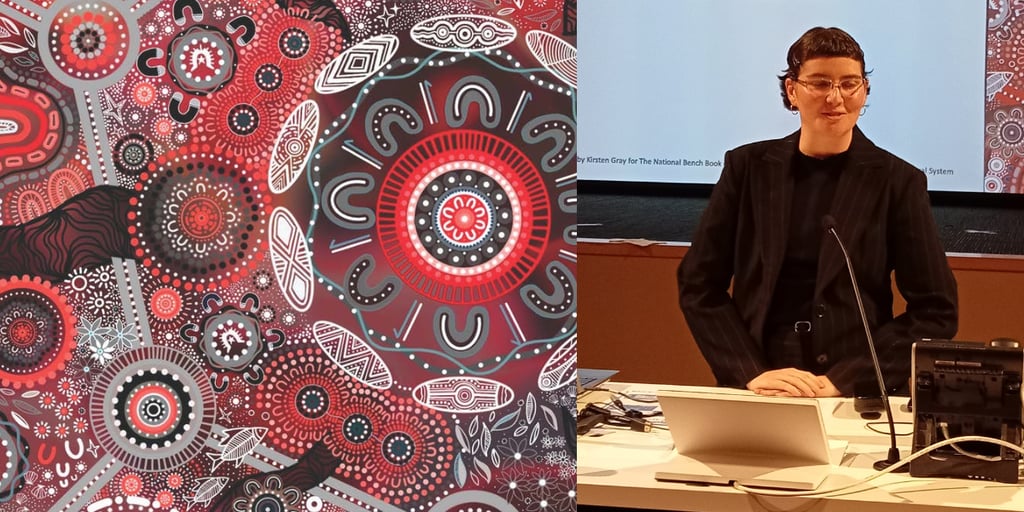
On the 8th of July 2026, the National Bench Book on Aboriginal and Torres Strait Islander Peoples and the Legal System was officially launched at UTS’ Guthrie Theatre.
The Bench Book was formulated through countless consultations with communities to gauge the relationship between First Nations people and the legal system; to ensure that First Nations’ voices were at the centre.
Michelle Toy emphasised how a lack of understanding of the judicial system shapes First Nations people’s experience within it, and, conversely, how a lack of understanding and cultural sensitivity by legal practitioners shapes sentencing and judgements in First Nations cases.
Having taken close to ten years to realise from concept to publication, the Bench Book stands as a project of great significance. The Bench Book is a living document which relies upon feedback- providing chapters of storytelling, case summaries, Indigenous-led critiques and additional resources.
In attendance were the Honourable Justice Dina Yehia and Tony McAvoy SC, two titans of their field- the latter specialising in native title and land rights. Justice Yehia stated that the Bench Book was a ‘Mammoth and Historic Achievement, [it is] a comprehensive resource’.
Alongside utilising First Nations perspectives to cover criminal law, native title, and intellectual property, just to name a few, Justice Yehia believes that the resource aligns with other ongoing projects and initiatives in the justice system. A work of this collaborative force demonstrates the achievements of ‘working together rather than working in silos’.
Tony McAvoy SC concluded the launch by underscoring the Bench Book’s legislative significance and its practical application. McAvoy drew on several landmark cases, ‘relics of the system brought here,’ a system that ruled Aboriginal people incompetent to testify due to a misguided belief of an absence of faith in God and divine sanction from lying under oath.
In coming to think of what the Bench Book might be able to do, just like Mabo [did] 30 years ago, we will look back on how justice can better serve all people. We see perhaps the notion that we prosecuted children with neurocognitive disabilities on the basis that they were criminally culpable as barbaric. The National Bench Book earmarks an Advancement of the legal system, putting these issues to rest.

News
Racism register wins federal government backing
The Call it Out register will receive an up to $2 million boost from the Australian Government.

News
What three million online posts reveal about anti‑First Nations hate in Australia
A new study examining online hate during the so-called March for Australia rallies found white supremacy was rife. But there are patterns we can see to help...

News
Indigenous Data Sovereignty: All In for the Stewardship of Cultural Knowledge
In her Oration, Kirsten challenged the audience to see data as more than records and statistics, highlighting its deep connections to people, community and...

News
Indigenous child protection is often a political football. Here’s what would actually help
If governments are serious about protecting Aboriginal children, they need to stop treating culture as a competing concern.
News
Racism register wins federal government backing
The Call it Out register will receive an up to $2 million boost from the Australian Government.
News
What three million online posts reveal about anti‑First Nations hate in Australia
A new study examining online hate during the so-called March for Australia rallies found white supremacy was rife. But there are patterns we can see to help...
News
Indigenous Data Sovereignty: All In for the Stewardship of Cultural Knowledge
In her Oration, Kirsten challenged the audience to see data as more than records and statistics, highlighting its deep connections to people, community and...
News
Indigenous child protection is often a political football. Here’s what would actually help
If governments are serious about protecting Aboriginal children, they need to stop treating culture as a competing concern.