


- Posted on 26 May 2026
- 4-minute read
From the ping of a sweetly hit golf shot to unravelling the origins of the universe, the measurement of vibrations in distant objects using the light from lasers has impacted all our lives.
A new review has been published of the past, present and future of laser Doppler vibrometry.
Published in the influential Nature Reviews Methods Primers, the review was written by an international team that included Associate Professor Benjamin Halkon from the UTS Centre for Audio, Acoustics and Vibration and School of Mechanical and Mechatronic Engineering.
“Instruments such as laser vibrometers have been around since shortly after the advent of the laser. Since then, they have revolutionised the things we can do in mechanical engineering to help us design anything from smartphones to cars and satellites,” said Associate Professor Halkon.
“Making a call on a smartphone doesn't happen without vibrometry. Smartphone 5G filters are made and tuned using microscope-based laser vibrometers to define the way that the acoustic wave moves through the electro-mechanical system within the phone.
“Gravitational waves are measured using a huge kilometre-scale interferometer – like what's inside a laser Doppler vibrometer – so the approach even helps us find out about the origins of the universe.”
Laser Doppler vibrometers are devices that measure the vibration of an object by collecting the light from a laser beam scattered by it, the colour of the light which is changed due to the Doppler effect – similar to the change in pitch we hear as an emergency vehicle siren moves towards or away from us.
They can be used on objects that are extremely small and close (microns across and centimetres away) to large and very far (tens to hundreds of metres away on the Earth’s surface, up to kilometres away in space).
There are myriad industrial applications for the technique across defence, space, agriculture, mining, automotive and process engineering among others.
It is routinely used to design and engineer anything that vibrates or makes noise – including cars, airplanes, white goods, industrial machines and other infrastructure.
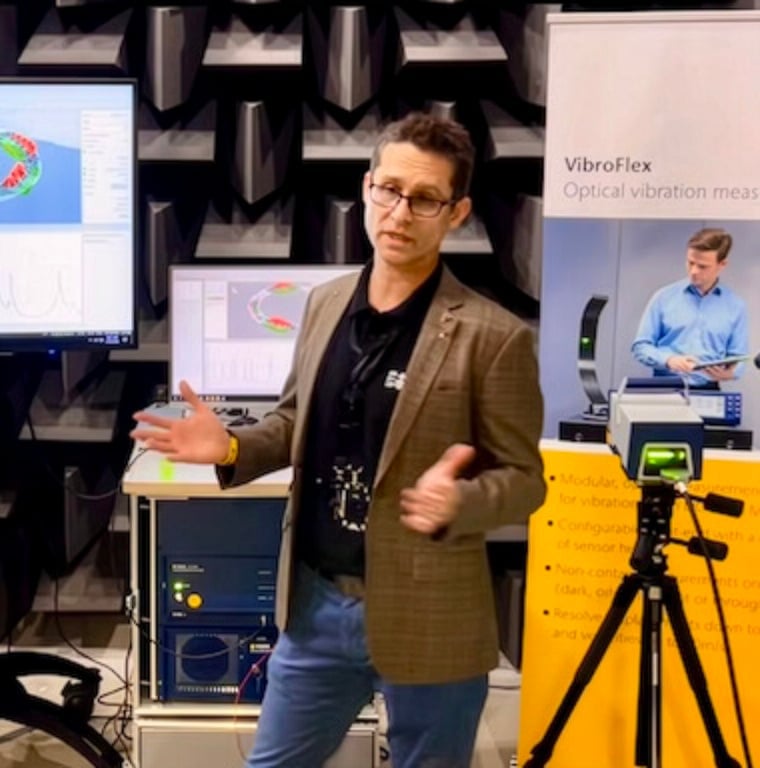
“Laser Doppler vibrometry has revolutionised the things we can do in mechanical engineering to help us design anything from smartphones to cars and satellites.”
Associate Professor Benjamin Halkon
UTS Centre for Audio, Acoustics and Vibration
It has even been used to refine the sounds that electric vehicles and golf clubs make.
“For example, the Callaway Big Bertha™ golf driver clubs from the 1990s were developed using laser vibrometers to measure the vibration of the golf club head and the ball as the impact occurred. The sound that's made – that ‘boom’ when you nail it off the tee – is the result of the funding invested in perfecting that process and engineering the equipment,” said Associate Professor Halkon.
“A further example of the value of the technique is in Formula 1® engines. Special laser vibrometers are needed to measure the motion of valves that operate at very high speeds, essential to producing the high power output that’s needed.”
The technical review covers the fundamentals of the technique from its origins and first principles, explores different versions and adaptations of the technique that have been developed for greater applicability and specific, challenging applications, the implications and considerations for these, and future directions and remaining challenges in the field of vibrometry.
In particular, it identifies a number of areas where the technology can be applied in future such as mobile measurements, biomedical diagnostics and telecommunications.
“It consolidates the state-of-the-art methodologies like instrumentation principles, experimental design considerations and emerging applications into a single reference article that will be useful across multiple engineering and science disciplines,” Associate Professor Halkon said.
Nature Reviews Methods Primers is a peer-reviewed high-impact journal that covers analytical, applied, theoretical and computational methods in the physical and life sciences.
Associate Professor Halkon has spent the past decade at UTS building capability in this field. He has worked projects measuring the vibration of rotating machinery and applying laser Doppler vibrometers in challenging measurement scenarios including within autonomous vehicles.
He has worked to establish the Vibration Lab at UTS Tech Lab in Botany. His work there has focussed on a range of industry applications including remote measurements applicable to security, defence and mining among other domains.
UTS researcher
Associate Professor, Faculty of Engineering & Information Technology

News
National First Nations College update
UTS has been working towards building a National First Nations College, an Indigenous-designed, culturally responsive residential community where students can...
News
After neoliberalism – what comes next?
A Trump-led post-neoliberal world order, dominated by four or five powerful nations, could dismantle decades of international cooperation in favour of...

News
Beyond Hormuz: US-China energy competition and what it means for Australia
The disruption to global energy markets caused by the conflict around the Strait of Hormuz has highlighted vulnerabilities that extend well beyond the...

News
Professor Catherine Kelly appointed Dean of Law
UTS is delighted to welcome Professor Catherine Kelly as our new Dean of the Faculty of Law.
News
National First Nations College update
UTS has been working towards building a National First Nations College, an Indigenous-designed, culturally responsive residential community where students can...
News
After neoliberalism – what comes next?
A Trump-led post-neoliberal world order, dominated by four or five powerful nations, could dismantle decades of international cooperation in favour of...
News
Beyond Hormuz: US-China energy competition and what it means for Australia
The disruption to global energy markets caused by the conflict around the Strait of Hormuz has highlighted vulnerabilities that extend well beyond the...
News
Professor Catherine Kelly appointed Dean of Law
UTS is delighted to welcome Professor Catherine Kelly as our new Dean of the Faculty of Law.