


- Posted on 13 Apr 2026
- 4-minute read
China stands to be impacted first, as the main buyer of Iran’s crude oil. But if the blockade drags on, its knock-on effects could impact the whole world.
For weeks now, the world economy has been on tenterhooks, waiting for one outcome: reopening the Strait of Hormuz.
In response to war with Israel and the United States, Iran has effectively closed the narrow waterway, through which about a fifth of the world’s oil and gas normally passes.
Some ships have passed through the strait during the war, but largely on Iran’s terms, including by reportedly paying tolls for safe passage.
Opening the strait back up to all shipping traffic was a key condition of the two-week ceasefire agreed to last week. But after “marathon” talks between the US and Iran failed to result in a deal on the weekend, US President Donald Trump used a Truth Social post to announce a major escalation:
Effective immediately, the United States Navy, the Finest in the World, will begin the process of BLOCKADING any and all Ships trying to enter, or leave, the Strait of Hormuz.
US Central Command later confirmed a blockade on all Iranian ports would begin on April 13 at 10am eastern time in the US.
The idea is to put severe pressure on the Iranian economy by restricting its exports, and force the country to allow all shipping through. But Iran – a major exporter of oil and gas – warned the global economy would pay.
So, under pressure to get oil and gas flowing again, why is the US blockading the Strait of Hormuz? What impacts could this have on the world?
Iran’s reliance on oil
According to the International Energy Agency (IEA), Iran produced 3.59 million barrels of crude oil per day in February (before war broke out).
In 2025, global crude oil demand was about 105 million barrels per day. That means Iran’s production accounts for about 3.5% of global demand – significant enough to influence global oil economy.
Iran’s economy is overwhelmingly dependent on oil and gas, especially crude oil, which accounted for 57% of the country’s total export revenue in 2024.
China is the main buyer, receiving about 90% of Iran’s oil exports in 2024. Other buyers include Syria (3.3%) and UAE (2%). Iraq, Turkey, Malaysia, and Oman bought less than 1% of Iranian oil exports.
Iran also exports petrochemicals products, such as methanol, urea, polyethylene and ammonia.
How the blockade will work
US Central Command has announced the blockade will target all vessels entering or departing Iranian ports and coastal areas.
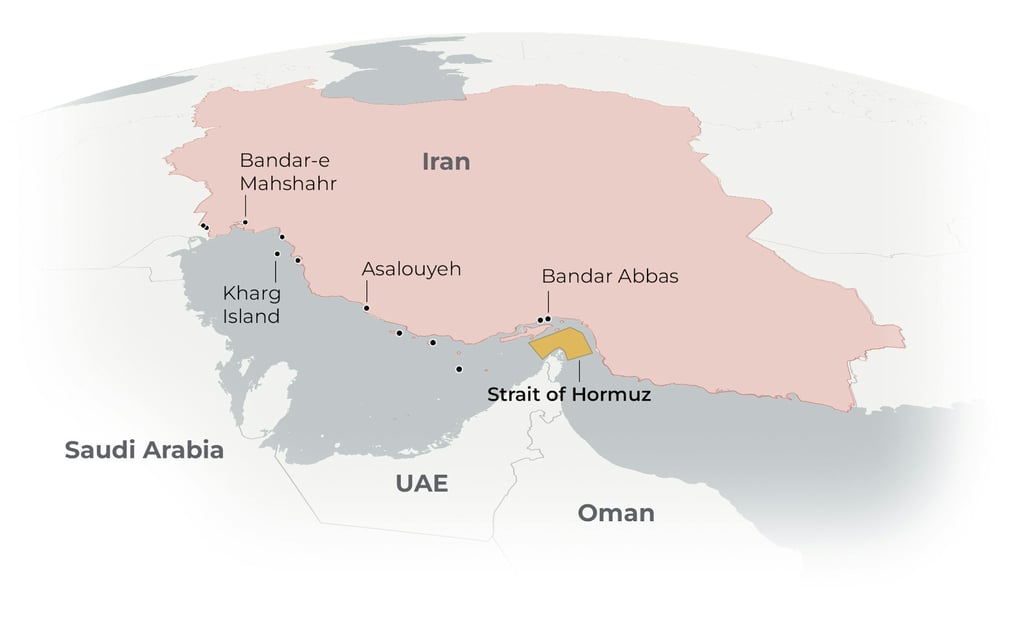
Iran has 11 major ports. Eight of them are in the Southern region in Arabian Gulf and Gulf of Oman regions and three in the Caspian Sea (North) for regional trade.
Iranian ports located in these regions are set to be impacted by the targeted blockade. This includes the port in Kharg Island that handles about 90% of the country’s crude exports.
What will the impacts be?
Oil prices rose again on the news, having fallen when a ceasefire was announced last week.
Trump isn’t planning a permanent blockade. As he stated in his Truth Social post announcing the the move:
At some point, we will reach an “ALL BEING ALLOWED TO GO IN, ALL BEING ALLOWED TO GO OUT” basis but Iran has not allowed that to happen […] No one who pays an illegal toll will have safe passage on the high seas.
But it’s difficult to predict how long a blockade would last, how successful it would be, and the extent to which shipping would be affected.
China will be impacted first, as the main buyer of Iran’s crude oil. The knock-on effects may create a chronic shortage of oil and contribute to higher oil prices in the global market.
Adding to this, many Gulf countries typically import key materials and food products from Iran. For example, in 2022, the United Arab Emirates imported mineral fuels, oils, distillation products, organic chemicals, iron and steel, copper and fertilisers from Iran.
Oman and Qatar also import key materials and food products, such as steel, iron, construction materials, petrochemicals, agricultural products, and fruits.
Pressure on farming
Urea, a crucial fertiliser used for farming, deserves a special mention. Iran is a major producer of urea and is the largest exporter in the Gulf region.
Farmers around the world are already under pressure as the conflict puts severe strain on global fertiliser supplies.
Even if they don’t get fertiliser from Iran directly, countries such as Brazil, India, and Australia could be impacted from the flow-on effects of disruption to the fertiliser supply chain.
A tense wait
After failed peace talks, Trump says he is moving to stop Iran’s “world extortion” – referring primarily to charging ships for safe passage through the Strait of Hormuz. But the knock-on effects of a US blockade could create new costs for the global economy.
For countries around the world, the unpredictability further strengthens the case for diversifying crude oil sources and investing in their own refining capability.
In the longer term, greater adoption of renewable energy and electrification of transportation, manufacturing and logistics systems can help a country to become less reliant on oil.
Authored by

Associate Professor, Business School
The Conversation
This article is republished from The Conversation under a Creative Commons license.
News by topic
News
Professor Catherine Kelly appointed Dean of Law
UTS is delighted to welcome Professor Catherine Kelly as our new Dean of the Faculty of Law.
News
AI improves long-term flood forecasting
Through the power of advanced artificial intelligence, UTS research could help communities get warnings weeks ahead of floods.
News
What can free‑living Indian street dogs teach us about how to care for pet dogs?
A study of how Indian street dogs live raises questions about what it means to care for pet dogs.

News
La Bola Negra is about the Spanish Civil War – but is unmistakably about our present moment
Set across 1932, 1937 and 2017, new Spanish film La Bola Negra follows three gay men whose lives become connected across generations.
News
Professor Catherine Kelly appointed Dean of Law
UTS is delighted to welcome Professor Catherine Kelly as our new Dean of the Faculty of Law.
News
AI improves long-term flood forecasting
Through the power of advanced artificial intelligence, UTS research could help communities get warnings weeks ahead of floods.
News
What can free‑living Indian street dogs teach us about how to care for pet dogs?
A study of how Indian street dogs live raises questions about what it means to care for pet dogs.
News
La Bola Negra is about the Spanish Civil War – but is unmistakably about our present moment
Set across 1932, 1937 and 2017, new Spanish film La Bola Negra follows three gay men whose lives become connected across generations.