


- Posted on 15 Apr 2026
- 3-minute read
New research sheds light on a crisis facing new and emerging Australian artists.
In September, the Australian Recording Industry Association (ARIA) excluded catalogue music (recordings more than two years old) from the Australian bestseller single and album charts.
From a marketing perspective this decision is logical, as it creates room to expose new recordings to the market. However, it also obscures the reality of the new music economy in Australia.
My latest research – which looks at new music releases in Australia from 2000 to 2024 – shows a significant decline in the sale of new music since the adoption of music streaming.
These findings point to a crisis for new and emerging artists in the Australian market.
The new music market is shrinking
In 2017, music streaming platforms, led by Spotify, became the dominant form of recorded music distribution in Australia. The shift from a purchase-based (CDs, vinyl and downloads) to an access-based (streaming) economy represented a fundamental change in the music business.
Streaming platforms, with close to unlimited repertoire, enable and encourage passive listening via playlists and algorithmic recommendation. The result is that catalogue music has become the mainstay of the recorded music industry.
From 2000 to 2018, new release music made up 99% of the ARIA annual top 100 singles, and 78% of the top 100 albums. But from 2022 to 2024, these figures dropped to 62% and 28%, respectively.
The data indicate that since 2000, new music revenue in Australia has declined by 55% in actual and 71% in inflation-adjusted value.
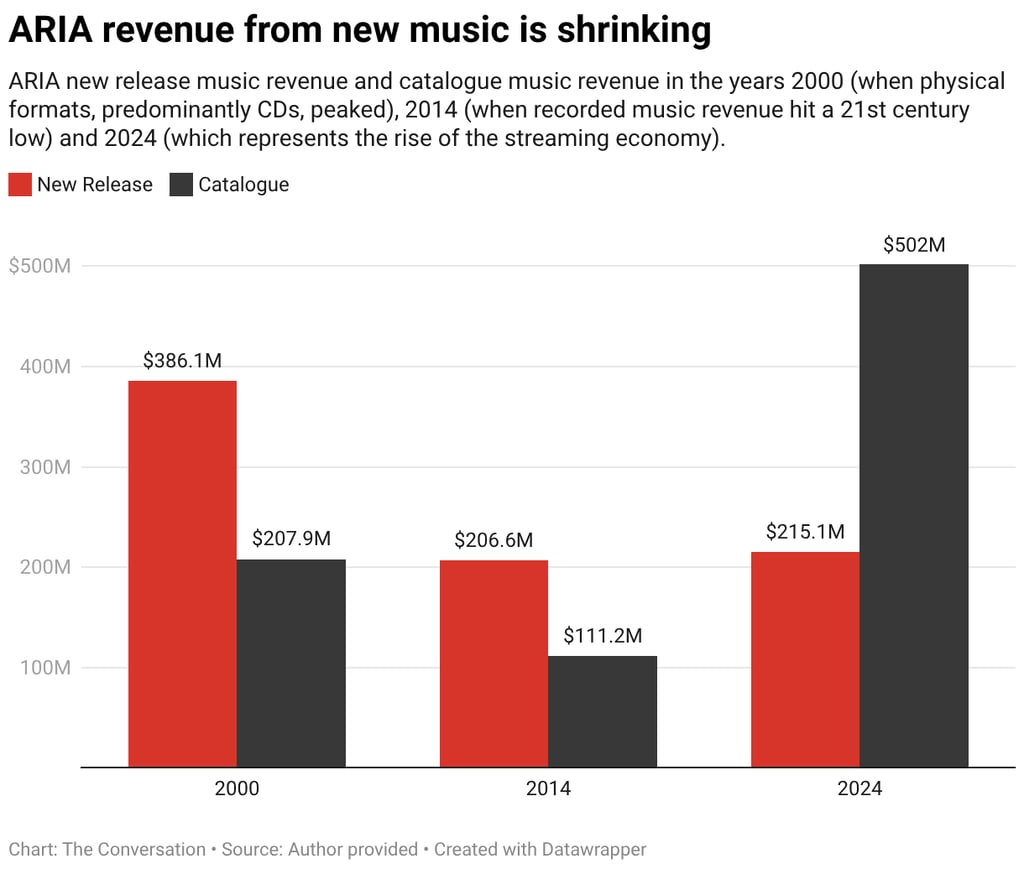
The rise of streaming has led to us spending more on music overall, but less of this is going to new music. My estimates suggest new music revenues in Australia have grown by just 4% since 2014, in a market that has doubled in value.
A similar trend is evident overseas. In the United States, new music accounted for an estimated 65% of recorded music revenue in the pre-streaming economy, compared to 25–30% post-streaming.
New talent can’t rely on industry
From an Australian perspective, the challenges for new music have created concern about pathways for emerging artists, and the music industry’s commitment to developing them.
Industry insiders I interviewed for the research highlighted how labels were playing a diminishing role in artist development.
The stress on the new music economy – combined with the reduced presence of Australian artists in the ARIA charts – has led to ongoing calls for the government to support the industry via cultural policy initiatives.
The recorded music industry also has a role to play in addressing the environment which it helped to create – particularly in regards to how artists are remunerated.
The current “pro-rata” model used by streaming platforms places equal value on all streams, regardless of whether it is a catalogue track or new release. Under this model, there is no business incentive to prioritise new music.
Adjusting this model, so that new releases are valued higher than catalogue music, could create this incentive.
Major labels will likely resist change, as they reap the rewards of selling back catalogue at pure profit. But the idea of valuing new music over catalogue is not new.
Before the streaming era, new release CDs were sold at full price and catalogue CDs were often sold at mid-price. This model reflected the costs associated with developing new products and provided business incentive by attaching greater profit margins to new releases.
Prioritising long-term industry health
Australia’s new music economy has experienced significant revenue decline and reduced industry commitment to new and emerging artists.
For independent labels, which are largely dependent on new release revenue, the ability to compete in a catalogue market is limited. For artists, the lack of pathways to earning revenue may lead to disconnection with the sector.
The role of Australian major record labels as generators of local talent is also in question.
In addition to policy, a business incentive for record labels to invest in new music could enable the long-term health of the sector.
Authored by:
Tim Kelly, PhD Candidate, UTS Faculty of Design and Society
The Conversation
This article is republished from The Conversation under a Creative Commons license.
News by topic

News
Professor Catherine Kelly appointed Dean of Law
UTS is delighted to welcome Professor Catherine Kelly as our new Dean of the Faculty of Law.

News
AI improves long-term flood forecasting
Through the power of advanced artificial intelligence, UTS research could help communities get warnings weeks ahead of floods.

News
What can free‑living Indian street dogs teach us about how to care for pet dogs?
A study of how Indian street dogs live raises questions about what it means to care for pet dogs.

News
La Bola Negra is about the Spanish Civil War – but is unmistakably about our present moment
Set across 1932, 1937 and 2017, new Spanish film La Bola Negra follows three gay men whose lives become connected across generations.
News
Professor Catherine Kelly appointed Dean of Law
UTS is delighted to welcome Professor Catherine Kelly as our new Dean of the Faculty of Law.
News
AI improves long-term flood forecasting
Through the power of advanced artificial intelligence, UTS research could help communities get warnings weeks ahead of floods.
News
What can free‑living Indian street dogs teach us about how to care for pet dogs?
A study of how Indian street dogs live raises questions about what it means to care for pet dogs.
News
La Bola Negra is about the Spanish Civil War – but is unmistakably about our present moment
Set across 1932, 1937 and 2017, new Spanish film La Bola Negra follows three gay men whose lives become connected across generations.