• Posted on 19 Mar 2026
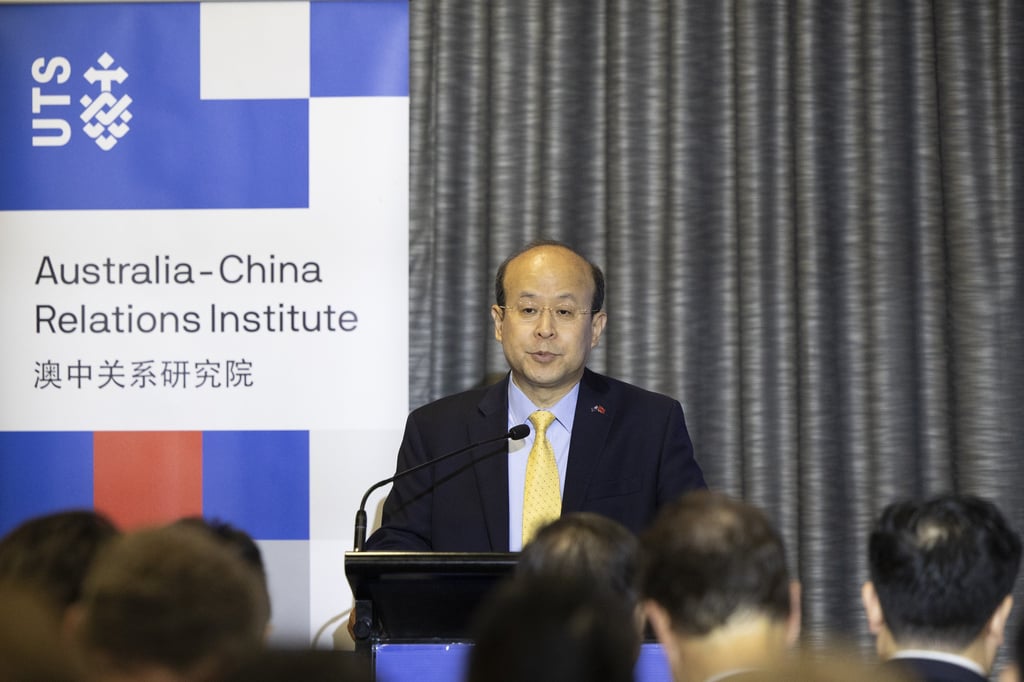
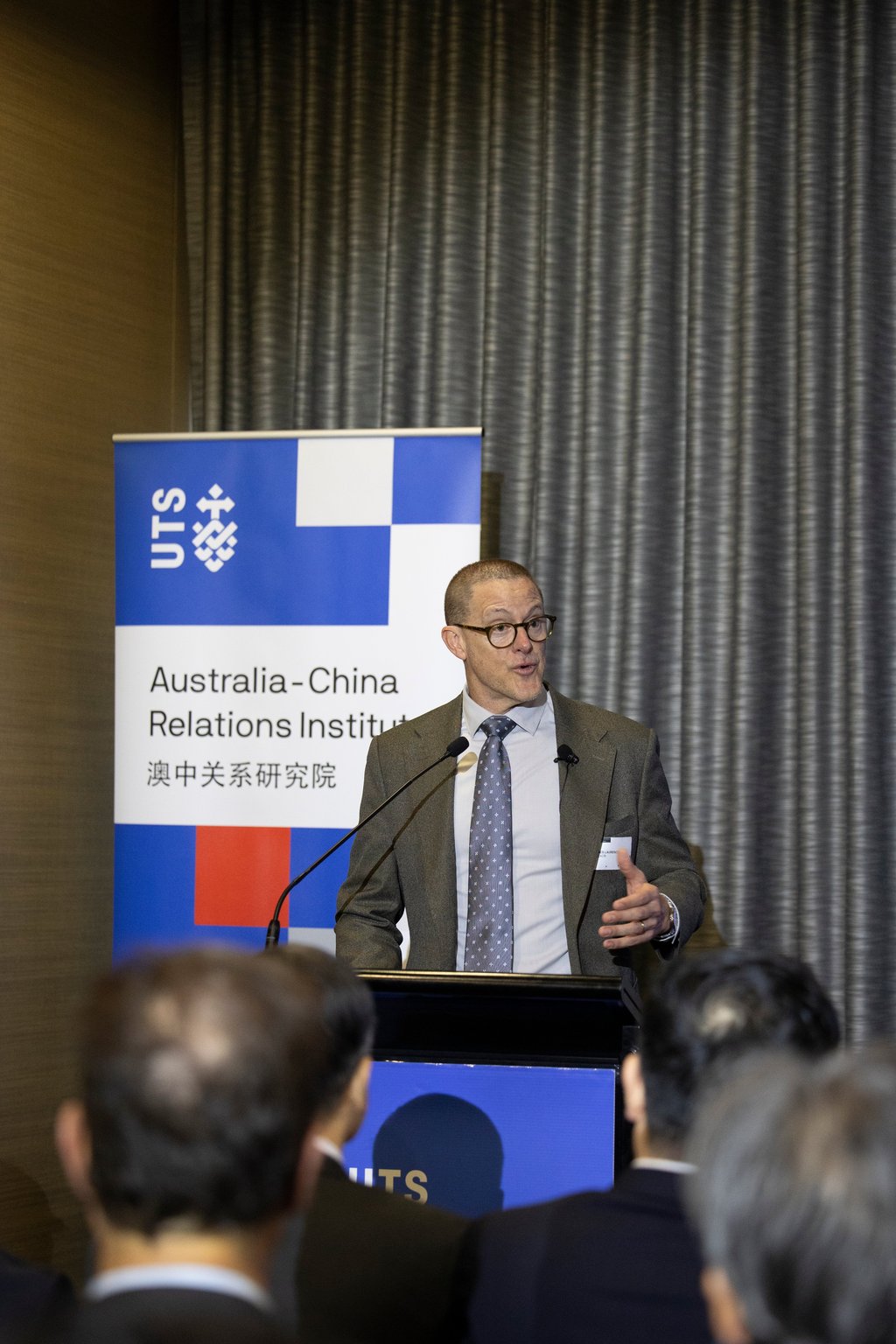
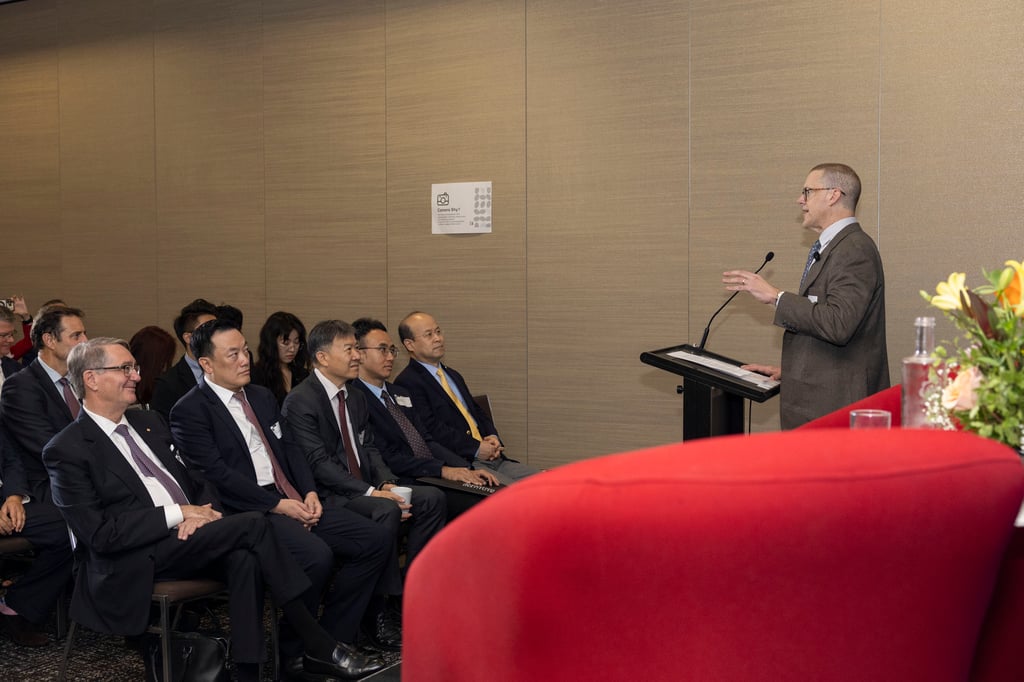
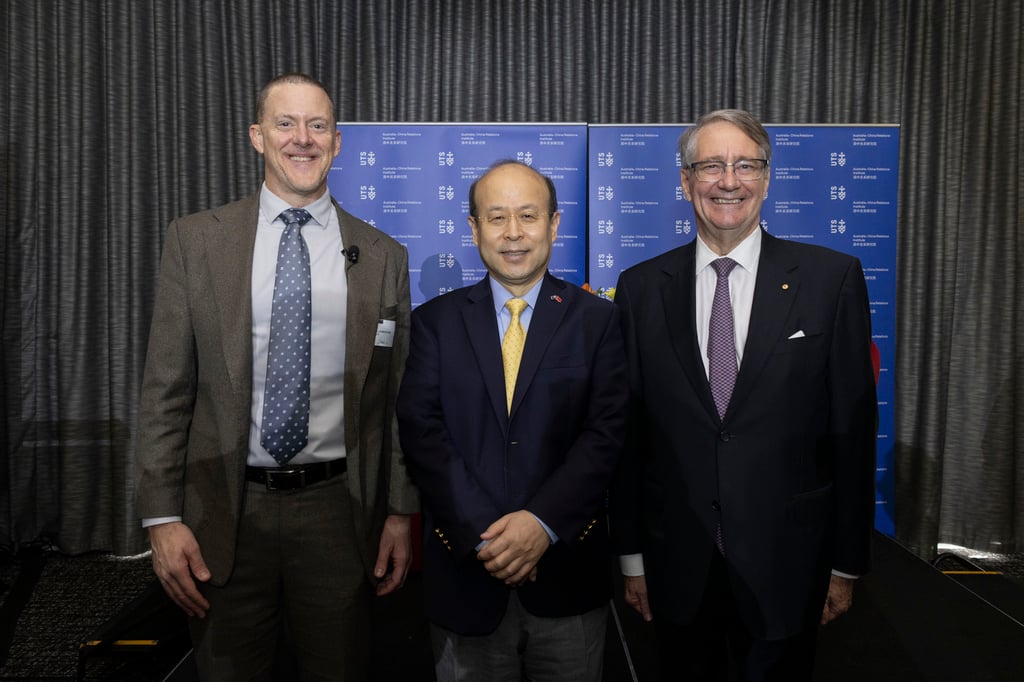
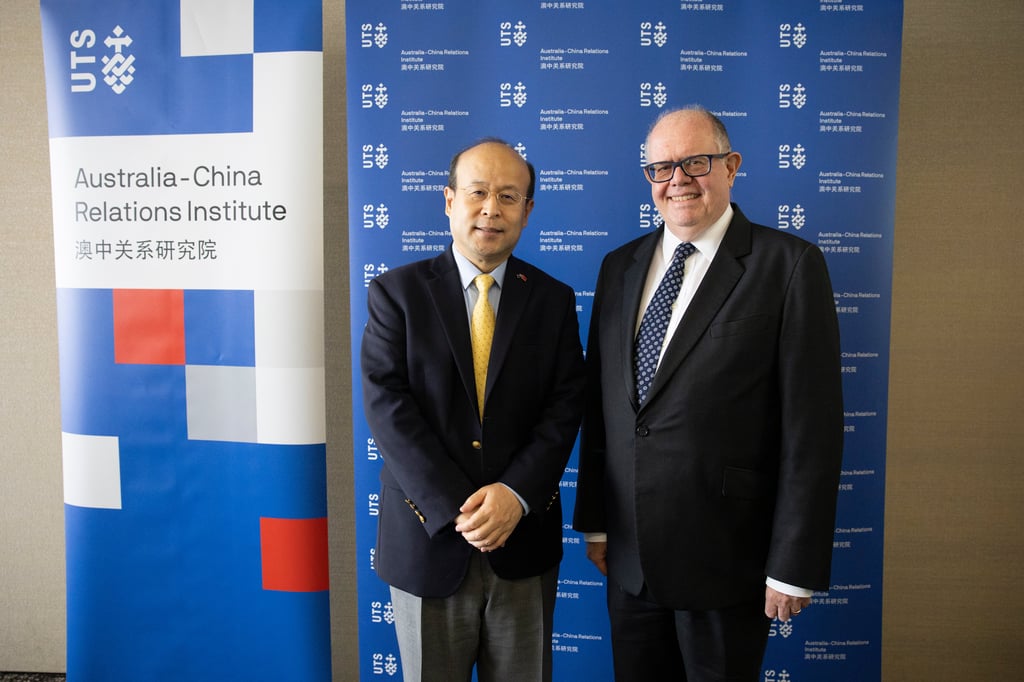
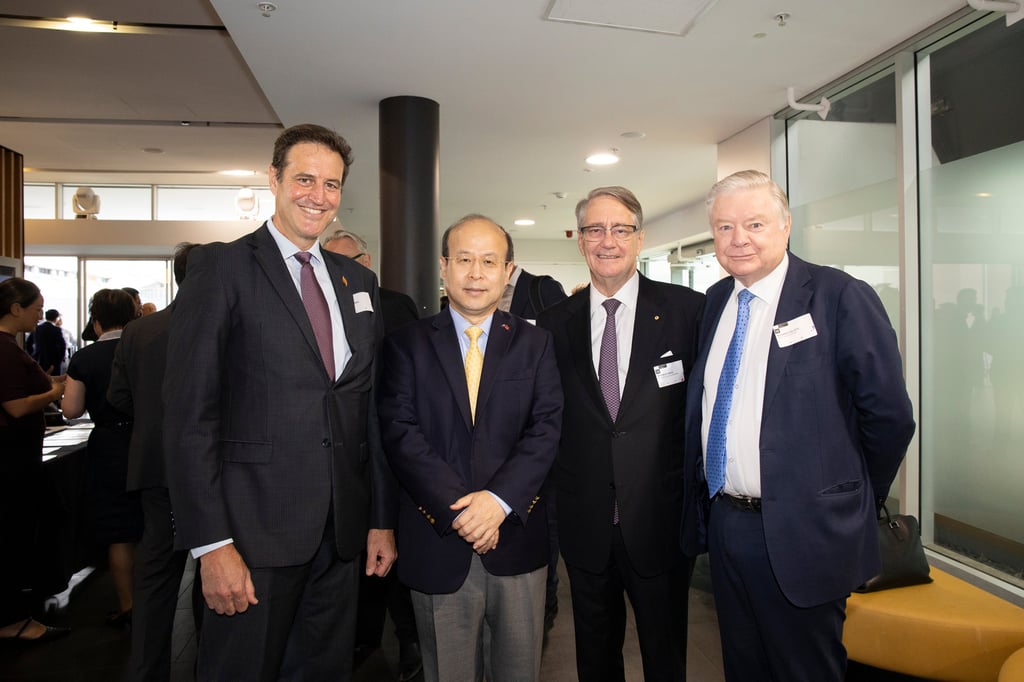
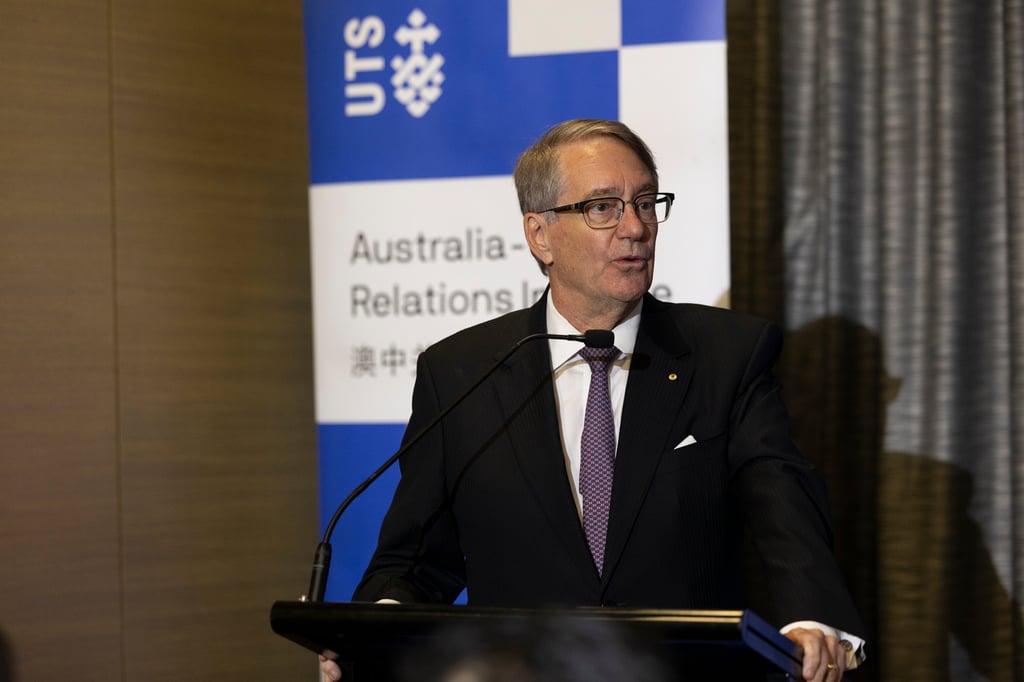
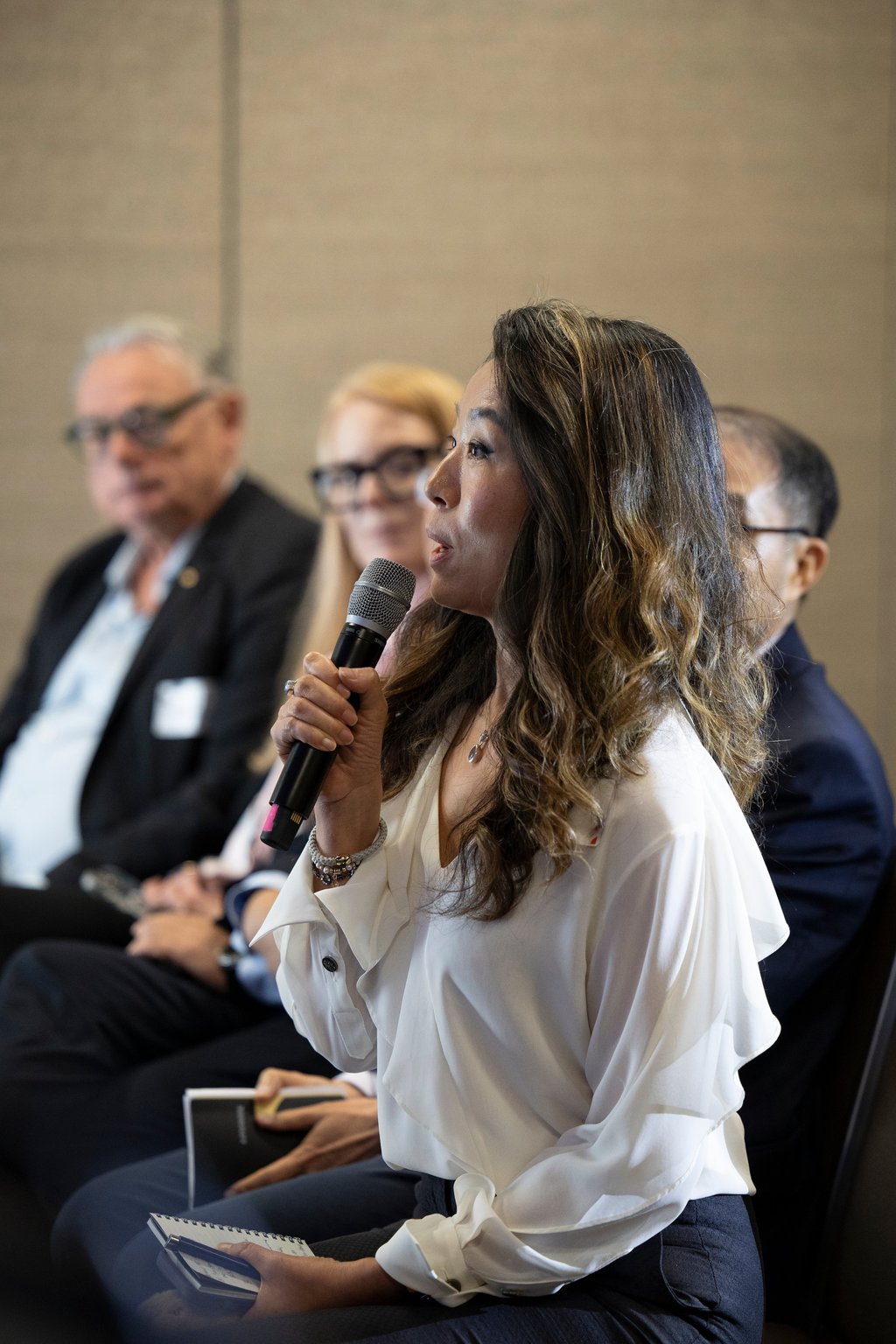
H.E. Xiao Qian, Ambassador of the People's Republic of China to Australia, addresses an event hosted by the Australia-China Relations Institute at the University of Technology Sydney on March 19 2026.

Video

(01:31:22)

Video transcript

UTS:ACRI address: H.E. Xiao Qian, Ambassador of the People's Republic of China to Australia

March 19 2026

UTS Aerial Function Centre

E&OE | Check against delivery


Professor James Laurenceson:

Good morning all. Before we begin today, and on behalf of all those present, I would like to acknowledge the Gadigal people of the Eora Nation, on whose ancestral lands this beautiful UTS City Campus stands. I would like to pay my respects to elders past and present, acknowledging them as the traditional custodians of knowledge for this land.

My name is James Laurenceson. I'm the director of the Australia-China Relations Institute here at the University of Technology Sydney, UTS:ACRI. UTS:ACRI is Australia's first and still only research centre that is focused on informing the bilateral relationship between Australia and China.

Our mission is simple: to inform Australia's engagement with China through research, analysis, and dialogue that is grounded in scholarly rigor. Much gets said about China and Australia. Much gets said about Australia's engagement with China. Our job is to bring more facts, more evidence, and more relevant context to that discussion.

Apart from friends of UTS:ACRI here today, can I send a particular welcome to - I know we have many members of the Australia-China Business Council and the China Chamber of Commerce in Australia. Welcome to you folks. I have enormous admiration for your organisations. I think you're critical to bringing insight and resilience to what is Australia's most important economic relationship.

After I invited our special guest today to be with us, and he generously offered to give us one and a half hours of his valuable time, I knew this would be a popular session. But, quite honestly, I didn't quite realise how popular it would be. We originally envisaged about 50 to 60 attendees, but very quickly we started getting emails and messages, and the registration list quickly expanded out to close to 100.

I just hope my boss will agree to cover the associated increase in costs. Otherwise, I may have to get you to make a donation on your way out today.

The structure of today's event is pretty straightforward. Very soon, I will invite our special guest to deliver an address for about 20 minutes. He's then agreed to join me in conversation for half an hour. Then even better, we'll still have half an hour where the ambassador has agreed to take your questions. I think in half an hour, we can cover a lot of ground indeed.

A very brief introduction because, frankly, I don't think he really needs an introduction. Ambassador Xiao Qian has had a four-decade diplomatic career in China's Ministry of Foreign Affairs.

Prior to arriving in Australia in January 2022, I remember that well, he served as China's Ambassador to Indonesia from 2017 to 2021, and prior to that, China's Ambassador to Hungary from 2012 to 2015. Ambassador Xiao, it was our pleasure to host you for your first big public address when you arrived back in 2022 and it is again our pleasure to host you today. I welcome you to the podium to deliver your address. Please welcome Ambassador Xiao.

H.E. Ambassador Xiao Qian:

Well, it's always a great pleasure to be back here in the UTS:ACRI. The special reason for that, four years ago when I came here as a Chinese ambassador, this is a platform that offered to me for my first engagement with the general public, not only from UTS but also from perhaps different sectors of Australia. That was a very interesting occasion, and it helped me for a quick and a very effective understanding of the situation, the atmosphere at that time, and people's worries and concerns and expectations about our relationship.

Here again, I thank the kind invitation from James. We're good friends. We meet frequently and we talk about our relationship. I appreciate the role that ACRI has been playing in facilitating the mission understanding a bit on two sides.

I'm so happy to see so many old friends, Warwick. By the way, Warwick Smith is not one of the, the first Australian that I met after my arrival in Canberra four years ago.

Thanks for your kind instruction four years ago about Australia, about China's relationship, and about ACBC and many other institutions that've been so important to our bilateral ties. And so happy to see many other colleagues, including my dear colleague, Consul-General Wang Yu, based in Sydney. Well, I feel great honour to share with you about my views, our bilateral ties, and I'll be happy to pick up questions that could cover both bilateral and perhaps regional and global issues.

Well, dear colleagues and friends, the year 2025 saw increased turbulences and transformation in the world, as well as growing instability and uncertainty. So against this background, China-Australia relations withstood numerous tests, and our comprehensive strategic partnership smoothly entered into its second decade, demonstrating greater momentum and a stronger resilience.

Recently, many Australian friends have asked for my view and vision of China-Australia relations in this new period. I think the most important point is to grasp the broader context in the following three key dimensions. First, the international landscape is marked by instability and uncertainty, but crisis also harbour opportunity.

Over the past year, the international landscape has become more turbulent, of course, with the law of the jungle and unilateralism gaining ground, bringing the cost of peace and development for humanity to a new crossroads. Some countries have amplified differences, pursued on broad confrontation, and even revived Cold War mentalities, thus undermining the foundation of trust and poisoning the atmosphere for cooperation. Even today, we have more than 60 conflicts. More than 60 conflicts continue to range worldwide. In particular, the escalating conflict in the Middle East and the Gulf Region is increasingly spilling over globally.

President Xi Jinping put forward the vision of common, comprehensive, cooperative, and sustainable security which points the way forward. All parties should promote talks for peace, oppose incitement, and resolve conflicts through mediation and dialogue. Amid rapid changes in the world not seen in a century, and with the global south rising collectively and the middle powers like Australia making their voices heard, the global governance system must evolve with the times, promote greater democracy in international relations, and ensure that global affairs are discussed by all and that the future of the world is shaped by all.

Second, China keeps forging ahead with its development on all fronts. Amid a global economic slowdown, China's GDP exceeded 140 trillion yuan last year and is projected to increase by six trillion yuan this year, equivalent to the annual GDP of a developed economy.

Facing growing uncertainties in the global energy landscape, China contributed to more than 50 percent of the world's new renewable energy's capacity and will further develop non-fossil energy with greater intensity, accelerate the shift towards new and green energy sources, and advance decarbonisation and green growth across industries.

China is also making significant strides in frontier technologies such as large language models and humanoid robots, and has entered the top 10 in the global innovation index ranking for the first time. As a major trading partner of more than 150 countries in the world and regions, China continues to open its doors and share opportunities with the world, remaining the most stable and reliable engine for global growth.

Third, China-Australia relations are advancing steadily, and the time is right for further progress. Over the past few years, China-Australia relationship have emerged from a low point. Stabilised, achieved a comprehensive, fruitful turnaround.

The key to this has been the strategic guidance and steady steering provided by the leaders of our two countries. President Xi Jinping and Prime Minister Anthony Albanese have met four times, agreeing to stay committed to mutual respect, seeking common ground while sharing differences and win-win cooperation. Our prime ministers, or the Australian Prime Minister and Chinese Premier, have successfully exchanged visits. And following the visit to China by the Senate President of Australia, the Chairman of China's National People's Congress Standing Committee visited Australia for the first time in last 20 years.

Dialogue and exchange of mechanisms across various views between China and Australia have been reactivated. Practical cooperation deepened when people-to-people exchanges continued to improve. The increasingly frequent cargo ships and flights between our two countries, the bustling of Australian booths at the China International Import Expos, and the friendly interaction between our peoples in tourist attractions and cyberspace all serve as proof. The facts show that the time is right to steadily and sustainably advance the China-Australia comprehensive strategic partnership.

Ladies and gentlemen, dear friends, the recently concluded two sessions in China witnessed the conclusion of the 14th Five-Year Plan and the commencement of the 15th Five-Year Plan. The international community has been following very closely the implementation of the 14th Five-Year Plan to go to the current state of China's economic development and is looking to the 15th Five-Year Plan to figure out the direction that China is heading to.

China has set its economic growth target for 2026 at a range between 4.5 percent to 5 percent, leaving some room for structural adjustments, risk prevention, and reform, thereby laying a solid foundation for more sustainable developments in the years ahead.

The 15th Five-Year Plan was reviewed and approved at the fourth session of the 14th National People's Congress, and there are three highlights of the plan that I would like to share with you. First, building a future-oriented high-quality industrial system. China has identified high-quality development as a major strategic task.

For the first time, the plan calls for creating new forms of smart economy, and a six plus six industrial metrics is taking shape. Six emerging pillar industries: integrated circuits, aerospace, biomedicine, low-altitude economy, new types of energy restorage, and intelligent robotics. These have already reached an output value near six trillion yuan. It is projected that by 2030, this figure could double or more to surpass 10 trillion yuan.

Six industries of the future: quantum technology, biomanufacturing, green hydrogen, brain computer interfaces, embodied AI, and 6G. They are on the cusp of technology, technological breakthroughs. We're confident that more and more innovations in these areas will capture the world's attention.

Australia's well-positioned to board the train of China's innovation and, together, China, Australia, we can leverage our complimentary strengths, collaborate on research and development, and jointly explore international markets to seize the opportunities for future growth.

Second, developing the world's largest consumer market. Of course, China is already the world's largest market for physical goods. China will further strengthen its large unified domestic market, implement measures to stimulate consumption, and better unleash consumer potential. In terms of investment, China will advance the construction of six key infrastructure networks. Six key infrastructure networks. Water, power, computing power, new-generation telecommunications, urban underground pipelines, and logistics to continuously improve people's living and working conditions.

Additionally, China will step up efforts against monopolies and unfair competition, strengthen fair competition, review mechanisms, deepen reforms to curb rat race competition, and foster a sound market ecosystem. This will provide broader, fairer, and more efficient market access for Australian's mineral resources and distinguishing agricultural products such as lobster, beef, et cetera.

Third, expanding high standard opening up. Over the next five years, China will focus on expanding market access and opening up, particularly in the services sector. Pilot initiatives will be further extended in areas such as the value-added telecommunications, biotechnology, and wholly foreign-owned hospitals, while ensuring national treatment for foreign-funded enterprises. China will launch more accelerators of high standard opening up, expand its network of high standard free trade zones, and ensure stable and unblocked industrial and supply chains.

We will also facilitate faster personnel exchanges, having already granted unilateral visa-free entry to passport holders from 50 countries, including Australia, and build new bridges for open and integrated development, helping various Chinese government departments and the localities better access international resources. Countries around the world, including Australia, will have even greater opportunities to participate in China's economic development and share in the benefits of its growing market.

Ladies and gentlemen, friends, as the ancient Chinese saying goes, when an opportunity strikes, one must seize it. Looking back on the more than half century journey of China-Australia diplomatic relations, despite twists and turns and ups and downs along the way, both sides have consistently assessed the situation, seized opportunities, sought common grounds, and resolved differences. The overarching theme of our bilateral ties has always been mutual benefit.

Looking ahead, a healthy and stable China-Australia relationship serves the fundamental interests of both countries and people. We should earnestly implement the important common standings, reached our leaders, work together in the same direction, and strive to make 2026 a year of progress and harvest in China-Australia relations, ensuring that the shift of our bilateral ties stays on course, maintains momentum, and forges steadily ahead.

First, we should foster a right perception of each other and dispel distractions. The trajectory of China-Australia relations in recent years demonstrated that how we perceive each other and how we handle differences are fundamental to our bilateral relationship. China's stance has been consistent. In our view, China, Australia, we are friends, not adversaries. We're partners, not competitors.

Recent posts by several Australian think tanks also show that a majority of Australians support expanding mutually beneficial cooperation between Australia and China, and this fully reflects the growing consensus in Australia on fostering friendly ties with China and highlights the broad public expectation for such a relationship. However, there remain voices clouded by uncertain occasions, a little bit of arrogance and prejudice, viewing China through a distorted lens or somewhat outdated perspective.

Going forward, both sides should continue to enhance strategic mutual trust, work to lengthen the list of cooperation and shorten the list of problems, strive for more progress and build a more mature, stable, and fruitful China-Australia comprehensive strategic partnership, so as to bring more benefits to our two peoples.

Second, we should manage differences appropriately and avoid crossing red lines. China and Australia differ in social systems, history, culture, ideology, and differences in some areas are inevitable. What matter is to respect each other's core interests and major concerns, adhere to the principle of mutual respect, seeking common ground while sharing reserving differences and treating each other as equals in addressing differences.

China and Australia are fully capable of setting an example of peaceful coexistence and win-win cooperation between countries with different political systems and at different stages of development.

Properly handling the Taiwan question is of particular importance to the healthy and stable development of China-Australia relations. The Taiwan question concerns China's sovereignty and territory integrity and is at the core of China's core interest. Achieving the complete reunification of the country is a stronger aspiration shared by all Chinese people. There's zero room to compromise and not an inch to give on the question of Taiwan. We are ready to work with Australia to respect each other's concerns, prudently manage differences, exclude external interferences, and ensure the sustained, sound, and stable growth of our bilateral relations.

Third, we should promote deeper convergence of interest with unwavering commitment. The economies of China and Australia are highly complimentary, and mutual benefit lies at the very heart of our relationship. China has been Australia's largest trading partner, largest export destination, and the largest source of imports for 17 consecutive years.

Last year, bilateral trade exceeded $300 billion Australian dollars. Both sides are currently reviewing the China-Australia FTA, Free Trade Agreement, and we are exploring its further upgrade. China is ready to better align development strategies with Australia, support Australia's productivity growth with high-quality development, enhance cooperation in high-speed rail infrastructure, new energy vehicles, and other emerging sectors, and actively foster collaboration in industries of the future such as artificial intelligence, quantum technology, and life sciences among others, thus contributing to the Future Made in Australia vision.

Four, we should uphold multilateralism with undivided focus. In the world of rising unilateralism and protectionism, China and Australia, as two important countries in Asia-Pacific region, we may enhance coordination and build consensus on international and regional issues.

Strength and collaboration within multilateral frameworks, such as the United Nations, the G20, APEC, adequate multilateralism, jointly safeguard regional peace and stability to defend the international rules-based order and inject more stability and certainty into a turbulent world.

Ladies and gentlemen, dear friends, this year's the Year of the Horse in the Chinese lunar calendar. In Chinese culture, the horse is a symbol associated with diligence, progress, and success.

Let us draw on this on its spirited energy, face challenges head on, seize opportunities, strengths and exchanges, and deepen cooperation with a more proactive and open approach so that China-Australia relationship gallop ahead steadily and travel far. Thank you.

Professor James Laurenceson:

Right on time. Well done. It's great to have a speaker who doesn't go on beyond the time. That was wonderful.

Ambassador Xiao, I want to start off with an observation rather than a question, if you don't mind. And the observation is this. In the 54 years that Australia and China have had formal diplomatic relations, China has had 15 ambassadors posted to Canberra. I'm not sure if you knew that.

H.E. Ambassador Xiao Qian:

Thanks for reminding me.

Professor James Laurenceson:

But here's the key point. You are now the fourth-longest serving, and in five months time, if you're still here, you'll be the second-longest serving. Let's give the Ambassador a hand of applause.

To what do you owe the resilience of your tenure?

H.E. Ambassador Xiao Qian:

It sounds like it's about saying goodbye to my posting here. No, that's not the case, yet. Well, time flies. I've been here as Ambassador for four years now. Two months ago, I started my fourth year.

But up to now, honestly speaking, there's no instruction from Beijing as to when I finish my posting. I finished four years, usually on the master's terms of four years, but I have not received the instruction part when I finish my posting.

And so long as I'm here, I continue to work as hard as I can. I work as hard as I'm in my first year.

Professor James Laurenceson:

Excellent.

H.E. Ambassador Xiao Qian:

Thank you.

Professor James Laurenceson:

Look, in light of your long tenure, and I appreciate in the address today, you talked about a lot of contemporary events. You referenced developments in the Middle East, uncertainty, global uncertainty. You also talked about the two sessions in Beijing very recently.

There's plenty of other day-to-day issues we could talk about. For example, one that's very hot in the Australian press at the moment is fuel supplies coming from China that are being disrupted. So I do want to get to that.

But I also don't want to miss the opportunity after you've been here for four years to sort of raise a head to the horizon a bit and to reflect on your four decades of diplomatic experience to reflect on some broader longer term issues, too.

And don't forget, ladies and gentlemen, after we've been talking for half an hour, you'll also get your opportunity to ask the Ambassador questions for half an hour, any questions you like.

But let me start with this one. Ambassador, when you arrived in Australia in January 2022, you said you were on "a noble mission." And then you said it was to "enhance mutual understanding and trust, eliminate misunderstanding and suspicion."

Now, I won't ask you to give yourself a grade out of 10, but I will ask you, has a degree of difficulty in delivering on that assignment you gave yourself, has it been as expected or has it been more difficult than you expected? I assume it hasn't been easier.

H.E. Ambassador Xiao Qian:

Yeah. No job easy. Well, I think when I reflect on the past four years as ambassador, I very much enjoy my stay here. I've been doing my job and making some humble contribution to our bilateral ties.

As a relations of complexity, there are many things where we share common interests. We have common grounds and we've been cooperating. At the same time, we have different views on certain issues.

And when I came here to say the ties, the relationship was at a very low point. The most difficult period ever since we developed ties in the 1970s.

But through all these four years, my general sense is that our common grounds very much overwhelm our differences. And we've been working on mostly focusing on collaborations while at the same time addressing differences wisely or as wisely as possible.

I think, honest speaking, it's comparatively easier to talk about collaboration and much easier to promote for collaboration. And we need to work much harder to address the differences, but that doesn't mean that we cannot solve those problems.

My approach has been identify our common grounds, focus on the common grounds, and promote for collaboration. This should be the main job for both sides because that is in our mutual interest. But at the same time, communicate for better understanding on our different views.

And if we can resolve differences, that's wonderful. Otherwise, let's be mature and wise enough to manage them wisely so that the difference is not going to define or hijack our overall relationship and the collaboration.

I think the past four years have turned out to be just the case that there is a understanding from both sides that this is the way we should approach in our bilateral ties.

Professor James Laurenceson:

Yeah. I actually distinctly remember, I think it was early on in your tenure, back in 2022, when I remembered hearing you say, "We have differences and we even have disputes."

I didn't actually take that as a negative. I actually thought that was a positive that was being acknowledged and the commitment on both sides was to managing those differences wisely, as our Foreign Minister Penny Wong likes to say.

Ambassador Xiao, you've had a four decade diplomatic career that does not make you old. Okay. That makes you wise and it makes you mature.

H.E. Ambassador Xiao Qian:

I lost all my hair.

Professor James Laurenceson:

Me, too. Join the club. Join the club.

It's crisscross multiple continents and regions, Africa, Europe, Southeast Asia, now Oceania. The question I wanted to ask you is, just reflecting back on your own diplomatic career, what is most different about how Australia thinks about China, or how it responds to China's rise compared with the other countries that you know well?

For example, is it just that Australia thinks about China more because it's our number one economic partner and it's the number one competitor of our security ally, the United States? Or is it perhaps not so much about how much we think about it, but how we frame it given our own history and culture?

What's your perspective on that? What is most different about how Australia thinks about China compared with your other posts?

H.E. Ambassador Xiao Qian:

Well, this is my seventh overseas posting. I've been posting in several other countries in Africa, in Europe, in North America, in Asia, two countries, three countries in Asia.

But here in Australia, in Oceanic region, I think Australia's view on China is somewhat special in a sense that this is a nation composed of mostly people from Europe, but you have most ancestors, Australians are from Europe.

But this country is located in the Oceanic region and they are neighboring Asia, neighboring Asian countries. So people expect Australians to better understand, in a position to better understand and communicate with Asians. And that is true.

So, I think the difference is that you have European history, ideology, political system, all those background. But Australians are looking at China with some Asian elements and I feel it's comparatively easier to communicate because we live in the same region. We are in a broader sense, neighbors, we're in the same neighbourhood of Asia-Pacific.

That is the philosophical point perspective. Otherwise, I think I appreciate the Australian people being very friendly, very hospitable, and certainly very sincere when I communicate, especially when I reach out into the different states and territories, and different cities in the localities.

The farer I'm from the political capital, the stronger I feel the friendship, openness, sincerity.

Professor James Laurenceson:

You're not the only one, Ambassador. That's quite a common...

H.E. Ambassador Xiao Qian:

So that is perhaps the point I want to mention. There are many, many aspects I can talk about. But I think this is a great nation with great people and very friendly.

And what is now lacking behind is a more or better understanding of each other. It takes time, but I'm patient. I continue to do the job of sharing my views and listening to views from Australian friends so that we could have a fortunately better, better understanding mutually and for a better relationship.

Professor James Laurenceson:

Look, I do want to stick with the bilateral relationship, but if I could just squeeze this one in, if I could get a brief reflection, because I think it's an irresistible question to ask you.

You were China's Ambassador to Indonesia before coming here. The Singaporean think tank, the Yusof Ishak Institute reported last year that when Indonesian elites were asked, quote, "If ASEAN were forced to align with one of the strategic rivals, i.e. China or the US, which should it choose?"

72 percent of Indonesians said China. So, very quickly, if I could, Ambassador Xiao, why do you think Indonesians take that view? I mean, Indonesia is a pretty important country for China and Australia. So why do you think Indonesians hold that view?

H.E. Ambassador Xiao Qian:

Well, in the first place, but China and the ASEAN countries, including Indonesia, we are good neighbours. We are in the same neighbourhood, for thousands of years. It's a long tradition of engagement with each other. So we understand Indonesia in a very deep sense, very comprehensive sense.

Second, we do not see the relationship between China and ASEAN countries as a relationship of competitors or rivals or strategic rival. We are partners, we are friends, and we continue to pursue a relationship that can contribute to our friendship, collaboration to regional in that region, particularly peace and tranquility.

That is what's going on in the relationship between China and, each and every ASEAN countries. Indonesia is very unique. Its size, the population, overall power is the number one in the ASEAN countries, and they have a tradition of playing the role of leadership in that regional grouping. So, when we deal with relations with Indonesia, we take that into a background.

But for how Indonesia looks at China, it's my four years ambassadorship in Jakarta tells me that the Indonesians look at China as a friend and partner. And they look at their relations with other countries, other major countries, including Australia, also as a friend and partner.

And if you have heard about this famous Java wisdom, thousand friends, zero enemy. In other words, 1,000 friends is not too many. One enemy is.

And also there's a tradition of non-alignment movement spirit in Indonesia ever since they became independent, many decades, at the end of the Second World War. They're not allies with the Soviet Union bloc or with the US-led Western bloc.

They were one of the leaders promoting for non-align movement. So, it's a strategy that they have. They are continuing to pursue their strategy and we feel comfortable to work with Indonesia in a mutually agreeable way.

Professor James Laurenceson:

The job of every diplomat, whether the Chinese diplomat or Australian diplomat is to be the representative of their country's government. It's not your job to freelance on China's foreign policy towards Australia, but nor are you independent from it. I mean, your view counts. You know Australia better than someone sitting in the Department of North American and Oceanic Affairs in the Foreign Ministry in Beijing.

I wanted to ask you, are you able to give our audience today an example, a concrete example of a piece of advice you've been able to give to your colleagues back home in Beijing that you think has made a real difference in the bilateral relationship?

H.E. Ambassador Xiao Qian:

There's a lot I can tell you, but there's very few that I can share with you on the public.

Professor James Laurenceson:

I guessed that. That's why I was only asking for one.

H.E. Ambassador Xiao Qian:

Well, I see my role as Ambassador as a bridge linking our two countries, linking our peoples, promoting friendship and collaboration. That is the first thing I talked about when I came here about four years ago. I said, "I'm here to make friends to promote cooperation."

But in practice, it's a role of a channel of communication indeed. I convey the points and views and expectations from China and to the Australian friends, colleagues, and I listen to their views and pass it on back to Beijing.

At the end of the day, it's the decisions to be made in my headquarters in Beijing. I'm the one to communicate and perhaps help to implement those decisions.

And secondly, in this process, there are a lot of nuances, but that is not important. What is important? The final decision, the final agreement, the final consensus, the final understanding at the top level, at the political level, or through diplomatic channels.

And so, I cannot cite too many specific issues unless I have the permission of the Australian side, but I can show you one, let's say a general idea or point that is not that much sensitive.

Like last year, the Labor achieved a overwhelming victory in the recent federal election. And I passed the conclusion of all this back to Beijing with my analysis and my advice.

My observation was that this is a party, this is a government that has got overwhelming support from the Australian public. So we should expect a stable government in three years to come and perhaps beyond.

My advice was less prepared to work with this government, not only for the benefits of our two countries in the three years, but perhaps we can think about some collaboration of strategic view and long-term perspective.

And I think my views, my observation, my advice was accepted. And that's what we've been working on since then. For the past year, you see the high-level contacts between our two countries, the congratulation message was from Chinese leaders to Prime Minister Albanese after the federal election was so immediate. The same day, the result was formally announced.

And then we have a warmly reception of Prime Minister's visit to China last July, then followed by Chairman Zhao Leji of National People's Congress' first ever visit since last 20 years as a Chairman of NPC. So all this has demonstrated that both sides started to prepare for a long-term relationship, long-term collaboration.

And I also want to say that with that observation, in our view, or in my view as Ambassador, at least, that the Australian people have given this Labor government a historical opportunity with overwhelming support that it's time perhaps to make big plans, and make big decisions, and make great contribution to this great nation of Australia, not only for the party, but also for the nation. Not only for the three years to come, but also for decades to come in the long run. And that is what we expect to cooperate with Australia.

Professor James Laurenceson:

Look, I want to start turning to a couple questions on the two sessions, which you referenced in your speech today. If I can start with the more general one first, though. I wanted to ask you this. It's very simple.

How open and reliable an economic partner does China consider Australia to be? And the background to that is, look, at one level, Canberra and Beijing are very aligned, right? Both want China's economic rise to continue.

There's no talk about containing China's economic rise. Both sides agree that economic engagement is good, not just for prosperity, but for security and stability, too, both as supporters of multilateral institutions. Australia has zero tariffs on all Chinese goods apart from a couple steel products, but generally speaking, it's zero.

And sorry, all this to say any technology, there's no technology-related bans outside of government on Chinese EVs, drones, CCTV cameras, large language models. Australia's trade minister says he wants more trade with China, not less. So Australia seems very open.

On the other hand, I think it's safe to say that Australia has become less open towards Chinese investment. I think Canberra's been non-committal, not dismissive, but non-committal about China's membership of CPTPP. And Australia's also actively working with the US and other like-minded countries to build out ex-China critical minerals supply chains.

So Ambassador, can China count on Australia as being an economic partner?

H.E. Ambassador Xiao Qian:

Simple answer is, yes.

Professor James Laurenceson:

Excellent. Okay. Next question.

H.E. Ambassador Xiao Qian:

Well, it's question that covers so many points. I think in general terms, China, Australia, we are partners in economic relationship. Our two economies are so strongly complementary with each other. We don't compete with each other. We complement each other. That is just a fact.

We make things, Australia make things and we trade with each other. We don't compete, like for example, vehicles, you don't make vehicles, so we export vehicles and we need iron ore and we don't have that, but you have it. So this is a mutually beneficial kind of collaboration.

We have a free trade agreement that was signed 11 years ago after President Xi's state visit in 2024. It was announced to finish the substantive negotiation on the free trade agreement 12 years ago and it was signed in the following year.

This FTA is especially important, critical in forging our very first strong, robust trade relationship. The first highest level FTA between China and a developed country, high-level. High-level means low tax, low tariff. And we're now into almost zero tariff, zero percent tariff trading between two countries.

And second, I think both sides are open to each other in general terms. And allow me to say that Chinese is even open even wider. If you think about the trade balance for more than decades, you have Australia enjoys trade surplus, big trade surplus against China.

Take the example of last year, we have a $300 billion trade volume in total between our two countries, and the balance is about two to one. Australia enjoys the trade surplus close to $100 billion for a country, for a single country, China.

And so the market in China for Australia is not replaceable. But we don't complain. We believe this is a market, we need your products, so we buy more and we can continue to trade.

We're not complaining that. But I think it also partly says China is open, widely open enough. If the same thing happens between relations between Australia and certain country, you're getting into trouble, you're getting in big trouble.

And secondly, may I also share that there are certain products on area that I think is not very open yet to the Chinese market. In general commodities, we have no problem in general commodities like irone ore, lithium, cotton, wood log, lobster, wine, abalone, grain, barley, all these, no problem.

But in certain areas, I think Australia should open the door or open even wider, like artificial intelligence products, telecommunications equipment. Allow me to cite an example. Just about three days ago I received a message from my telecommunications service company saying that, "Your cellphone can no longer be allowed to operate because of blah, blah, blah." I need to change [to] another device. I have to borrow, I have to borrow a cellphone from my colleague for the temporary use. That's why I'm using two phones at the same time. One is for my phone from China and the other one for the local telephone chip.

Of course, I'm using Huawei. It's because you're using Huawei, this phone is not allowed to use. But I have been using that for four years. Suddenly, I'm asked to stop using the cellphone and choose a different cellphone. I think we need more openness in our bilateral trade that, this is one that is mutually beneficial. The good news is that both sides have agreed to review the FTA. We're in the process of collecting views from different sectors of lives in both countries. And after that, we'll engage in terms discussion about where the areas we can further elevate our FTA and upgrade FTA to the further benefits of our two sides.

Professor James Laurenceson:

Yeah. Look, I just thought that question was useful asking, because in Australia, not surprisingly, it's perfectly reasonable and understandable, we often have anxieties about our exposure to China. But if you're looking at the world from Beijing, you've got your own set of anxieties. I thought it was useful just asking, how dependable, how reliable does China consider Australia to be? Look, let me follow up with another business question. We have lots of business people in the audience. In light of the Two Sessions, what's your number one tip for Australia and Chinese companies engaged in the corridor to best take advantage of the direction that China's headed?

H.E. Ambassador Xiao Qian:

Well, I broadly touched on this issue in my keynote address and I think there are many, many opportunities for Australia to think about further collaboration with China, especially in the 15th Five-Year Plan. Number one, we're going to build an even bigger domestic market. We have international market and also domestic market. The idea is, we're going to promote for a bigger super market in China, within China. That means more stimulus to promote for more domestic consumption. That means more import of foreign products, and that means more export of Australian products to China. As to what specifically, I think it's for colleagues from the business sector to think about, figure out what you can best benefit from this process.

Secondly, I think there's some new frontiers we can think about, briefly think about tapping and see if we can cooperate on these areas. One is infrastructure. This country needs housing, because of housing prices. And if you're going to host 2032 Brisbane Olympics, there's a lot of infrastructure things you need to improve in several major cities. And there's this new grand vision of a fast railway system linking Brisbane to Melbourne, just offered by the Labor government. This will offer great opportunities for collaboration between China and Australia.

Allow me to say proudly that China is ... We are the best in the fast railway. We have success experiences in China. We have also successful stories. We collaborate with other countries, including Indonesia. The Jakarta-Bandung High Speed Railway, it covers about 150 kilometres. It used to take like four or six hours driving from Jakarta to Bandung. Now by fast railway, just 40 minutes. Save your time, at the same time promote for a economic belt along the fast railway, which is more significant. These are the areas we can collaborate.

And another area is green energy, climate change, addressing climate change. We're talking about steel de-carbonization. This is a big deal. The mining cooperation and mining products trading is a big deal. Once we agree on how to cooperate on steel de-carbonization, that is to minimise the carbon in the processing of steel, it's going to involve immense investment, immense increase of trade, between the two countries. These are the areas I think we can think about.

There are many others like biotechnology, aging care. China has unfortunately entered into a stage of aging population before we're becoming a developed country. But we need to address this issue and the government has made decisions for the 15[th Five-Year] Plan. And Australia, you are advanced. You have experiences, capabilities, and those you can share and invest in this area. Biomanufacturing... Well, there are many things I think we can work on.

Professor James Laurenceson:

Okay. Ladies and gentlemen, I'm going to be asking one more question, then I will invite your questions as well, so please do get those ready. As I said, we've got half an hour, so we should be able to get through quite a few.

H.E. Ambassador Xiao Qian:

The question is, do we have enough questions to fill in half an hour?

Professor James Laurenceson:

That will not be a problem, trust me. Ambassador, before I asked you the question, can China rely on Australia? I guess I also want to ask the opposite of that now. Can Australia rely on China? And I think that's a question that's particularly being thought about at the moment, because last week it was reported that Beijing had instructed exporters of aviation fuel to cease making new export contracts.

I saw a report in The Australian Financial Review over the weekend that a ship contracted to bring fuel from China to Australia, in fact had to sail on to Korea to get loaded there and then come on to Australia. Given around one-third of Australia's aviation fuel comes from China, how reliable is China as a trading partner for Australia? And can you bring any clarity to the specific issue of aviation fuel?

H.E. Ambassador Xiao Qian:

In the first place, China is a reliable partner. It's a very reliable partner of Australia. I think mutually, we depend on each other. I like the words you say, we rely on each other. We need each other. We'll continue to cooperate in the long run. On that particular issue of aviation fuel, well, I've been communicating with the Australian side at various levels. There have been concerns on this issue and they've been asking for some clarification. And I'm now trying to contact our colleagues in Beijing to find out what is going on there. As you said, it's a reported issue. And up to now, there's no response from Beijing that what is reported is true, and why it is happening the way it is.

I can engage with our colleagues in China to find out what is really the truth. Second, I want to say, this is a world where we're facing a lot of challenges, uncertainty and turbulence. What's going on in the Middle East, in the Gulf region, is the cause of the recent chaos to the energy security. This is affecting every country, each and every country, including China and Australia. The root of the problem as in that region, and the root of the problem in that region is in the war, the war between the US, Israel and Iran.

So our priority has been, we need a immediate stop of the war. We need those relevant parties to sit down, come back to the negotiation table, to talk about the differences and sort out the differences through peaceful means instead of resorting to military ways. There's going to be a benefit in the countries all over the world, not only China and Australia.

And thirdly, our energy supply, we are mutually beneficial and we're mutually complimentary. China imports energy from Australia through Brisbane and LNG and gas and all this. I cannot give you a clarification exactly about that report, but I think in general terms, we will continue to pursue a stable, reliable partnership relationship in our bilateral ties. That will include in energy supply as well.

Professor James Laurenceson:

Okay. And on that specific issue, it sounds like at the very least you're on it. You're talking to the Australian colleagues back in Beijing. Good to hear. Okay, let's have some questions from the audience. I can see a couple hands go up, but I do want to ask first, do we have a female member of our audience who wants to ask the first question?

Because one of the things you learn if you're in my position, as I am in quite regularly, is that about 10 male hands shoot up. That's welcome. Don't feel bad, gentlemen. But I would like it if we could perhaps start off with a female member. We've got a couple here. One of them. Yeah, please.

Audience member:

Thank you. I'm so lucky that I probably put my hands down later earlier, but I just want to - Ambassador, I'm really pleased to meet you today. And I want to follow up with the last question, our last minute's conversation between you and James. It's about the global issue. Because my name is Lai-Ha Chan from UTS. I'm a senior lecturer at UTS, and my major is as political science.

So you see the war in the Middle East right now and the war in Iran. And I just want to ask you a question about whether or not you will ... Can you see China could be a mediator for this war to try to stop or minimise the conflict between the US and Iran and what role China could play in this conflict?

H.E. Ambassador Xiao Qian:

Well, thank you for that question. First of all, let me show my respect to all female participants. Just, what date is it? 19th, right? Yeah, but nine days ago, we will celebrate the International Women's Day when we have all my respect for all ladies. I think what's going on in Iran is a war that should not have happened and should not be continued. That's the observation of my Foreign Minister, Mr Wang Yi on quite a number of publications.

I don't usually comment on a third country when I'm here based in Australia, but allow me to say this. For the United States and Israel to attack Iran, which is a sovereign state, and to kill its leader, that's an action, that's a violation of the UN charter, international law[s], international rules. And secondly, it's creating tremendous chaos in that region and also bringing very, very negative spillover effects to regional even global economy. And both China and Australia, we're feeling already the side effects of that situation.

Our approach is, we need to have a[n] immediate stop of the war and a peace negotiation between the two sides, either on issues or differences on Iran's nuclear issue. China has been trying to promote for a peaceful solution by advocating our principles, our ideas, our views. But whether or not China can play the role as a mediator ... For a third party to mediate between another two parties, you need to have, number one, the permission or agreement or endorsement, acceptance of those two parties.

Because when you accept mediation, it means both sides are ready to compromise, to listen to the advice from the mediator and compromise on some of the issues. But I do not see right at this moment that either the United States or Israel or Iran are ready for showing the flexibility or compromise to make a deal. The leaders of the two countries ... President Trump and the leader of Iran are saying [in] public that they are not ready for mediation, for stop the war.

This is now the situation. So realistically, I'm not saying that perhaps any country can play a role to mediate. But we will continue to play the role of promoting for peace, stop the war, and negotiations, demographic channels, and for the relevant countries to take their responsibility to minimise the negative impact on innocent civilians, innocent facilities, and the impact on the regional global economy.

For the past several years, we're having too much trouble on global economy. It's going basically in the downturn. Of course, Australia has been doing wonderfully enough, luckily. But we're having enough problems, so we need more ... We need peace, we need stability. We can focus on development inside of the ROA realm, but we continue to make our efforts and we'll see how situation develops. We'll continue to engage. We'll send our special invite to the region to talk with relevant parties to see what we can contribute. We'll continue to make our efforts. Thank you.

Professor James Laurenceson:

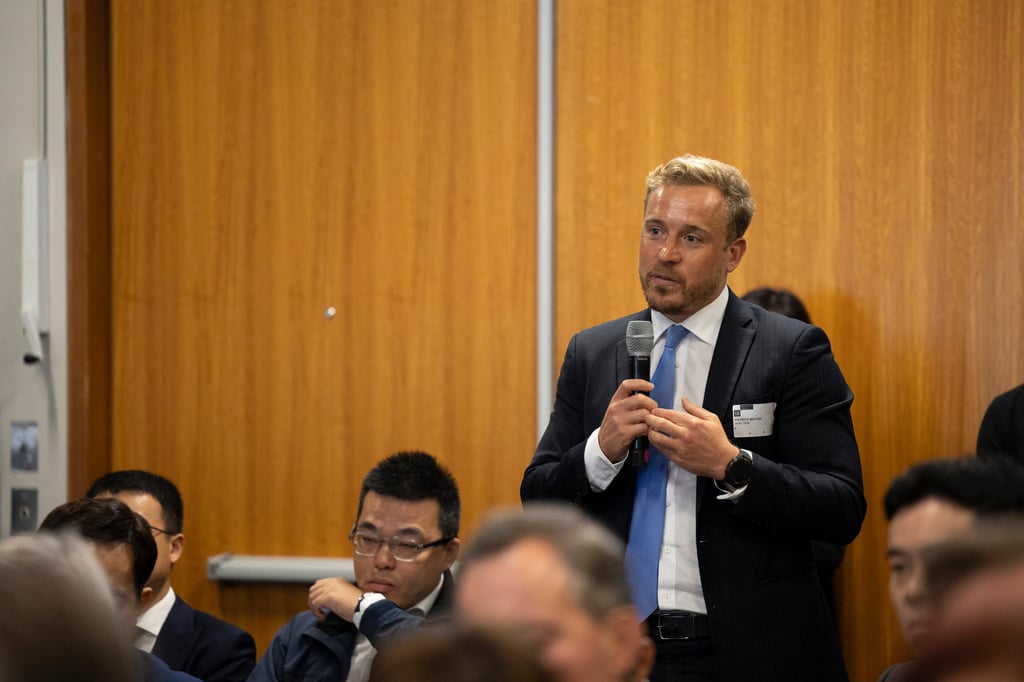
Let me go to - I see Patrick Mayoh from the ACBC. Patrick, over to you.

Audience member:

Wonderful. Thank you, James. And let me start off by just commending the excellent work you're doing here at ACRI. You're such an important voice in the media, and I think we need more voices like yours. Ambassador, you've mentioned the China Australia Free Trade Agreement upgrade twice in your presentation today. I'm very interested in your views, your assessment on where you think we'll land in that upgrade, particularly around new areas of cooperation.

In your question on trade, you mentioned infrastructure, green technology, but elsewhere, Chinese officials have also mentioned AI, quantum computing, big data, advanced manufacturing, robotics. You only had to watch Chinese spring gala to see how advanced Chinese robotics are. I'm wondering what appetite you see there is for both sides to come together in these new areas as part of a ChAFTA update?

H.E. Ambassador Xiao Qian:

Well, thanks, Patrick, for your question. It's a very good question. In a sense, it touches on part of our relationship which is a little bit sensitive. As I said earlier, we have a wonderful trade relationship. In my keynote speech, we have a wide range of engagement covering many, many fields at various levels. But having said that, there are certain areas I feel we could do more, or in more honest words, it's I think somewhat lacking behind. One is defence and military. I don't want to talk about that too much.

But another is science, technology, and some of the new frontiers that relates to modern technology, like AI, artificial intelligence, quantum computing, critical minerals, all these issues. On these issues, I'm hoping that we could have more engagement between China and Australia and we could have a[n] open attitude, open policy from both sides, especially from the Australian side. These are the areas critical, not only for now, but also in the decades in the future. And these are the areas China, Australia, we have relative advantages respectively, and we are complimentary. We can work together to the benefits for our two countries.

On this issue, we need to think more about our own respective national interests rather than the concerns or worries or elements from a third country or other outside elements. Should we work together on these areas, we can learn more in our collaboration, in the future development of our respective national, either economy or development, we can grab this opportunity to make both our two countries a better one in the future. These areas are somewhat sensitive, but I think there's great potential. I think I'm still very hopeful. I'm optimistic. We can eventually fight some common problems we can work on. Of course, to the level that is mutually comfortable, we can talk about collaboration on all those possible aspects. Thank you.

Professor James Laurenceson:

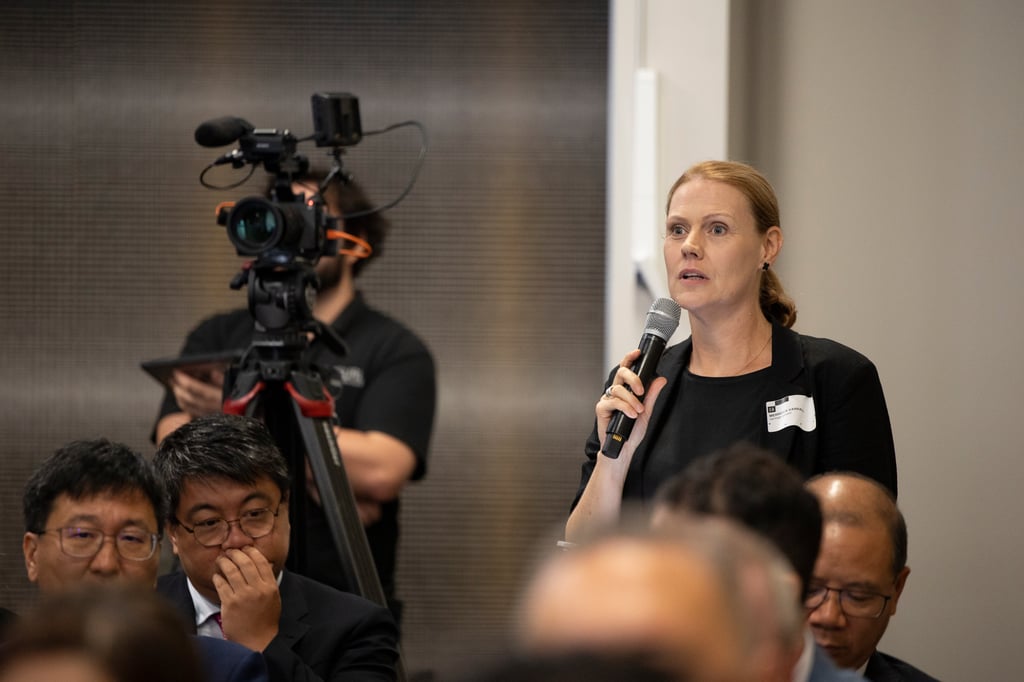
And there was a question on the front, but I might just check. I see Merriden Varrall at the back. I thought you had your hand up before. Is that right? Yeah. Could we just get a microphone over to Merriden?

Audience member:

Hello. Thank you very much, James. Thank you, Ambassador. In my role, I hear a lot from the Chinese community, but I also hear a lot from the defense and strategic community. And often, those narratives are very different from each other. I hear a lot of positivity and optimism from the Chinese community or the business community, and a lot of concern and anxiety from the strategic or defence community.

You've talked a little bit about the positivity, but also some of the challenges, and you mentioned red lines, important to avoid crossing red lines, respecting China's core interests. And you also noted that we need to make sure we're handling the Taiwan issue properly. Can you give us just a bit more information on what you mean specifically by those red lines and handling things properly?

And the second part, if you can, I'd really be interested if you could comment on this narrative about Beijing taking Taiwan back by force in 2027. And that's a really common narrative and I hear it a lot. I'd just love to get your comments on that narrative. Thank you.

H.E. Ambassador Xiao Qian:

Well, thank you for that question. As I said, we have a wide range of areas in our relationship, a lot of common ground, lot of collaboration, also differences on certain issues. That is inevitable. People have differences. Even between husband and wife, you have different views. Sometimes they quarrel at home. But what matters is that we deal with these differences wisely. And there are differences covering many issues, but there are critical issues. There are current issues. And the question of Taiwan is the current issue in our bilateral ties.

It involves the political foundation of our diplomatic relationship. It's different from any other issue. It's different from any other issue in our bilateral ties, trade issue and other related issue, because of China's sovereignty and territory integrity. That's why we're so extremely sensitive. By talking about the red lines, I'm saying that we have agreement 54 years ago when we established development relations that the government of Australia - What's the word you use? Acknowledged or recognised -

Professor James Laurenceson:

Acknowledged.

H.E. Ambassador Xiao Qian:

- one China. There's one China, and Taiwan is a province of China, and the government in Beijing is the sole legitimate government representing whole China. That is the One China consensus, and this is a consensus at the political level. We hope it will be implemented in practice. So when something happens that is in violation of these commitments, that's touching our red lines. I hope both sides can sit down and talk about the issue, and we can always keep this issue within a scope that we're going to let it to lose control or spring out of control, bringing further damages to our overall relationship. That involves official contacts between Australia and Taiwan province that involves substantive relationship that should happen only between sovereign states and countries. This is an issue that's been there and we've been engaging with other Australian colleagues through diplomatic channels. So allow me to stop here. I will continue to pursue through diplomatic channels. Hopefully, we can manage this issue wisely, maturely enough.

On the solution of question of Taiwan, there's only one China, and Taiwan is part of China. It's a province. There's a very, very strong aspiration in the more than 1.4 billion Chinese people that we'll have a complete unification, and we hope that we come as early as possible. As to how we can achieve it, peaceful reunification. That is our policy. This policy is in our government statements, in our Anti-Secession Law passed by our parliament, that we're going to pursue a unification through peaceful means. But at the same time, we cannot renounce using non-peaceful means. But that is only to deter those in Taiwan Island who want to try to seek Taiwan independence, deter outside the forces trying to split Taiwan from China. So there's a very clear policy there, and we hope that the debut come as soon as possible, that the Chinese people will enjoy a complete unification.

The solution of the question of Taiwan politically was solved about 80 years ago at the end of the Second World War. It's already in the UN resolution and international practice, international consensus, in so many documents between China and the rest of the countries. What is now remain is a administration, I mean, the sovereignty issue is already solved. We hope that the day will come we can have a complete administrative solution on this issue. I understand this is an issue of great interest in this country. Well, based on my four-year experience in this country, I tried to convey, to make that point, but honestly, I feel very strongly there's a very serious misunderstanding among some Australian friends, the thought that Taiwan is a sovereign state, which is not true. Taiwan was never a sovereign state. It was a part of China before, and it was a colony of Japan for 50 years.

And at the end of Second World War, the sovereignty returned back to China. It was occupied by Nationalist Party of China, which is still there in the Taiwan Island, so this is a part of China. This is a basic understanding about the situation. I understand there's a calling for peaceful solution. I enjoy that very much. I'm with you. I'd love to have peaceful solution. The people in Taiwan also are compatriots or our brothers and sisters. Why should we have a war? We're going to have a peaceful solution so that people from across the street will join together like families. I will continue to share my views, help more and more friends in this country can understand what is the essence, what the difference, and what is the possible future for the question of Taiwan. Thank you.

Professor James Laurenceson:

I don't want to dwell on this, but I do want to - Merriden also asked that question about, is Beijing committed to using force by 2027? Now, that may sound funny to some folks in the audience, but there are many people in this country who firmly believe that decision has been taken. So can I just ask you to comment specifically on that issue? Is Beijing committed to taking Taiwan by force by 2027?

H.E. Ambassador Xiao Qian:

There'[re] always reports about this and that, and I don't think that is based on any facts. Up to now, there's no... I don't know. I have no idea. I have no instruction from my government saying that we're going to solve the problem by the year 2027, which is next year. The thing is, the fact of the matter is that number one, I mean, the Central Government in Beijing is already having the capability to solve the problem by whichever means. That include the non-peaceful means, but we're not doing that. We've been patiently waiting. Waiting for what? Waiting for the opportunity for a peaceful unification. And that's why we are having this patience of engaging with people in Taiwan and tell them that it's a better future once they come back and we join together as a Chinese nation as a one country.

Some of the reports or assumptions are... I don't think they are founded based on confirmed Chinese government policies. Sometimes they are misleading. They try to create atmosphere to say that something could happen on the question of Taiwan, so we need to blah, blah, blah, do this to try to stop, to contain, or to help the other side, which is not based on fact and which is not necessary.

Professor James Laurenceson:

Okay. Thank you for answering that very directly. It's quite amazing how these narratives can get their own head of steam.

H.E. Ambassador Xiao Qian:

James, I want to add one more point. In my view, there's no timetable is today or next year or the year after next, but there's a criteria upon which we have to resort to non-peaceful means. In the Anti-Secession Law passed by the National People's Congress about decade ago, they cited three scenarios under which we will have to pursue to a non-peaceful means. Number one, Taiwan is seeking independence. Number two, outside forces will take Taiwan away from China. Number three, the opportunity, the chances of peaceful reunification is completely exhausted. So these are the three scenarios under which we're going to - Things might change dramatically. But now, I think we are still in the situation where we try to seek a peaceful unification.

Professor James Laurenceson:

Okay. Let it not be said that a business-heavy audience steers away from geopolitics. I think we gave geopolitics a good run in our discussion today. Yes, question? There're two more. So let's give one to front and then to you next one. Yes, please, Helen.

Audience member:

Thank you.

H.E. Ambassador Xiao Qian:

Please take your seat. Please take your seat. Yes, we consider you're a lady.

Audience member:

Thank you. I'm in the front. Thank you for your remarks, which I found really comprehensive and insightful. My question is one from the business community. I represent ACBC today, and last year, we did a survey of over 300 Australian corporates. Most of them are ACBC members. What surprised me mostly from the key findings is only a third of the corporates say that they're confident when it comes to deal with China. I'm surrounded every day by China experts like Mr. Smith here, Geoff Raby here, and many of members travel to China four, five, six times a year for the last decade or so. I thought the level of confidence should be a lot higher than just a third. So I'm curious of your observations in your four years in Australia in talking to Australian corporates and organisations like ACRI and ACBC. What's your observation? Do you think Australia corporates should be more confident? And if not, what more can we do? What more can we do to help Australia corporates more confident to have business engagement with China?

H.E. Ambassador Xiao Qian:

Thank you. Oh, thank you for the question. I think the simple answer is yes. Yeah. I think both sides should have confidence in the other side, and we should have confidence in the future of our bilateral ties. We should have confidence to invest in our two countries to collaborate, to build up joint ventures and confidence to do more trade. Number one, our two econom[ies] are so complimentary. We need each other not for today, but in the long run, and that's not going to change. And the second, we have built up enough solid foundations for the past several decades. We have one of the biggest trading partner, corporator for Australia, and we need more top quality products from Australia. At the same time, China's contribute to also export more like the electric vehicles, new energy products, et cetera. That momentum is increasing.

Number three, I think what's caused the so-called inconfidence, we need to figure out what's the reason and what is it that some colleagues, friends from Australia are not having enough confidence in dealing with China. Is it because of ideology, political system, culture, or because of what happened four years ago, or I meant for seven years before four years ago in that difficult period of time during the Liberal-led coalition or during the COVID time? We need to find out what is the reason behind that, and we should try to explain and make friends and colleagues to be assured that the bad time have passed. We should expect a bright future, and we should have confidence in building up a long-term perspective relationship.

Lastly, China's development and Australia's initiative vision for the future are offering great opportunities for us to build closer cooperation. Our 15th Five-Year Plan, it involves a lot of collaboration, investment, and in Australia's Future Made in Australia, including some of the proposed major products like infrastructure or high-speed railway system, et cetera, these are offering opportunities for the other side. So there'[re] a lot we can do, and these are physical, solid reasons for us to believe. There should be more reason to have confidence with each other. And also as we improve our bilateral ties, we're seeing more, I think, improving atmosphere among people in both countries. I mean, the popularity, support, friendship are increasing little by little, but it is increasing, and the hurdles and trust and mistrust and disputes are being managed more and more wisely. These will also create some philosophical or spiritual mental environment that will be in favor of a more confident relationship.

So I do strongly encourage our friends from, well, ACBC or CCCA that history is now opening up for a future world that is full of turbulences, uncertainties, but the future for China-Australia friendship is pretty certain. We have a reason to trust each other more, to have more confidence to engage with each other more openly, more substantively. Thank you.

Professor James Laurenceson:

I can't help but thinking the visa-free policy has really helped. I was looking at the numbers not so long ago, and there are record numbers of Australians now going to China, and certainly, I've taken advantage of the visa-free policy myself. Let me now invite the Honourable Warwick Smith AO, a man of many achievements, but his most important one is as the Chair of the UTS:ACRI Advisory Board. I'm sure he would agree with that. So let me invite Warwick now to deliver a vote of thanks.

The Hon. Warwick Smith AO:

Well, good morning still to Professor James and his excellent team and all those involved in bringing together this important occasion, we say a very special thank you on behalf of the Advisory Board and also the broader university. I might say that, James, during your directorship of this institute, many things have come a long way, most of which is the very strong reputation of UTS. I can say that as Chairman of the Advisory Board for some years, but those who are objective observers will agree. You heard James right at the beginning say the focus is on academic scholarship and facts, and that has been reflected in everything that James has done and every presentation he and his colleagues make. Now, I can testify having been trained in Canberra about the importance of facts. You learn it once you leave Canberra. So I want to say to you, James, you're doing a very, very good job, and you did a masterful job this morning in navigating some wonderful questions of your own and also taking questions from colleagues.

Ambassador, potentially the second-longest serving Ambassador from China to Australia, and I think I've known every single one of the Ambassadors, except the very first one. I know that you'll be staying a little bit longer. I don't know if you've been told yet, but certainly, we are very encouraged by the fact that you've got some extended time. You are very close colleagues to the Executive Vice Minister of Foreign Affairs, Mr Ma, who was an Ambassador here. And so, your influence through that friendship, and we saw that when your Premier visited here a little while ago, the notice that is taken of Ambassadors, whoever they might be and from whichever country, depends on their excellence and their capacity. When you see the Ambassador today, you will all agree with me, his excellence and capacity is far in excess of many others that we might see, not just from China, but elsewhere.

When you came here, sir, and it was here four years ago, not long after you arrived, it was a difficult time in Australia-China relationships. I remember saying to you very early, along with other colleagues and like Geoff Raby, a former Australian [Ambassador to China], it was going to be a navigation that required nuance, patience, and calmness. You demonstrated that and look where we are today. The protestors outside are about domestic issues that are not about issues that concern the relationship between China and Australia. So for that, we congratulate you for that navigation, and we hope that it will continue for some time. The prospect of seeing you return to Chad or somewhere like that in Africa doesn't fill us with any pleasure whatsoever. So we would like to see you stay here.

In your address today, the couple of key points, it's not my job because James and his team will be writing in a summation of the excellent contribution that you made today in a very thoughtful speech, but I guess there'[re] two things that I would want to point out. People will understand that the two sessions in the 15th Five-Year Plan is very significant in the context of the global situation and the changing technological pressures that we see between our relationship to which you referred and globally and the very speed with which technology is changing. We read daily about data centers and inference and NVIDIA chips, et cetera, et cetera, and 6G coming through Huawei.

There are many things to be navigated, but the 15th Five-Year Plan brings, in my sense, one key word. It brings clarity as to where the number two economic power is going to be directing itself over the next five years. That clarity in a changing world is extremely important. And so, the basis and the detail[s] in your speech, I think gave us some clear pointers. Largely an economic-orientated group today, but we can see there are opportunities and the long-term relationship that we've had for 54-odd years is something that we can see there is an upside for us into the future.

The second point that you made is linked to probably two points, and that was you respect our differences and we respect your differences, both in terms of our institutional makeup. I've long argued for principled realism. We have our institutional principles, around our democracy. You have your principles around your structures, but we also have a commitment to realism and managing that balance is what is important for the governments of Australia. Now, for a little while, sir, we had more prime ministers than did Greece in the 10-year period. We've probably come beyond that, and that was your point about the value of longevity of governments in a democracy. I would probably, because of my earlier training in Canberra, disagree that that's going to go for a long time. I still believe in our principle of elections, but I think that you make a very solid point, a very solid point.

We need consistency at all levels of government and business about where Australia-China relations go. You can look at the 15th Five-Year Plan and those who have long memories will remember a policy brought forward in this country in the early '90s called Fightback! We're almost where we need something similar again for Australia to set out a plan, some clarity about how we deal with our domestic economic challenges, recognizing that we are a trading nation from our birth. To enhance that, to build that with our number one economic partner, I think, is where the direction of Australian government policy should go, regardless of who might be leading Australia, but I do accept longevity and leadership has worked for you. It won't work necessarily as well for us. It hasn't, but we do recognize the benefits of farsighted policy. So in that sense, I give China great credit for the 15th [Five-Y]ear [P]lan.

Sir, you are urbane. You are calm. You are patient. You're dedicated to your task as an ambassador. I know we share colleagues from your time in Hungary and Romania where you had many friends, so we know about you for a long time. You have grown closer to Australia since you've been here. That's why you shouldn't rush back. So delighted to see you here today. On behalf of this university, I welcome you again here, and I thank you to our professor for a wonderful day, and I thank you all colleagues for being here today.


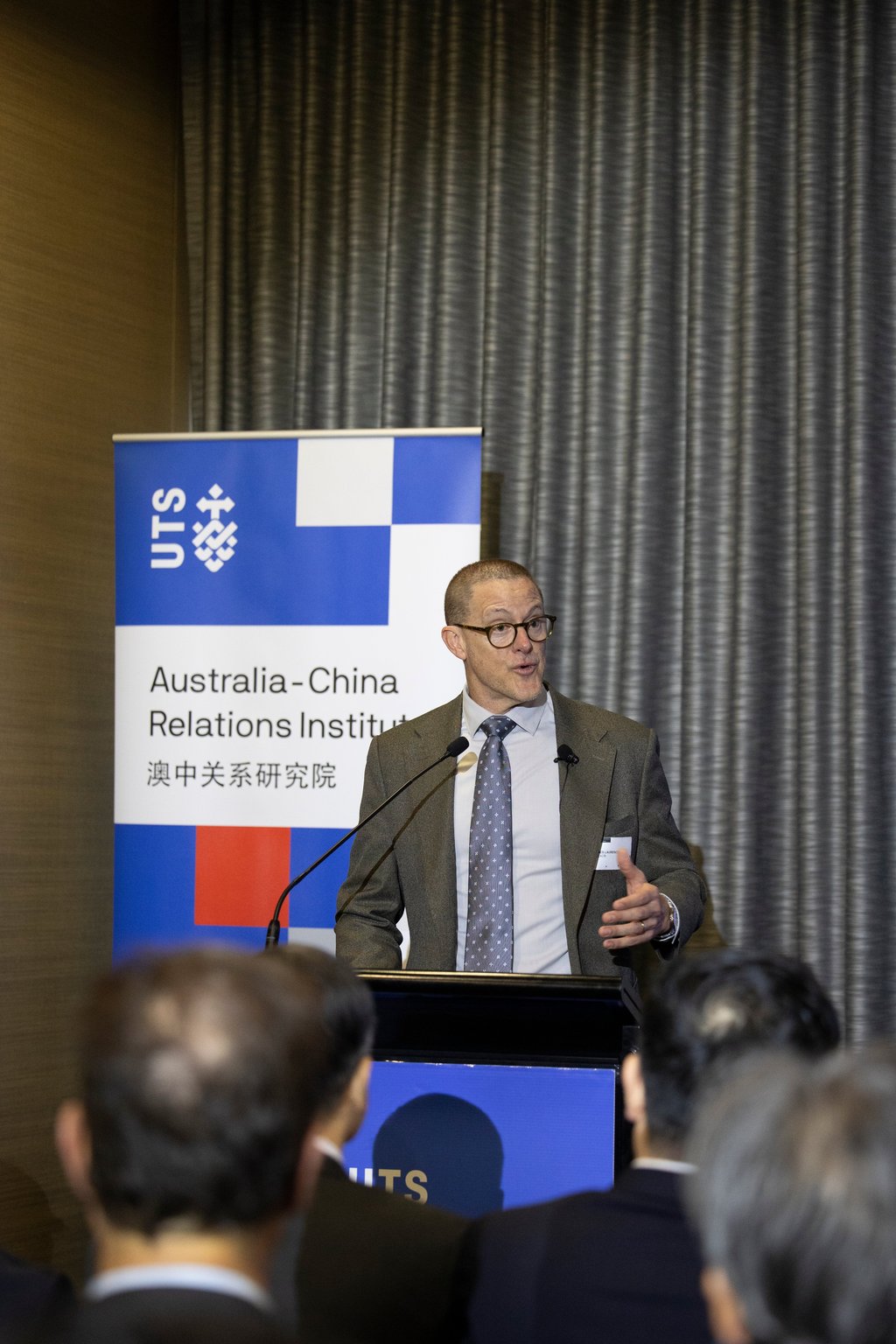
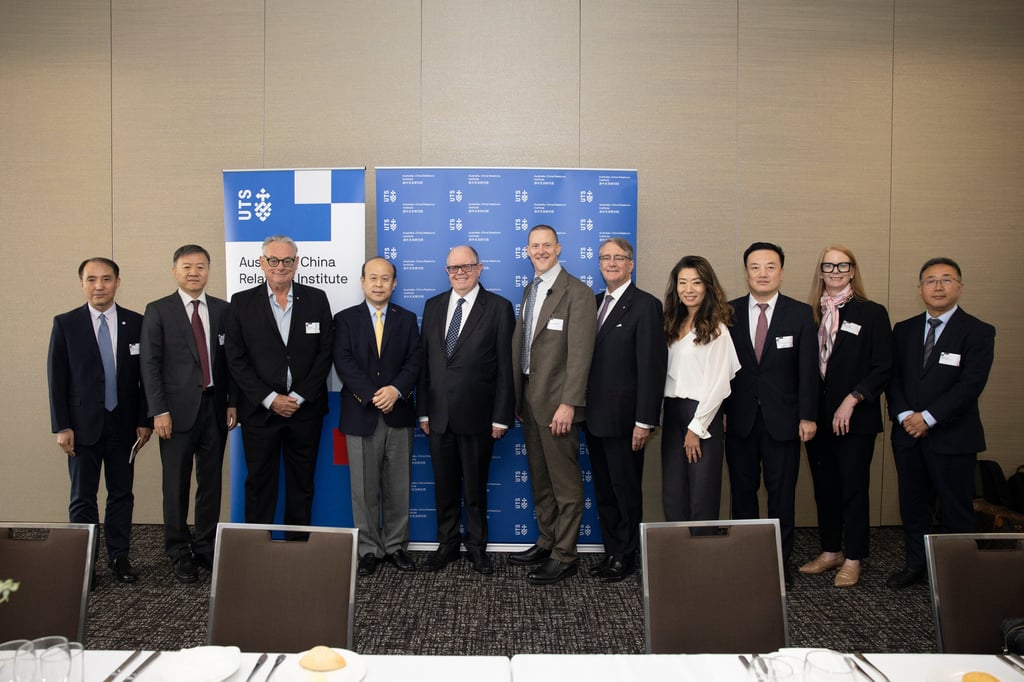
On March 19 2026, the Australia-China Relations Institute at the University of Technology Sydney (UTS:ACRI) hosted H.E. Xiao Qian, Ambassador of the People’s Republic of China (PRC) to Australia, to deliver a keynote address on Australia-PRC relations. Ambassador Xiao shared his perspectives on recent developments in the bilateral relationship and the key issues shaping its future trajectory.

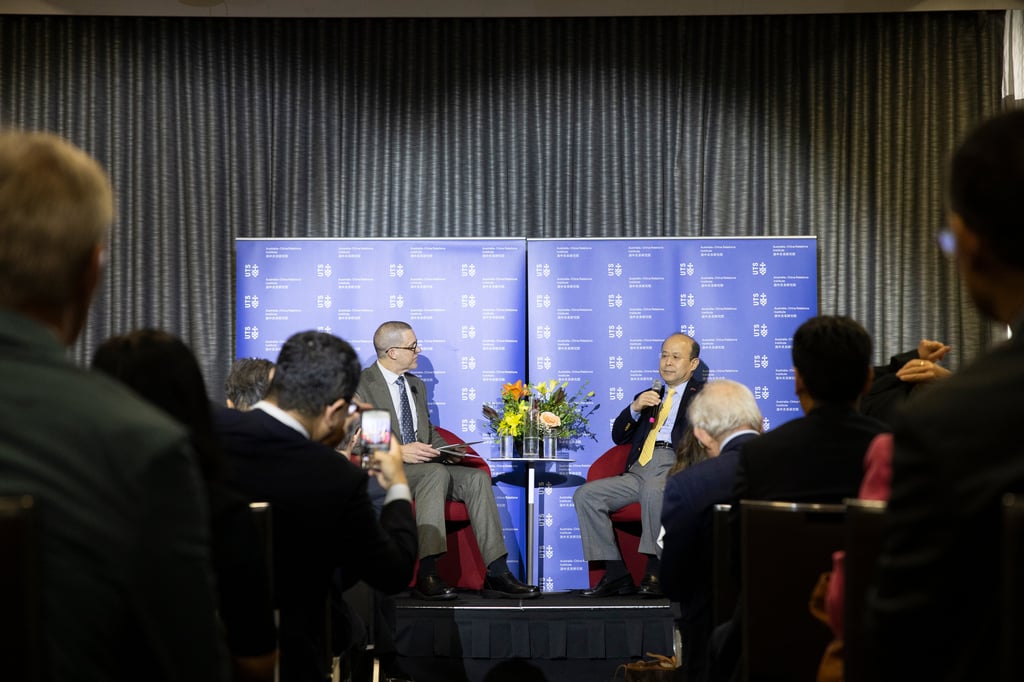
The address was followed by an in-depth discussion with UTS:ACRI Director James Laurenceson, and an audience Q&A. The event concluded with a vote of thanks from UTS:ACRI Advisory Board Chair Warwick Smith.

calendar_month Date: Thursday March 19 2026

schedule Time: 10.30 am - 12.00 pm

location_on Venue: UTS Aerial Function Centre


Listen to audio (opens in Soundcloud)


About the speaker

H.E. Xiao Qian

Ambassador Xiao Qian is the current Chinese ambassador to Australia, in office since January 2022. Previously he served as Chinese ambassador to Indonesia (2017 - 2021) and before that, Chinese ambassador to Hungary (2012 - 2015).

About the moderator

Professor James Laurenceson

Professor James Laurenceson is Director of the Australia-China Relations Institute at the University of Technology Sydney (UTS:ACRI). His research interests relate to the Chinese economy and the Australia-China economic and broader relationship.


Share