


- Posted on 5 Aug 2025
- 3 mins read
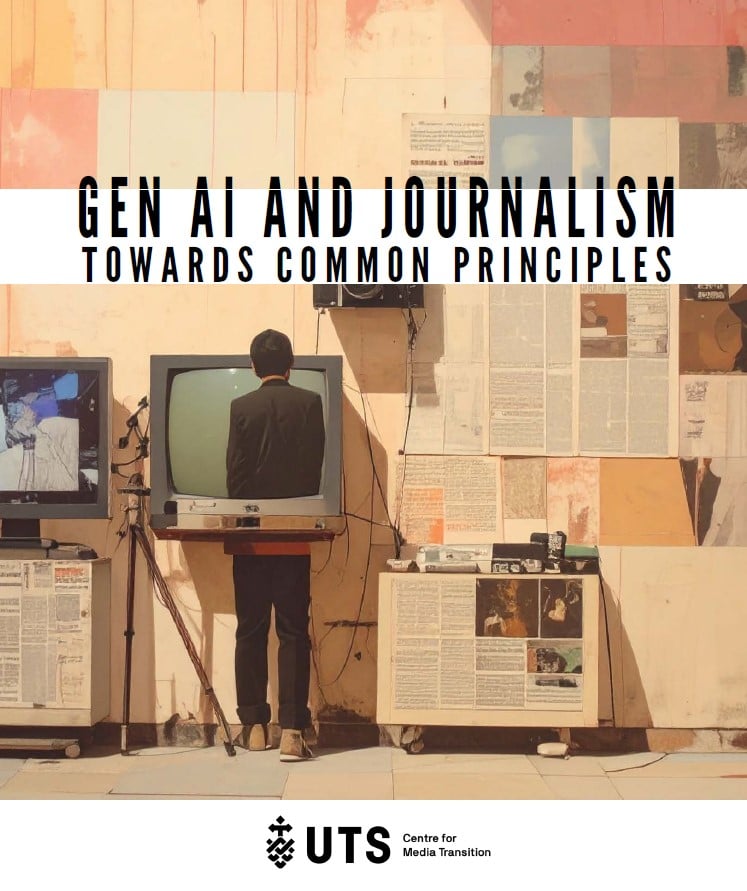
Three years after the launch of OpenAI’s ChatGPT saw generative AI threatening to become yet another major disruptor to the journalism industry, it remains neither its saviour nor its downfall. In Australia the journalism sector is still struggling to survive. It is still battling fractured audience bases and the flight of advertising revenue to digital platforms. Trust remains on a downward trajectory. And moreover, the known challenges of generative AI remain virtually unchanged – including those of bias, verification and hallucination.
Generative AI undoubtedly offers opportunities to improve news-production efficiency and even the quality of journalism, through sophisticated tools to allow deeper research and more comprehensive examination of data. But it also poses increasingly complex challenges to the strategies used by media companies to ensure the information they produce remains trustworthy.
When we released our 2023 landmark report on the impact of generative AI on journalism, we found a significant degree of caution in the way newsrooms were thinking about the technology. The dominant approach was ‘test and learn’. Whilst some newsrooms were encouraging experimentation, all prohibited its use in any public-facing publication. Some had officially adopted generative AI to assist with research, particularly analysis and summarisation of large amounts of information and there was an optimism about the future possibilities generative AI could offer.
One year later, in late 2024 when we conducted interviews for this report, newsrooms were thinking differently. They remain cautious – even overly cautious – but some outward-facing uses have been deployed, particularly with synthetic voice in service journalism such as weather reporting and where articles are turned into voice recordings using AI. However, Australian newsrooms remain most comfortable with using AI to augment rather than automate production, and the majority of experimentation is still occurring in the back-end rather than audience-facing uses.
Our 2nd report, generously funded by the Minderoo Foundation, brings together our research interviews with 13 news editors and six product leads from 14 news organisations conducted between August and November 2024, and in a day-long workshop conducted in collaboration with RMIT and the ARC Centre of Excellence for Automated Decision Making and Society. Some participants have chosen to remain anonymous.
Download the report
Explore


News
Is AI really the problem?
Susanne Lloyd-Jones looks at the AI breaches of Australian Federal government sites and questions whether agentic AI working independently of human...

News
Maintaining trust in an era of AI Slop
Chris Hall takes a deep dive into the increasing amount of AI use on YouTube and he looks at how serious youtubers are being challenged by the increased...

News
Jason Arday and the media
This DoubleTake episode of the podcast features journalist and University of Melbourne lecturer Sami Shah talking with Monica about the media treatment of the...
News
Is AI really the problem?
Susanne Lloyd-Jones looks at the AI breaches of Australian Federal government sites and questions whether agentic AI working independently of human...
News
Maintaining trust in an era of AI Slop
Chris Hall takes a deep dive into the increasing amount of AI use on YouTube and he looks at how serious youtubers are being challenged by the increased...
News
Jason Arday and the media
This DoubleTake episode of the podcast features journalist and University of Melbourne lecturer Sami Shah talking with Monica about the media treatment of the...