

• Posted on 4 Nov 2024
  • 5-minute read

Distinguished Professor Karu Esselle and Dr Jiayan Liao were awarded at the NSW Premier’s Prizes for Science and Engineering.
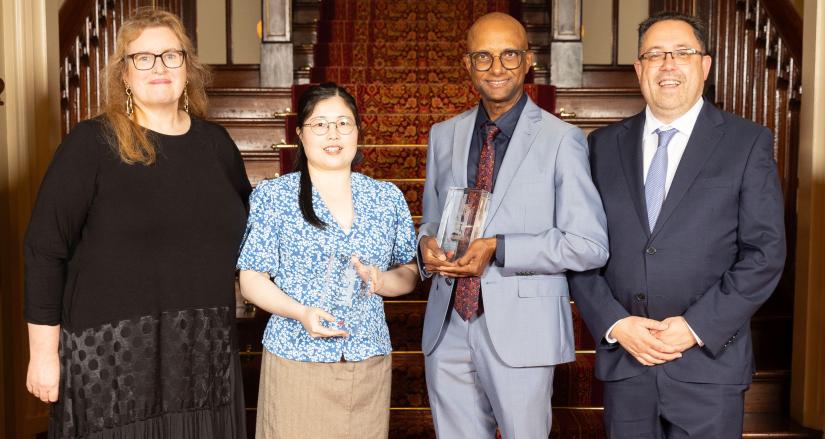
Photo of UTS academics at NSW Premier's Prizes ceremony
Dr Jiayan Liao (centre left) and Professor Karu Esselle (centre right) with Professor Kate McGrath (UTS DVC Research) and Professor Michael Blumenstein (UTS PVC).

The NSW Premier’s Prizes for Science and Engineering recognise excellence and reward leading researchers for cutting-edge work that has generated economic, environmental, health, social or technological benefits for New South Wales. 

University of Technology Sydney’s (UTS) Distinguished Professor Karu Esselle and Dr Jiayan Liao were awarded for their cutting-edge research in science and engineering. 

Leadership in Innovation

Distinguished Professor Karu Esselle is an expert in nanotechnology, specialising in developing next-generation bioanalytical and imaging tools, as well as advanced detection techniques. Professor Esselle is a leader in electromagnetic, antenna and radio frequency engineering and is at the forefront of developing innovative antenna technologies for a wide range of applications. 

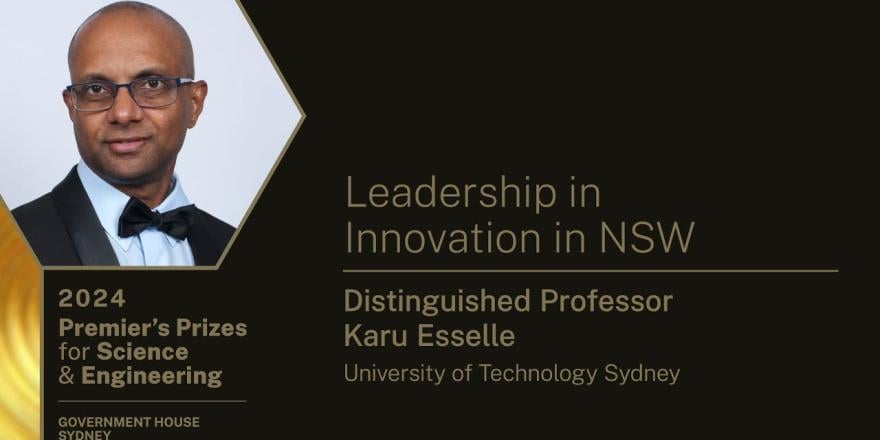
Among his many research innovations, Distinguished Professor Karu Esselle has made significant contributions to satellite communication technology, aiming to close the divide between rural and regional NSW. Professor Esselle was awarded the 2024 Leadership in Innovation Premier's Prize. 

Distinguished Professor Karu Esselle.

Distinguished Professor Karu Esselle.
ySyV2NqQ0Nk

0:00

[Music]

0:05My name is Karu Esselle and I am a Distinguished0:08

Professor in electromagnetic and antenna

0:10

engineering at the University of Technology

0:13

Sydney. My area of specialty is

0:16

electromagnetic and antenna engineering

0:19

that is developing radio frequency

0:22

circuits for telecomunication systems

0:25

sensor systems and other electronic

0:27

systems. We are aiming to solve certain

0:30

global challenges and national

0:34

challenges. So we are developing radio

0:36

frequency technologies, advanced antenna

0:39

systems to address these challenges and

0:42

to find solutions. The challenge is to

0:45

reduce the power consumption in most of

0:47

the electronic systems. So we are leading

0:49

our research towards that direction to

0:52

make them low cost and consume less

0:55

power. The methods I invented in major

0:58

companies to develop new satellite

1:01

communication Terminals and other

1:03

electronic equipment. My aim is to resolve

1:06

the remaining challenges in

1:08

telecommunications. We are developing

1:10

technologies to increase the data

1:13

rates and throughput for communications

1:16

and for sensing we are aiming to improve

1:20

the capability of sensing from space for

1:23

Australia and other countries. My

1:26

colleagues have been extremely

1:28

supportive and important for all these

1:31

achievements and I want to thank all of

1:33

them as always. There's no such thing as

1:36

individual prize, I consider this as a

1:40

group prize for my group my team it's a

1:44

it's a great privilege to be recognised

1:47

by the state of New South Wales our

1:51

research contributions my contributions

1:53

and my team's contributions this way. 

1:58

[Music]

English (auto-generated).

Early Career Researcher of the Year (Physical Sciences)

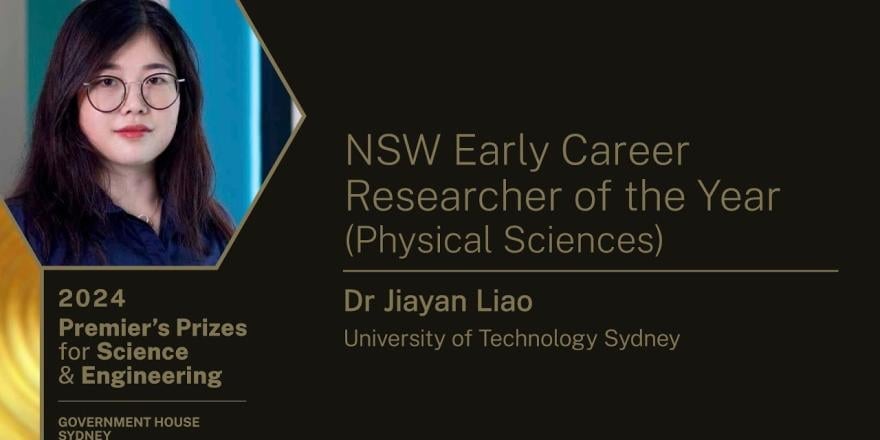
Materials and biomedical scientistDr Jiayan Liao was awarded the NSW Premier’s Prize for Early Career Researcher of the Year (Physical Sciences) for her exploration of fundamental photophysical phenomena and the development of next-generation bioanalytical tools.

“By developing advanced nanophotonic and imaging technologies, we aim to understand the photophysical processes occurring in the nanoscale world and uncover the underlying mechanisms. Through the development and application of these nanoprobes, we strive to address some of the significant health challenges, particularly by enhancing the accuracy and accessibility of disease diagnostics with cutting-edge nanotechnology,” Dr Liao explains.
wJ4_QrNkfxE

[Music]0:04

My name is Jiayan Liao I'm a Chancellor's

0:07

Research Fellow and a NHMRC EL1 Fellow

0:10

at the faculty of science at the

0:12

University of Technology Sydney. My

0:14

expertise is in Material Science Optical

0:18

physics and nanotechnology with

0:21

particularly focus on developing

0:23

Advanced nanop photonic and image

0:26

Technologies my work is PR us both the

0:29

fun mental photo physical phenomena and

0:32

the magm behind them we're also aiming

0:35

to create Next Generation by analytical

0:39

tues these tools are designed to

0:42

diagnose disease at a molecule level

0:45

using nanoscopic probe to detect the

0:48

disease in their early stages my primary

0:51

goal is to understand the photo physical

0:54

processing occurring in the nanoscale

0:57

world and uncover the underlying

1:00

mechanisms by dering and applying this

1:03

Nano probe I hope to adjust some of the

1:07

most significant health challenges so

1:10

far our work has led to several

1:13

breakthroughs including advancments in

1:17

novel Material Science and nanop

1:19

photonics we have conducted studies on

1:22

the photophysical properties and

1:24

principles of these materials applying

1:27

them in a wide range of areas particular

1:30

in image and analytical immunes looking

1:33

forward my goal is to expand our

1:37

research application to cover a wide

1:40

range of disease and to further refund

1:43

the technology for even faster and more

1:46

accurate results I couldn't achieve the

1:49

results without the support and help

1:52

from my colleages and students at UTS

1:55

winning this prize is a incredible honor

1:58

it's refres the sportive event at UTS

2:03

and it recognize the hard work and

2:05

dedication of our team. 

English (auto-generated)

Share