

- Posted on 18 Jun 2024
- 7-minute read
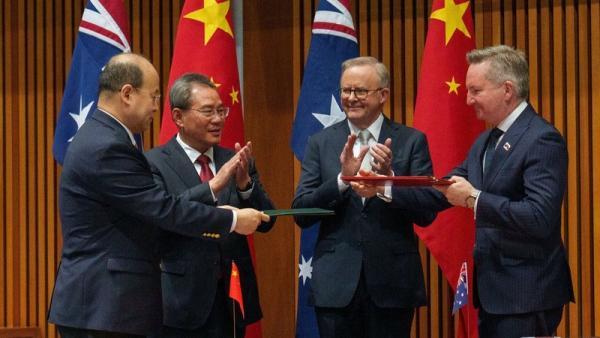
@AlboMP / X

Wanning Sun, Deputy Director, UTS:ACRI; Professor of Media and Communication, Faculty of Arts and Social Sciences, UTS
This article appeared in Crikey on June 18 2024.
The first thing Chinese Premier Li Qiang noticed after disembarking from his plane was the Adelaide sky. He was speaking to South Australian Premier Peter Malinauskas, who was with Foreign Affairs Minister Penny Wong at the airport to greet him. Pointing to the sky, Premier Li said: ‘Very beautiful.’
‘Oh, yes, the sunset,’ replied the smiling SA premier.
‘Very beautiful indeed,’ Premier Li added. ‘I also saw it on the plane.’
This diplomatic pleasantry on the part of Li Qiang seemed to be setting the overall tone of his visit to Australia.
When Chinese President Xi Jinping addressed the Australian Parliament in 2014, he quoted a supposedly Australian saying: ‘Keep your eyes on the sun, and you will not see the shadows.’ This saying was also recently mentioned by Chinese Ambassador Xiao Qian. In Premier Li’s speech in New Zealand before coming to Australia, he also invoked this saying, except this time he attributed its origin to New Zealand.
Regardless of its genesis, focusing on the sunny side of the relationship seems the guiding principle of Chinese leaders’ thinking when negotiating their country’s relationship with New Zealand and Australia. One could be forgiven for thinking these Chinese leaders might be channelling Monty Python, who famously told us to ‘always look on the bright side of life.’
A tension of differences
Soon after arriving in Adelaide, Li made a statement saying that the best way forward is ‘seeking common ground while shelving differences’ in order to achieve ‘mutually beneficial cooperation’ between our two nations.
But here lies the core of the problem: Australia cannot shelve differences. Indeed, you’d be living under a rock if you hadn’t heard Labor’s carefully worded mantra: ‘We will cooperate where we can, disagree where we must and engage in the national interest.’
In contrast with the warm bromance between Prime Minister Anthony Albanese and Indian Prime Minister Narendra Modi, and in comparison with the sanguine tone of the Chinese leaders, the language of Australia’s leaders when speaking about China seems to foreshadow more cloud than sunshine.
In an article penned in anticipation of Premier Li’s visit, Albanese is painstakingly measured, cautious and clearly burdened with the need to address multiple, and sometimes conflicting, target audiences. He reminds the public that Labor is better at managing China and delivering beneficial outcomes. For the security establishment, he stresses an ‘explicit link’ between economic security and national security. And for the media hawks and the opposition criticising his government for being soft on China, he argues that direct dialogue is the best way to manage differences, ‘advance our interests’ and ‘articulate our values’.
He assures the Americans that Australia is their steadfast ally, but that Australia needs to deal with China on its own terms to protect its national interests. To the Pacific nations, he implies that although they’re free to work with China, we would like to be their preferred partner. And, of course, to the Chinese leaders, he stresses the need to uphold the ‘rules-based order, respecting our neighbours’ sovereignty’.
The leaders of the two countries differ not only in language but also in perspective.
To the Chinese, the Australia-China relationship can be managed to achieve what Xi Jinping calls a ‘virtuous cycle of development and security’. Unlike China’s relationship with Japan (which is dogged by memories of the Japanese war) or with the US (which remains China’s chief rival and competitor), the Chinese leadership seems to believe that the China-Australia partnership is marked by mutual benefit and complementarity.
To their minds, this should be a matter of win-win cooperation rather than a zero-sum game. As Xi Jinping said to Albanese in late 2023 during the latter’s visit to China, ‘There are no historical grievances or conflicts of fundamental interests’, and that the two countries have every reason to be ‘partners who trust each other and contribute to each other’s success’. A sense of puzzlement — even frustration — as to why Australia chooses to be antagonistic towards China despite this apparent complementarity has also been repeatedly aired by the Chinese media and by Chinese think tanks visiting Australia.
A blinding sun
Neither the Australian media nor the government wants to heed Premier Li’s advice about keeping their eyes on the sun and allowing the shadows to recede. In fact, they seem to be worried that they might go blind if they look at the sun for too long.
As Premier Li was en route to Canberra from Adelaide, Penny Wong said on the ABC’s Insiders that Australia was in a ‘permanent contest’ with China over the Pacific, and that Australia ‘remained focused on areas of disagreement’.
This has also been the tenor of our media’s coverage of Li’s visit. It seems no amount of goodwill gesturing that comes with panda diplomacy, the promise of lifting the final tariff on Australian lobsters, and the announcement of unilateral visa exemption can help reduce the seemingly insurmountable array of differences on ideological, geopolitical and security fronts.
When asked on the ABC whether it was possible to ‘shelve the differences’ between Australia and Beijing as Premier Li had suggested, international affairs reporter Stephen Dziedzic said emphatically, ‘It’s not possible to shelve differences.’
Our media’s coverage of Premier Li’s visit mostly reflects such realistic views of China, acknowledging the need for dialogue but highlighting the tensions and conflicts in the bilateral relationship. In comparison, The Australian has consistently struck a noticeably sour note. Its foreign editor Greg Sheridan urges against ‘diplomatic nonsense’; the paper’s editorial says that the government’s mantra — cooperate when we can, disagree where we must — is easier said than done since Australia is dealing with a one-party state.
Peter Jennings, former director of the Australian Strategic Policy Institute, penned an op-ed that included a litany of 14 grievances against China, which he urged Albanese to present to the Chinese Premier — clearly a reference to an earlier episode in the bilateral relationship during the Coalition era.
Even before Li had landed, Jennings was already casting suspicion on Chinese-Australians, predicting that ‘so-called patriotic supporters — mainland Chinese students — will be paid and organised by the Chinese embassy to surround visit venues’.
This suspicion of nefarious intentions on the part of Li’s supporters is echoed across The Australian’s coverage. One report suggests that members of the Chinese community wishing to greet Premier Li are ‘linked to Beijing’s United Front Work Department’. Another divides Chinese-Australians on the scene into simplistic binary groups: ‘pro-Beijing Chinese community associations’ and ‘anti-China protesters’.
Then, no longer content with being straitjacketed by the genre of news, the same journalist wrote a commentary piece telling readers that ‘Chinese spies are assumed to be travelling with Li’s delegation’, and that Albanese would end up being viewed as a ‘panda hugger’ if he is not wary of Li as a ‘Beijing wolf in panda clothing’, as the headline of its online version put it.
In contrast, no such insinuations of nefarious intentions were made about Indian-Australians flocking to welcome India’s Prime Minister Modi last year. And nobody seemed to suggest — implicitly or otherwise — that there was an inherent contradiction in these individuals wanting to welcome the leader of their homeland, while still being loyal to the country in which they now reside.
Given all these counter-currents to the process of stabilisation in the Australia-China relationship, it seems there won’t be just sunshine ahead. Maybe the only thing that is safe to predict is that the bilateral relationship will be more akin to a foxtrot: two steps forward, two to the side, two steps back, and repeat.
Author
Professor Wanning Sun is Deputy Director at UTS:ACRI and a Professor of Media and Communication in the Faculty of Arts and Social Sciences at UTS.